EduNinja
[Maximum number: 4]

E4. This question is about Hubble's law.
(a) State
(i) Hubble's law.
(ii) the significance of the reciprocal of the Hubble constant.
(b) The wavelength of a certain line in the hydrogen spectrum is measured to be 434 nm in the laboratory. The same line in the hydrogen spectrum of the galaxy 3C-273 is measured on Earth to be 504 nm .

Determine the distance of 3C-273 from Earth using a Hubble constant of 72 km s1Mpc172 \mathrm{~km} \mathrm{~s}^{-1} \mathrm{Mpc}^{-1}.

[Maximum number: 3]

E4. This question is about Newton's model of the universe.
Newton suggested that the universe is infinite, uniform and static.
For each of Newton's three suggestions, outline one piece of current astronomical evidence that contradicts the suggestion.

Infinite:
Uniform:
Static:

[Maximum number: 5]

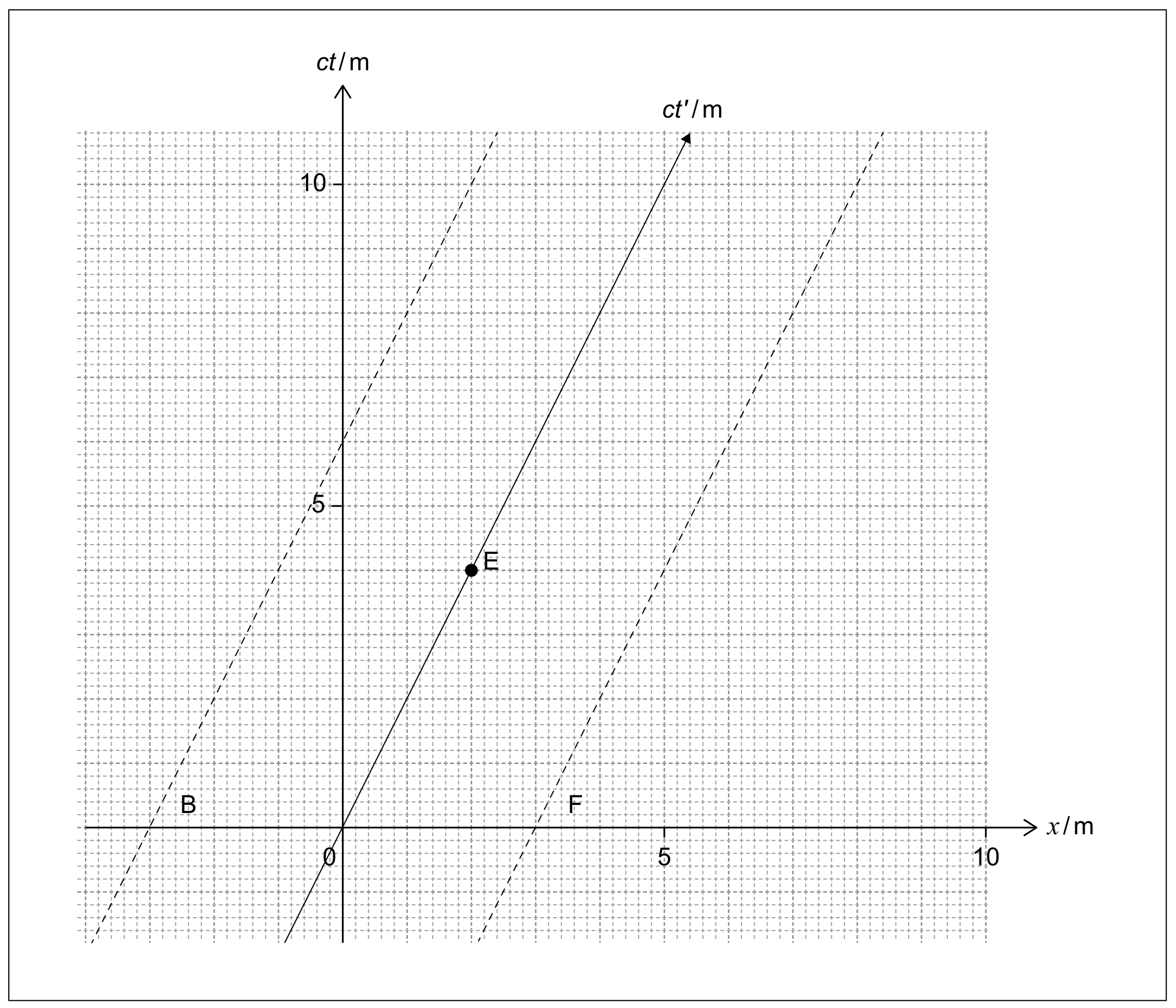
The spacetime diagram shows the x, ct axes for an observer on the ground. The ctc t^{\prime} axis for a passenger on a train moving relative to the observer and world lines for the back ( B ) and front (F) of the moving train are also shown. The observer on the ground and the passenger are opposite each other at the origin of the spacetime diagram.

The train is travelling at 0.5 c.

Question image

Event E is the lighting of a match by the passenger in the train, with coordinates x=2 mx=2 \mathrm{~m} and ct=4 mc t=4 \mathrm{~m}. The light from the match reaches two mirrors at the back and front of the train.

(a)

Draw, on the graph, the xx^{\prime} axis for the passenger on the train.

[ 1 ]
(b)

Draw, on the graph, the path of the light emitted from the match to show the events where the light strikes both mirrors. Label the events TBT_{B} and TFT_{F}.

[ 1 ]
(c)

Explain, with reference to TBT_{B} and TFT_{F}, which person concludes that the light reached both mirrors simultaneously.

[ 2 ]
(d)

State the length of the train for the observer on the ground.

[ 1 ]
[Maximum number: 1]

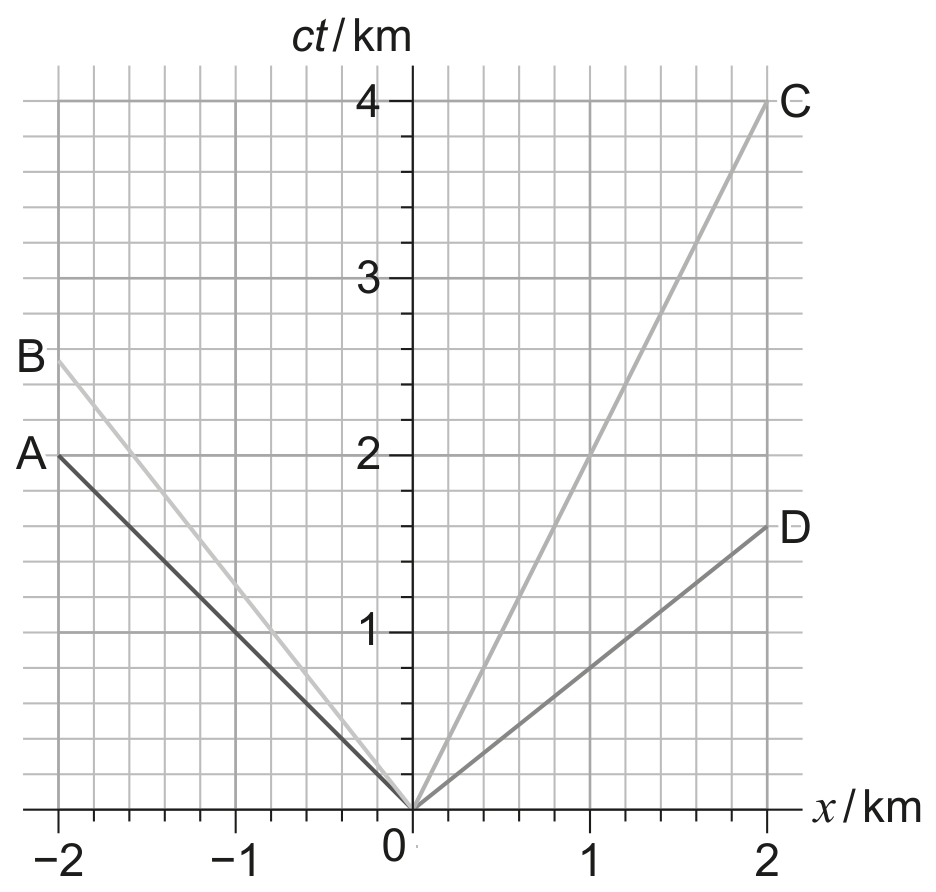
Rocket R travels away from an observer on Earth at a speed of 0.80 c . A space-time diagram shows four world lines.

What is the correct world line of R in the reference frame of Earth?

Question image
[Maximum number: 1]

A muon of proper lifetime t is produced in the high atmosphere and travels towards Earth at a relativistic speed v. What is the distance travelled by the muon in the reference frame of Earth?

A

v t

B

vt(1v2c2)v t\left(1-\frac{v^{2}}{c^{2}}\right)

C

vt1v2c2v t \sqrt{1-\frac{v^{2}}{c^{2}}}

D

vt1v2c2\frac{v t}{\sqrt{1-\frac{v^{2}}{c^{2}}}}

[Maximum number: 1]

This question is about the Doppler effect.

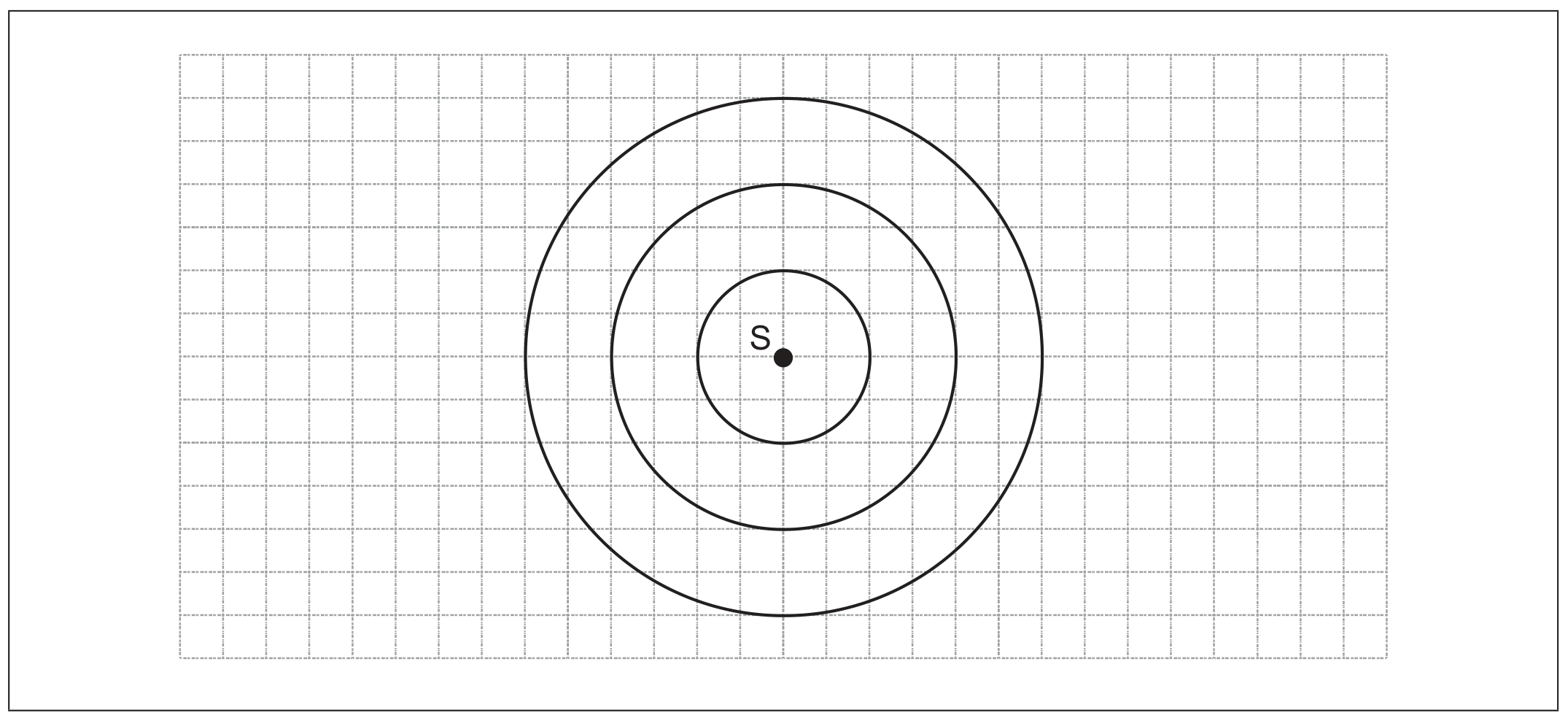
The diagram shows wavefronts in air produced by a stationary source S of sound.
The distance between successive wavefronts is equal to the wavelength of the sound.
The speed of sound is c.

Question image
(a)

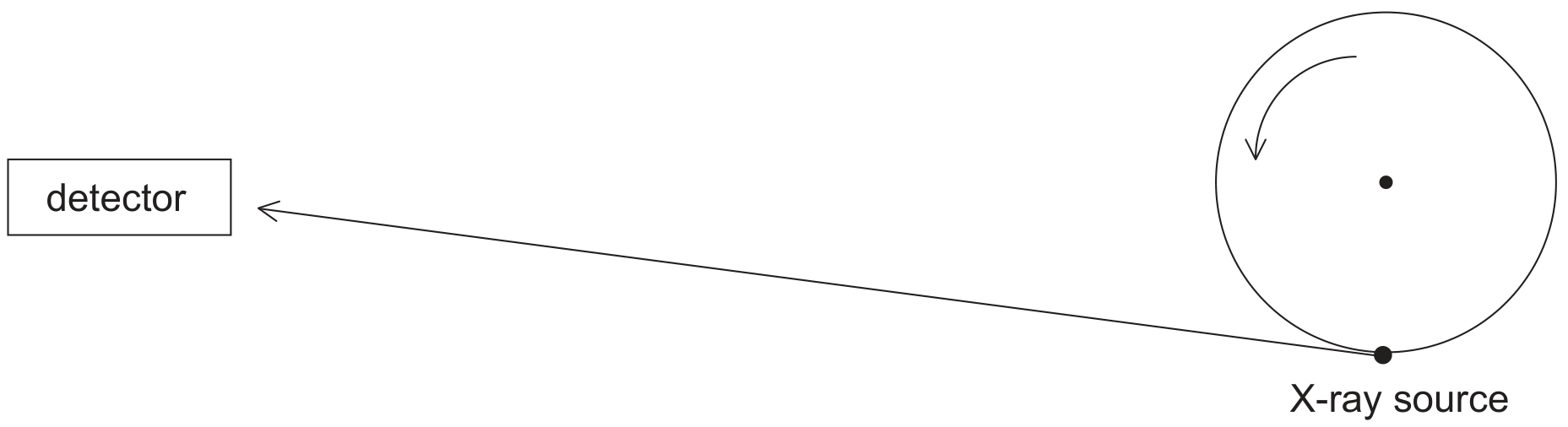
A source of X-rays rotates on a turntable. Radiation of wavelength 7.5 nm is emitted by the source and undergoes a maximum shift of 0.50 fm . The distance between the source and the detector is large in comparison to the diameter of the turntable.

Question image
[ 1 ]
(i)

State the assumption you made in your answer to (b)(i).

[ 1 ]
[Maximum number: 4]

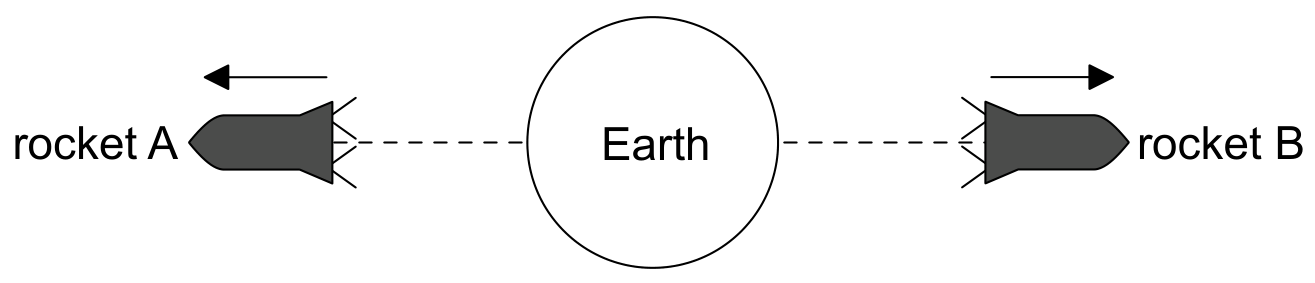
Rocket A and rocket B are travelling in opposite directions from the Earth along the same straight line.

Question image

In the reference frame of the Earth, the speed of rocket A is 0.75 c and the speed of rocket B is 0.50 c.

(a)

Calculate, for the reference frame of rocket A, the speed of rocket B according to the

[ 3 ]
(i)

Galilean transformation.

[ 1 ]
(ii)

Lorentz transformation.

[ 2 ]
(b)

Outline, with reference to special relativity, which of your calculations in (a) is more likely to be valid.

[ 1 ]
[Maximum number: 1]

The fixed distance between Earth and a star measured in Earth's reference frame is dEd_{E}. A spaceship travels from Earth to the star at a constant speed of 0.8c relative to Earth. The distance between Earth and the star as measured by the spaceship is dsd_{s}.

What is dsdE\frac{d_{s}}{d_{E}} ?

A

35\frac{3}{5}

B

45\frac{4}{5}

C

54\frac{5}{4}

D

53\frac{5}{3}

[Maximum number: 1]

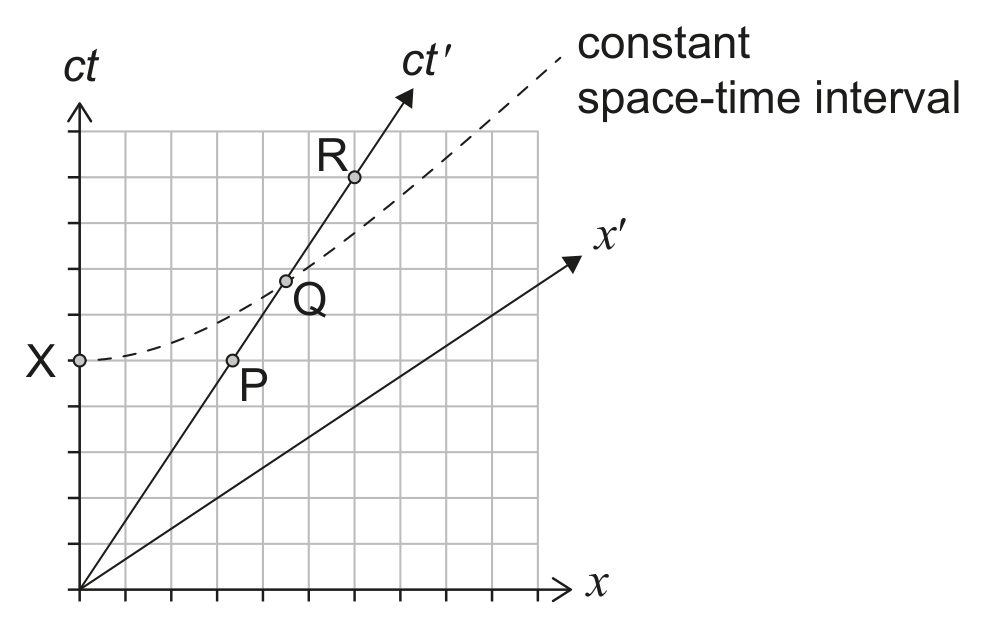
The space-time diagram shows coordinate axes of inertial reference frames S(x, c t) and S(x,ct)\mathrm{S}^{\prime}\left(x^{\prime}, c t^{\prime}\right). Event X occurs at t=1 st=1 \mathrm{~s} according to the S reference frame. A line of constant space-time interval is drawn through X .

Question image

In the SS^{\prime} reference frame, which event is simultaneous with X and which event has the time coordinate t=1 st^{\prime}=1 \mathrm{~s} ?

Simultaneous with X
in the S\mathrm{S}^{\prime} frame

t=1s\boldsymbol{t}^{\boldsymbol{\prime}}=\mathbf{1} \mathrm{s} in the S'frame

P

R

Q

R

R

P

R

Q

[Maximum number: 1]

A pendulum has a period of 3.0 s as measured in its inertial frame of reference. An observer is moving with a speed of 0.80 c with respect to the pendulum's frame.

What is the period of the pendulum measured by the observer?

A

8.3 s8.3 \mathrm{~s}

B

5.0 s5.0 \mathrm{~s}

C

1.8 s

D

1.1 s1.1 \mathrm{~s}

0