[Maximum number: 1]
This question is about objects in the universe.
(a)
State how
[ 1 ]
(i)
it is known that main sequence stars are made predominantly of hydrogen.
[ 1 ]
 EduNinja
This question is about objects in the universe.
State how
it is known that main sequence stars are made predominantly of hydrogen.
What is the best estimate for the diameter of a helium nucleus?
The ratio of the diameter of an atom to the diameter of its nucleus is:
The diagram shows the three lowest energy levels of the hydrogen atom.
The energy of each level is indicated.
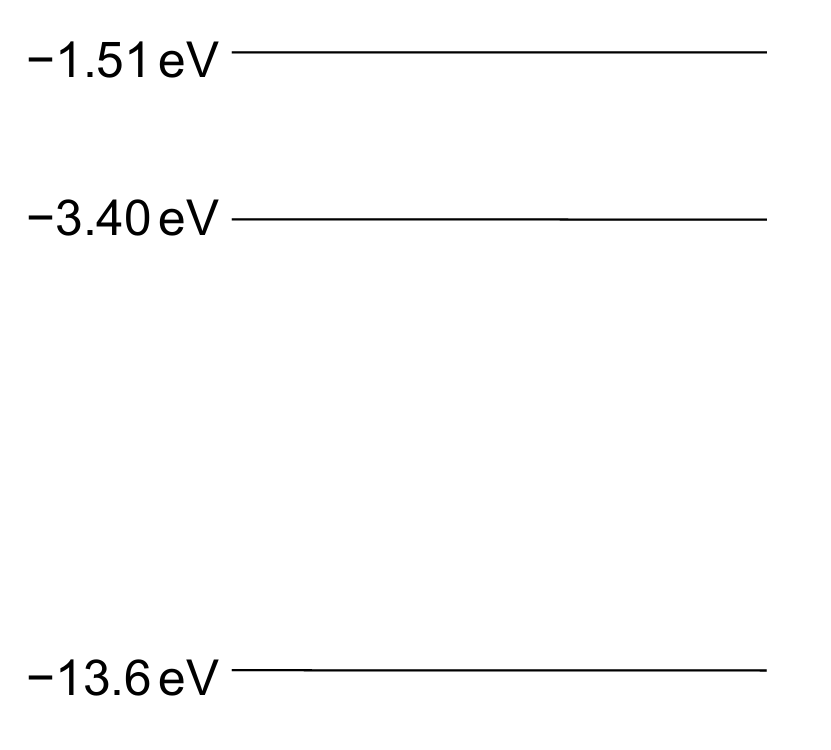
State the number of transitions between these levels that result in the emission of photons.
Calculate the largest photon wavelength for these transitions.
The diagram shows the three lowest energy levels of the hydrogen atom.
The energy of each level is indicated.
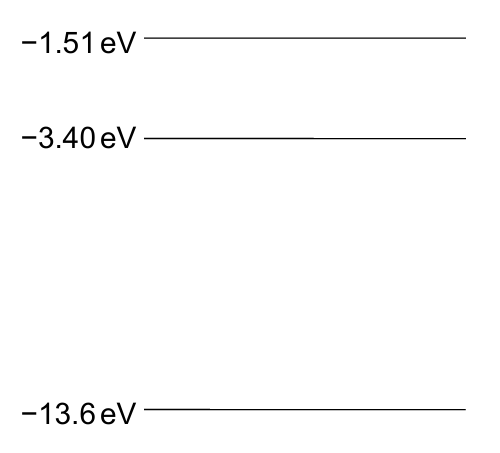
State the number of transitions between these levels that result in the emission of photons.
Calculate the largest photon wavelength for these transitions.
The Feynman diagram shows electron capture.
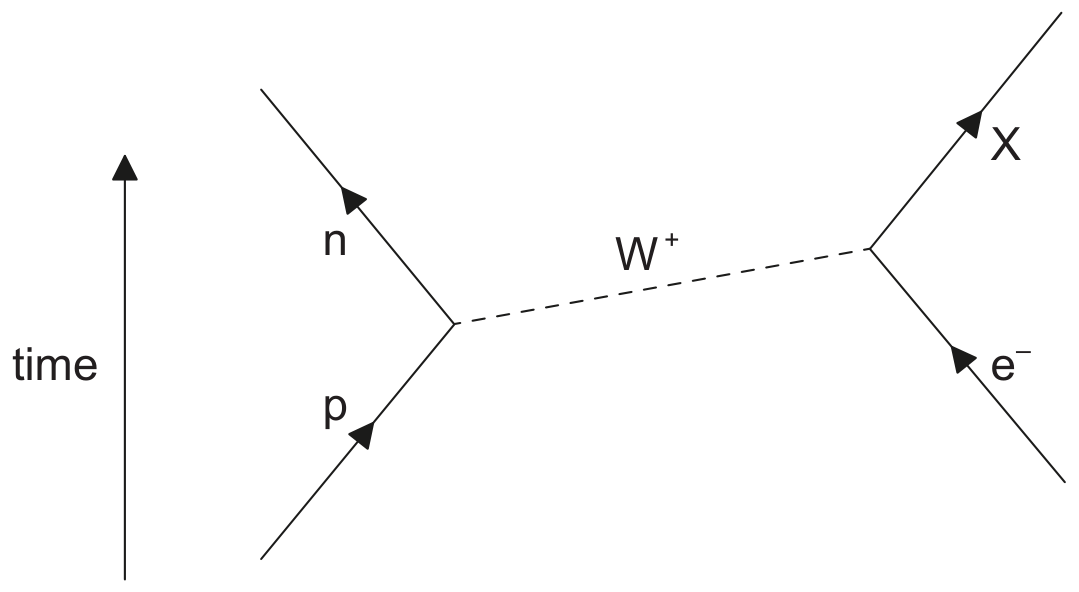
Distinguish between hadrons and leptons.
Rutherford modelled the scattering of alpha particles by a nucleus of gold. However, when the initial alpha particle energy is greater than a certain value , the fraction of alpha particles scattered at angles close to does not follow Rutherford's model.
Outline
why this deviation from the model occurs, and
how can be used to estimate the nuclear radius of gold.
Gold-198 (Au-198) is a radioactive nuclide of gold. Au-198 decays into stable mercury-198 (Hg-198) with an emission of a beta particle followed by one or two gamma photons.
The half-life of Au-198 is 2.69 days.
D2. This question is about quarks and interactions.
(a) Outline how interactions in particle physics are understood in terms of exchange particles.
(b) The sigma ( ) decays into a positive pion ( ) and a neutron according to the following reaction.
The colour of each of the quarks in is indicated in the diagram below.
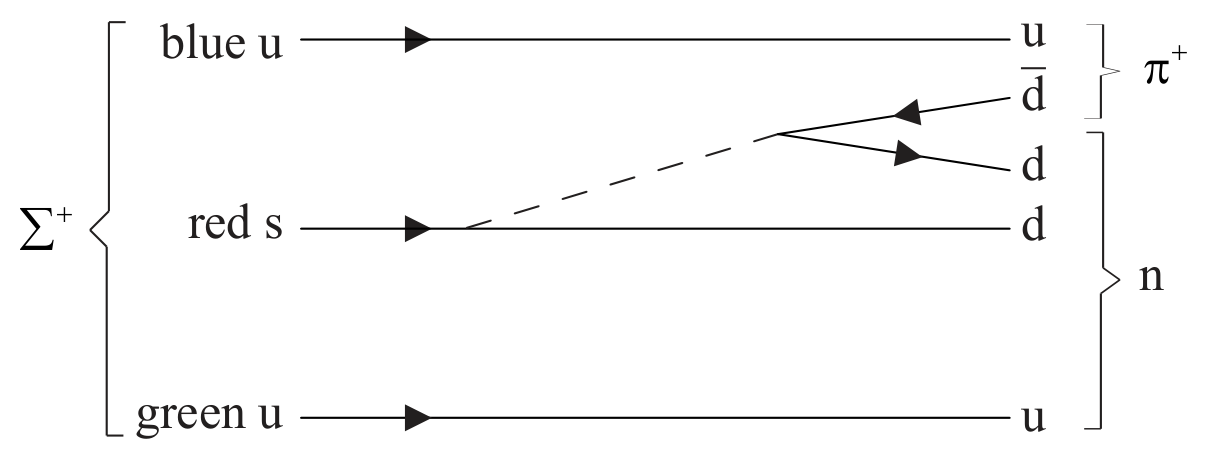
Deduce
(i) the colour of the in .
(ii) the electric charge of the particle represented by the dotted line.
(c) Determine whether or not strangeness is conserved in this decay.
(d) The total energy of the particle represented by the dotted line is 1.2 GeV more than what is allowed by energy conservation. Determine the time interval from the emission of the particle from the s quark to its conversion into the pair.
(e) The pion is unstable and decays through the weak interaction into a neutrino and an anti-muon.
Draw a Feynman diagram for the decay of the pion, labelling all particles in the diagram.
A stationary isotope of (Radium) decays into Rn (Radon) and an alpha particle.
Identify the proton number of Rn .
The following data are available:
Atomic mass of Ra=226.02540 u
Atomic mass of Rn=222.01757 u
Mass of
In an experiment performed by Geiger, Marsden and Rutherford to investigate the atomic structure, alpha particles were directed into a thin metal foil.
Describe two observations of this experiment.
Outline how the experiment was interpreted.
This question is about polarization.
Outline how polarization may be used in stress analysis.
This question is about atomic energy levels.
Explain how atomic spectra provide evidence for the quantization of energy in atoms.