EduNinja
[Maximum number: 2]

A box of mass 1.2 kg is lying at rest on a surface. The coefficient of static friction between the box and the surface is 0.36 and the coefficient of dynamic friction between the box and the surface is 0.28 .

(a)

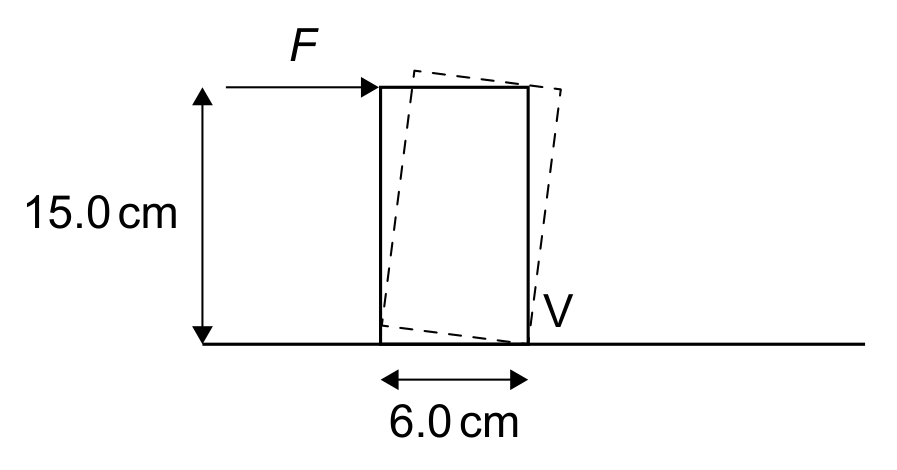
The box is now standing up. The height of the box is 15.0 cm and its base is 6.0 cm . A person pushes the box with an increasing force F at the top until the box tips about the corner V without sliding, as shown.
Question image
[ 2 ]
(i)

Determine F.

[ 2 ]
[Maximum number: 1]

A wheel, initially at rest, rolls without slipping down an incline for 4.0 s . The final angular velocity of the wheel is 5πrads15 \pi \mathrm{rads}^{-1}.

How many revolutions did the wheel complete?

A

5

B

10

C

15

D

30

[Maximum number: 1]

What is the unit of angular impulse?

A

Ns

B

Nm

C

Nms1\mathrm{Nms}^{-1}

D

Nms

[Maximum number: 1]

A system of moment of inertia I rotates from rest about a given axis. The angular acceleration α\alpha of the system is constant.

What is the change in angular momentum when the system has made four complete rotations about the given axis?

A

2I2πα2 I \sqrt{2 \pi \alpha}

B

4Iπα4 I \sqrt{\pi \alpha}

C

2I2α2 I \sqrt{2 \alpha}

D

4Iα4 I \sqrt{\alpha}

[Maximum number: 1]

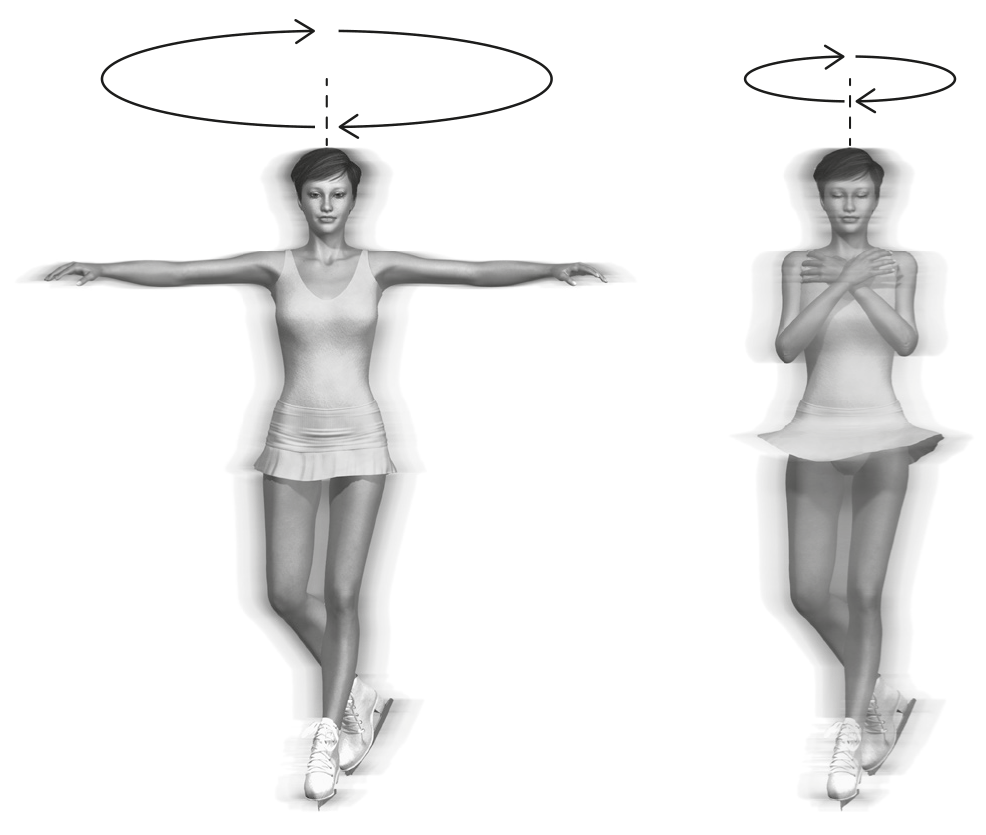
An ice skater is spinning with their arms extended in a fixed position at a constant angular velocity. The ice skater then quickly pulls their arms closer to their body. Frictional effects are negligible.

Question image

Three statements are made about the ice skater's motion.
I. The angular momentum of the ice skater remains constant.
II. The rotational kinetic energy of the ice skater remains constant.
III. The net torque acting on the ice skater is zero.

Which of the statements are correct?

A

I and II only

B

I and III only

C

II and III only

D

I, II and III

[Maximum number: 1]

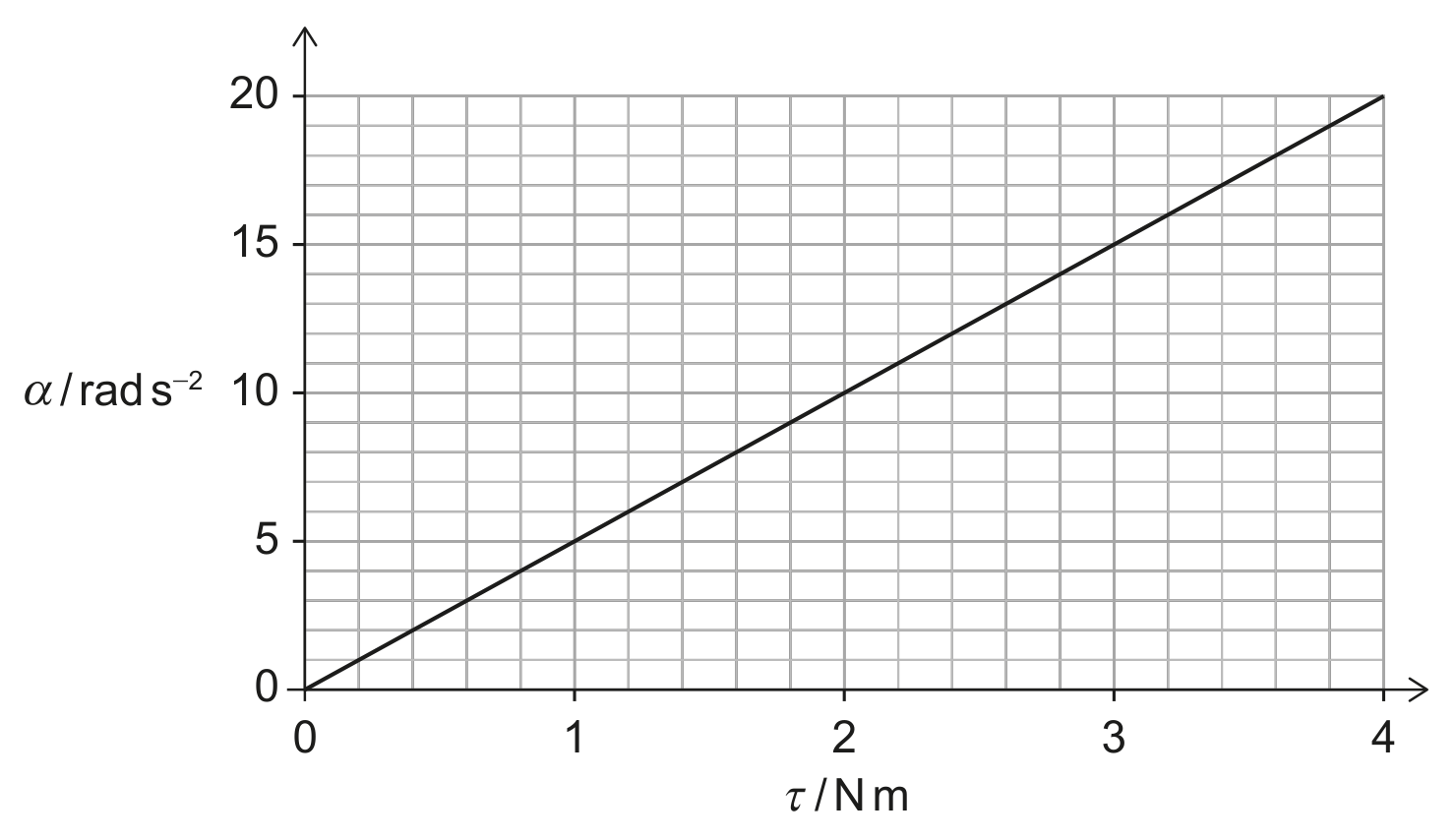
The graph shows how the angular acceleration α\alpha of a flywheel varies with torque τ\tau applied to the flywheel.

Question image

What is the moment of inertia of the flywheel?

A

0.20 kg m20.20 \mathrm{~kg} \mathrm{~m}^{2}

B

5.0 kg m25.0 \mathrm{~kg} \mathrm{~m}^{2}

C

40 kg m240 \mathrm{~kg} \mathrm{~m}^{2}

D

80 kg m280 \mathrm{~kg} \mathrm{~m}^{2}

[Maximum number: 1]

Two spheres, X and Y, are spinning with the same rotational kinetic energy. The moment of inertia of X is IXI_{\mathrm{X}} and that of Y is IYI_{\mathrm{Y}}.

What is  angular momentum of X angular momentum of Y\frac{\text { angular momentum of } X}{\text { angular momentum of } Y} ?

A

IXIY\sqrt{\frac{I_{\mathrm{X}}}{I_{\mathrm{Y}}}}

B

IYIX\sqrt{\frac{I_{\mathrm{Y}}}{I_{\mathrm{X}}}}

C

IXIY\frac{I_{\mathrm{X}}}{I_{\mathrm{Y}}}

D

IYIX\frac{I_{\mathrm{Y}}}{I_{\mathrm{X}}}

[Maximum number: 1]

A car of total mass M is travelling with a constant speed v. Each of the four wheels of the car has a mass m and a radius R and rolls without slipping.

The moment of inertia of each wheel is I=12mR2I=\frac{1}{2} m R^{2}.
What is  sum of the rotational kinetic energy of all four wheels  translational kinetic energy of the car ?\frac{\text { sum of the rotational kinetic energy of all four wheels }}{\text { translational kinetic energy of the car }} ?

A

m2M\frac{m}{2 M}

B

mM\frac{m}{M}

C

2mM\frac{2 m}{M}

D

4mM\frac{4 m}{M}

[Maximum number: 1]

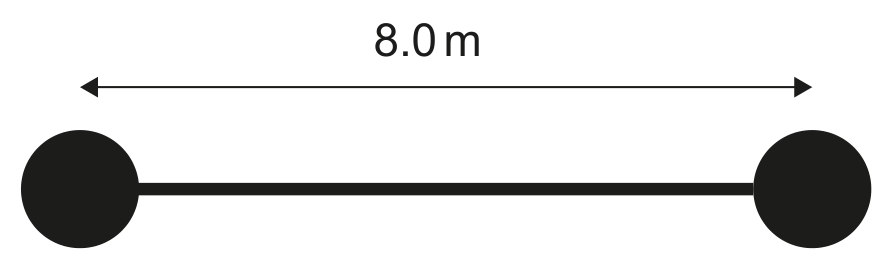
Two small spheres each of mass 10 kg are 8.0 m apart and connected by a rod of negligible mass. This system rotates about an axis halfway along the rod and at right angles to it.

Question image

What is the moment of inertia of the system?

A

160 kg m2160 \mathrm{~kg} \mathrm{~m}^{2}

B

320 kg m2320 \mathrm{~kg} \mathrm{~m}^{2}

C

640 kg m2640 \mathrm{~kg} \mathrm{~m}^{2}

D

1280 kg m21280 \mathrm{~kg} \mathrm{~m}^{2}

[Maximum number: 6]

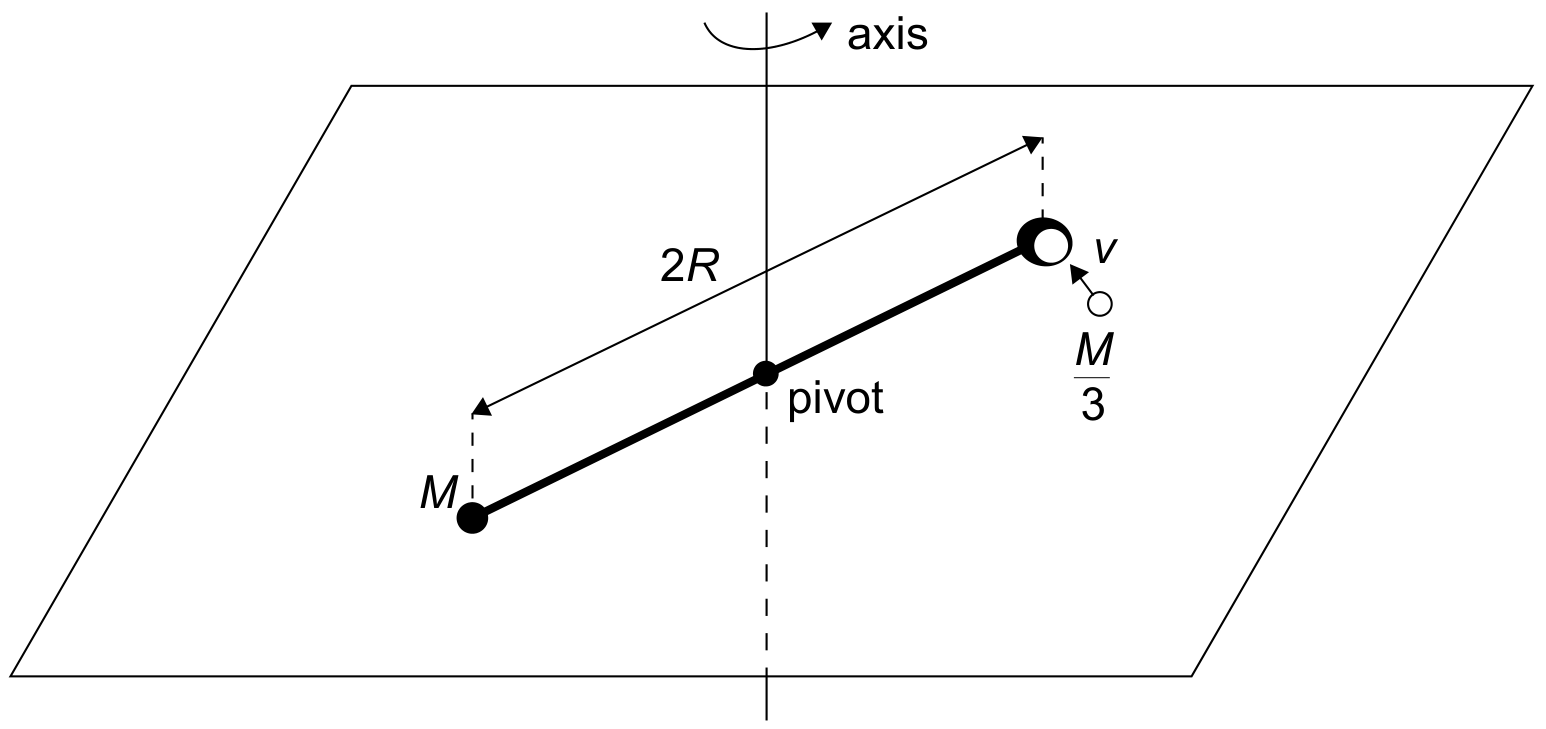
A horizontal rigid bar of length 2 R is pivoted at its centre. The bar is free to rotate in a horizontal plane about a vertical axis through the pivot. A point particle of mass M is attached to one end of the bar and a container is attached to the other end of the bar.

A point particle of mass M3\frac{M}{3} moving with speed v at right angles to the rod collides with the container and gets stuck in the container. The system then starts to rotate about the vertical axis.

The mass of the rod and the container can be neglected.

Question image
(a)
(i)

Write down an expression, in terms of M, v and R, for the angular momentum of the system about the vertical axis just before the collision.

[ 1 ]
(ii)

Just after the collision the system begins to rotate about the vertical axis with angular velocity ω\omega. Show that the angular momentum of the system is equal to 43MR2ω\frac{4}{3} M R^{2} \omega.

[ 1 ]
(b)

A torque of 0.010 Nm brings the system to rest after a number of revolutions. For this case R=0.50 m,M=0.70 kgR=0.50 \mathrm{~m}, M=0.70 \mathrm{~kg} and v=2.1 ms1v=2.1 \mathrm{~ms}^{-1}.

[ 4 ]
(i)

Show that the angular deceleration of the system is 0.043rads20.043 \mathrm{rad} \mathrm{s}^{-2}.

[ 1 ]
(ii)

Calculate the number of revolutions made by the system before it comes to rest.

[ 3 ]
0