EduNinja
[Maximum number: 1]

Data analysis question.

A student sets up a circuit to study the variation of resistance R of a negative temperature coefficient (NTC) thermistor with temperature T. The data are shown plotted on the graph.
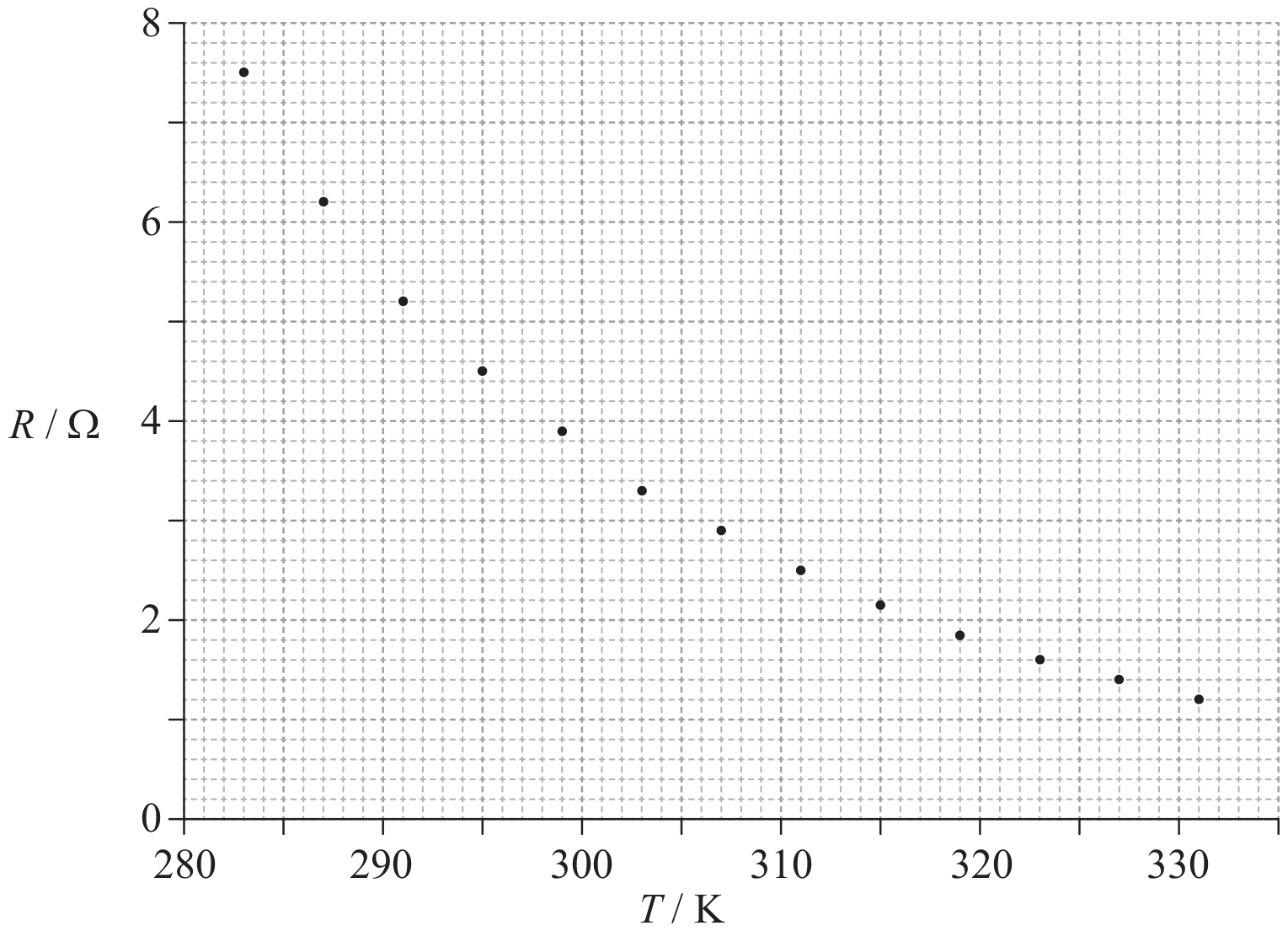
Question image
(a)

The electric current through the thermistor for T=283 KT=283 \mathrm{~K} is 0.78 mA . The uncertainty in the electric current is 0.01 mA .

[ 1 ]
(i)

Calculate the power dissipated by the thermistor at T=283 KT=283 \mathrm{~K}.

[ 1 ]
[Maximum number: 6]

A girl rides a bicycle that is powered by an electric motor. A battery transfers energy to the electric motor. The emf of the battery is 16 V and it can deliver a charge of 43 kC when discharging completely from a full charge.

(a)

The maximum speed of the girl on a horizontal road is 7.0 m s17.0 \mathrm{~m} \mathrm{~s}^{-1} with energy from the battery alone. The maximum distance that the girl can travel under these conditions is 20 km .

[ 1 ]
(i)

Show that the time taken for the battery to discharge is about 3×10³ s3 \times 10^{3} \mathrm{~s}.

[ 1 ]
(b)

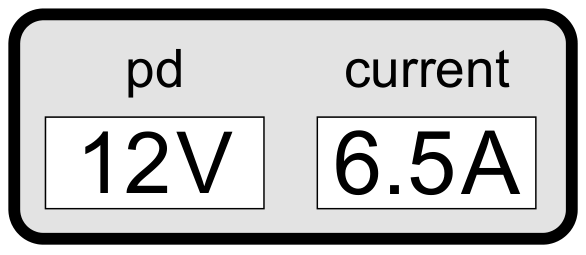
The bicycle has a meter that displays the current and the terminal potential difference (pd) for the battery when the motor is running. The diagram shows the meter readings at one instant. The emf of the cell is 16 V .

Question image

Determine the internal resistance of the battery.

[ 2 ]
(c)

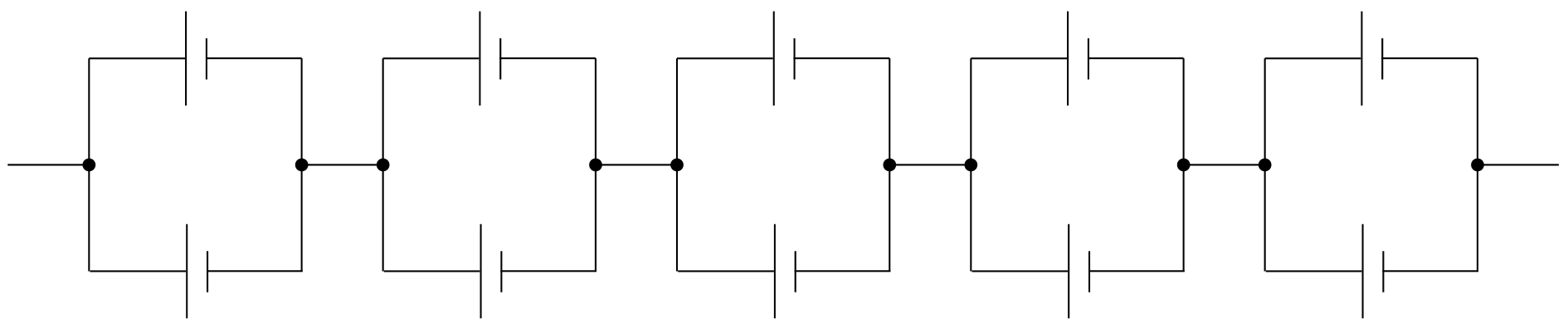
The battery is made from an arrangement of 10 identical cells as shown.

Question image

Calculate

[ 3 ]
(i)

the emf of one cell.

[ 1 ]
(ii)

the internal resistance of one cell.

[ 2 ]
[Maximum number: 6]

A girl rides a bicycle that is powered by an electric motor. A battery transfers energy to the electric motor. The emf of the battery is 16 V and it can deliver a charge of 43 kC when discharging completely from a full charge.

(a)

The maximum speed of the girl on a horizontal road is 7.0 m s17.0 \mathrm{~m} \mathrm{~s}^{-1} with energy from the battery alone. The maximum distance that the girl can travel under these conditions is 20 km .

[ 1 ]
(i)

Show that the time taken for the battery to discharge is about 3×10³ s3 \times 10^{3} \mathrm{~s}.

[ 1 ]
(b)

The bicycle has a meter that displays the current and the terminal potential difference (pd) for the battery when the motor is running. The diagram shows the meter readings at one instant. The emf of the cell is 16 V .
pd current \\ 12 V 6.5A
Determine the internal resistance of the battery.

[ 2 ]
(c)

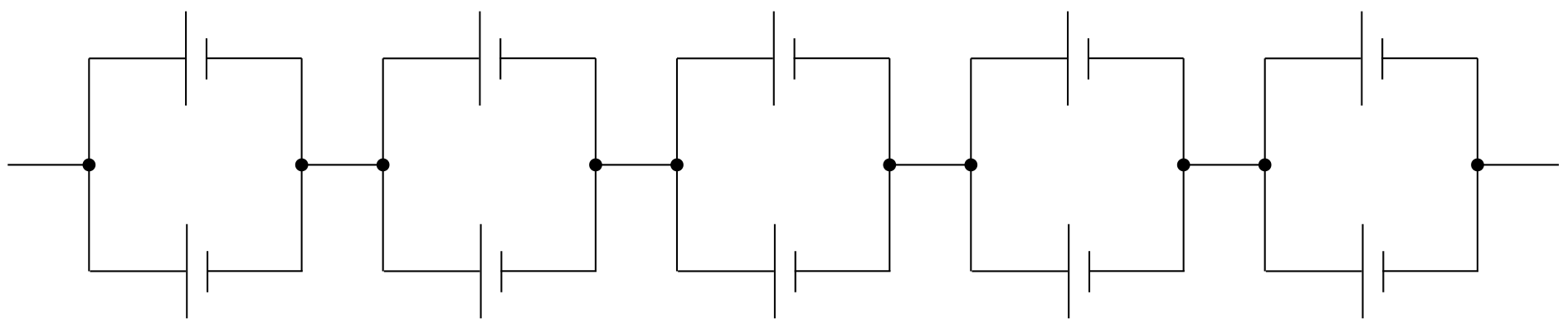
The battery is made from an arrangement of 10 identical cells as shown.

Question image

Calculate

[ 3 ]
(i)

the emf of one cell.

[ 1 ]
(ii)

the internal resistance of one cell.

[ 2 ]
[Maximum number: 2]

A student investigates the electromotive force (emf) ε\varepsilon and internal resistance r of a cell.

Question image

The current I and the terminal potential difference V are measured.
For this circuit V=εIrV=\varepsilon-I r.
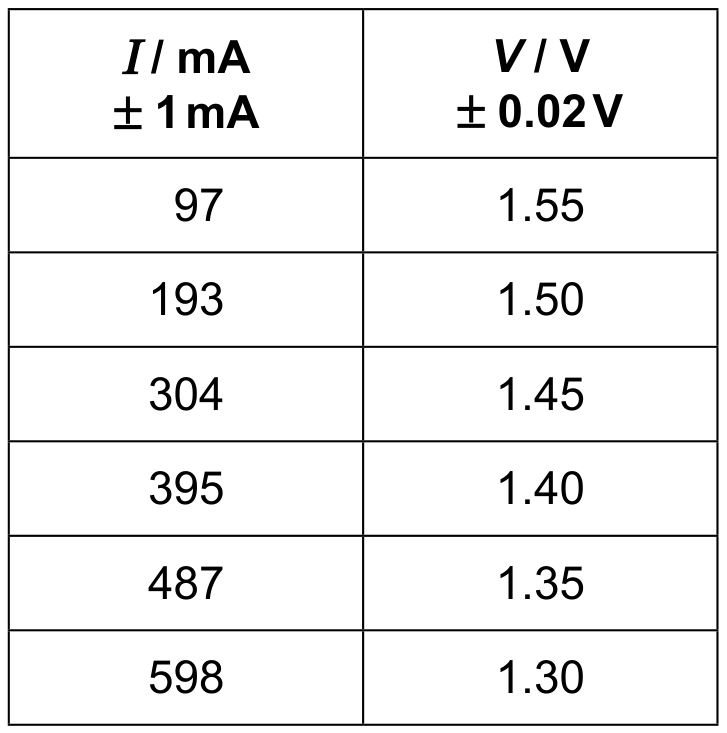
The table shows the data collected by the student. The uncertainties for each measurement are shown.

Table

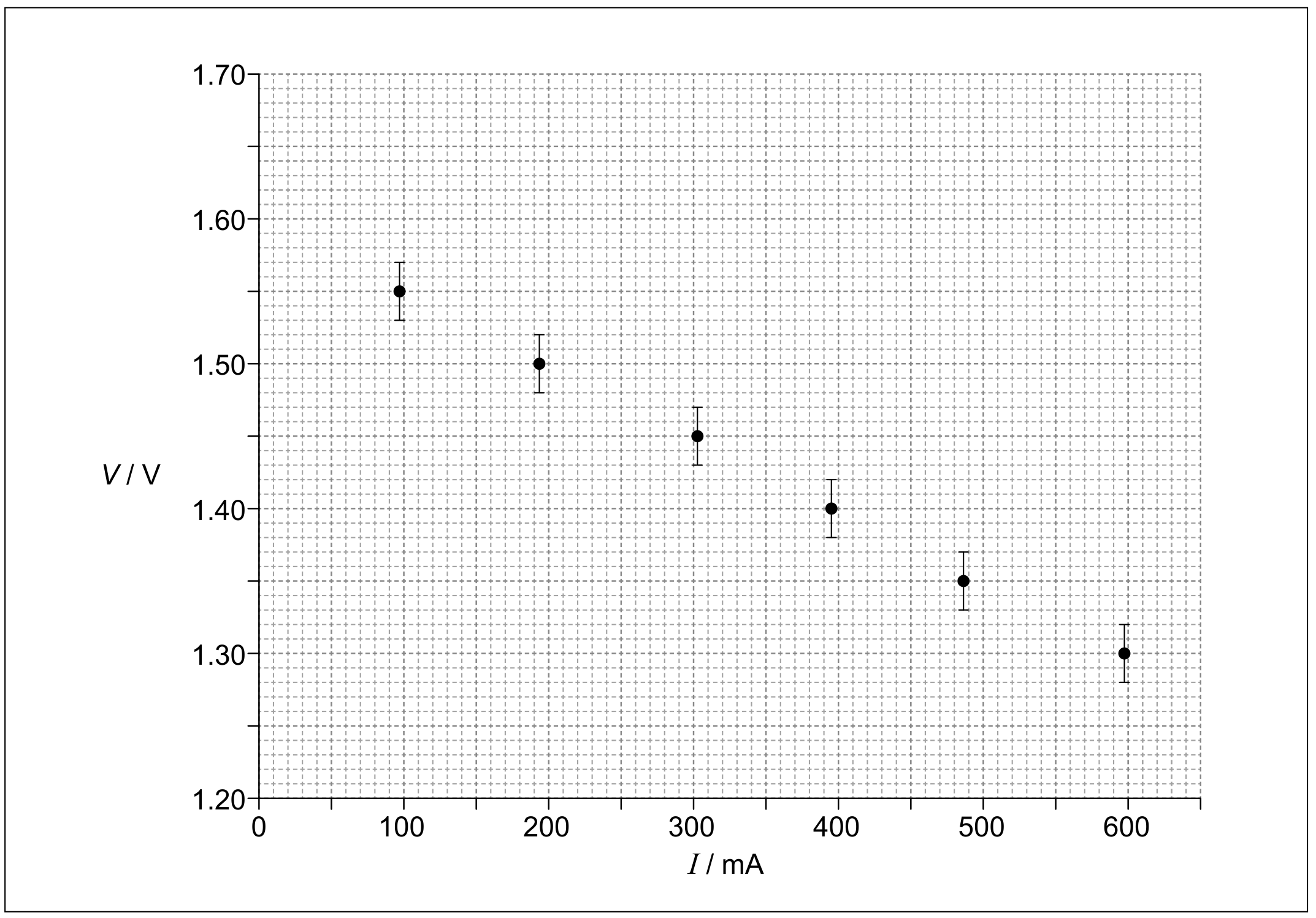
The graph shows the data plotted.

Question image
(a)

Outline, without calculation, how the internal resistance can be determined from this graph.

[ 2 ]
[Maximum number: 7]

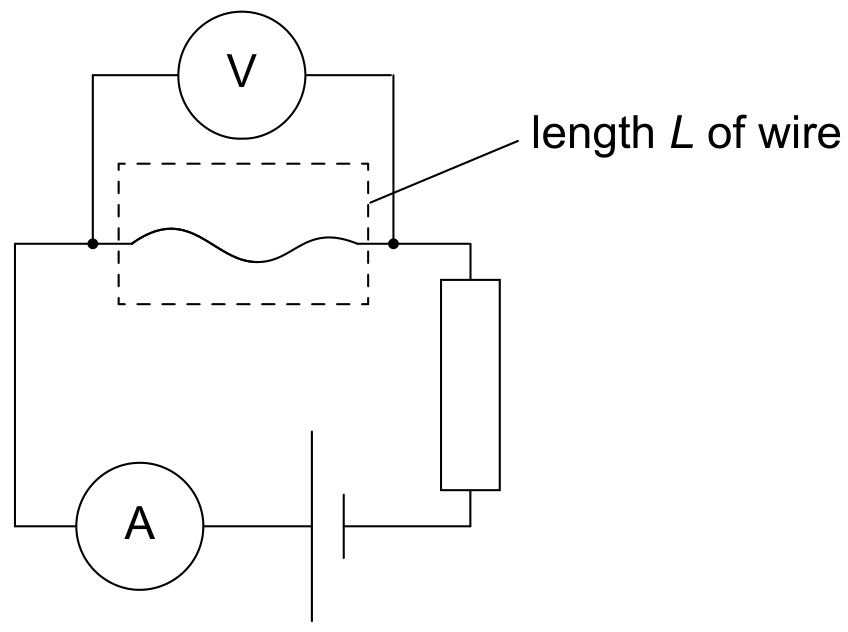
The resistance R of a wire of length L can be measured using the circuit shown.

Question image
(a)

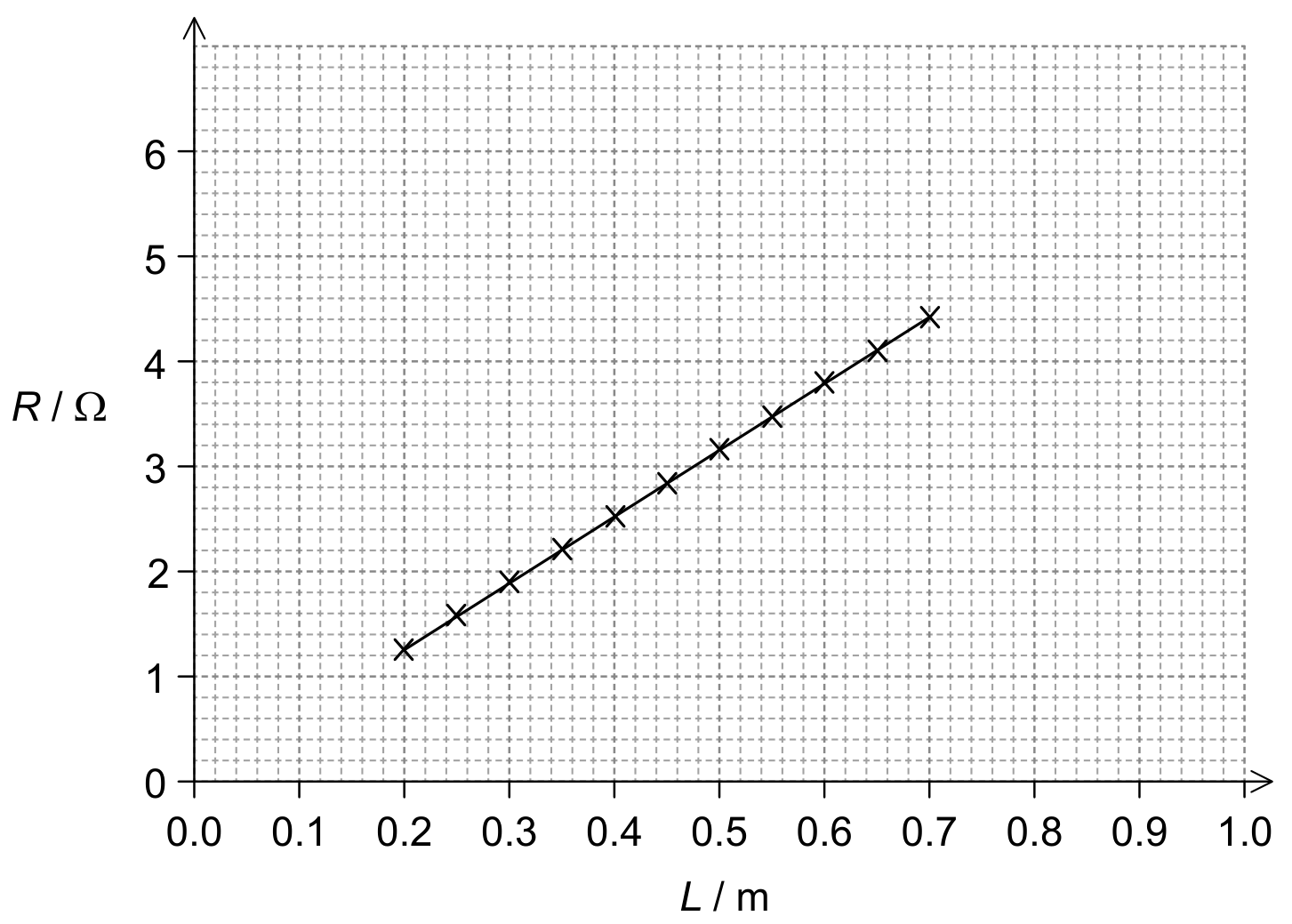
In one experiment the wire has a uniform diameter of d=0.500 mmd=0.500 \mathrm{~mm}. The graph shows data obtained for the variation of R with L.

Question image

The gradient of the line of best fit is 6.30Ω m16.30 \Omega \mathrm{~m}^{-1}.

[ 5 ]
(i)

Estimate the resistivity of the material of the wire. Give your answer to an appropriate number of significant figures.

[ 2 ]
(ii)

Explain, by reference to the power dissipated in the wire, the advantage of the fixed resistor connected in series with the wire for the measurement of R.

[ 3 ]
(b)

The experiment is repeated using a wire made of the same material but of a larger diameter than the wire in part (a). On the axes in part (a), draw the graph for this second experiment. provided.

[ 2 ]
[Maximum number: 2]

A solar heating panel is placed on the roof of a house in order to heat water in a storage tank. The rest of the roof is covered with tiles.

(a)

Another method of harnessing solar energy involves the use of photovoltaic cells.

Outline one advantage of the output of a photovoltaic cell compared to the output of a solar heating panel.

[ 2 ]
[Maximum number: 6]

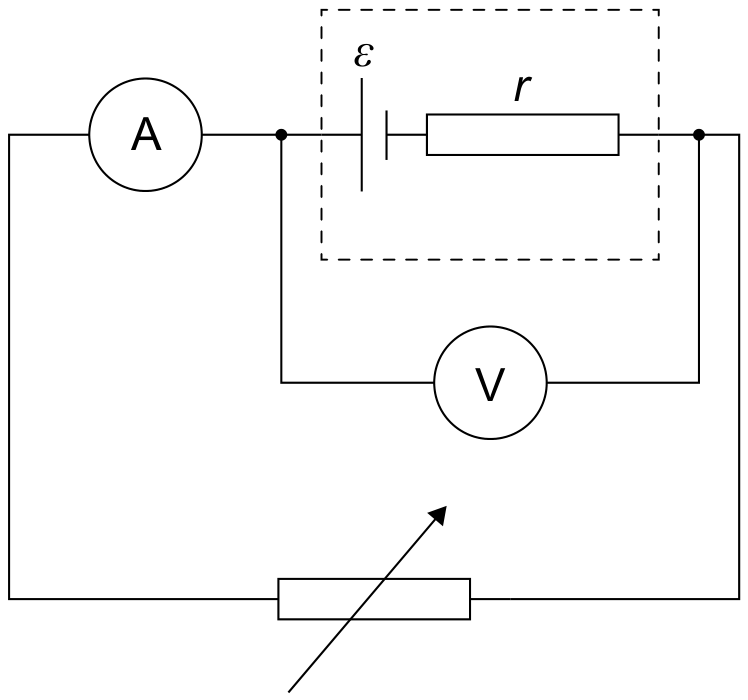
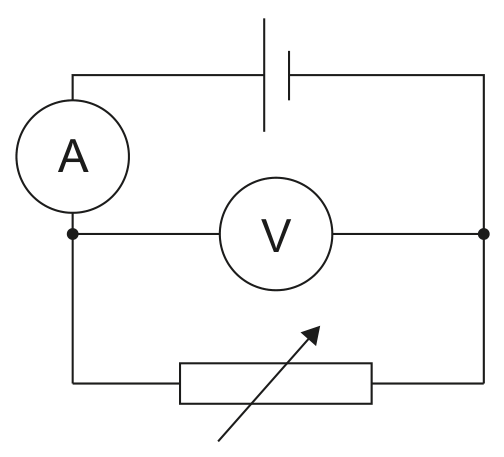
A student is investigating the emf and internal resistance of a cell, using the circuit shown. The ammeter and the voltmeter are ideal.

Question image

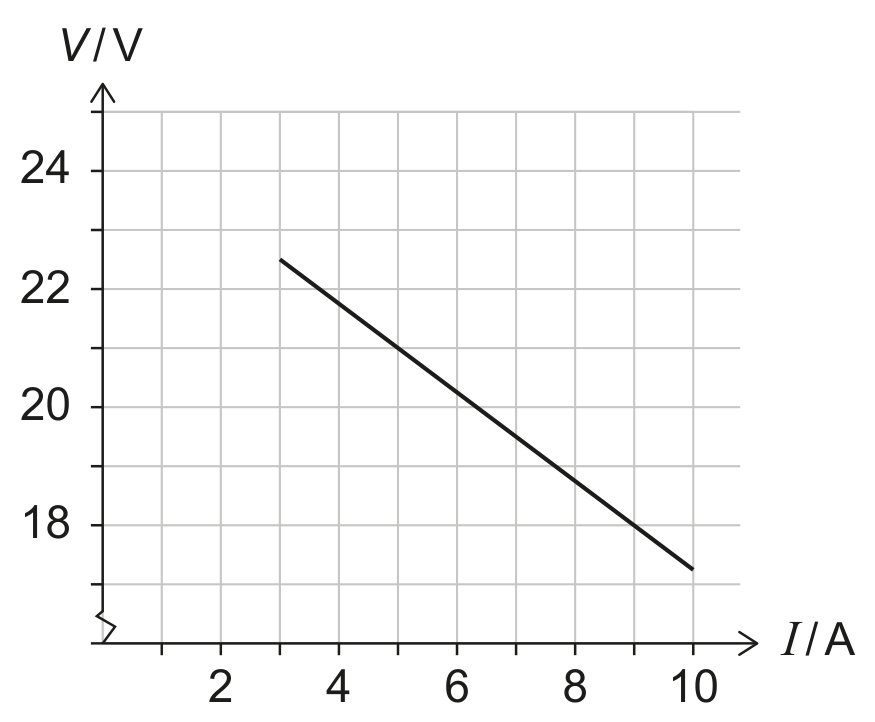
The graph shows the variation of the voltmeter reading V with the ammeter reading I.

Question image
(a)

Explain why V changes when the resistance of the variable resistor is changed.

[ 2 ]
(b)

Show that the internal resistance of the cell is about 0.8Ω0.8 \Omega.

[ 2 ]
(c)

Determine the emf of the cell.

[ 2 ]
[Maximum number: 6]

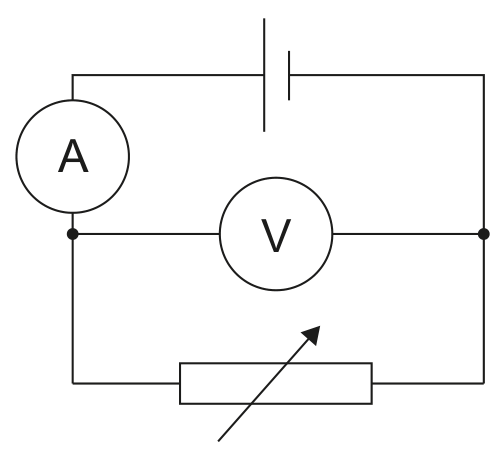
A student is investigating the emf and internal resistance of a cell, using the circuit shown. The ammeter and the voltmeter are ideal.

Question image

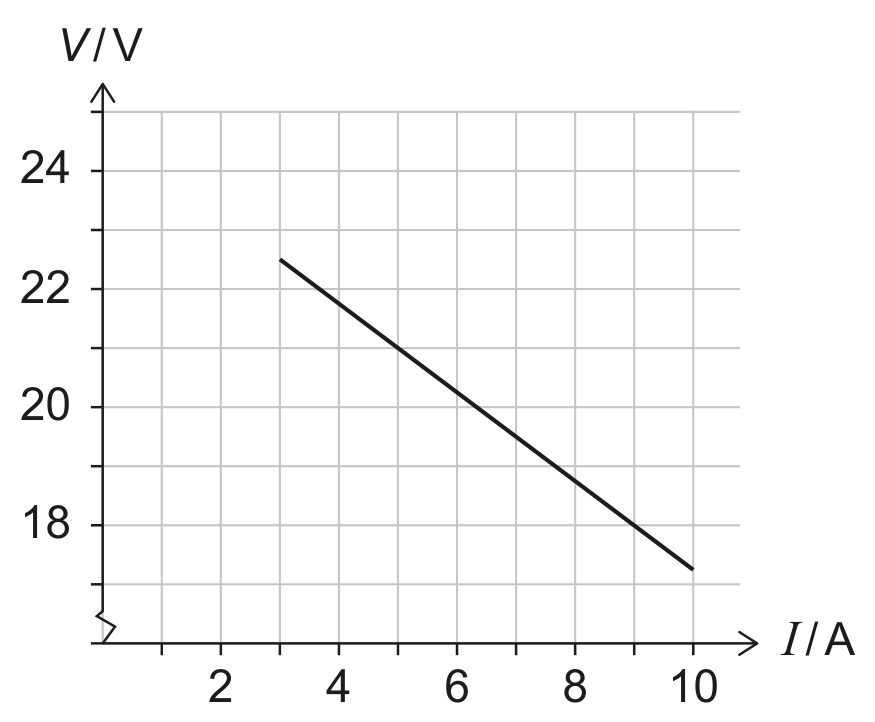
The graph shows the variation of the voltmeter reading V with the ammeter reading I.

Question image
(a)

Explain why V changes when the resistance of the variable resistor is changed.

[ 2 ]
(b)

Show that the internal resistance of the cell is about 0.8Ω0.8 \Omega.

[ 2 ]
(c)

Determine the emf of the cell.

[ 2 ]
[Maximum number: 4]

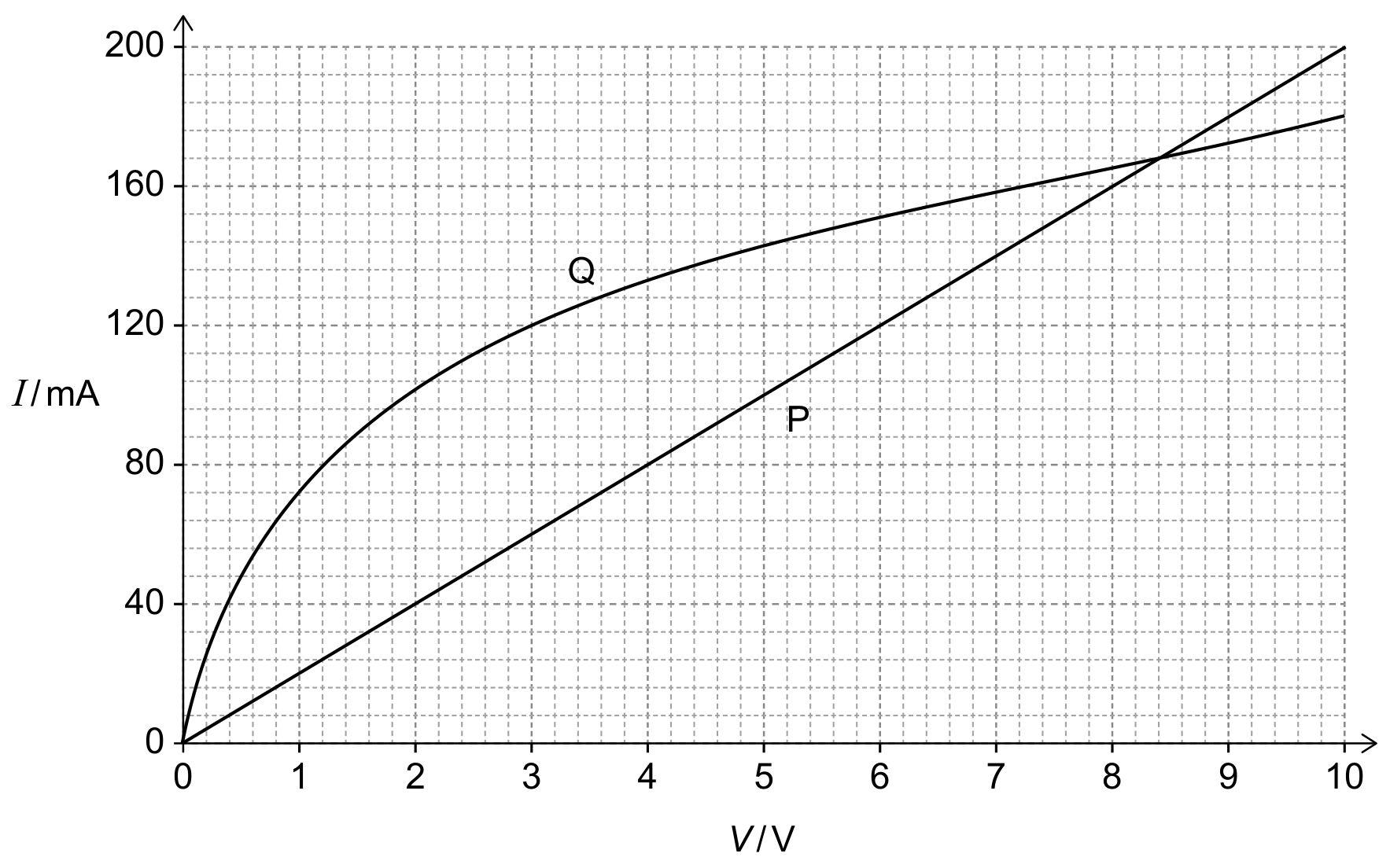
The graph shows the variation with the potential difference V of the current I in an ohmic resistor P and a non-ohmic component Q .

Question image
(a)

Calculate the resistance of P.

[ 1 ]
(b)

Outline how the resistance of Q changes when the current in it increases.
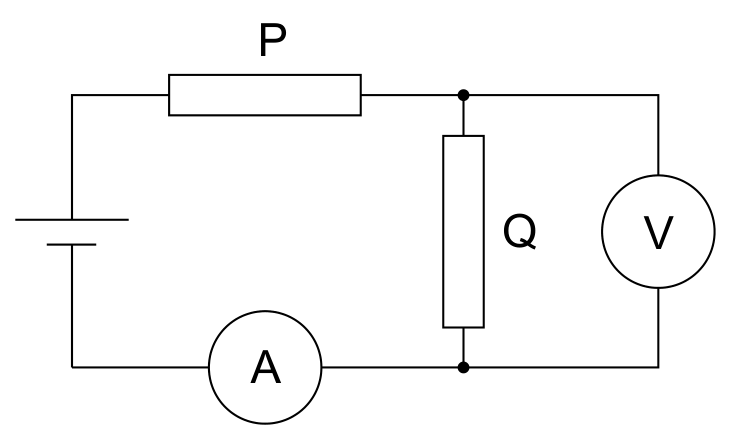
P and Q are connected in a circuit with a cell of negligible internal resistance as shown. The ammeter and the voltmeter are ideal.

Question image

The reading of the voltmeter is 3.0 V .

[ 1 ]
(c)

Determine the emf of the cell.

[ 2 ]
[Maximum number: 1]

A wire of length L is used in an electric heater. When the potential difference across the wire is 200 V , the power transferred in the wire is 500 W . A second wire is made from the same metal and has the same cross-sectional area. When a potential difference of 400 V is applied across the second wire, the power transferred is 2000 W .

What is the length of the second wire?

A

L4\frac{L}{4}

B

L2\frac{L}{2}

C

L

D

2 L

0