EduNinja
[Maximum number: 9]

A spherical oil droplet is released from rest at the bottom of a column of water.

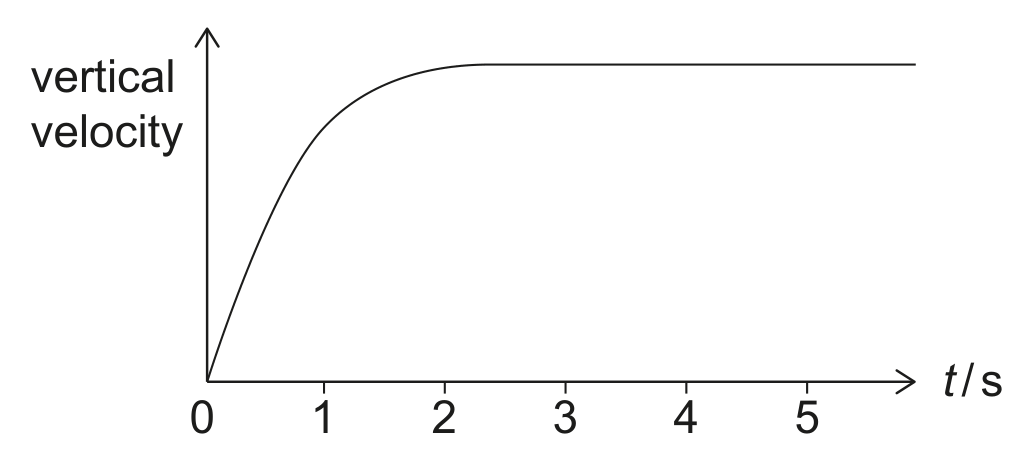
The graph shows the variation with time t of the vertical velocity of the oil droplet.
Question image
(a)

The following data are available:

 radius of the oil droplet =3.5 mm weight of the oil droplet =1.6×10³ N density of the water =1000 kg m3 viscosity of the water =1.1×10³Pas\begin{aligned} \text { radius of the oil droplet } & =3.5 \mathrm{~mm} \\ \text { weight of the oil droplet } & =1.6 \times 10^{-3} \mathrm{~N} \\ \text { density of the water } & =1000 \mathrm{~kg} \mathrm{~m}^{-3} \\ \text { viscosity of the water } & =1.1 \times 10^{-3} \mathrm{Pas} \end{aligned}
[ 3 ]
(i)

Calculate the initial acceleration of the oil droplet.

[ 3 ]
(b)

Describe why the acceleration of the oil droplet changes.

[ 2 ]
(c)
(i)

Explain why the velocity of the oil droplet is constant for t>3 st>3 \mathrm{~s}.

[ 2 ]
(ii)

Deduce the velocity of the oil droplet for t>3 st>3 \mathrm{~s}.

[ 2 ]
[Maximum number: 5]

A group of students is trying to determine the density and the viscosity of a liquid.

To determine the density, they use a balance to read the mass m of a sphere in air and immersed in the liquid.

They use a sphere of volume V=1.827×10⁷ m3V=1.827 \times 10^{-7} \mathrm{~m}^{3}.
The readings are mair =1.427 gm_{\text {air }}=1.427 \mathrm{~g} in air and mlmmersed =1.208 gm_{\text {lmmersed }}=1.208 \mathrm{~g} in the liquid.
The readings are different due to buoyancy. The buoyancy force FbF_{\mathrm{b}} is given by

Fb=ρVgF_{\mathrm{b}}=\rho V g

where V is the volume of the sphere and ρ\rho is the density of the liquid.

(a)

Show that FbF_{\mathrm{b}} is about 2 mN .

[ 1 ]
(b)

Calculate the viscosity of the liquid and its absolute uncertainty. Ignore uncertainties in the mass, radius and volume of the sphere. Give your answer in the form η±Δη\eta \pm \Delta \eta, to an appropriate number of significant figures, including units.

The students search literature values and find the viscosity of this liquid to be 0.24 , when expressed in SI base units.

[ 4 ]
[Maximum number: 1]

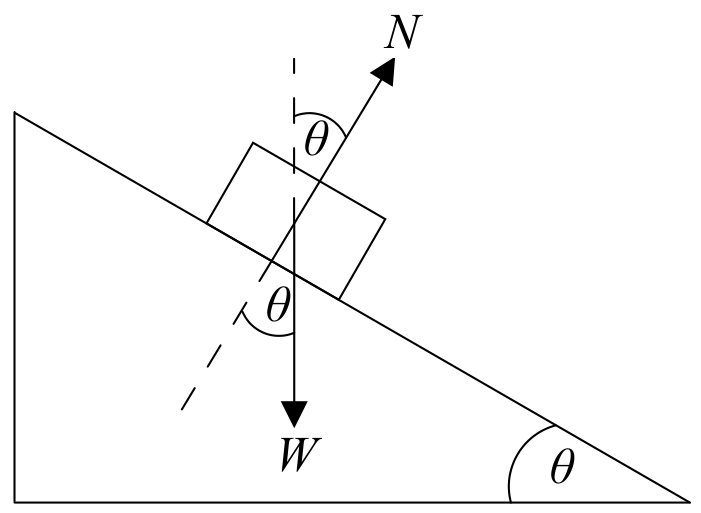
The diagram below shows the forces acting on a block of weight W as it slides down a slope. The angle between the slope and the horizontal is θ\theta, the normal reaction force on the block from the slope is N and friction is negligible.

Question image

Which of the following gives the resultant force on the block?

A

WsinθW \sin \theta

B

WcosθW \cos \theta

C

NsinθN \sin \theta

D

NcosθN \cos \theta

[Maximum number: 1]

A boy jumps from a wall 3 m high. What is an estimate of the change in momentum of the boy when he lands without rebounding?

A

5×100 kg m s15 \times 10^{0} \mathrm{~kg} \mathrm{~m} \mathrm{~s}^{-1}

B

5×101 kg m s15 \times 10^{1} \mathrm{~kg} \mathrm{~m} \mathrm{~s}^{-1}

C

5×10² kg m s15 \times 10^{2} \mathrm{~kg} \mathrm{~m} \mathrm{~s}^{-1}

D

5×10³ kg m s15 \times 10^{3} \mathrm{~kg} \mathrm{~m} \mathrm{~s}^{-1}

[Maximum number: 3]

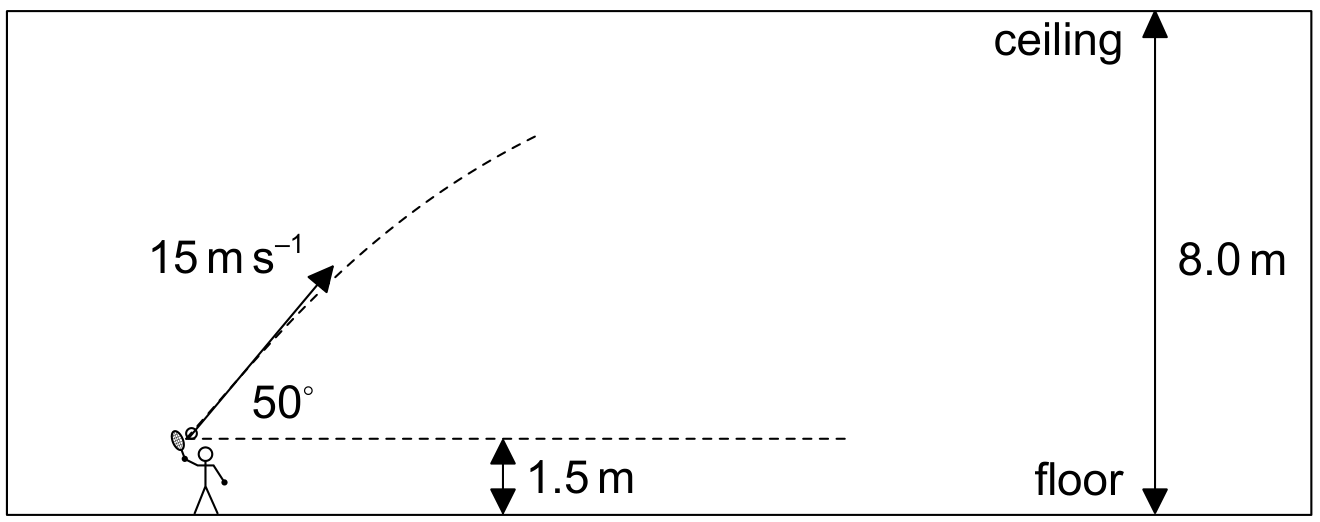
A tennis ball is hit with a racket from a point 1.5 m above the floor. The ceiling is 8.0 m above the floor. The initial velocity of the ball is 15 m s115 \mathrm{~m} \mathrm{~s}^{-1} at 5050^{\circ} above the horizontal. Assume that air resistance is negligible.

Question image
(a)

The tennis ball was stationary before being hit. It has a mass of 5.8×10² kg5.8 \times 10^{-2} \mathrm{~kg} and was in contact with the racket for 23 ms .

[ 3 ]
(i)

Calculate the mean force exerted by the racket on the ball.

[ 1 ]
(ii)

Explain how Newton's third law applies when the racket hits the tennis ball.

[ 2 ]
[Maximum number: 3]

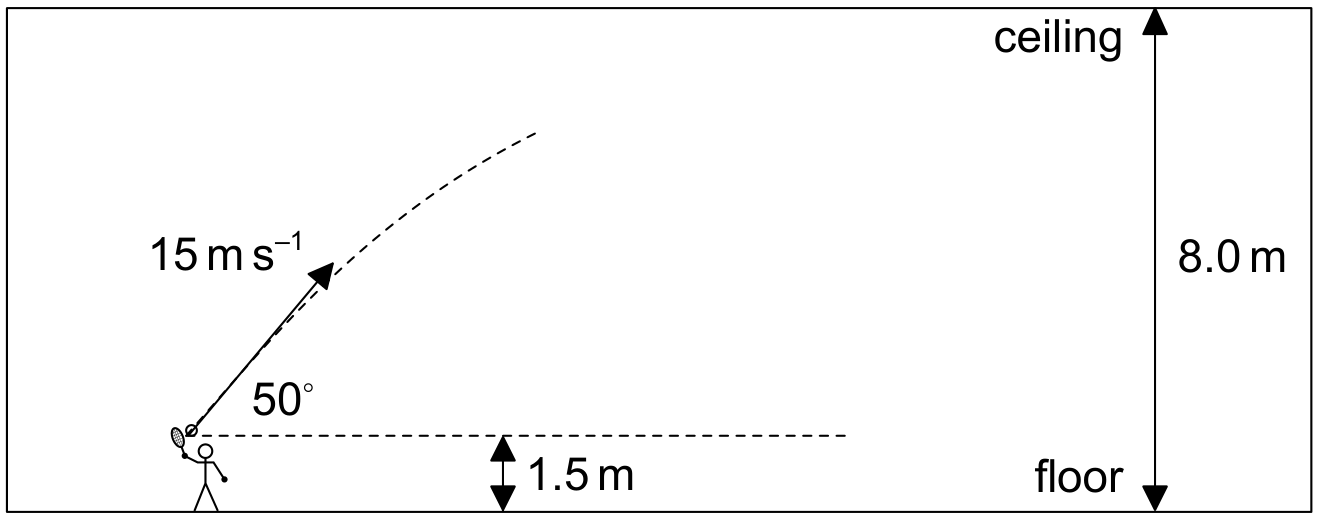
A tennis ball is hit with a racket from a point 1.5 m above the floor. The ceiling is 8.0 m above the floor. The initial velocity of the ball is 15 m s115 \mathrm{~m} \mathrm{~s}^{-1} at 5050^{\circ} above the horizontal. Assume that air resistance is negligible.

Question image
(a)

The tennis ball was stationary before being hit. It has a mass of 5.8×10² kg5.8 \times 10^{-2} \mathrm{~kg} and was in contact with the racket for 23 ms .

[ 3 ]
(i)

Calculate the mean force exerted by the racket on the ball.

[ 1 ]
(ii)

Explain how Newton's third law applies when the racket hits the tennis ball.

[ 2 ]
[Maximum number: 5]

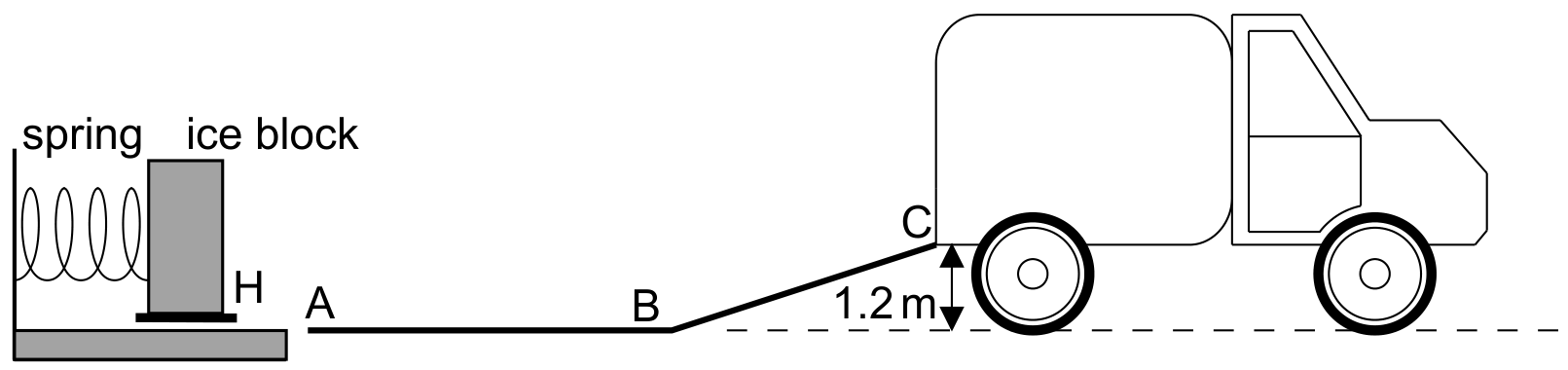
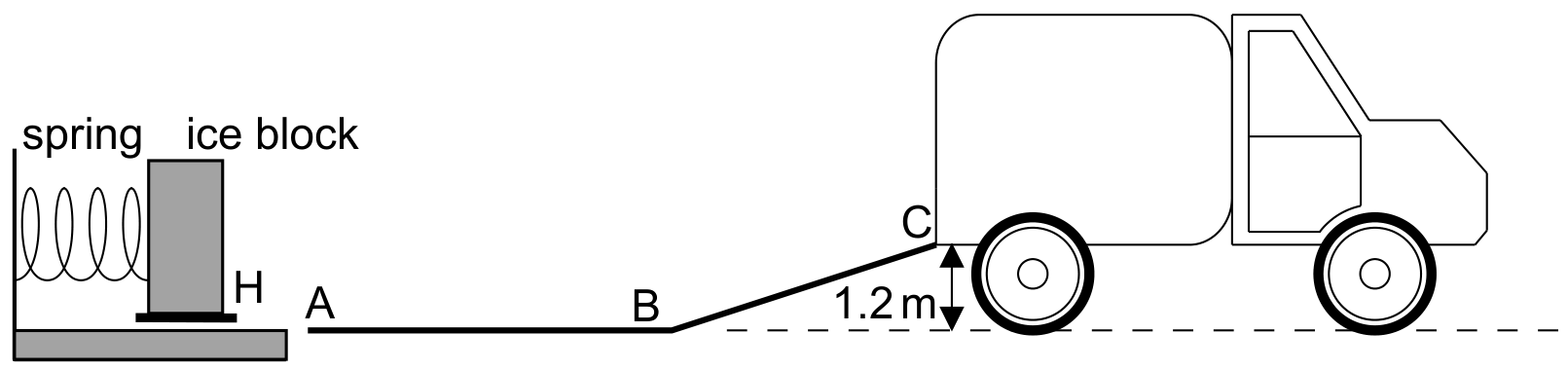
A company designs a spring system for loading ice blocks onto a truck. The ice block is placed in a holder H in front of the spring and an electric motor compresses the spring by pushing H to the left. When the spring is released the ice block is accelerated towards a ramp ABC . When the spring is fully decompressed, the ice block loses contact with the spring at A . The mass of the ice block is 55 kg .

Question image

Assume that the surface of the ramp is frictionless and that the masses of the spring and the holder are negligible compared to the mass of the ice block.

(a)

Describe the motion of the block

[ 3 ]
(i)

from A to B with reference to Newton's first law.

[ 1 ]
(ii)

from B to C with reference to Newton's second law.

[ 2 ]
(b)

The spring decompression takes 0.42 s . Determine the average force that the spring exerts on the block.

[ 2 ]
[Maximum number: 7]

A company designs a spring system for loading ice blocks onto a truck. The ice block is placed in a holder H in front of the spring and an electric motor compresses the spring by pushing H to the left. When the spring is released the ice block is accelerated towards a ramp ABC . When the spring is fully decompressed, the ice block loses contact with the spring at A . The mass of the ice block is 55 kg .

Question image

Assume that the surface of the ramp is frictionless and that the masses of the spring and the holder are negligible compared to the mass of the ice block.

(a)

Describe the motion of the block

[ 3 ]
(i)

from A to B with reference to Newton's first law.

[ 1 ]
(ii)

from B to C with reference to Newton's second law.

[ 2 ]
(b)

The spring decompression takes 0.42 s . Determine the average force that the spring exerts on the block.

[ 2 ]
(c)

On a particular day, the ice blocks experience a frictional force because the section of the ramp from A to B is not cleaned properly. The coefficient of dynamic friction between the ice blocks and the ramp A B is 0.030 . The length of A B is 2.0 m .

Determine whether the ice blocks will be able to reach C .

[ 2 ]
[Maximum number: 9]

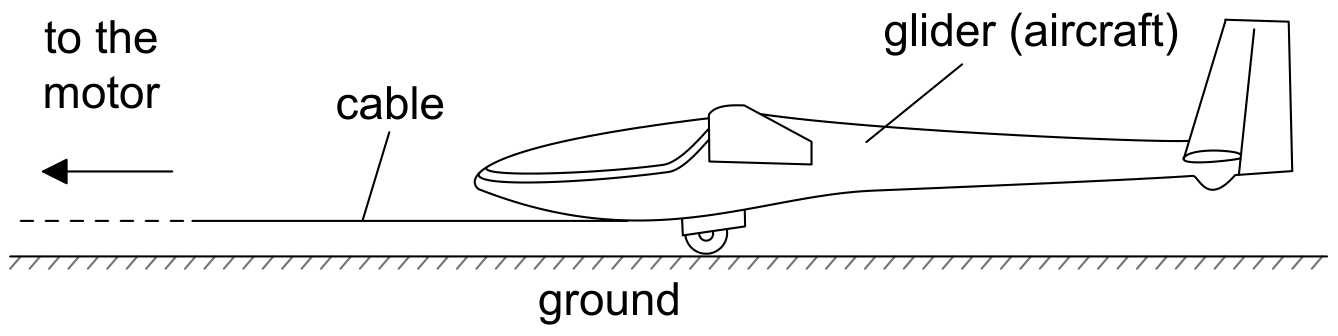
A glider is an aircraft with no engine. To be launched, a glider is uniformly accelerated from rest by a cable pulled by a motor that exerts a horizontal force on the glider throughout the launch.

Question image
(a)

The glider and pilot have a total mass of 492 kg . During the acceleration the glider is subject to an average resistive force of 160 N . Determine the average tension in the cable as the glider accelerates.

[ 3 ]
(b)

The cable is wound onto a cylinder of diameter 1.2 m . Calculate the angular velocity of the cylinder at the instant when the glider has a speed of 27 m s127 \mathrm{~m} \mathrm{~s}^{-1}. Include an appropriate unit for your answer.

[ 2 ]
(c)

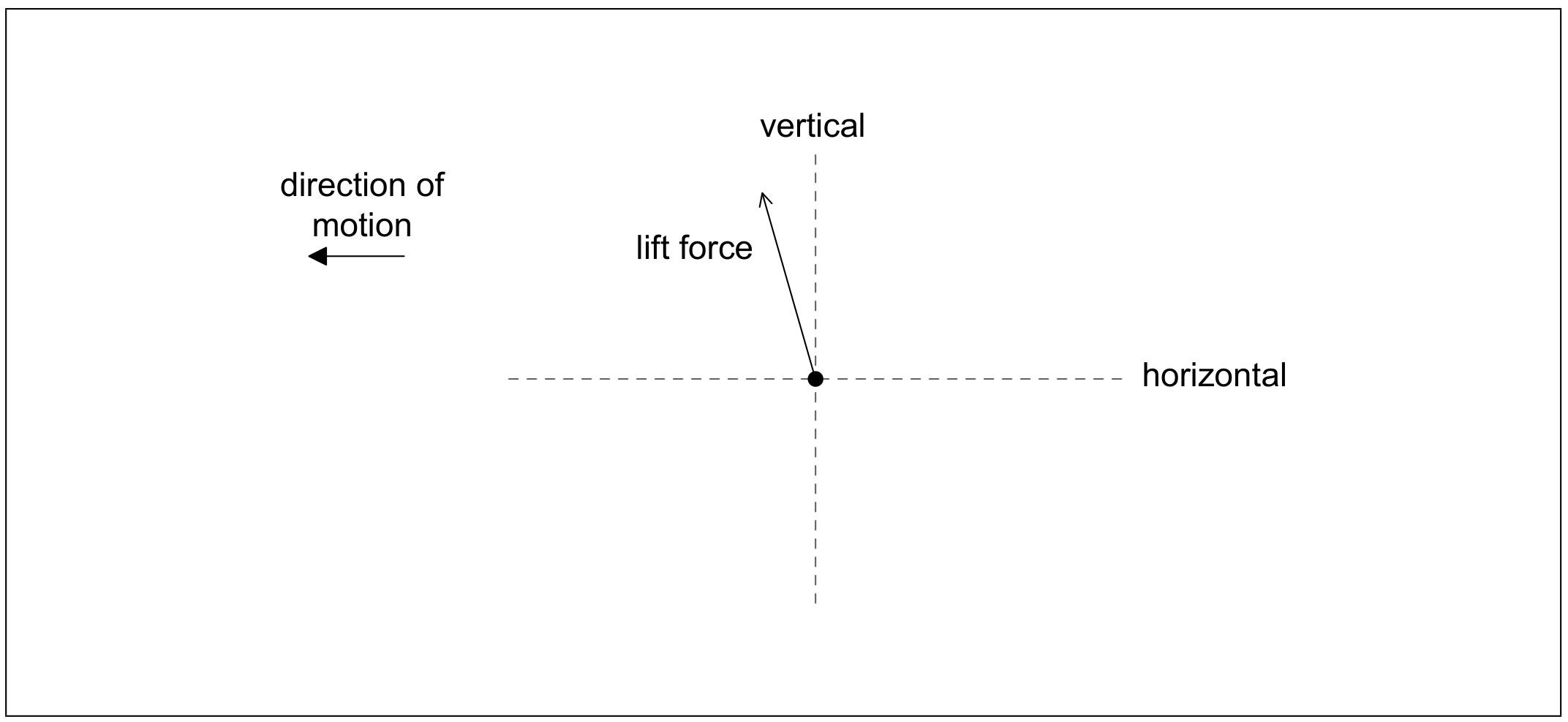
After takeoff the cable is released and the unpowered glider moves horizontally at constant speed. The wings of the glider provide a lift force. The diagram shows the lift force acting on the glider and the direction of motion of the glider.

Question image

Draw the forces acting on the glider to complete the free-body diagram. The dotted lines show the horizontal and vertical directions.

[ 2 ]
(d)

Explain, using appropriate laws of motion, how the forces acting on the glider maintain it in level flight.

[ 2 ]
[Maximum number: 12]

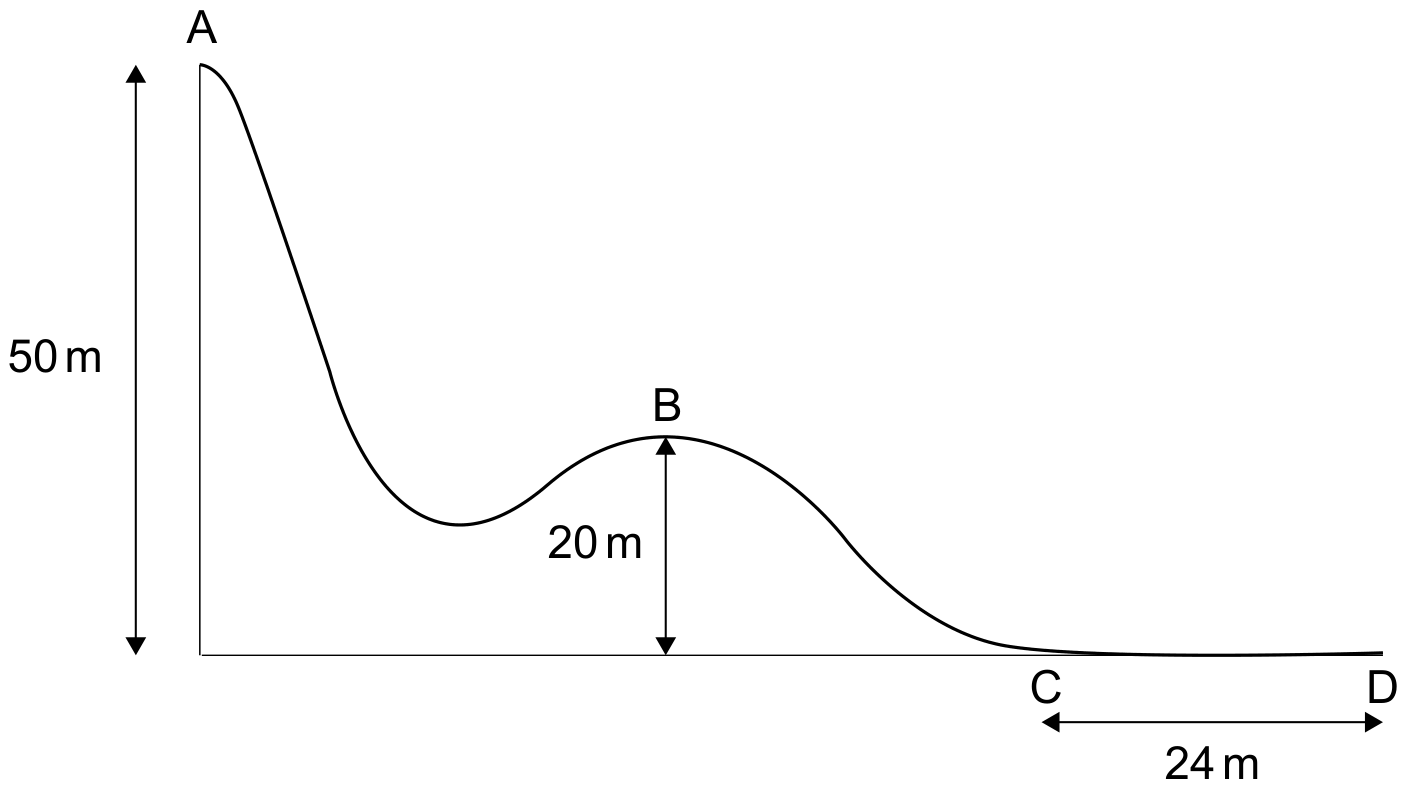
The diagram below shows part of a downhill ski course which starts at point A,50 m\mathrm{A}, 50 \mathrm{~m} above level ground. Point B is 20 m above level ground.

Question image
(a)
(i)

The dot on the following diagram represents the skier as she passes point B . Draw and label the vertical forces acting on the skier.

Question image
[ 2 ]
(ii)

The hill at point B has a circular shape with a radius of 20 m . Determine whether the skier will lose contact with the ground at point B .

[ 3 ]
(b)

The skier reaches point C with a speed of 8.2 m s18.2 \mathrm{~m} \mathrm{~s}^{-1}. She stops after a distance of 24 m at point D .

Determine the coefficient of dynamic friction between the base of the skis and the snow. Assume that the frictional force is constant and that air resistance can be neglected.

[ 3 ]
(c)

At the side of the course flexible safety nets are used. Another skier of mass 76 kg falls normally into the safety net with speed 9.6 ms19.6 \mathrm{~ms}^{-1}.

[ 4 ]
(i)

Calculate the impulse required from the net to stop the skier and state an appropriate unit for your answer.

[ 2 ]
(ii)

Explain, with reference to change in momentum, why a flexible safety net is less likely to harm the skier than a rigid barrier.

[ 2 ]
0