[Maximum number: 1]
A proton has momentum and the uncertainty in the position of the proton is . What is the minimum fractional uncertainty in the momentum of this proton?
A
B
C
D
 EduNinja
A proton has momentum and the uncertainty in the position of the proton is . What is the minimum fractional uncertainty in the momentum of this proton?
B1. This question is about the photoelectric effect.
(a) Describe the concept of a photon.
(b) In the photoelectric effect there exists a threshold frequency below which no emission of photoelectrons takes place.
Outline how the
(i) wave theory of light is unable to account for this observation.
(ii) concepts of the photon and work function are able to account for this observation.
(c) Light of wavelength 420 nm is incident on a clean metal surface. The work function of the metal is 2.0 eV .
Determine the
(i) threshold frequency for this metal.
(ii) maximum kinetic energy in eV of the emitted electrons.
B2. This question is about the photoelectric effect.
The diagram shows apparatus used to investigate the photoelectric effect.
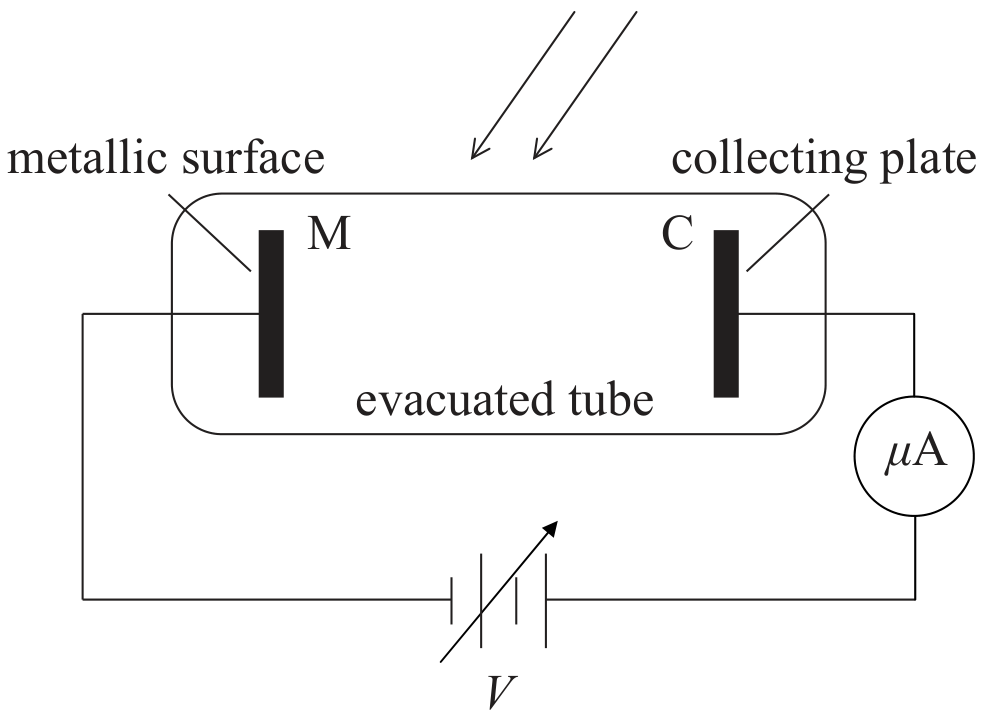
(a) When red light is incident on the metallic surface M the microammeter registers a current. Explain how a current is established in this circuit even though nothing joins M to C inside the tube.
(b) The graph shows the variation with voltage V of the current I in the circuit.
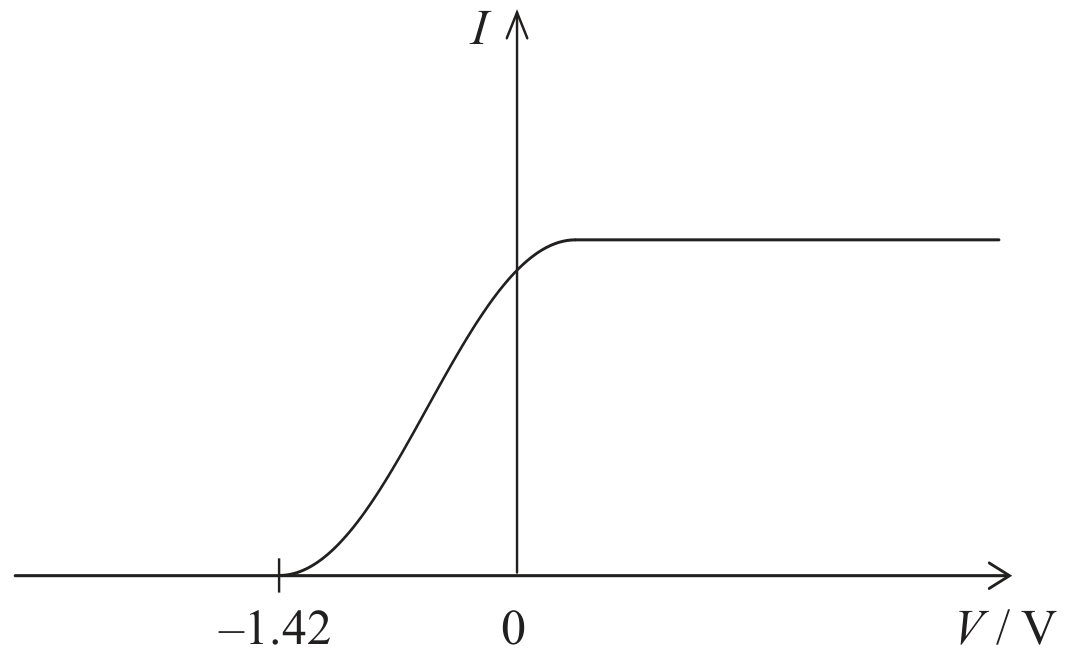
The work function of the metallic surface M is 0.48 eV .
(i) Define work function.
(ii) State the maximum kinetic energy of an electron immediately after it has been emitted from M.
(iii) Calculate the energy of a photon incident on M .
(iv) The red light incident on M is now replaced by blue light. The number of photons incident on M per second is the same as in (b).
On the axes opposite, sketch a graph to show the variation with V of the current I.
er
B3. This question is about electron diffraction.
(a) A beam of electrons is accelerated from rest by a potential difference of 750 V . Calculate the de Broglie wavelength of the accelerated electrons.
(b) The beam of electrons is incident on crystalline material. The diagram shows the electron intensity pattern after scattering from the material.

(i) State the reason why it is necessary for the material to be crystalline.
(ii) Dark regions denote large numbers of incident electrons. Describe how the diagram opposite provides evidence for the wave nature of electrons.
An electron has a linear momentum of . What is the order of magnitude of the kinetic energy of the electron?
A beam of electrons each of de Broglie wavelength is incident on a thin film of silicon-30 . The variation in the electron intensity of the beam with scattering angle is shown.
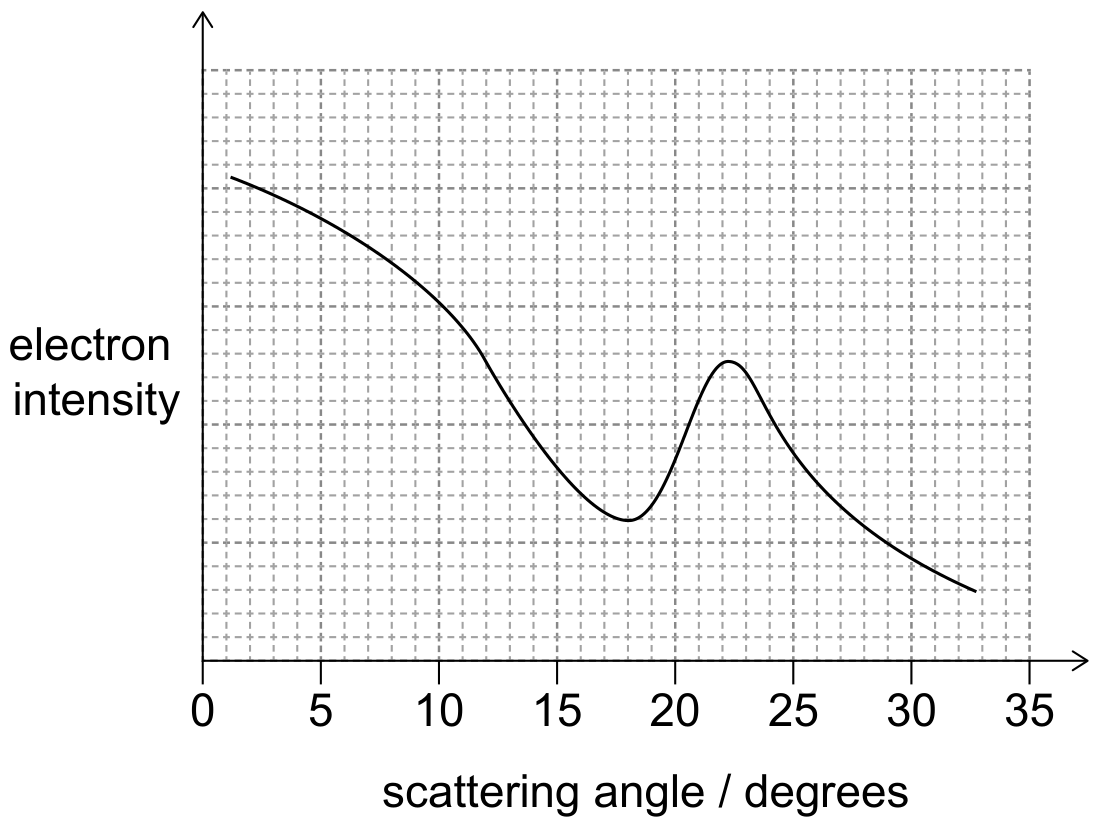
Suggest one reason why a beam of electrons is better for investigating the size of a nucleus than a beam of alpha particles of the same energy.
This question is about the photoelectric effect.
Monochromatic light of different frequencies is incident on a metal surface placed in a vacuum. As the frequency is increased a value is reached at which electrons are emitted from the surface. Below this frequency, no matter how intense the light, no electrons are emitted. Outline how the
wave theory of light is unable to account for these observations.
Einstein model of the photoelectric effect is able to account for these observations.
The graph shows how the maximum kinetic energy of the ejected electrons in (a) varies with the frequency f of the incident light.
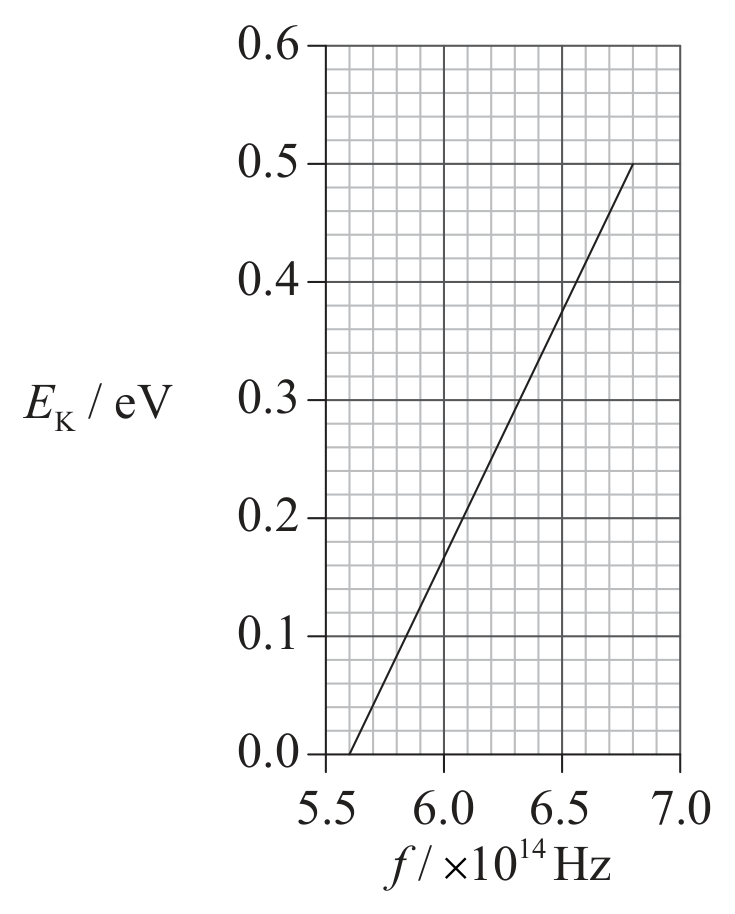
Use the graph to determine the
Planck constant.
work function of the metal.
Show that electrons of energy 0.50 eV have a de Broglie wavelength of about .
This question is about the photoelectric effect.
When light is incident on a clean metal surface, electrons can be emitted through the photoelectric effect.
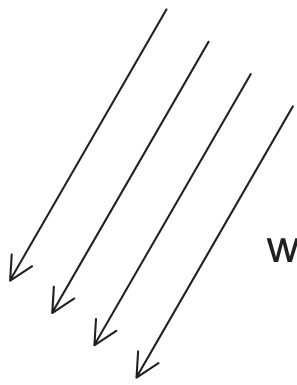
wavelength metal surface
Outline how the Einstein model is used to explain the photoelectric effect.
State why, although the incident light is monochromatic, the energies of the emitted electrons vary.
Explain why no electrons are emitted if the frequency of the incident light is less than a certain value, no matter how intense the light.
For monochromatic light of wavelength 620 nm a stopping potential of 1.75 V is required. Determine the minimum energy required to emit an electron from the metal surface.
This question is about polarization.
Outline how polarization may be used in stress analysis.
This question is about atomic energy levels.
Outline how the de Broglie hypothesis explains the existence of a discrete set of wavefunctions for electrons confined in a box of length L.
The diagram below shows the shape of two allowed wavefunctions and for an electron confined in a one-dimensional box of length L.
> amplitude of wave function
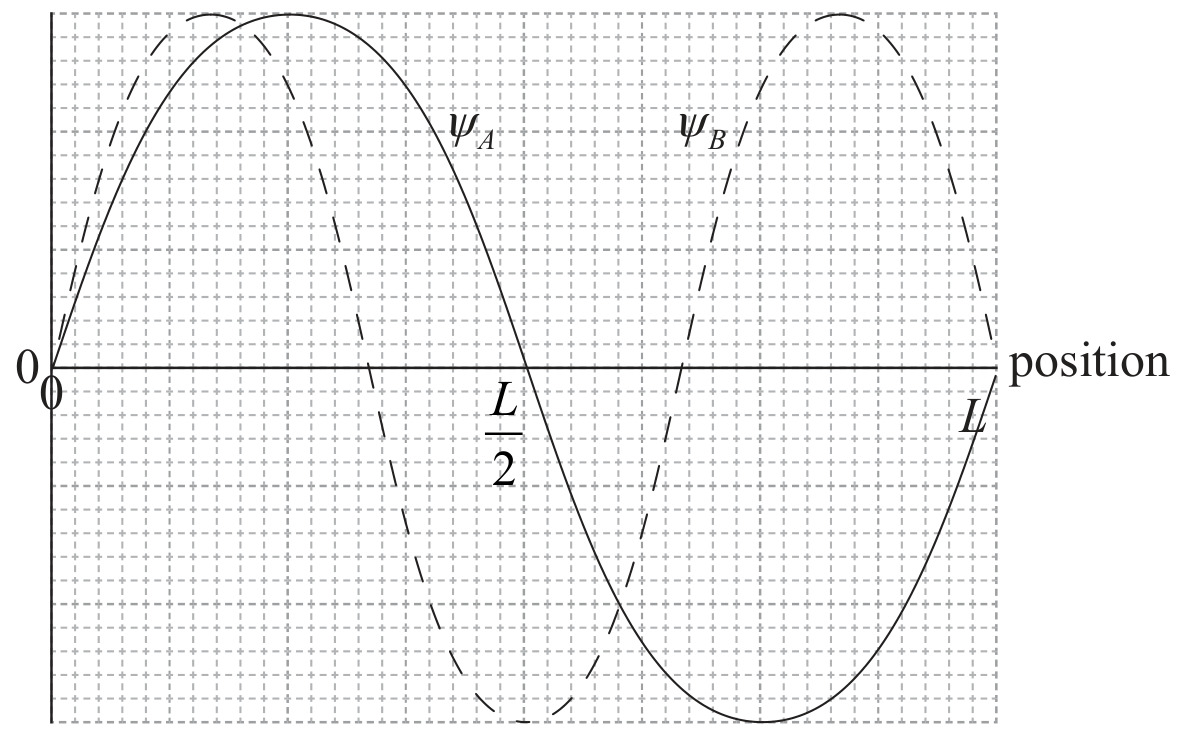
With reference to the de Broglie hypothesis, suggest which wavefunction corresponds to the larger electron energy.
Predict and explain which wavefunction indicates a larger probability of finding the electron near the position in the box.
On the graph in (c) on page 7 , sketch a possible wavefunction for the lowest energy state of the electron.
This question is about the wave nature of matter.
Describe wave-particle duality in relation to the de Broglie hypothesis.
In 1927 Davisson and Germer tested the de Broglie hypothesis. They directed a beam of electrons onto a nickel crystal as shown in the diagram. The experiment was carried out in a vacuum.
nickel crystal
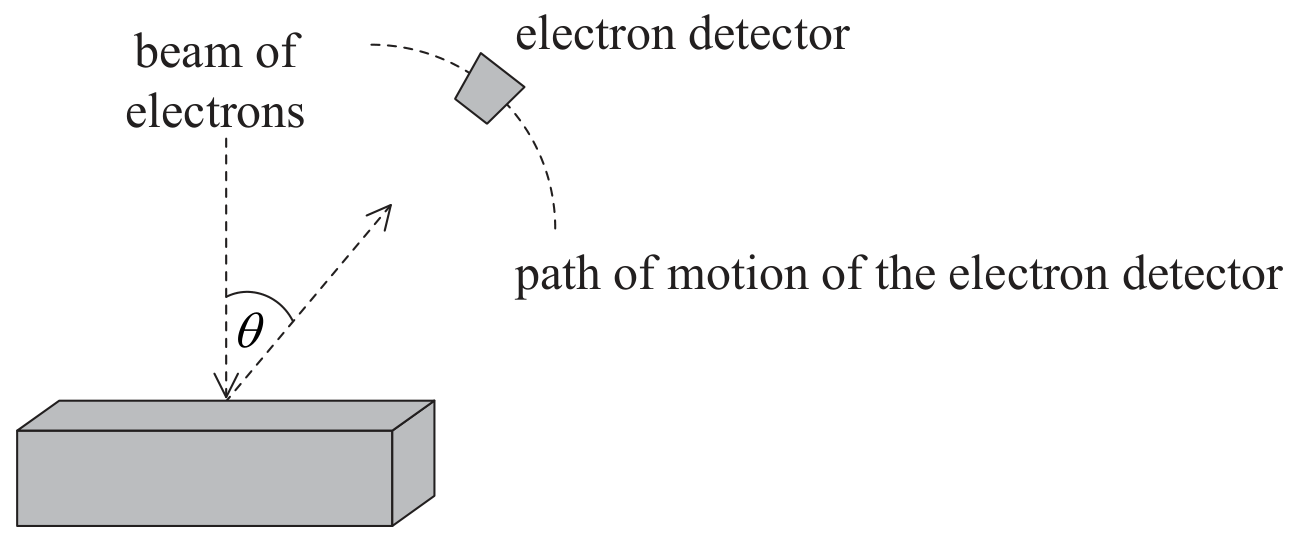
The electrons were accelerated through a potential difference of 54 V . Show that the associated de Broglie wavelength for the electrons is about .
The electron detector recorded a large number of electrons at a particular scattering angle . Explain why a maximum in the number of scattered electrons is observed at a particular angle.