EduNinja
[Maximum number: 8]

This question is about diffraction and resolution.

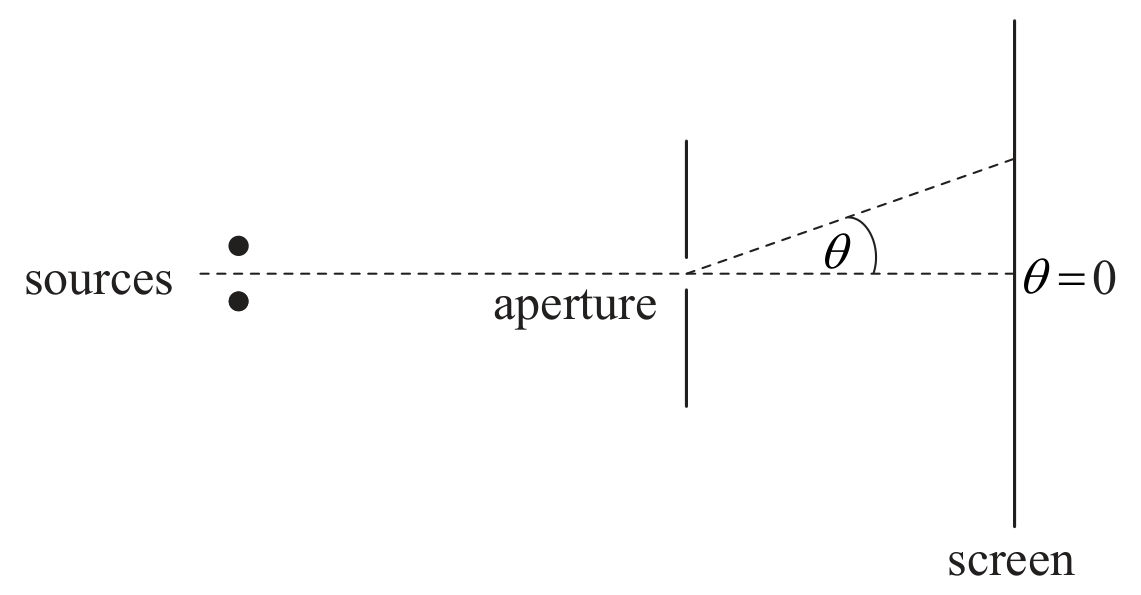
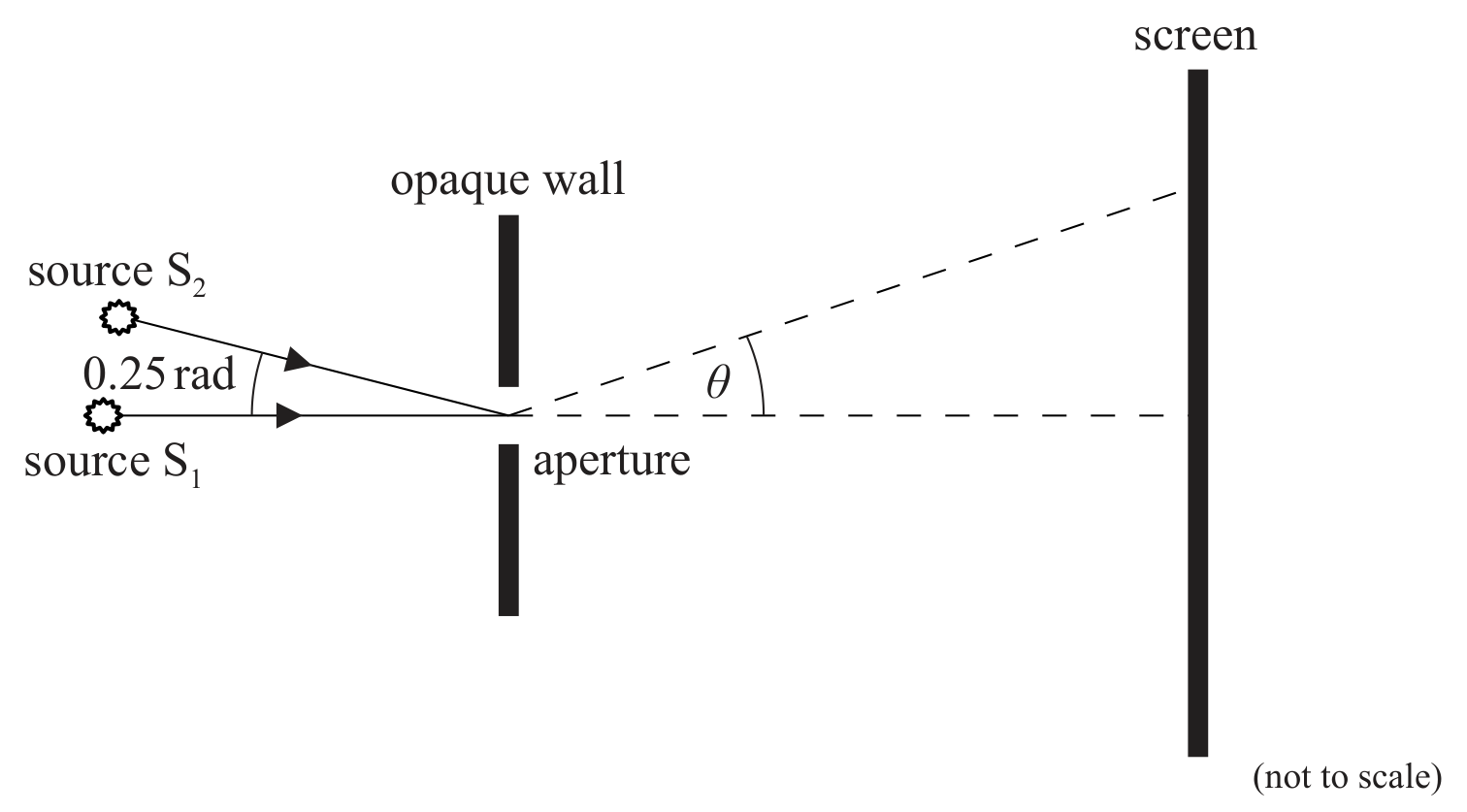
Two identical sources of electromagnetic radiation, S1\mathrm{S}_{1} and S2\mathrm{S}_{2}, emit monochromatic coherent waves of wavelength 59μ m59 \mu \mathrm{~m}. The waves pass through a circular aperture and are incident on a screen.
Question image

S1\mathrm{S}_{1} and S2\mathrm{S}_{2} are at the same distance from the aperture. The diameter of the aperture is 0.18 mm . The angle between the lines joining the sources to the aperture is 0.25 rad .

(a)

S1\quad \mathrm{S}_{1} is turned on and S2\mathrm{S}_{2} is turned off.

[ 4 ]
(i)

Show that the angle at which the first minimum of the diffraction pattern occurs is 0.40 rad .

[ 1 ]
(ii)

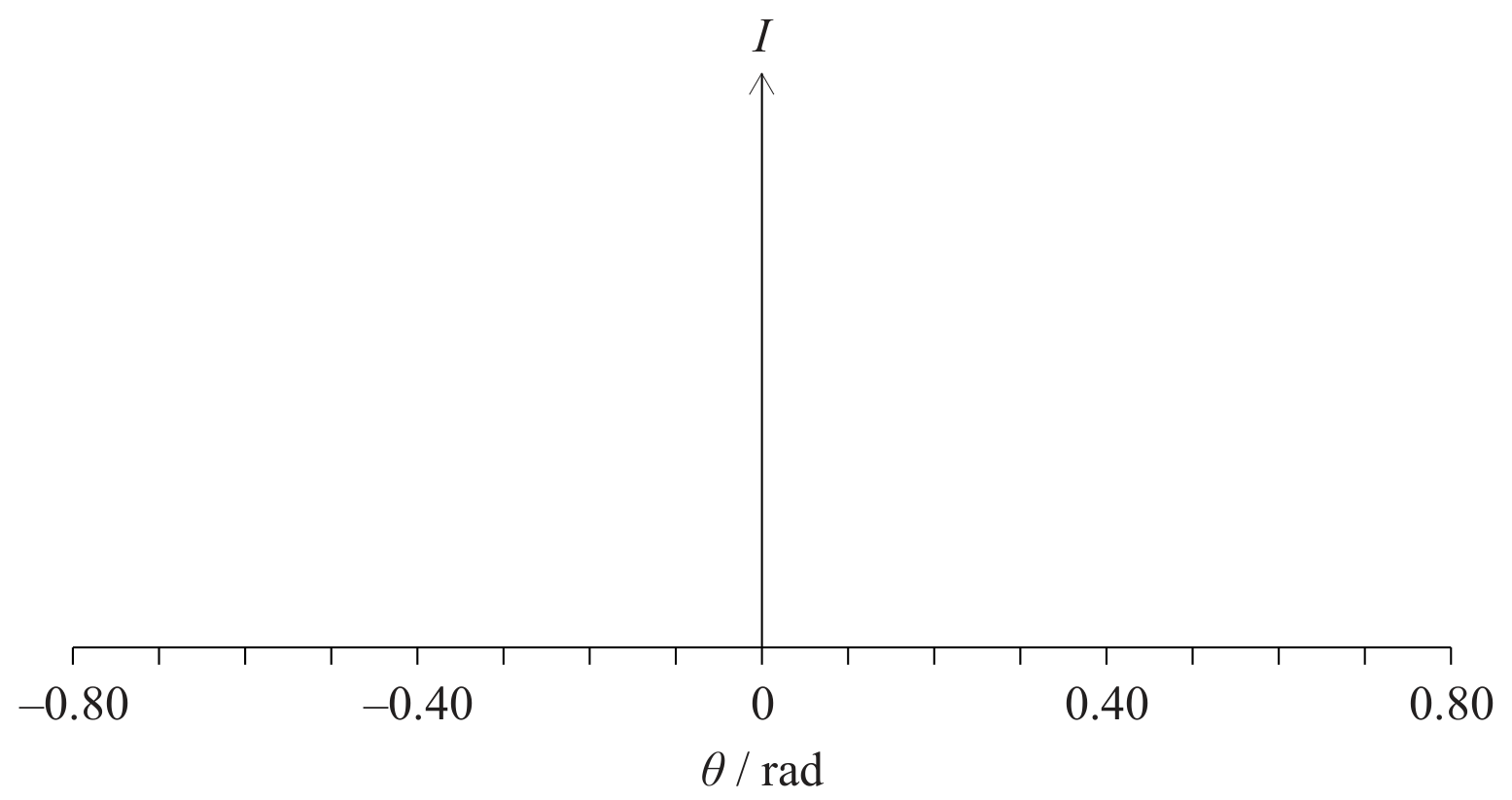
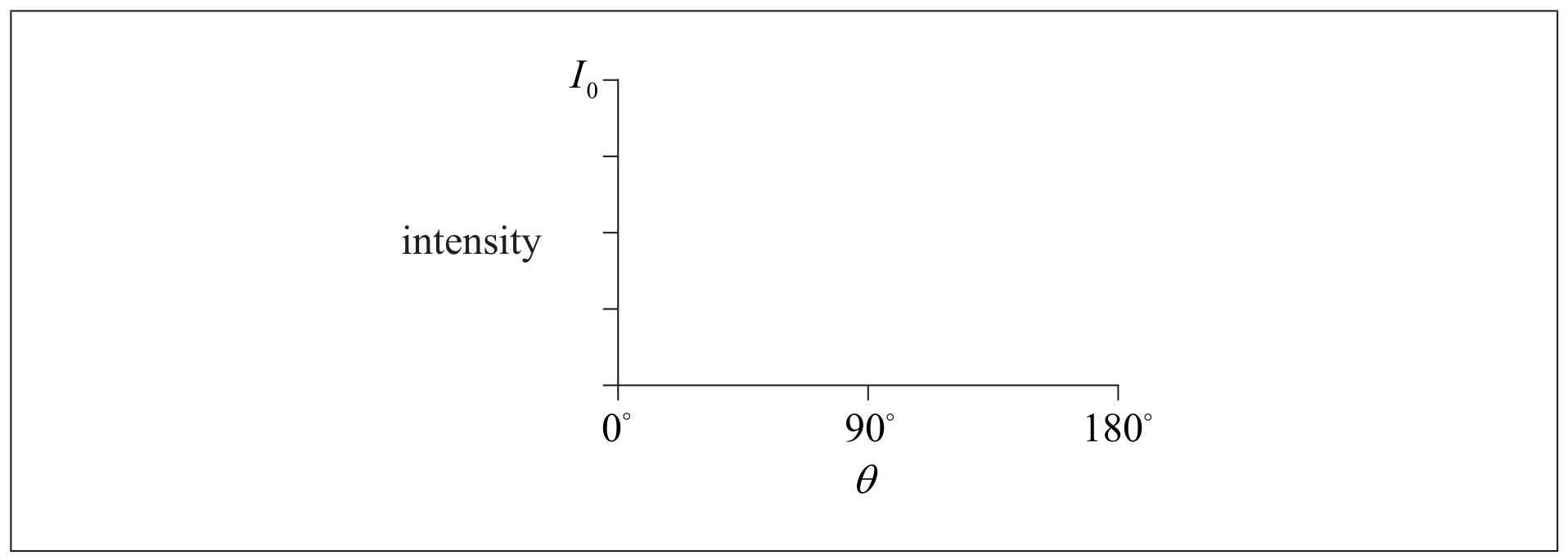
On the axes below, sketch a graph to show how the intensity I of the radiation from S1\mathrm{S}_{1} varies with the diffraction angle θ\theta.

Question image
[ 3 ]
(b)

S1\mathrm{S}_{1} is turned off and S2\mathrm{S}_{2} is turned on. On the same set of axes in (a)(ii), sketch the intensity of the light emitted by source S2S_{2} reaching the screen.

[ 1 ]
(c)

S1\quad \mathrm{S}_{1} and S2\mathrm{S}_{2} are both turned on.

[ 3 ]
(i)

State the Rayleigh criterion for the images of two sources to be just resolved.

[ 1 ]
(ii)

State and explain whether the images of the two sources, S1\mathrm{S}_{1} and S2\mathrm{S}_{2}, are resolved.

[ 2 ]
[Maximum number: 3]

This question is about the eye and its resolution.

A house on a hillside is viewed at night by a human eye.

(a)

The eye viewing the house has a pupil of diameter 2.5 mm . Two lamps on the wall of the house are separated by a horizontal distance of 1.5 m and produce light of average wavelength 450 nm . The eye can just resolve the images of the two lamps. Determine the distance between the house and the eye.

[ 3 ]
[Maximum number: 4]

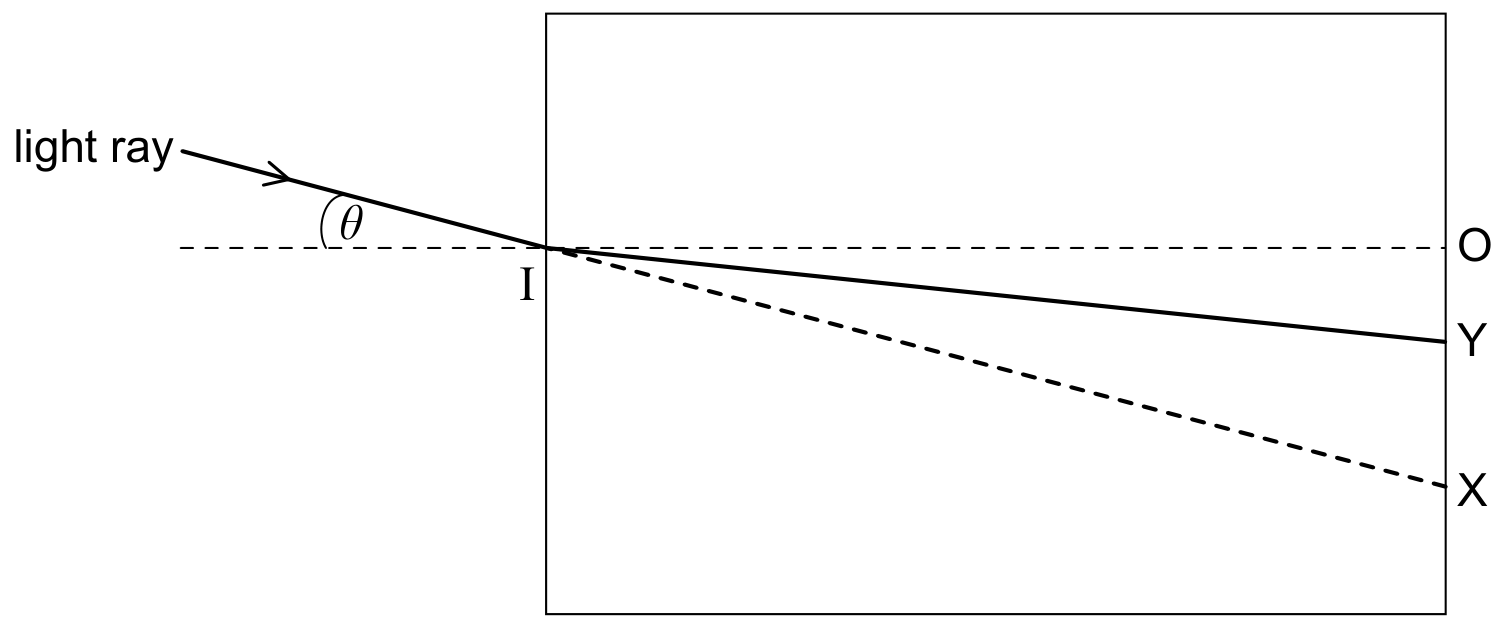
A student measures the refractive index of water by shining a light ray into a transparent container.

IO shows the direction of the normal at the point where the light is incident on the container. IX shows the direction of the light ray when the container is empty. IY shows the direction of the deviated light ray when the container is filled with water.

The angle of incidence θ\theta is varied and the student determines the position of O, X and Y for each angle of incidence.

Question image

(top view)

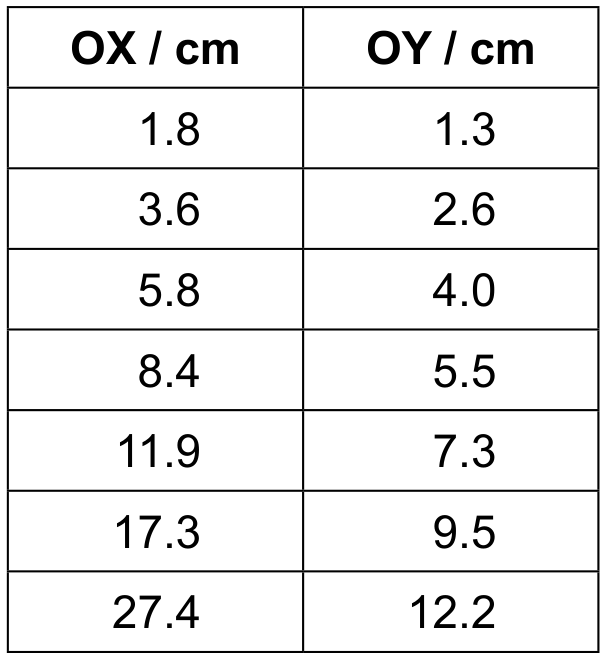
The table shows the data collected by the student. The uncertainty in each measurement of length is ±0.1 cm\pm 0.1 \mathrm{~cm}.

Table
(a)

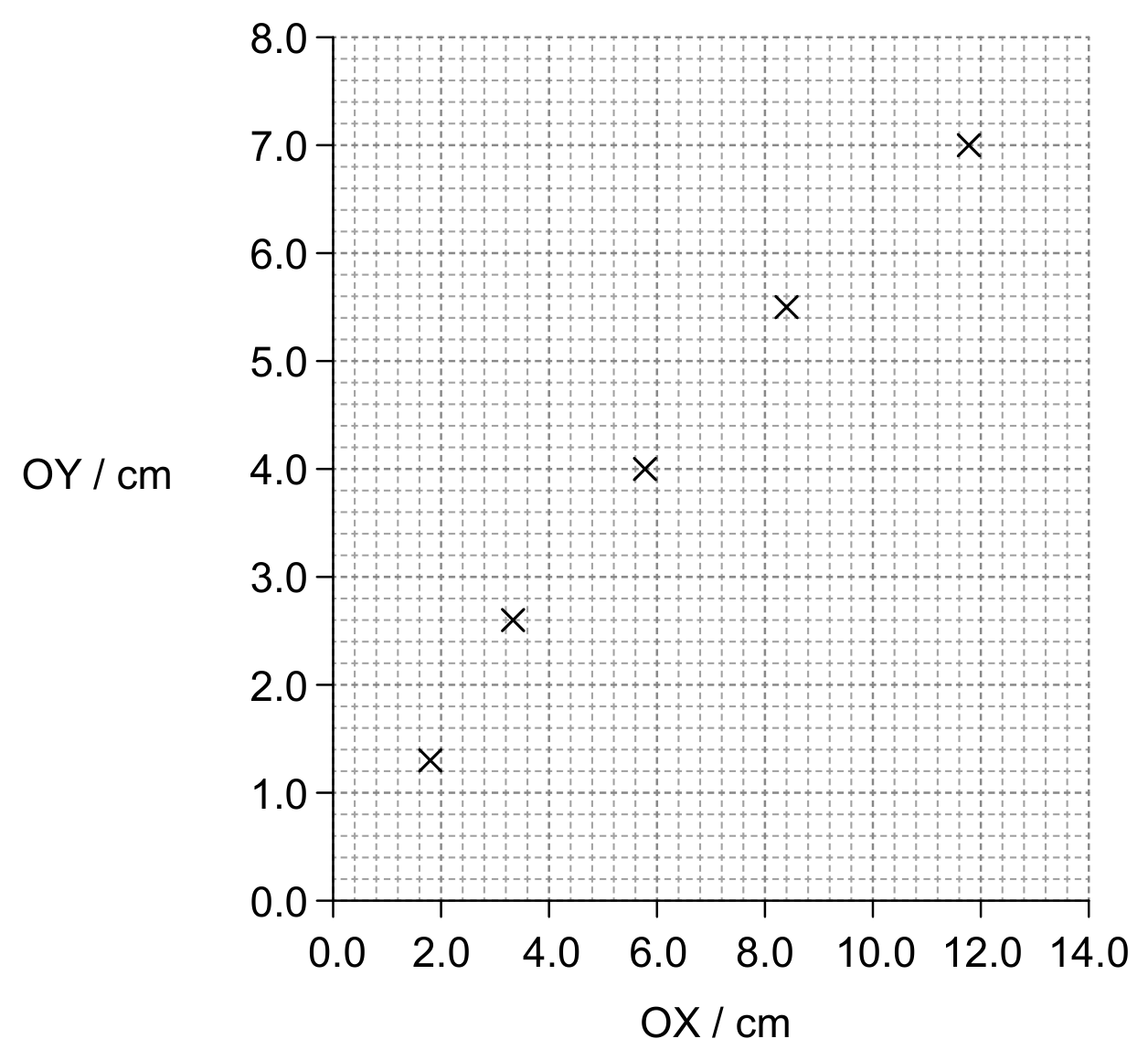
A graph of the variation of OY with OX is plotted.

Question image
[ 4 ]
(i)

Determine, using the graph, the refractive index of the water in the container for values of OX less than 6.0 cm .

[ 3 ]
(ii)

The refractive index for a material is also given by sinisinr\frac{\sin i}{\sin r} where i is the angle of incidence and r is the angle of refraction.

Outline why the graph on page 4 deviates from a straight line for large values of OX.

[ 1 ]
[Maximum number: 1]

Light of wavelength 400 nm is incident on two slits separated by 1000μ m1000 \mu \mathrm{~m}. The interference pattern from the slits is observed from a satellite orbiting 0.4 Mm above the Earth. The distance between interference maxima as detected at the satellite is

A

0.16 Mm.

B

0.16 km0.16 \mathrm{~km}.

C

0.16 m0.16 \mathrm{~m}.

D

0.16 mm0.16 \mathrm{~mm}.

[Maximum number: 3]

A3. This question is about resolution.

Light from two monochromatic point sources passes through a circular aperture and is observed on a screen.

Question image

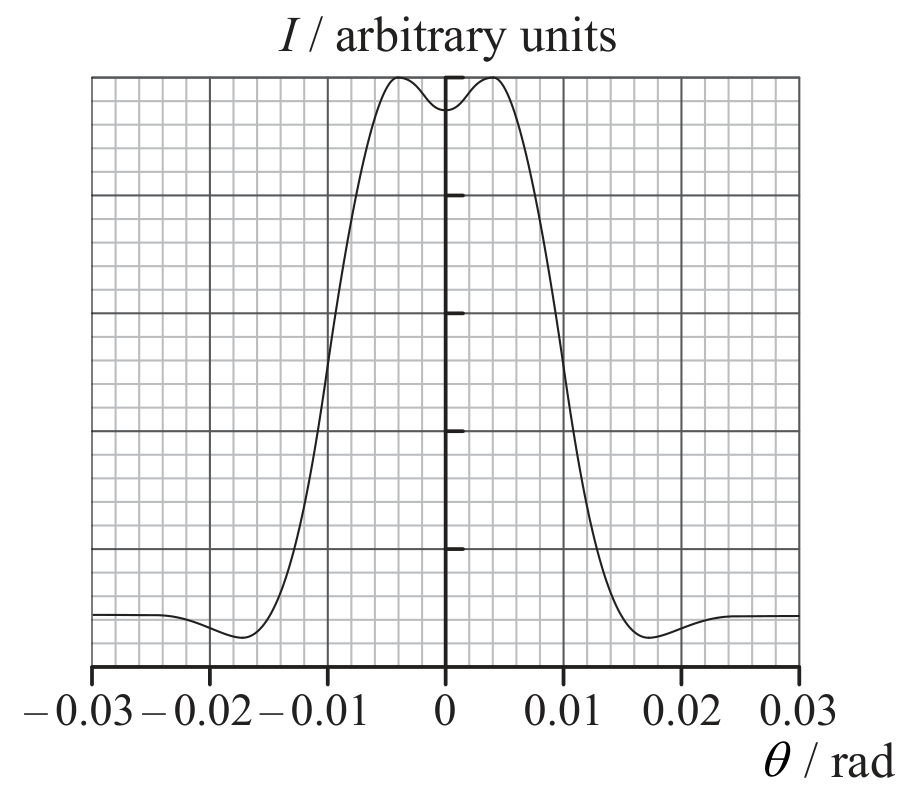
The graph shows how the intensity I of the light on the screen varies with the angle θ\theta.

Question image

The two sources are just resolved according to the Rayleigh criterion.
(a) State what is meant by resolved in this context.
(b) The wavelength of the light from the two sources is 528 nm . The distance of the two sources from the aperture is 1.60 m .

Using data from the graph opposite, determine the
(i) separation of the two sources.
(ii) diameter of the aperture.

[Maximum number: 3]

A4. This question is about polarization.
(a) State what is meant by polarized light.
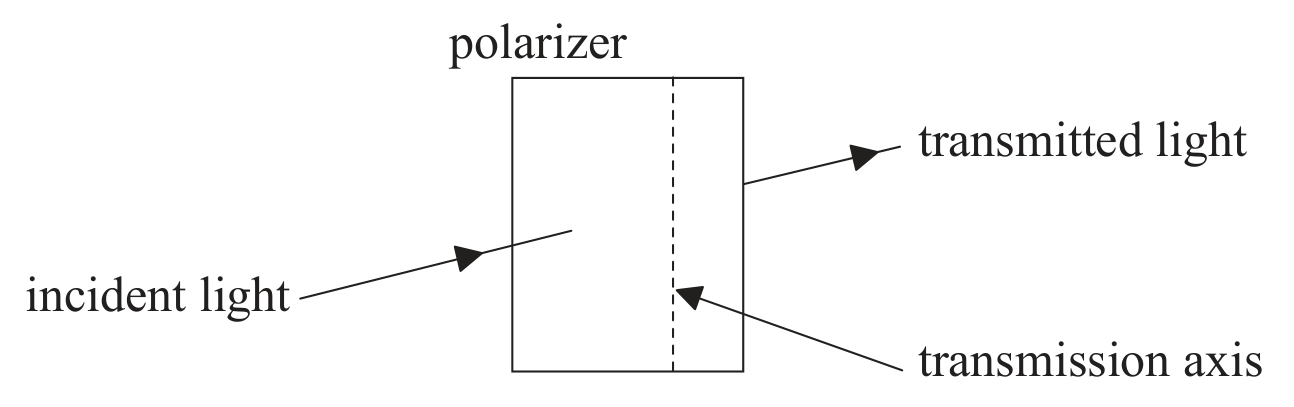
(b) Light of intensity I0I_{0} is incident on a polarizer. The transmission axis of the polarizer is vertical. The polarizer is rotated by an angle θ\theta about the direction of the incident light. The intensity of the transmitted light is measured for various angles θ\theta.

Question image

On the axes below, sketch graphs to show the variation of the transmitted intensity I with θ\theta when the incident light is
(i) horizontally polarized.

Table
[Maximum number: 5]

This question is about polarization.
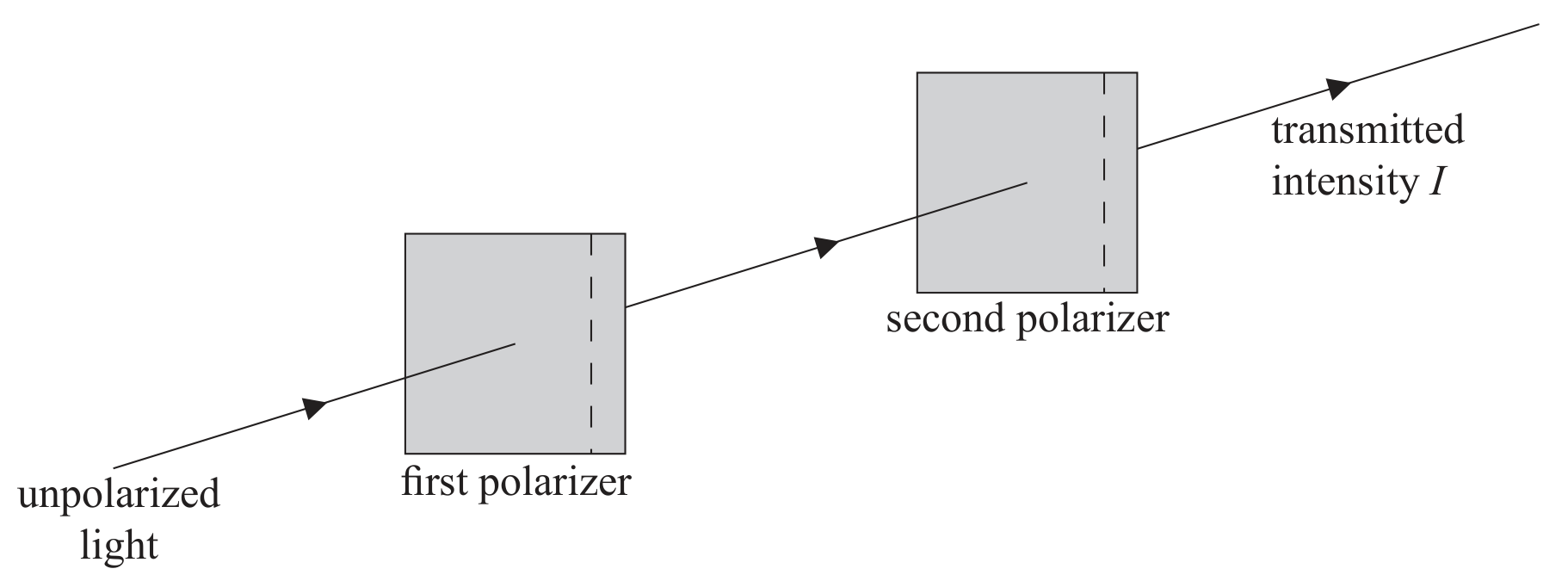
Unpolarized light is directed towards two polarizers. The dashed lines represent the transmission axes of the polarizers. The angle θ\theta between the transmission axes of the polarizers is initially 00^{\circ}.

Question image

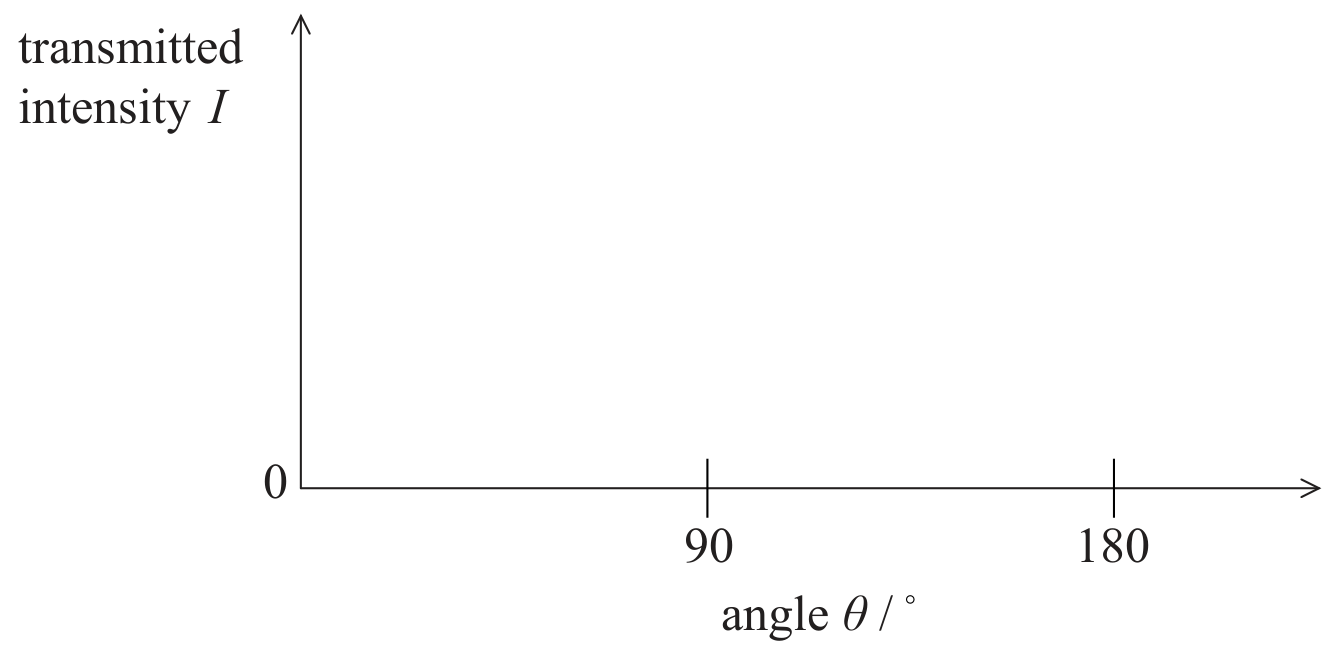
(a) On the axes below, sketch a graph to show how the intensity I of the light emerging from the second polarizer varies with θ\theta.

Question image

(b) Outline how two polarizers can be used to compare the concentrations of different sugar solutions.

[Maximum number: 4]

This question is about radio telescopes.
A distant galaxy emits radio waves of frequency 6.0×10⁹ Hz6.0 \times 10^{9} \mathrm{~Hz} and is moving with speed 6.0×10⁶ m s16.0 \times 10^{6} \mathrm{~m} \mathrm{~s}^{-1} directly away from an observer on Earth.

(a)

The radio signals from two stars on opposite sides of the galaxy are detected on Earth using a radio telescope. The telescope has a circular receiving dish.

[ 4 ]
(i)

State the Rayleigh criterion for the images of two point sources to be just resolved.

[ 2 ]
(ii)

The galaxy is 2.0×10²¹ m2.0 \times 10^{21} \mathrm{~m} from Earth and the stars are separated by 5.0×10¹⁹ m5.0 \times 10^{19} \mathrm{~m}. Determine the minimum size of the telescope dish required to resolve the images of the two stars at a wavelength of 5.1×10² m5.1 \times 10^{-2} \mathrm{~m}.

[ 2 ]
[Maximum number: 1]

A student measures the refractive index of the glass of a microscope slide.

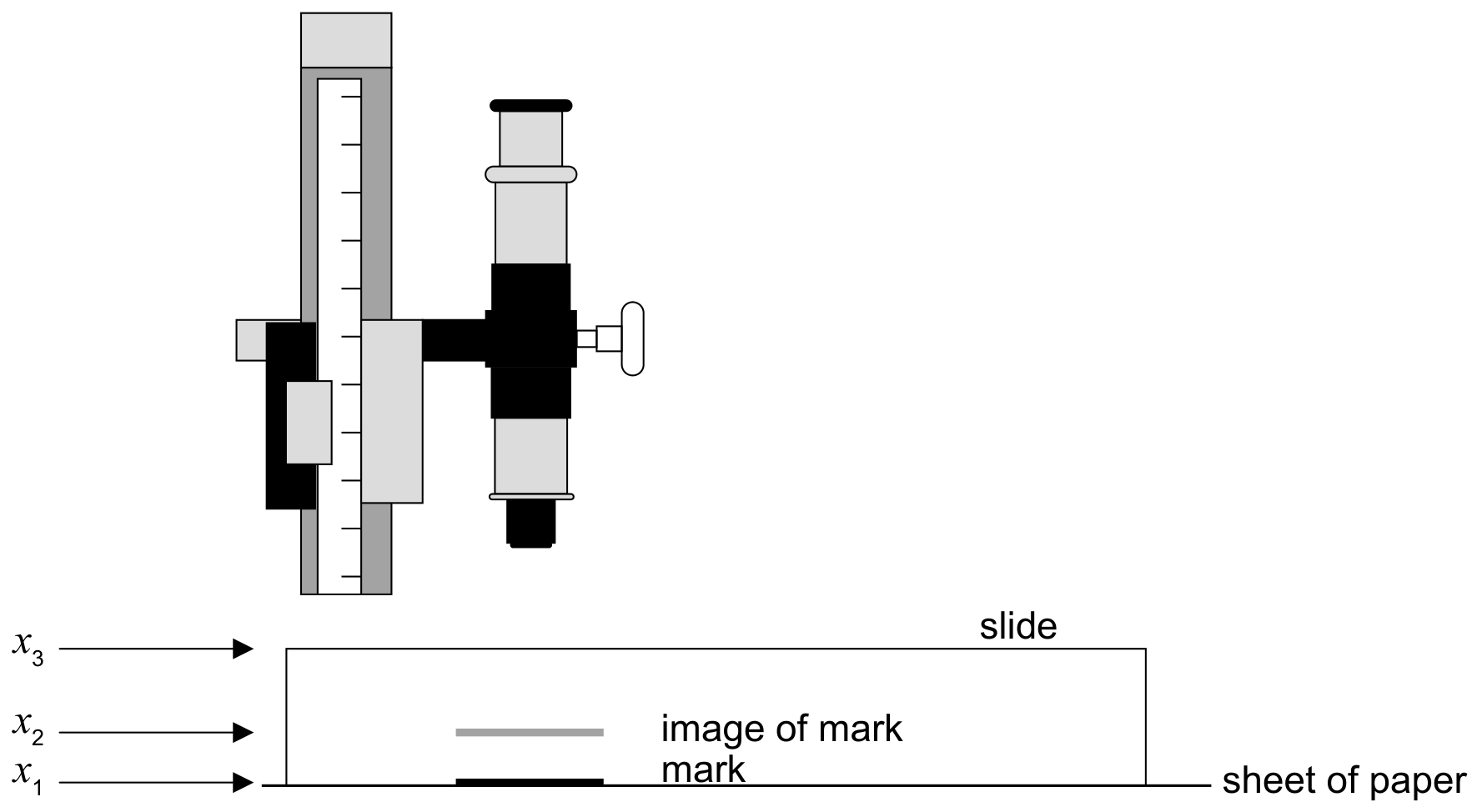
He uses a travelling microscope to determine the position x1x_{1} of a mark on a sheet of paper. He then places the slide over the mark and finds the position x2x_{2} of the image of the mark when viewed through the slide. Finally, he uses the microscope to determine the position x3x_{3} of the top of the slide.

Question image

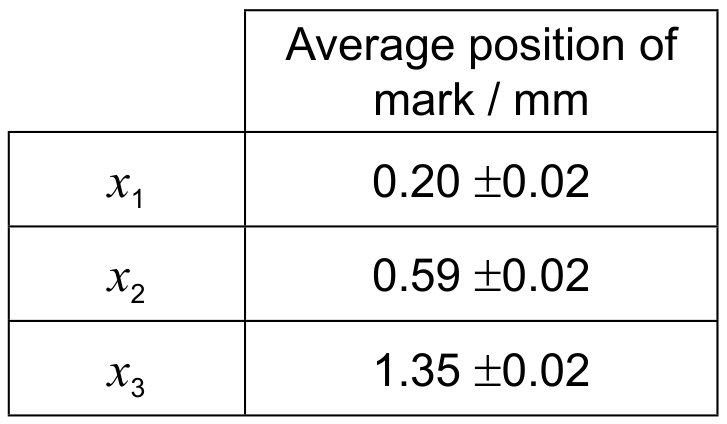
The table shows the average results of a large number of repeated measurements.

Table
(a)

The refractive index of the glass from which the slide is made is given by

x3x1x3x2.\frac{\frac{x_{3}-x_{1}}{x_{3}-x_{2}} .}{}

Determine

[ 1 ]
(i)

the refractive index of the glass to the correct number of significant figures, ignoring any uncertainty.

[ 1 ]
[Maximum number: 6]

C1. This question is about digital devices.
(a) Both a CD and a long playing record (LP) are used to store and reproduce musical sounds.

Outline the difference between these two methods of storing musical sounds.

CD:

LP:
(b) In a particular CD, the wavelength of the laser light used to retrieve the musical sounds stored is 720 nm .

Determine, explaining your answer, the depth d of a pit on the surface of the CD.
(c) A charge-coupled device (CCD), unlike an audio CD, stores optical images. The surface of a CCD is divided into small regions called pixels. Each pixel behaves like a capacitor with capacitance C.
(i) Define capacitance.
(ii) A pixel of a particular CCD has capacitance C=20 pF and a quantum efficiency of 80 %. The pixel is illuminated with light for a short period of time, such that the electric potential of the pixel changes by 0.18 mV .

Estimate the number of photons incident on the pixel in this time period.

0