C2.2.5—Synapses as junctions

Synapses are narrow junctions where neurotransmitters carry signals from presynaptic neurons to receptor-bearing postsynaptic membranes, linking cellular mechanisms to rapid communication in nervous systems.

Syllabus
First assessment 2025
Objective
C2.2.5
Level
SL

Exam analysis

Chance of appearing6%of analysed past papers
Latest appearanceNovember 2025
Most common paperPaper2
Typical marks1–7

Common command terms

  • Explain
  • Describe
  • State
  • Identify
  • Distinguish
  • Suggest

Recent exam appearances

November 2025Paper2 ["SL"] · TZ15(c)[ 1 ]C2.2.5—Synapses as junctions
November 2025Paper2 ["SL"] · TZ15(b)[ 2 ]C2.2.5—Synapses as junctions
November 2024Paper1 ["SL"] · TZ128[ 1 ]C2.2.5—Synapses as junctions
November 2022Paper2 ["SL"] · TZ05(a)[ 1 ]C2.2.5—Synapses as junctions
May 2022Paper2 ["SL"] · TZ15(d)[ 3 ]C2.2.5—Synapses as junctions

Coverage 2012–2025 · Updated 15 Jul 2026

A Chemical Synapse Has a Sender and a Receiver

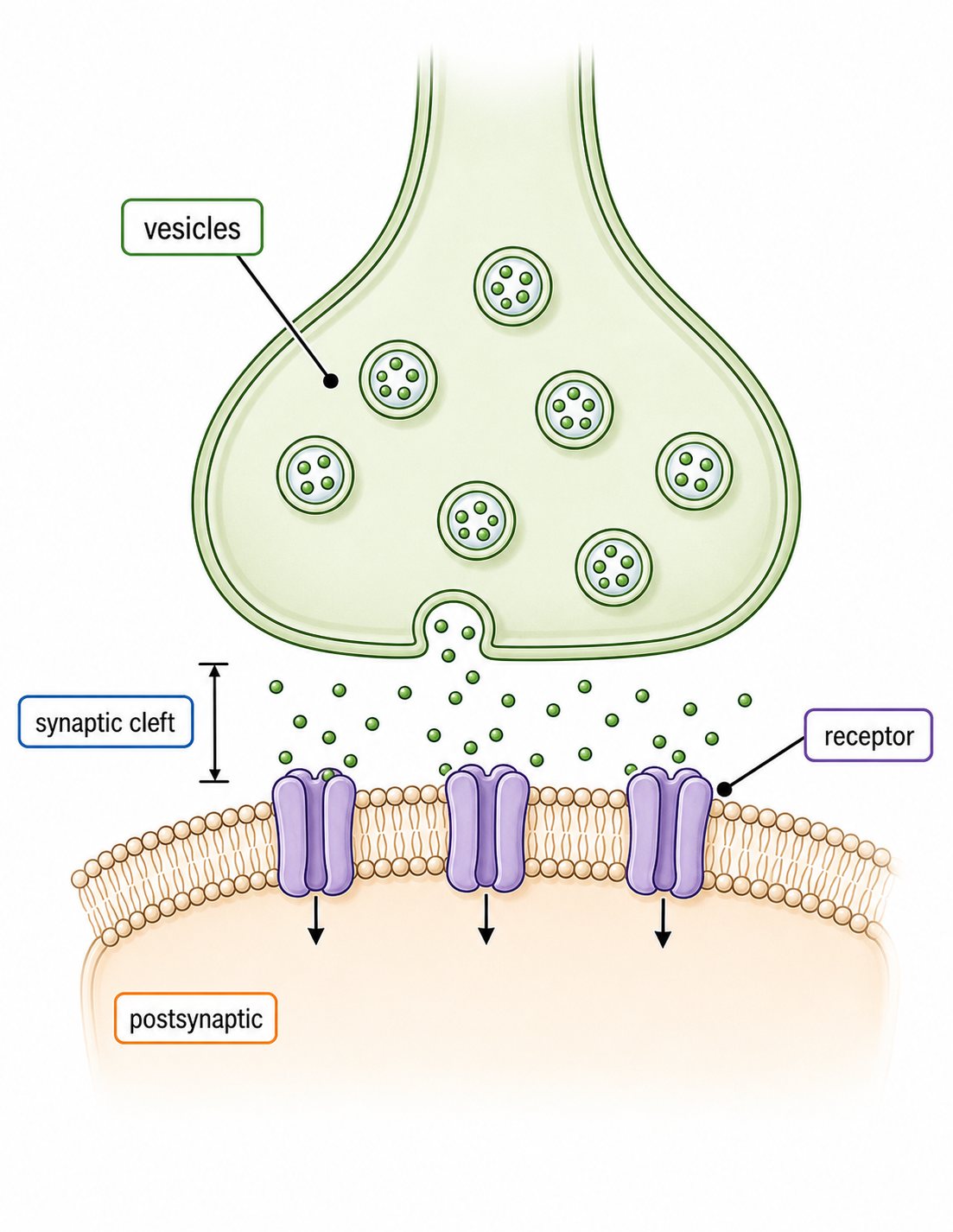
  • The presynaptic terminal stores neurotransmitter in vesicles and releases it.
  • The synaptic cleft is a narrow extracellular gap, typically about 20 nm.
  • The postsynaptic membrane carries receptors that convert the chemical signal into a membrane response.

Transmission is normally one-way because release machinery is presynaptic while matching receptors are postsynaptic. Synapses can connect neuron to neuron, neuron to muscle, or neuron to a gland cell.

A presynaptic terminal contains neurotransmitter vesicles above a narrow synaptic cleft and a postsynaptic membrane bearing receptor proteins.

SL Summary: Trace the Signal into the Next Cell

Within a neuron: ion gradients create a resting potential; threshold opens a regenerative membrane event; axon diameter and myelin change how quickly it travels.

Across a synapse: arriving depolarization opens Ca²⁺ channels → Ca²⁺ triggers exocytosis → transmitter diffuses → postsynaptic receptors open channels → an EPSP moves the next cell toward threshold.

If transmission fails here… Inspect…
resting voltage cannot be maintained ATP supply, Na⁺/K⁺ pump and membrane permeability
presynaptic impulse arrives but no transmitter appears voltage-gated Ca²⁺ channels and vesicle fusion
transmitter reaches the cleft but no EPSP forms receptor match, postsynaptic channel and transmitter removal

Synapses as junctions

[ 2 ]

Distinguish between the presynaptic and postsynaptic membranes by giving two differences.

Concept essentials

  • Synapses transmit signals chemically between neurons.
  • Calcium entry into the presynaptic terminal triggers neurotransmitter release.
  • Neurotransmitters diffuse across the synaptic cleft and bind postsynaptic receptors.
  • Neurotransmitter removal helps end the postsynaptic signal.