IB Physics SL S1.3.3 Units and Numerical Values

Practise deriving compound units from equations, reducing them to SI base units and presenting calculated values with appropriate prefixes, significant figures and symbols.

Syllabus
First assessment 2025
Objective
S1.3.3
Level
SL

Exam points

  • substitute SI base units into an equation and cancel powers to derive a compound unit
  • check dimensional consistency by comparing the base-unit powers on both sides of an equation
  • state a calculated value with an appropriate prefix, significant figures and complete SI unit

S1.3.3—Units and numerical values question 1

[Maximum number: 2]

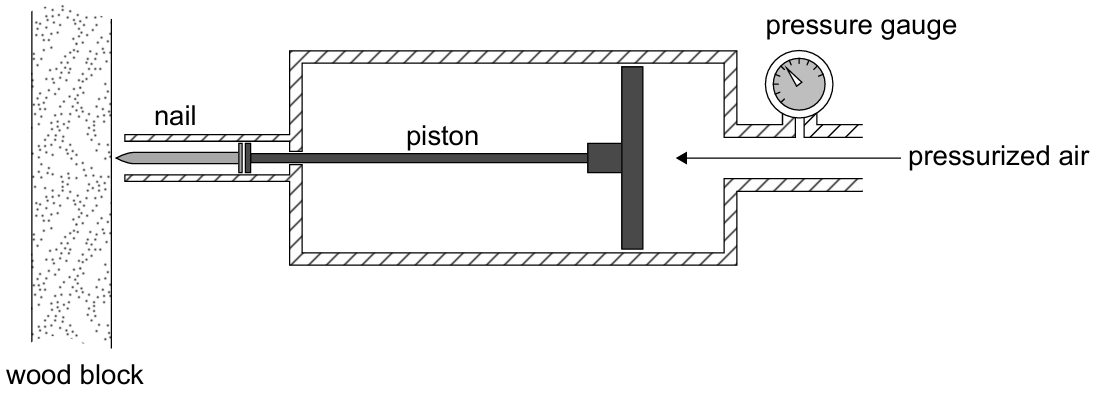
A group of students uses pressurized air to move a piston that forces a nail into a block of wood. A gauge is used to measure the pressure P of compressed air above atmospheric pressure. The nail enters the wood perpendicular to its surface.

Figure for Question S1.3.3—Units and numerical values question 1 — IB Physics SL

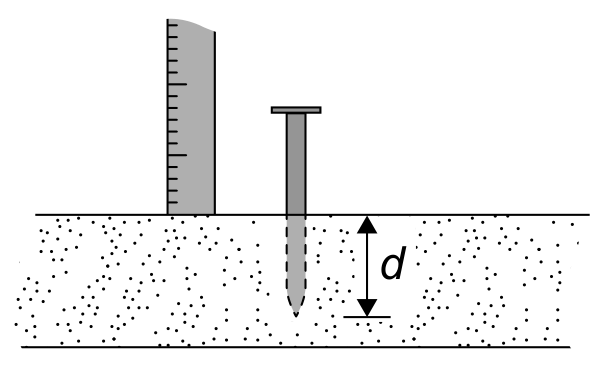
The students use a ruler to measure the length of the nail which remains above the surface of the wood as shown. The depth of the nail inside the wood is d. All necessary length measurements are recorded using a ruler with uncertainty ±1 mm\pm 1 \mathrm{~mm}.

Figure for Question S1.3.3—Units and numerical values question 1 — IB Physics SL

The students suggest the following relationship between d and P :

d=kPd=k \sqrt{P}

where k is a constant.
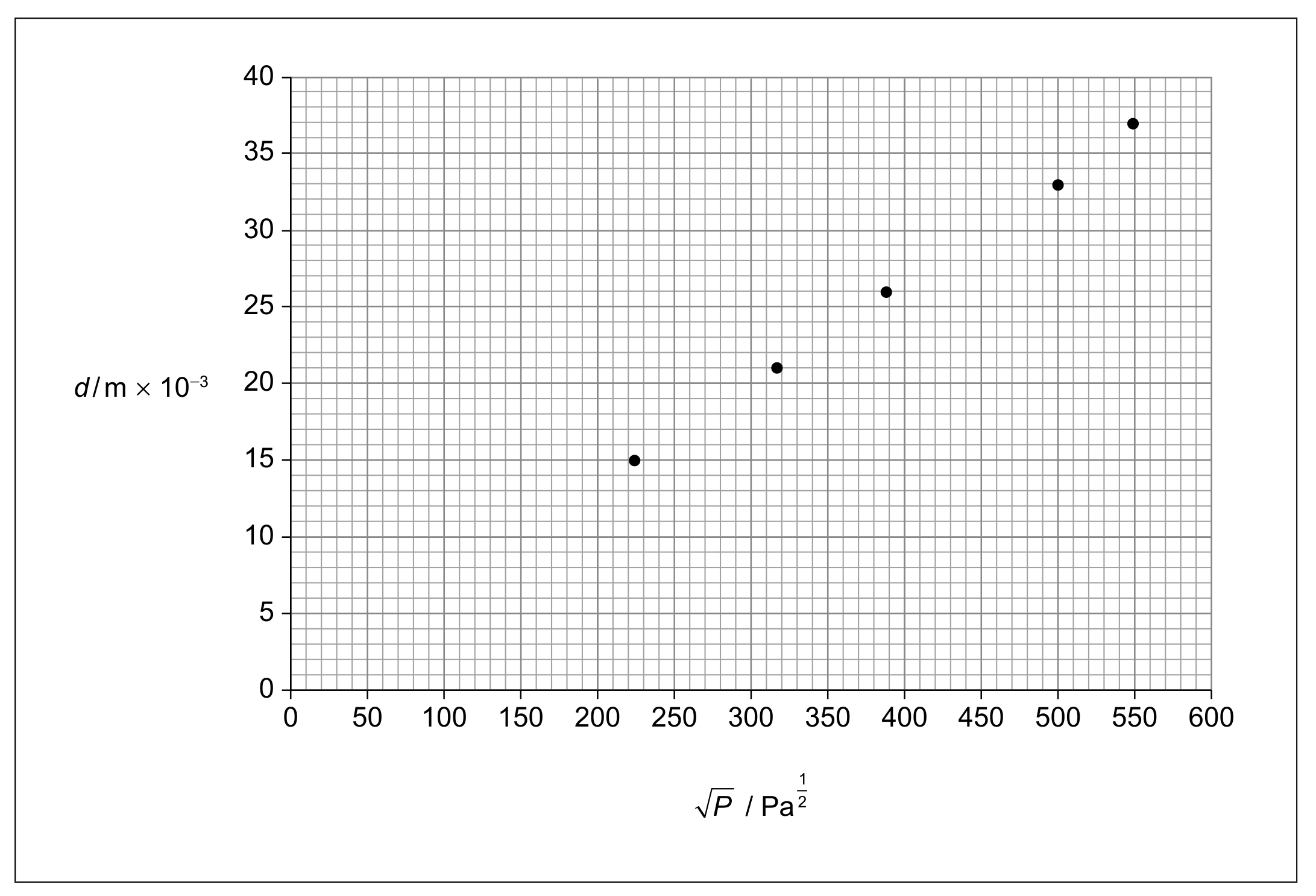
To verify the relationship, the variation of d with P\sqrt{P} is plotted.
One data point is missing.

Figure for Question S1.3.3—Units and numerical values question 1 — IB Physics SL

The SI units of k can be expressed as kg12 mx sy\mathrm{kg}^{-\frac{1}{2}} \mathrm{~m}^{x} \mathrm{~s}^{y}. Determine the values of x and y.

All question bank results loaded