EduNinja

IB Physics SLS2.2 Collecting and processing dataQuestion Bank

Question 1

[Maximum number: 2]

Data analysis question.

Connie and Sophie investigate the effect of colour on heat absorption. They make grey paint by mixing black and white paint in different ratios. Five identical tin cans are painted in five different shades of grey.

Question image

Connie and Sophie put an equal amount of water at the same initial temperature into each can. They leave the cans under a heat lamp at equal distances from the lamp. They measure the temperature increase of the water, T, in each can after one hour.

Question 1(a)

(a)

Connie suggests that T is proportional to B, where B is the percentage of black in the paint. To test this hypothesis, she plots a graph of T against B, as shown on the axes below. The uncertainty in T is shown and the uncertainty in B is negligible.

Question image
[ 2 ]

Question 1(a)(iv)

(i)

Outline why the data do not support the hypothesis that T is proportional to B.

[ 2 ]

Question 1

[Maximum number: 1]

This question is about the flow of liquids.

A student carries out an experiment to investigate how the rate of flow R of water through a narrow tube varies with the pressure difference across the tube. The pressure difference is proportional to the height h shown in the diagram. The student measures h in cm with a metre ruler. R is obtained by measuring the volume of water collected in a measuring cylinder in a time of 100 s .

Question image

Question 1(a)

(a)

The student enters the data on a spreadsheet and produces the graph and trend line shown below.

Question image

The data point for h=57 cm,R=1.70 cm3 s1h=57 \mathrm{~cm}, R=1.70 \mathrm{~cm}^{3} \mathrm{~s}^{-1} has not been shown on the graph. The student estimates the uncertainties in all values of h to be ±1 cm\pm 1 \mathrm{~cm} and the uncertainties in the values of R to be ±5%\pm 5 \%.

[ 1 ]

Question 1(a)(iii)

(i)

Comment on why the trend line is not a perfect match for the data.

[ 1 ]

Question 1

[Maximum number: 3]

A student investigates the electromotive force (emf) ε\varepsilon and internal resistance r of a cell.

Question image

The current I and the terminal potential difference V are measured.
For this circuit V=εIrV=\varepsilon-I r.
The table shows the data collected by the student. The uncertainties for each measurement are shown.

Table

The graph shows the data plotted.

Question image

Question 1(b)

(a)

Determine, using the graph, the emf of the cell including the uncertainty for this value. Give your answer to the correct number of significant figures.

[ 3 ]

Question 1

[Maximum number: 4]

A student investigates the relationship between the pressure in a ball and the maximum force that the ball produces when it rebounds.

A pressure gauge measures a difference Δp\Delta p between the atmospheric pressure and the pressure in the ball. A force sensor measures the maximum force Fmax F_{\text {max }} exerted on it by the ball during the rebound.

Question image

Question 1(b)

(a)

Deduce, using two suitable data points from the table, that the student's initial hypothesis is not supported.

[ 3 ]

Question 1(d)

Question 1(d)(iii)

(b)
(i)

Explain why the new hypothesis is supported.

[ 1 ]

Question 1

[Maximum number: 2]

A spherical soap bubble is made of a thin film of soapy water. The bubble has an internal air pressure PiP_{\mathrm{i}} and is formed in air of constant pressure PoP_{\mathrm{o}}. The theoretical prediction for the variation of ( PiPoP_{\mathrm{i}}-P_{\mathrm{o}} ) is given by the equation

(PiPo)=4 gR\left(P_{\mathrm{i}}-P_{\mathrm{o}}\right)=\frac{4 \mathrm{~g}}{R}

where γ\gamma is a constant for the thin film and R is the radius of the bubble.
Data for ( PiPoP_{\mathrm{i}}-P_{\mathrm{o}} ) and R were collected under controlled conditions and plotted as a graph showing the variation of ( PiPoP_{\mathrm{i}}-P_{\mathrm{o}} ) with 1R\frac{1}{R}.

Question image

Question 1(a)

(a)

Suggest whether the data are consistent with the theoretical prediction.

[ 2 ]

Question 1

[Maximum number: 4]

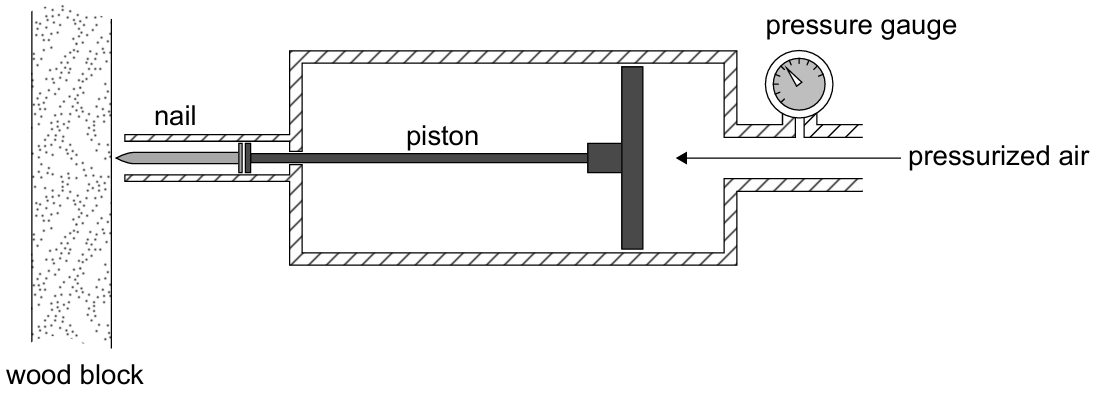
A group of students uses pressurized air to move a piston that forces a nail into a block of wood. A gauge is used to measure the pressure P of compressed air above atmospheric pressure. The nail enters the wood perpendicular to its surface.

Question image

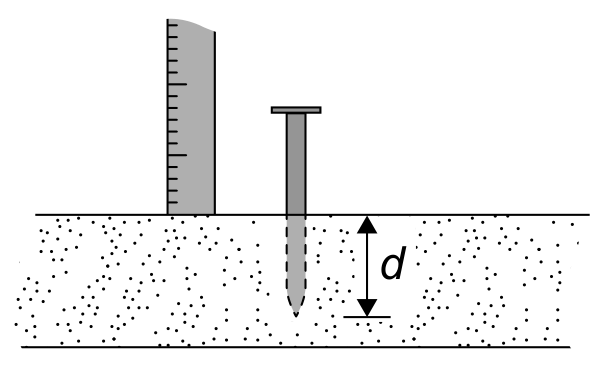
The students use a ruler to measure the length of the nail which remains above the surface of the wood as shown. The depth of the nail inside the wood is d. All necessary length measurements are recorded using a ruler with uncertainty ±1 mm\pm 1 \mathrm{~mm}.

Question image

Question 1(b)

(a)

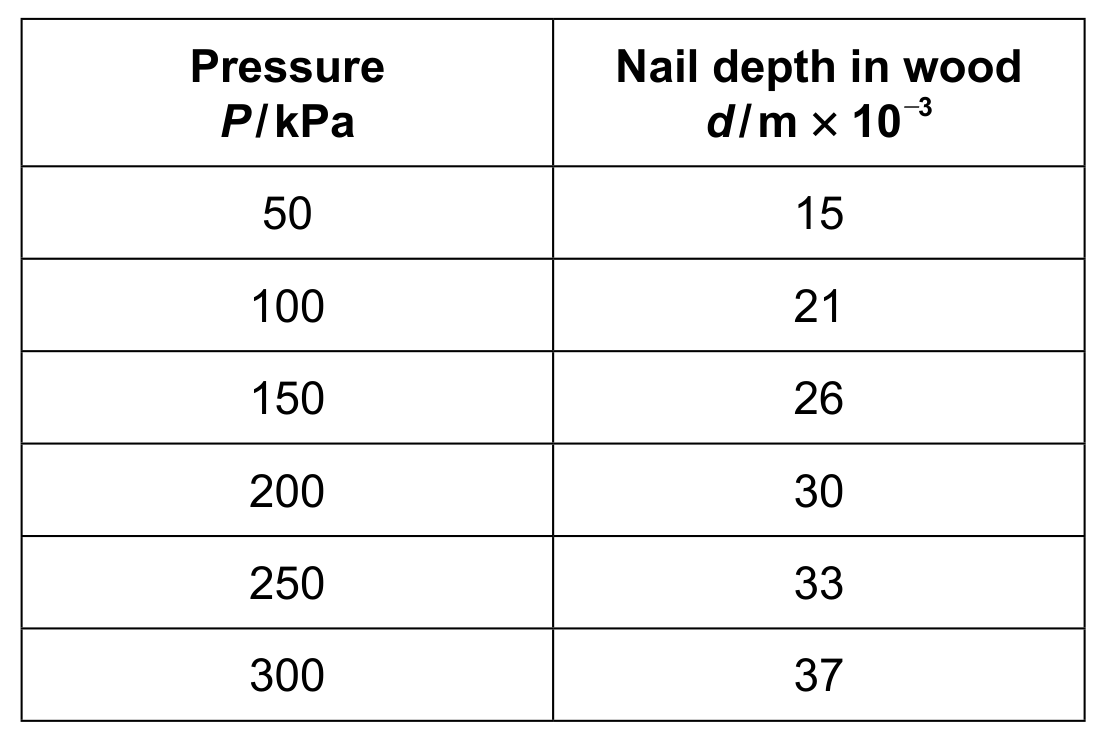
The students systematically increase the pressure and calculate d.

Table
[ 2 ]

Question 1(b)(iv)

(i)

By using two sets of data in the table, show that the relationship between d and P is not directly proportional.

[ 2 ]

Question 1(c)

(b)

The students suggest the following relationship between d and P :

d=kPd=k \sqrt{P}

where k is a constant.
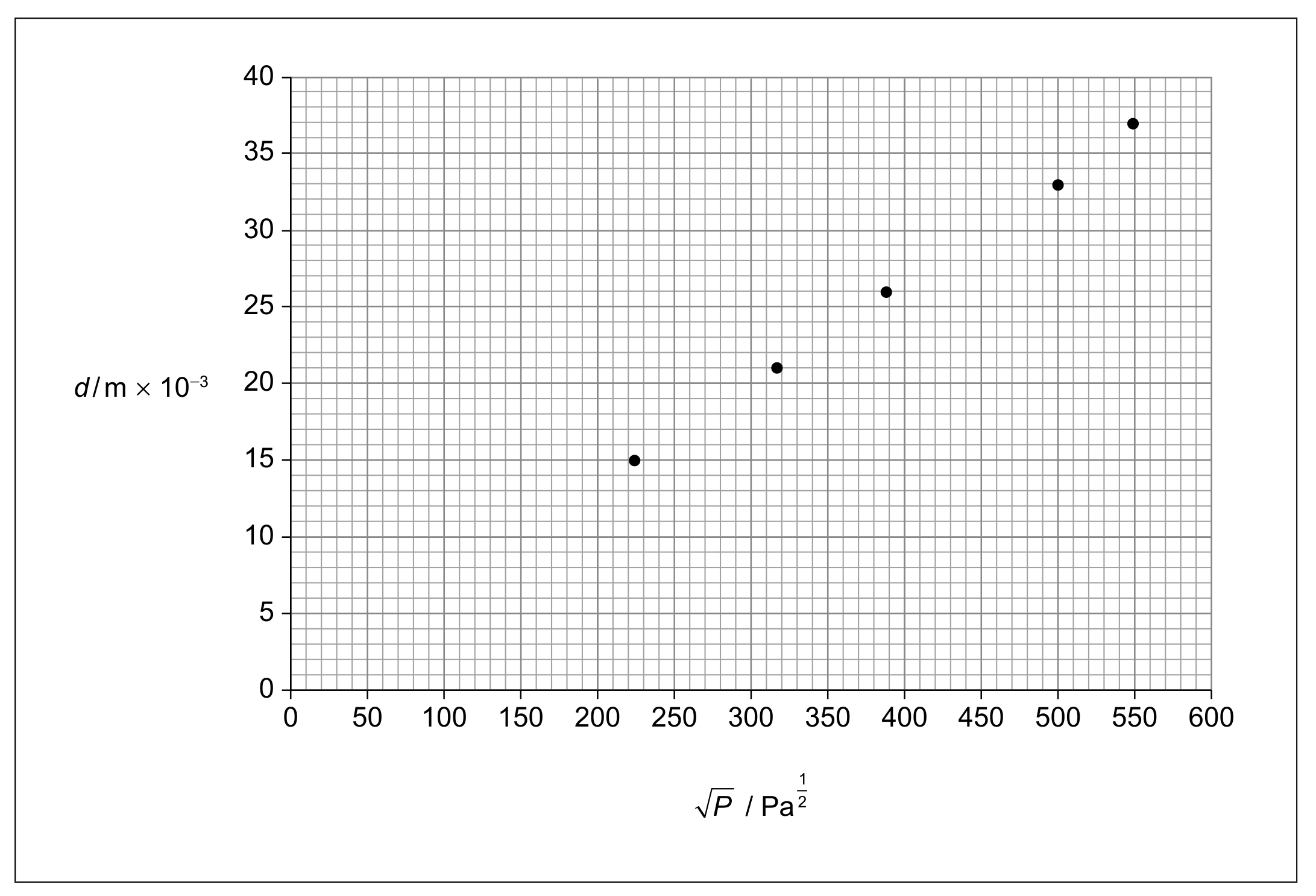
To verify the relationship, the variation of d with P\sqrt{P} is plotted.
One data point is missing.

Question image
[ 1 ]

Question 1(c)(i)

(i)

Determine the coordinates of the missing point using the original data set and plot it on the graph.

[ 1 ]

Question 1(d)

(c)

The students collect only one value of d for each value of P. Suggest why this is a poor method.

[ 1 ]

Question 1

[Maximum number: 2]

A student determines the resistivity ρ\rho of a metal that is in the form of a cylindrical wire. The student makes the following measurements:

 Length L of the wire =(462±2)mm\text { Length } L \text { of the wire }=(462 \pm 2) \mathrm{mm}
Readings for the diameter d of the wire:

Readings for the diameter d of the wire:

 Resistance R of the wire =13.7Ω±1.5%\text { Resistance } R \text { of the wire }=13.7 \Omega \pm 1.5 \%

Question 1(c)

Question 1(c)(i)

(a)
(i)

Show that the mean diameter of the wire is about 0.2 mm .

[ 2 ]

Question 1

[Maximum number: 3]

A student performs an experiment with a rod that is free to oscillate in a horizontal plane. Two identical small spheres, each of mass m, are placed at equal distances from the centre of the rod. The student records values of the period of oscillation of the rod T in seconds for different values of the distance of separation of the spheres d, in metres.

Question image

The student plots the variation with d of T, keeping m constant.

Question image

Question 1(a)

Question 1(a)(ii)

(a)
(i)

The student proposes the hypothesis that T is directly proportional to d. Outline whether the graph supports this model.

[ 1 ]

Question 1(c)

(b)

The student goes on to investigate the relationship proposed in (b) between T and m, keeping d constant.

Sketch the graph expected for this experiment on the axes provided.

Question image
[ 2 ]

Question 1

[Maximum number: 1]

A student attaches one end of a copper wire to an oscillator operating at a fixed frequency. The other end of the wire passes over a pulley to weights that hang vertically. The first harmonic standing wave is established by using the slider to change the length of the wire. The procedure is repeated for different weights.

Question image

The mass m of the weights and the wavelength λ\lambda of the wave are related by

m=μf2gλ2m=\frac{\mu f^{2}}{g} \lambda^{2}

where μ\mu is a constant, f is the frequency of the wave and g=9.8 ms2g=9.8 \mathrm{~ms}^{-2}.

Question 1(b)

(a)

The graph shows the data obtained by the student, plotted to show the variation of m with λ2\lambda^{2}.

Question image
[ 1 ]

Question 1(b)(ii)

(i)

Identify the evidence for a systematic error in the data.

[ 1 ]

Question 2

[Maximum number: 1]

Two different experiments, P and Q, generate two sets of data to confirm the proportionality of variables x and y. The graphs for the data from P and Q are shown. The maximum and minimum gradient lines are shown for both sets of data.

Question image
Question image

What is true about the systematic error and the uncertainty of the gradient when P is compared to Q ?

Systematic error

Uncertainty of the gradient

larger for set P

larger for set P

larger for set Q

larger for set P

larger for set P

larger for set Q

larger for set Q

larger for set Q

0 selected