EduNinja

IB Physics SLS2.1 Exploring and designingQuestion Bank

Question 1

[Maximum number: 1]

A student investigates the relationship between the pressure in a ball and the maximum force that the ball produces when it rebounds.

A pressure gauge measures a difference Δp\Delta p between the atmospheric pressure and the pressure in the ball. A force sensor measures the maximum force Fmax F_{\text {max }} exerted on it by the ball during the rebound.

Question image

Question 1(a)

(a)

State one variable that needs to be controlled during the investigation.

The student collects the following data.

Table

The student initially hypothesizes that Fmax F_{\text {max }} is proportional to Δp\Delta p.

[ 1 ]

Question 1

[Maximum number: 2]

A student performs an experiment with a rod that is free to oscillate in a horizontal plane. Two identical small spheres, each of mass m, are placed at equal distances from the centre of the rod. The student records values of the period of oscillation of the rod T in seconds for different values of the distance of separation of the spheres d, in metres.

Question image

The student plots the variation with d of T, keeping m constant.

Question image

Question 1(a)

Question 1(a)(i)

(a)
(i)

Explain why m was kept constant.

[ 1 ]

Question 1(a)(iii)

(ii)

State one other feature of the experiment that the student should keep constant.

[ 1 ]

Question 1

[Maximum number: 1]

A group of students uses pressurized air to move a piston that forces a nail into a block of wood. A gauge is used to measure the pressure P of compressed air above atmospheric pressure. The nail enters the wood perpendicular to its surface.

Question image

The students use a ruler to measure the length of the nail which remains above the surface of the wood as shown. The depth of the nail inside the wood is d. All necessary length measurements are recorded using a ruler with uncertainty ±1 mm\pm 1 \mathrm{~mm}.

Question image

Question 1(b)

(a)

The students systematically increase the pressure and calculate d.

Table
[ 1 ]

Question 1(b)(i)

(i)

State one variable that needs to be controlled when collecting the data.

[ 1 ]

Question 2

[Maximum number: 1]

In an investigation a student folds paper into cylinders of the same diameter D but different heights. Beginning with the shortest cylinder they applied the same fixed load to each of the cylinders one by one. They recorded the height H of the first cylinder to collapse.

Question image

They then repeat this process with cylinders of different diameters.
The graph shows the data plotted by the student and the line of best fit.

Question image

Theory predicts that H=cD23H=c D^{\frac{2}{3}} where c is a constant.

Question 2(c)

(a)

Identify one factor that determines the value of c. provided.

[ 1 ]

Question 2

[Maximum number: 1]

A student wants to verify the relation T=2πLgT=2 \pi \sqrt{\frac{L}{g}} between the period T of a simple pendulum and the length L of the pendulum, where g is the acceleration of free fall. The student operates a stopwatch to measure one oscillation and a millimeter ruler to measure the length of the pendulum.

Question 2(a)

(a)

State, for this experiment,

[ 1 ]

Question 2(a)(i)

(i)

one variable that must be controlled,

[ 1 ]

Question 2

[Maximum number: 1]

A student studies the relationship between the centripetal force applied to an object undergoing circular motion and its period T.
The object (mass m ) is attached by a light inextensible string, through a tube, to a weight W which hangs vertically. The string is free to move through the tube. A student swings the mass in a horizontal, circular path, adjusting the period T of the motion until the radius r is constant. The radius of the circle and the mass of the object are measured and remain constant for the entire experiment.

Question image

The student collects the measurements of T five times, for weight W. The weight is then doubled ( 2 W ) and the data collection repeated. Then it is repeated with 3 W and 4 W. The results are expected to support the relationship

W=4π2mrT2W=\frac{4 \pi^{2} m r}{T^{2}}

Question 2(a)

(a)

State why the experiment is repeated with different values of W.

In reality, there is friction in the system, so in this case W is less than the total centripetal force in the system. A suitable graph is plotted to determine the value of m r experimentally. The value of m r was also calculated directly from the measured values of m and r.

[ 1 ]

Question 2

[Maximum number: 1]

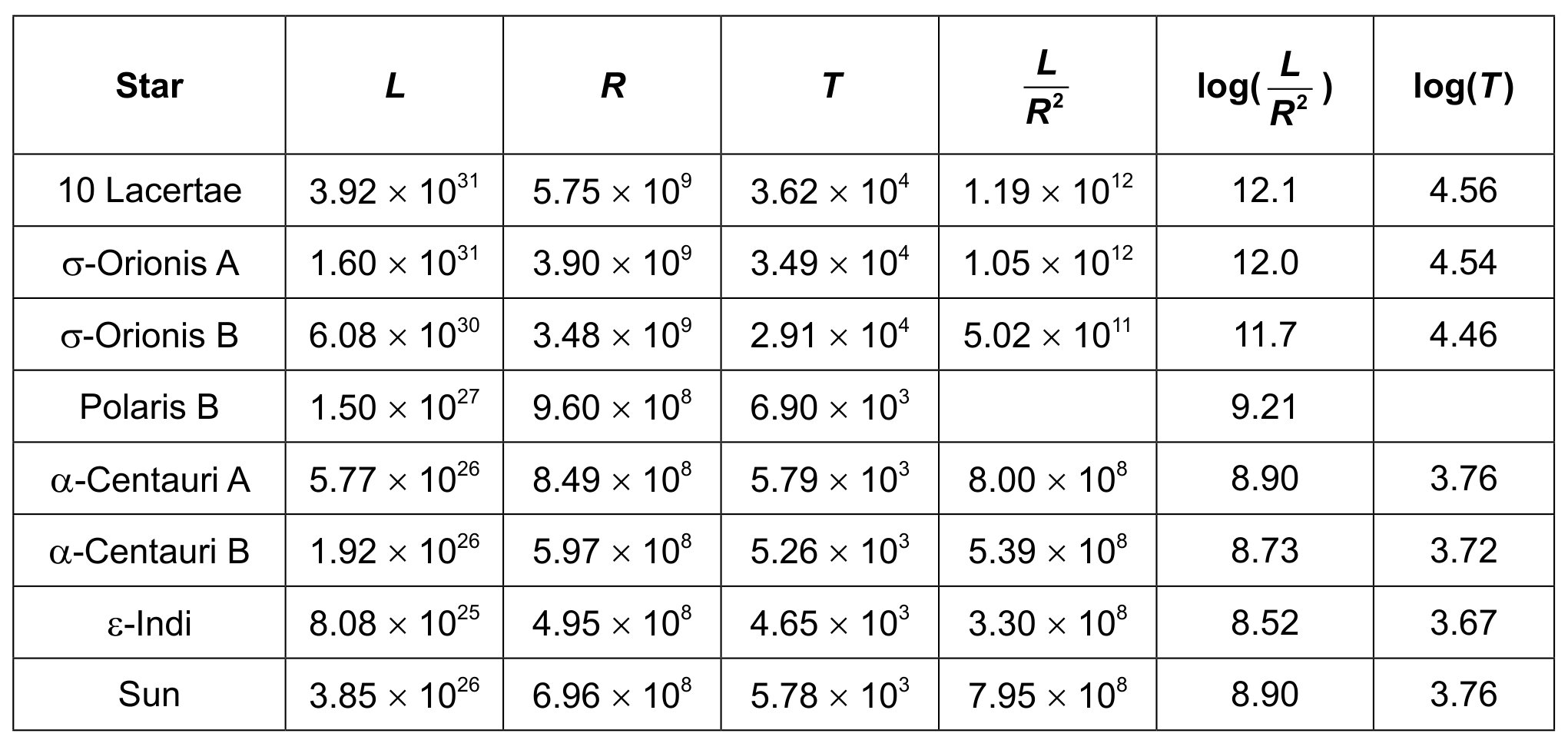
A student investigates whether the Stefan-Boltzmann law, L=4πσR2T4L=4 \pi \sigma R^{2} T^{4}, applies to stars.
L= luminosity of the star, in W
σ=\sigma= Stefan-Boltzmann constant
R= radius of the star, in m
T= surface temperature of the star, in K
To verify the law, they obtain values from databases and manipulate the data as shown.

Table

Question 2(e)

(a)

Suggest a possible improvement of the investigation, related to the range of the surface temperatures of the stars selected.

[ 1 ]
0 selected