EduNinja

IB Physics SLS1.1 Experimental techniquesQuestion Bank

Question 1

[Maximum number: 1]

The density of a metal sphere is determined using a digital caliper and a mass balance.

The digital caliper is used to measure the diameter D of the sphere by placing the sphere in the jaws of the digital caliper. This reading is shown.

The sphere is then removed and another reading is taken immediately afterwards with the jaws closed.

Question image
Question image

Question 1(a)

Question 1(a)(i)

(a)
(i)

Calculate D.

[ 1 ]

Question 1

[Maximum number: 2]

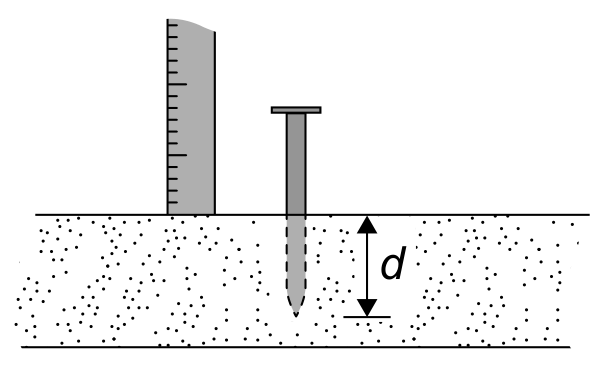
A group of students uses pressurized air to move a piston that forces a nail into a block of wood. A gauge is used to measure the pressure P of compressed air above atmospheric pressure. The nail enters the wood perpendicular to its surface.
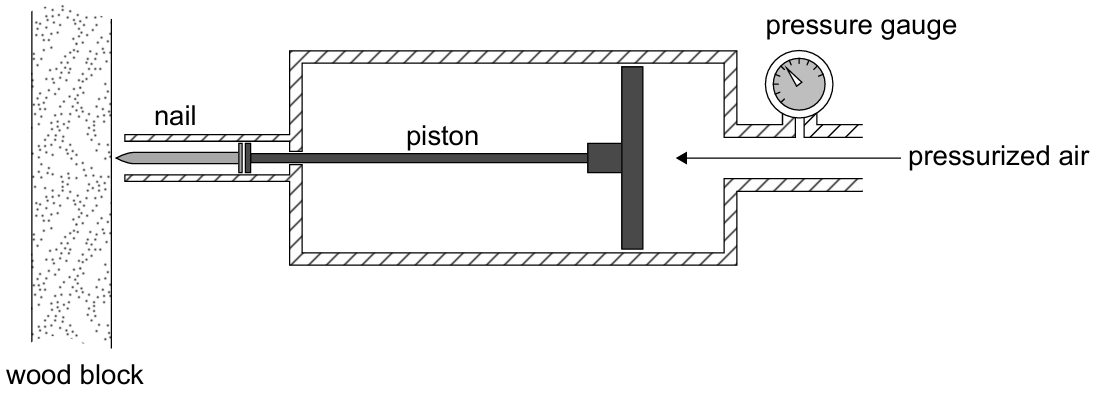
Question image

The students use a ruler to measure the length of the nail which remains above the surface of the wood as shown. The depth of the nail inside the wood is d. All necessary length measurements are recorded using a ruler with uncertainty ±1 mm\pm 1 \mathrm{~mm}.

Question image

Question 1(a)

(a)

Describe one consideration that must be made when placing the ruler to ensure that the length of the nail remaining above the surface of the wood is measured accurately.

[ 1 ]

Question 1(b)

(b)

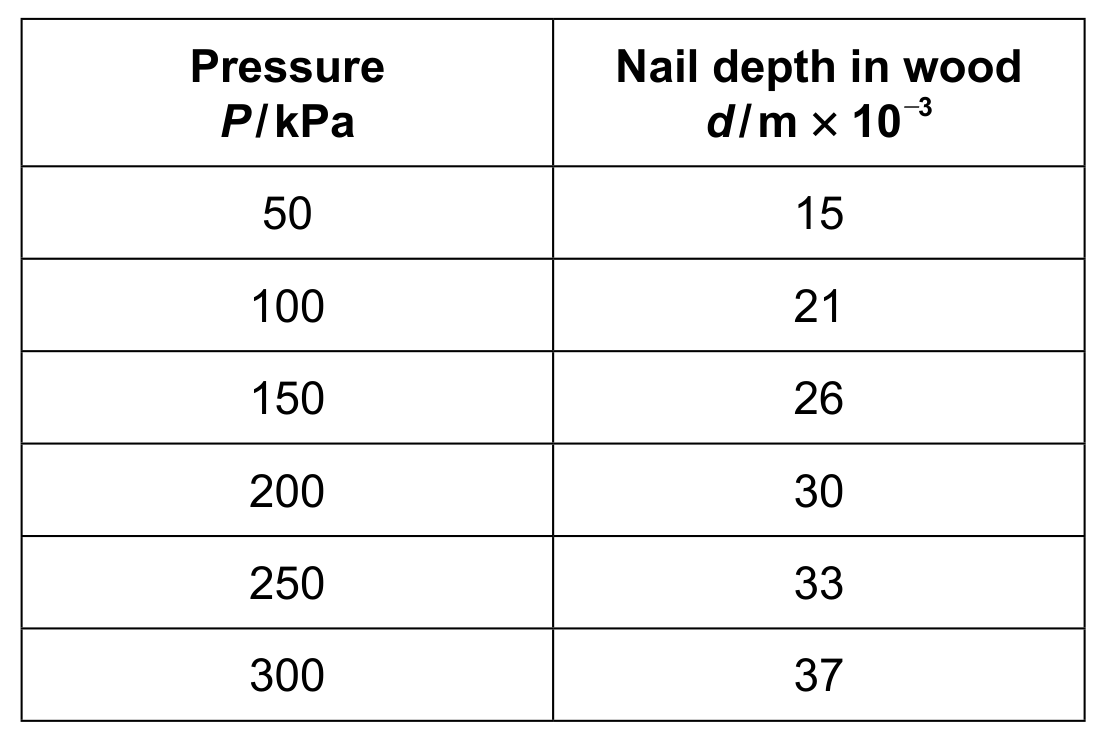
The students systematically increase the pressure and calculate d.
Table
[ 1 ]

Question 1(b)(ii)

(i)

Outline how the students determined the value of d.

[ 1 ]

Question 1

[Maximum number: 2]

A student determines the resistivity ρ\rho of a metal that is in the form of a cylindrical wire. The student makes the following measurements:

 Length L of the wire =(462±2)mm\text { Length } L \text { of the wire }=(462 \pm 2) \mathrm{mm}
Readings for the diameter d of the wire:

Readings for the diameter d of the wire:

 Resistance R of the wire =13.7Ω±1.5%\text { Resistance } R \text { of the wire }=13.7 \Omega \pm 1.5 \%

Question 1(b)

(a)

Suggest suitable instruments for the measurement of

[ 2 ]

Question 1(b)(i)

(i)

L\quad L

[ 1 ]

Question 1(b)(ii)

(ii)

d

[ 1 ]

Question 1

[Maximum number: 1]

A student is analysing a sample of water. To determine its density, the student measures the volume with a measuring cylinder and the mass with an electronic balance.

Question 1(a)

(a)

Identify one way to ensure that the volume is read accurately.

The following data are collected:

 Volume =(10.6±0.2)cm3 Mass =(10.82±0.01)g\begin{array}{ll} \text { Volume } & =(10.6 \pm 0.2) \mathrm{cm}^{3} \\ \text { Mass } & =(10.82 \pm 0.01) \mathrm{g} \end{array}
[ 1 ]

Question 2

[Maximum number: 1]

A group of students is investigating refraction in a semi-circular glass block.

Light from a ray box enters the curved side of the block. The light passes through the block and leaves, refracted, at P .

Question 2(b)

(a)

The students vary the position of the ray box to obtain data to determine the refractive index of the glass. They use a protractor to collect values for the angles of incidence θi\theta_{i} and refraction θr\theta_{r} at P and record them on a table.

Question image
[ 1 ]

Question 2(b)(i)

(i)

One of their measurements is shown. State θr\theta_{r} for this measurement.

Question image
Question image
[ 1 ]

Question 2

[Maximum number: 1]

This question is about the internal resistance of a cell.

Question 2(b)

(a)

A circuit is used to determine the internal resistance and emf of a cell. It consists of the cell, a variable resistor, an ideal ammeter and an ideal voltmeter. The diagram shows part of the circuit with the ammeter and voltmeter missing.

Question image

The variable resistor is set to 1.5Ω1.5 \Omega. When the cell converts 7.2 mJ of energy, 5.8 mC of charge moves completely around the circuit. The potential difference across the variable resistor is 0.55 V .

[ 1 ]

Question 2(b)(i)

(i)

Draw on the diagram the positions of the ammeter and voltmeter.

[ 1 ]

Question 2

[Maximum number: 1]

A student conducts an experiment to determine the specific heat capacity of a metal cube. The cube is heated in a beaker of boiling water to a temperature of 100C100^{\circ} \mathrm{C} and then quickly transferred into an insulated vessel of negligible thermal capacity. The vessel contains water at 20C20^{\circ} \mathrm{C} and of known specific heat capacity.

Question 2(a)

(a)

State one other measurement that the student will need to make.

[ 1 ]

Question 4

[Maximum number: 1]

The first scientists to identify alpha particles by a direct method were Rutherford and Royds. They knew that radium-226 ( 88226Ra{ }_{88}^{226} \mathrm{Ra} ) decays by alpha emission to form a nuclide known as radon (Rn).

Question 4(e)

(a)

(e) The work was first reported in a peer-reviewed scientific journal. Outline why
Rutherford and Royds chose to publish their work in this way.

[ 1 ]

Question 11

[Maximum number: 2]

This question is about mobile phones.

The number of mobile phones has grown rapidly in recent years. Discuss environmental issues associated with this rapid increase.

0 selected