IB Physics SL C.1.4 Period, Frequency and Angular Frequency

Practise converting T, f and ω and applying spring or pendulum period relations to predict how mass, stiffness, length or gravitational field changes an oscillator's timing.

Syllabus
First assessment 2025
Objective
Level
SL

Exam points

  • convert between T, f and ω with T = 1/f = 2π/ω and retain seconds, hertz or rad s⁻¹
  • use T = 2π√(m/k) to compare spring systems after mass or effective stiffness changes
  • use T = 2π√(L/g) for small-angle pendulums and identify variables that do not affect period

C.1.4—Period, frequency and angular frequency question 1

[Maximum number: 3]

This question is in two parts. Part 1 is about ideal gases and specific heat capacity. Part 2 is about simple harmonic motion and waves.
Part 1 Ideal gases and specific heat capacity

Simple harmonic motion and waves

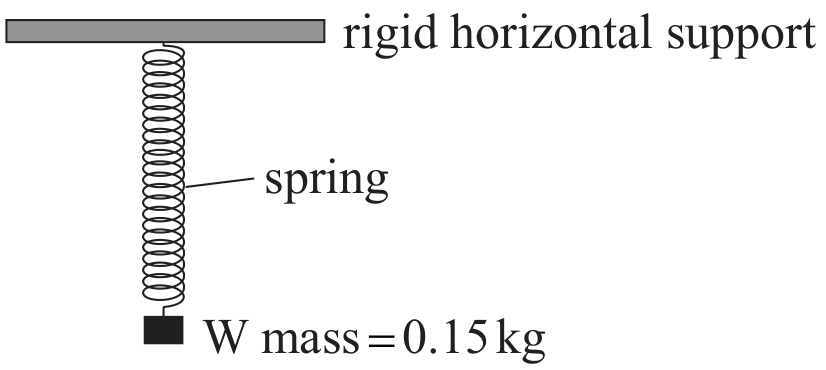
One end of a light spring is attached to a rigid horizontal support.

Figure for Question C.1.4—Period, frequency and angular frequency question 1 — IB Physics SL

An object W of mass 0.15 kg is suspended from the other end of the spring. The extension x of the spring is proportional to the force F causing the extension. The force per unit extension of the spring k is 18Nm118 \mathrm{Nm}^{-1}.

A student pulls W down such that the extension of the spring increases by 0.040 m . The student releases W and as a result W performs simple harmonic motion (SHM).

Determine the period of oscillation of the spring.

All question bank results loaded