2.2.7—Covalent network structures
- Syllabus
- First assessment 2025
- Objective
- 2.2.7
- Level
- SL
| Material | Structural evidence | Property or use explained |
|---|---|---|
| Diamond | each C covalently bonded in a rigid 3D network | very hard; high melting point; no mobile charge carriers |
| Graphite | strong covalent sheets with delocalized electrons; weak attractions between sheets | conducts along sheets; layers slide, so it is soft/lubricating |
| Graphene | one atom-thick covalent sheet with delocalized electrons | strong, light and electrically conducting |
| Fullerenes | finite carbon cages or tubes rather than an infinite 3D network | molecular shape and intermolecular contacts give properties distinct from diamond/graphite |
| Silicon | extended covalent structure with limited charge mobility | semiconductor behaviour; detailed doping is outside this card |
| Silicon dioxide | 3D Si–O covalent network, not discrete SiO₂ molecules | hard and high-melting because many strong covalent bonds must be overcome |
Decide conductivity by available mobile charges, not by the word covalent alone.
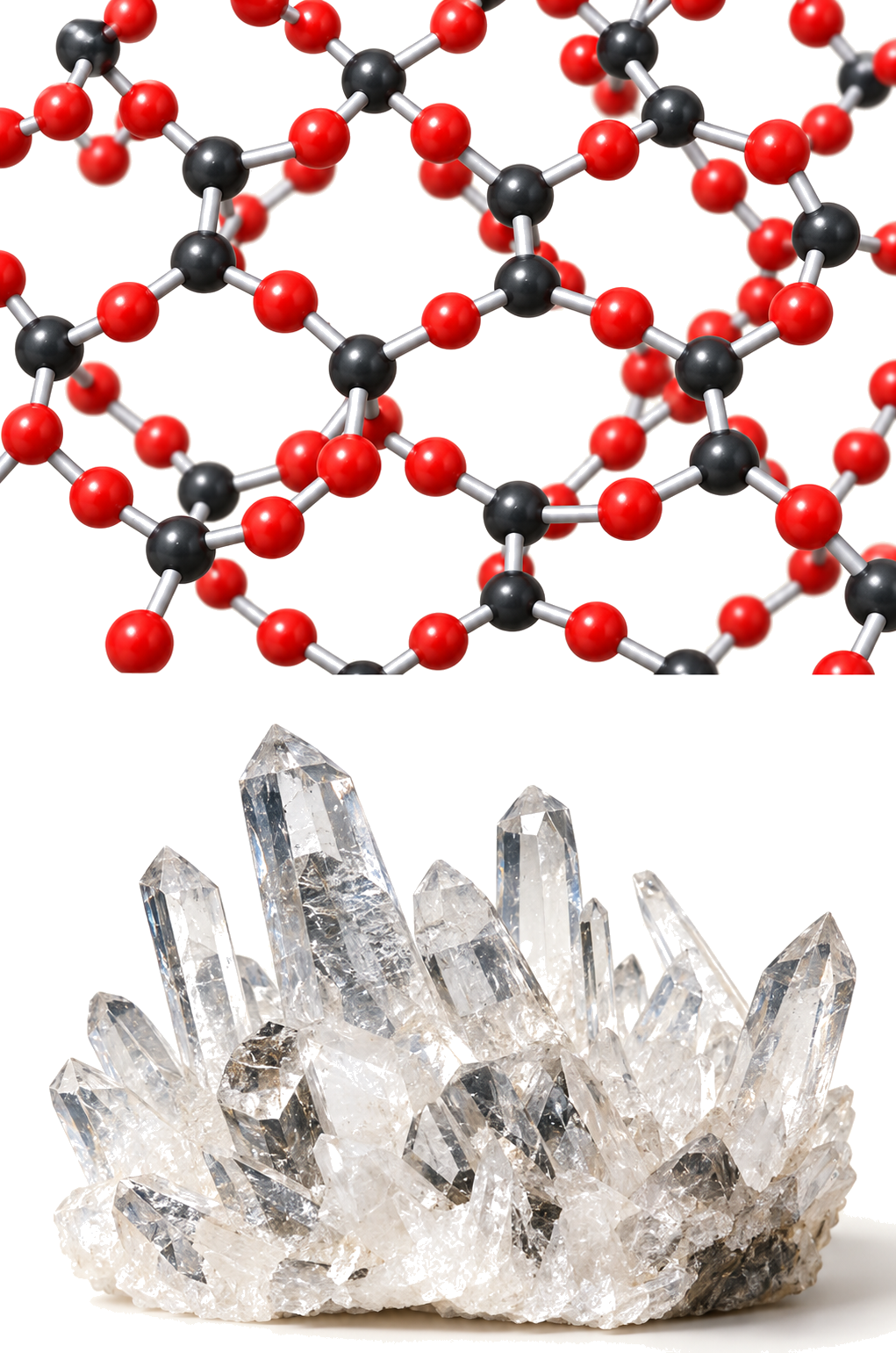
Explain a network material property by connecting the structure and bonding arrangement to the relevant mobility, strength, or dimensional feature.
Diamond is hard because each carbon is held in a three-dimensional covalent network, while graphite conducts along layers through delocalized electrons and its layers can slide. Silicon dioxide is also an extended network: describe network atoms, not discrete SiO₂ molecules, when explaining its high melting point.