Reactivity 3. What are the mechanisms of chemical change?

Syllabus
First assessment 2025
Section
Level
SL

Exam analysis

No tagged past-paper evidence yet

Published Concept pages under this syllabus area do not have tagged past-paper appearances in the selected level yet.

Recent 5 years

In this section

Topic 3.1

3.1 Proton transfer reactions

Objectives in this topic

Brønsted–Lowry Acids and Bases

A Brønsted–Lowry acid donates H+ and a Brønsted–Lowry base accepts H+. An alkali is a base that is soluble in water.
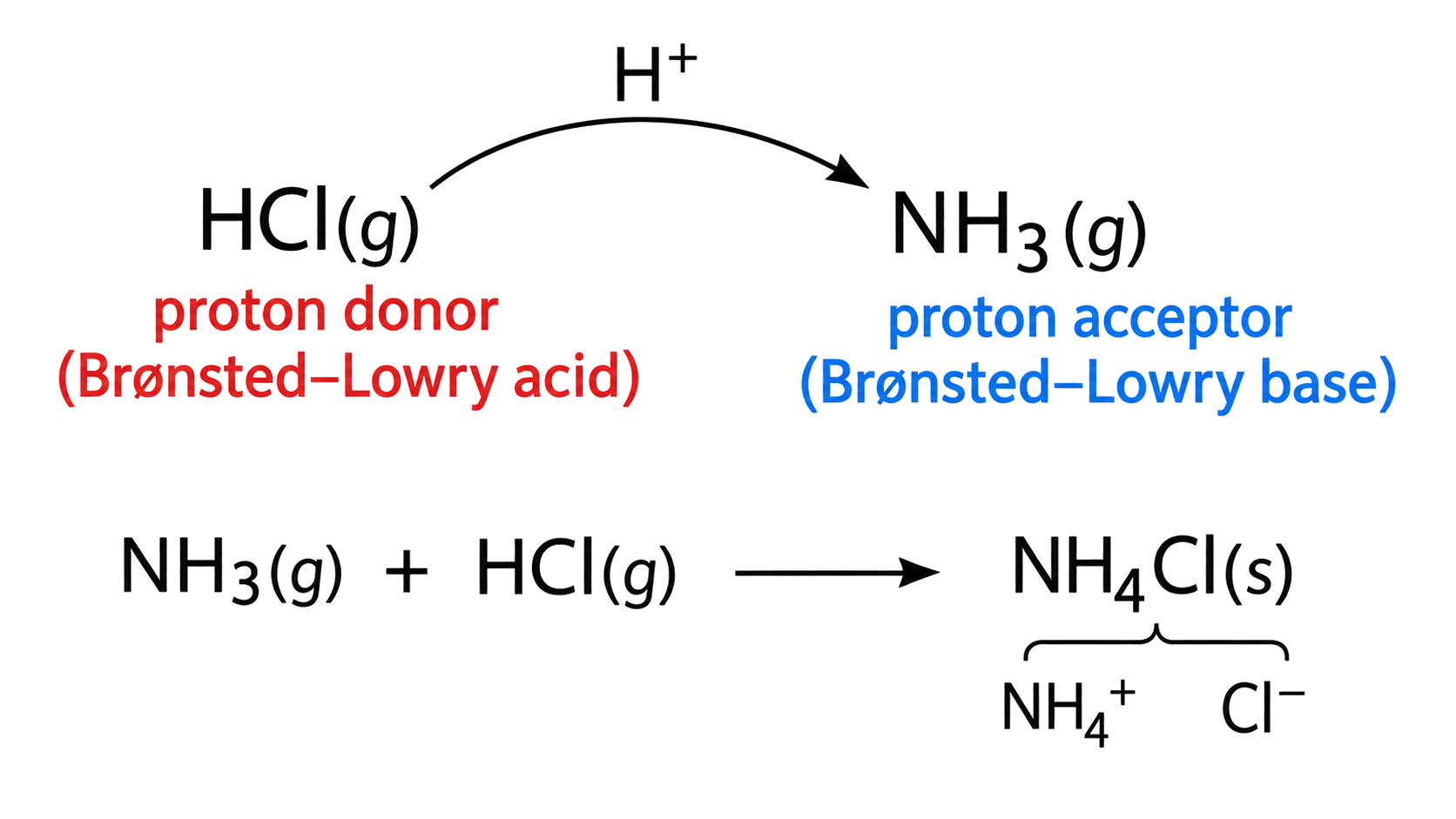
Follow the proton: the species losing it is the acid and the species gaining it is the base.

Pair species that differ by exactly one H⁺ to identify conjugate acid–base pairs. Charge alone does not decide the role: in NH₄⁺ + H₂O ⇌ NH₃ + H₃O⁺, NH₄⁺ is the proton donor and water is the acceptor.

Assigning Acid and Base Roles

Assessment in practice

Representative question

Question 1

[Maximum number: 2]

Describe whether ammonia acts as a Brønsted-Lowry acid or base in its reaction with water. Include an equation in your answer.

Conjugate Acid–Base Pairs

A conjugate base is what remains after an acid donates one proton. A conjugate acid is formed when a base accepts one proton; the pair differs by exactly one H+.

Remove H+ to find the conjugate base or add H+ to find the conjugate acid, then check the charge changes by one unit.

NH₄⁺/NH₃ and H₂CO₃/HCO₃⁻ are conjugate pairs because each pair differs by one H⁺. Removing H⁺ lowers charge by one; adding H⁺ raises it by one. Do not pair species merely because they occur on opposite sides of an equation—trace the specific proton transfer.

Deducing Conjugate Formulae

Assessment in practice

Representative question

Question 1

[Maximum number: 2]

A solution of nitrous acid contains two conjugate acid-base pairs.

State the formulas of the conjugate acid and conjugate base in each pair.

Conjugate acid:
Conjugate base:
Conjugate acid:
Conjugate base:

Amphiprotic Species

An amphiprotic species can donate H+ in one reaction and accept H+ in another.
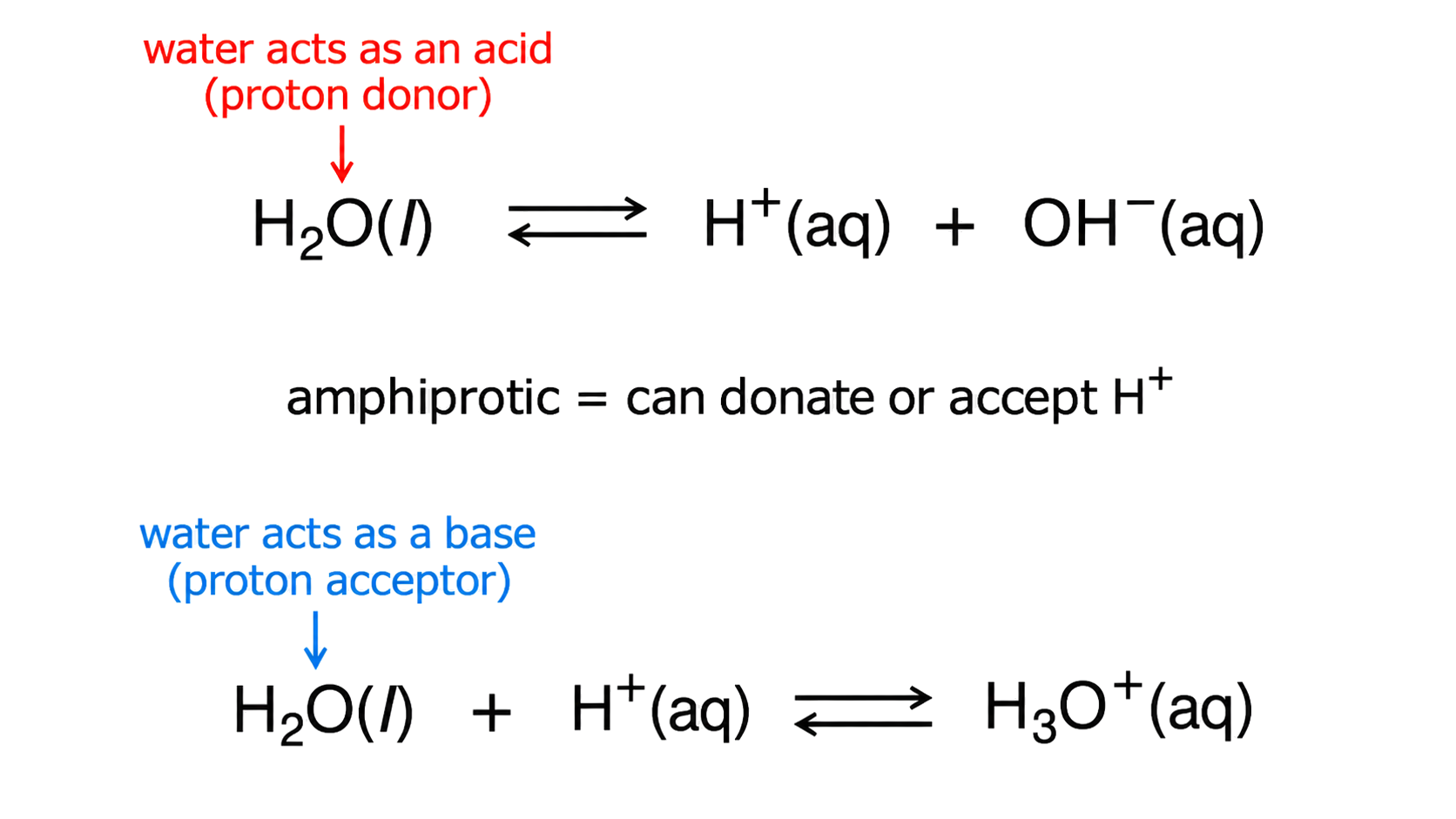
Write one equation in which the species becomes its conjugate base and another in which it becomes its conjugate acid.

For HCO₃⁻, donation gives CO₃²⁻ whereas acceptance gives H₂CO₃. Showing both reactions is the evidence for amphiprotic behaviour; one acid–base equation alone is insufficient.

Showing Amphiprotic Behaviour

Assessment in practice

Representative question

Question 1

[Maximum number: 2]

Formulate two equations to show the amphiprotic nature of H2PO4\mathrm{H}_{2} \mathrm{PO}_{4}^{-}.

pH and Hydrogen-Ion Concentration

pH=log10[H+];[H+]=10(pH)pH = −log10[H+]; [H+] = 10^(−pH)

pH is logarithmic: a one-unit change represents a tenfold concentration change. Universal indicator gives a colour range; a pH probe gives an instrumental pH measurement.

For [H⁺] = 2.0 × 10⁻³ mol dm⁻³, pH = 2.70; the leading 2 makes the answer non-integer. A colour indicator estimates a range, whereas a calibrated probe supports a numerical measurement.

Calculating pH and [H+]

Assessment in practice

Representative question

Question 1

[Maximum number: 1]

A solution has a pH of 3.0 . What is the hydrogen ion concentration in the solution in moldm3\mathrm{mol} \mathrm{dm}^{-3} ?

A

3.0×1033.0 \times 10^{-3}

B

1.0×1031.0 \times 10^{-3}

C

1.0×1031.0 \times 10^{3}

D

3.0×1033.0 \times 10^{3}

The Ion Product of Water

Kw=[H+][OH]Kw = [H+][OH−]

Solution Ion comparison
acidic [H+] > [OH−]
neutral [H+] = [OH−]
basic [H+] < [OH−]

At 25 °C, Kw = 1.0 × 10⁻¹⁴, so a neutral solution has [H⁺] = [OH⁻] = 1.0 × 10⁻⁷ mol dm⁻³. Neutrality always means equal ion concentrations; neutral pH is not necessarily 7 when temperature changes.

At a fixed temperature, Kw is constant, so [OH-] = Kw/[H+]: a higher [H+] means a lower [OH-]. For example, at pH 9.3 and 25 C, [OH-] = 2.0 x 10^-5 mol dm^-3. Classify a solution from the ion comparison; do not assume neutral pH is 7 at every temperature.

Classifying Solutions with Kw

Assessment in practice

Representative question

Question 1

[Maximum number: 1]

Calculate the concentration of hydroxide ions in an ammonia solution with pH=9.3. Use sections 1 and 2 of the data booklet.

Strong and Weak Acids and Bases

A strong acid or base ionizes completely in aqueous solution; a weak acid or base ionizes only partially. The equilibrium favours the weaker conjugate species.
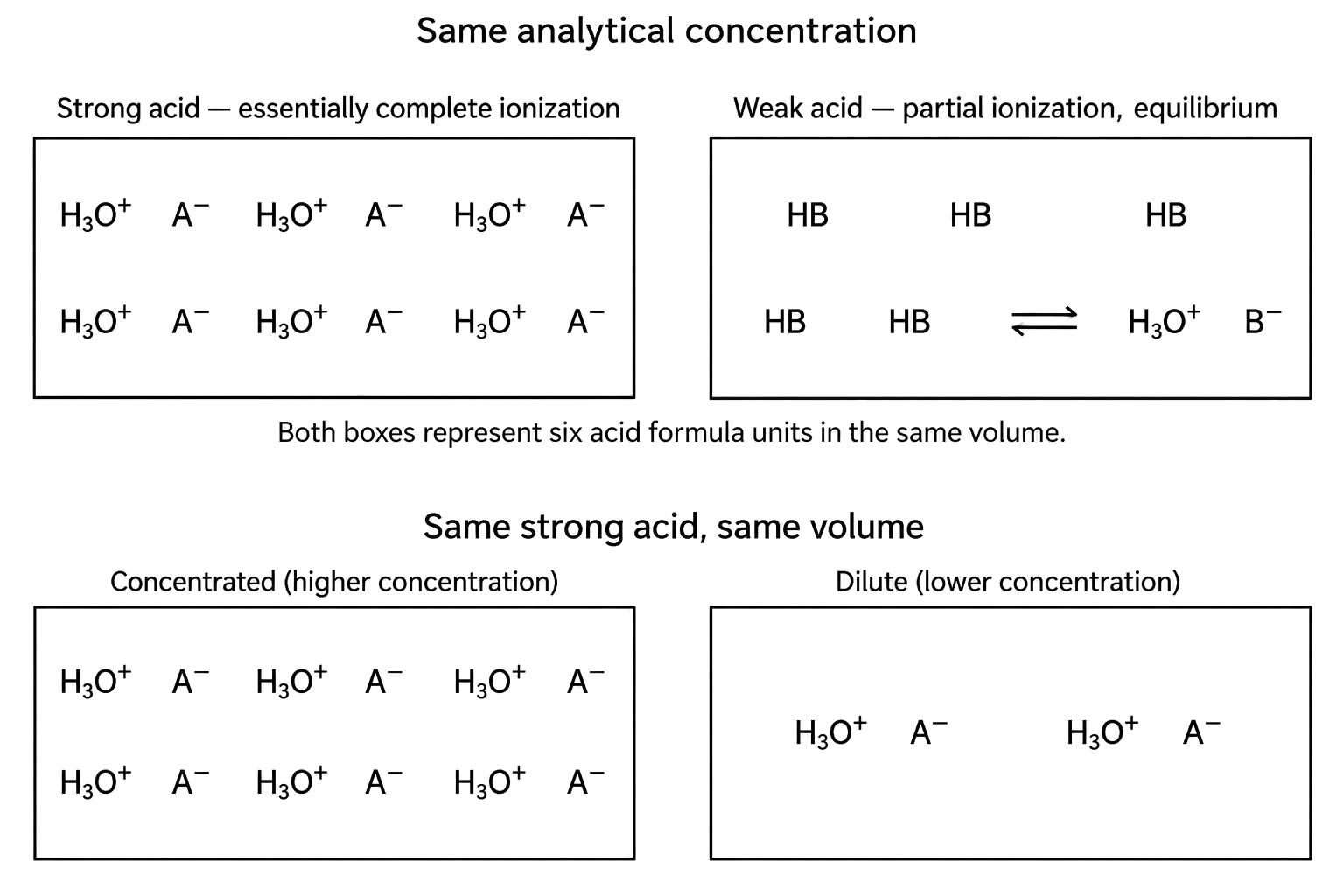
Strength is the extent of ionization, whereas concentration is the amount of solute per volume. A concentrated weak acid can be more acidic than a dilute strong acid.

Represent a strong acid with essentially complete ionization and a weak acid with an equilibrium containing substantial undissociated acid. Strength is an equilibrium property, while concentration is an initial amount per volume; pH depends on both, so strength alone cannot rank arbitrary solutions.

Distinguishing Strength from Concentration

Assessment in practice

Representative question

Question 1

[Maximum number: 2]

Explain the difference in pH .

Neutralization Reactions

Acids neutralize metal oxides and hydroxides to form salt and water. Carbonates and hydrogencarbonates also produce carbon dioxide when the reaction requires it; balance all formulae and coefficients.

Identify the parent acid and parent base of a salt by tracing its anion and cation back to the neutralization reactants.

Balance proton capacity as well as atoms: H₂SO₄ + 2NaOH → Na₂SO₄ + 2H₂O, while an acid–carbonate reaction also releases CO₂. To identify parents of Na₂SO₄, trace SO₄²⁻ to the acid and Na⁺ to the base rather than treating the salt name as a reaction equation.

Writing Neutralization Equations

Assessment in practice

Representative question

Question 1

[Maximum number: 1]

Write two equations showing how these antacids neutralize excess hydrochloric acid.

Magnesium carbonate:

Aluminium hydroxide:

Strong-Acid–Strong-Base Titration Curves

The equivalence point is where stoichiometric amounts of analyte and titrant have reacted. A monoprotic strong-acid–strong-base curve has a steep neutral region centred at the equivalence point.
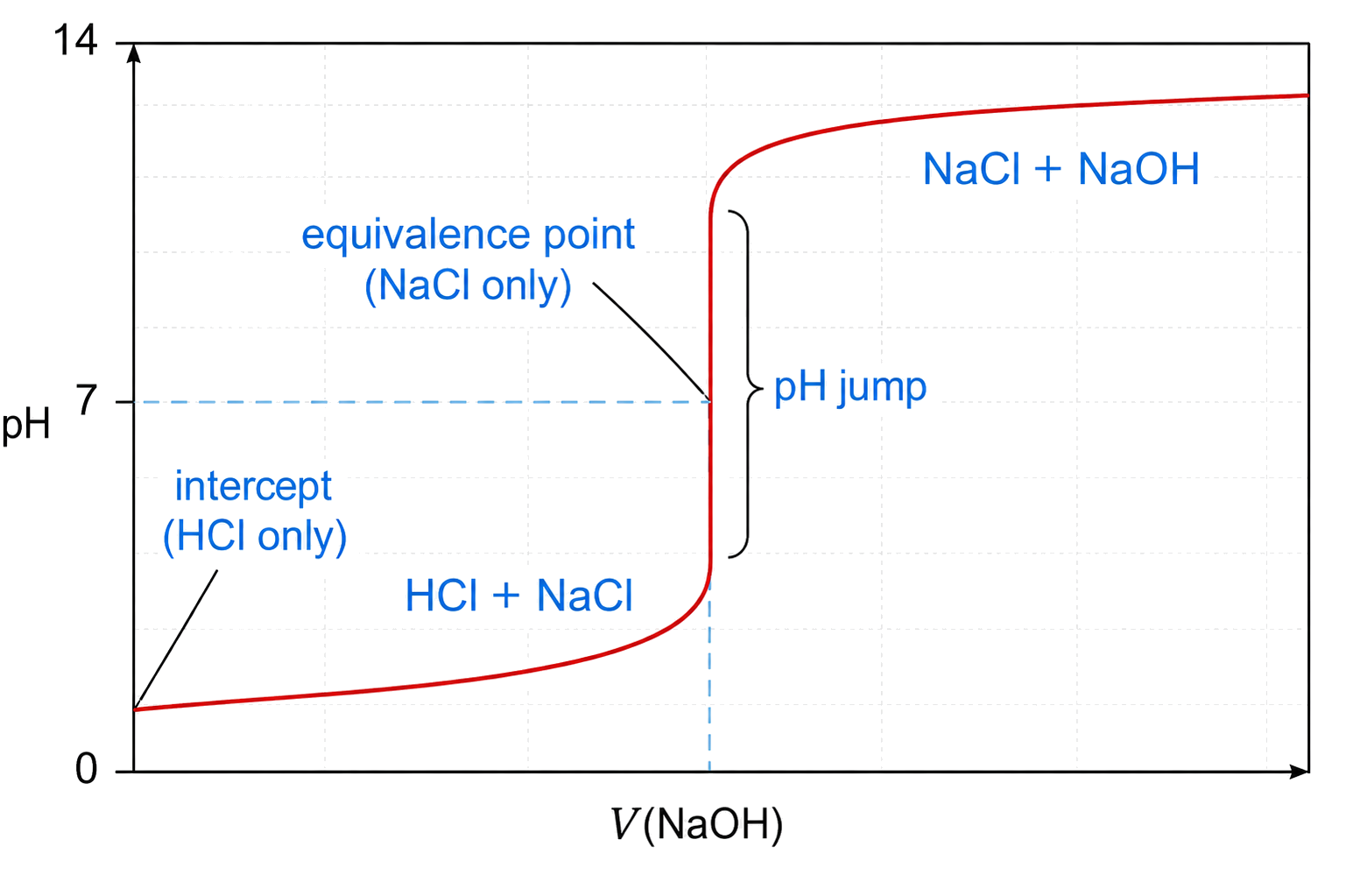
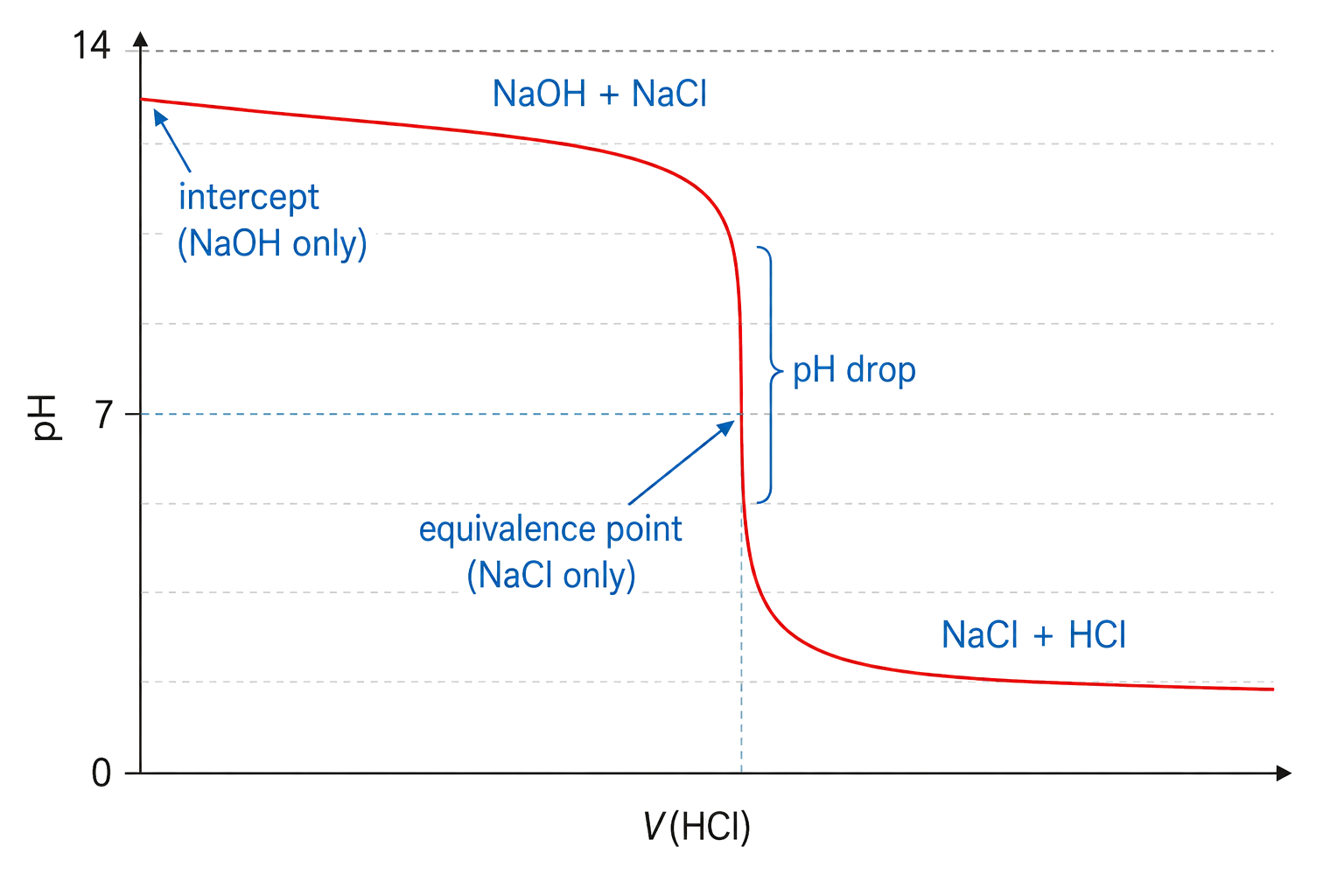
Read the initial pH, steep intercept region and final plateau; curve direction depends on whether acid or base is added.

For a strong acid titrated with strong base at 25 °C, calculate the initial pH from excess acid, locate equivalence from stoichiometric moles, and place the steep section around pH 7. Equivalence is a mole condition; it is not the same as equal solution volumes unless concentrations and stoichiometry make it so.

Interpreting a Strong Titration Curve

Assessment in practice

Representative question

Question 1

[Maximum number: 1]

Which graph would be obtained by adding 0.10moldm3HCl(aq)0.10 \mathrm{moldm}^{-3} \mathrm{HCl}(\mathrm{aq}) to 25 cm325 \mathrm{~cm}^{3} of 0.10moldm3NaOH(aq)0.10 \mathrm{moldm}^{-3} \mathrm{NaOH}(\mathrm{aq}) ?

A
B
C
D

Proton Transfer Reactions Summary

Retrieve the route: track proton transfer and conjugates, calculate pH and Kw, distinguish strength, balance neutralization, read titration curves, use Ka/Kb and hydrolysis, select indicators, and explain and calculate buffer behaviour.

Check donor versus acceptor, one-proton differences, logarithm direction, ion comparison, strength versus concentration, equivalence versus endpoint, pKa landmarks, conjugate equations and dilution ratios.

Topic 3.2

3.2 Electron transfer reactions

Objectives in this topic

Oxidation and Reduction

Oxidation is loss of electrons and an increase in oxidation state; reduction is gain of electrons and a decrease. The oxidizing agent is reduced, and the reducing agent is oxidized.

Use the oxidation-state rules and total charge to identify which species changed and which agent caused the change.

In Zn + Cu²⁺ → Zn²⁺ + Cu, Zn rises from 0 to +2 and is oxidized, so it is the reducing agent; Cu²⁺ falls from +2 to 0 and is reduced, so it is the oxidizing agent. Name agents from what happens to them, not from the process they cause in the other species.

Identifying Redox Agents

Assessment in practice

Representative question

Question 1

[Maximum number: 2]

Identify the oxidising and reducing agents, and the species oxidised and reduced, in the forward reaction.

CO(g)\mathbf{C O}(\mathbf{g})H2O(g)\mathbf{H}_{\mathbf{2}} \mathbf{O}(\mathbf{g})
oxidising or reducing agent?
species oxidised or reduced?

Redox Half-Equations

Separate oxidation and reduction, balance atoms, add H2O and H+ in acidic solution as needed, balance charge with electrons, then multiply to cancel electrons before adding.

A valid full redox equation conserves atoms and charge and contains no uncancelled electrons.

For MnO₄⁻ → Mn²⁺ in acid, balance O with 4H₂O, H with 8H⁺ and charge with 5e⁻: MnO₄⁻ + 8H⁺ + 5e⁻ → Mn²⁺ + 4H₂O. After combining halves, cancel electrons and any identical H⁺ or H₂O, then recheck both atoms and net charge.

To adapt an acidic half-equation to neutral or basic conditions, first balance it with H₂O, H⁺ and e⁻. Add the same number of OH⁻ to both sides to neutralize every H⁺, replace H⁺+OH⁻ by H₂O, then cancel water appearing on both sides. Recheck atoms and total charge; do not leave free H⁺ in a stated neutral medium unless the chemistry justifies it.

Balancing Redox Equations

Assessment in practice

Representative question

Question 1

[Maximum number: 2]

The reaction continues until the violet colour disappears. The thiosulfate ion, S2O32\mathrm{S}_{2} \mathrm{O}_{3}{ }^{2-}, is oxidized to SO2\mathrm{SO}_{2}, and Fe3+\mathrm{Fe}^{3+} is reduced to Fe2+\mathrm{Fe}^{2+}. Deduce the oxidation half-equation, and the overall redox equation for this second step of the reaction.

Oxidation half-equation:
Overall redox equation:

Redox Displacement

A more active metal more readily donates electrons to a less active metal ion. A halogen with greater reduction tendency oxidizes the halide of a weaker halogen.

Test a predicted displacement by placing one metal in the other metal's sulfate or comparing supplied electrode data.

Zinc displaces Cu²⁺ because Zn more readily oxidizes: Zn + Cu²⁺ → Zn²⁺ + Cu. Chlorine displaces Br⁻ because Cl₂ more readily reduces. Keep the metal and halogen trends in their correct electron directions instead of using one vague 'more reactive' rule.

Predicting Displacement Reactions

Assessment in practice

Representative question

Question 1

[Maximum number: 2]

Discuss how the relative reactivity of copper and thallium could be established using the metals and aqueous solutions of their sulfates.

Metals with Dilute Acids

A metal above hydrogen in the activity series can donate electrons to acid and release hydrogen gas; a metal below hydrogen, such as copper, does not react with dilute hydrochloric acid.

metal+acidsalt+H2(g)metal + acid → salt + H2(g)

Balance the electron transfer behind the molecular equation: metal atoms are oxidized and 2H⁺ + 2e⁻ → H₂ is the reduction. Use the metal charge and acid anion to construct the salt rather than assuming every metal forms a 2+ ion.

Predicting Hydrogen Release

Assessment in practice

Representative question

Question 1

[Maximum number: 2]

Outline, using an ionic equation, what is observed when magnesium powder is added to a solution of ammonium chloride.

Anodes, Cathodes and Polarity

Oxidation always occurs at the anode and reduction always occurs at the cathode. In a voltaic cell the anode is negative and cathode positive; in an electrolytic cell the anode is positive and cathode negative.
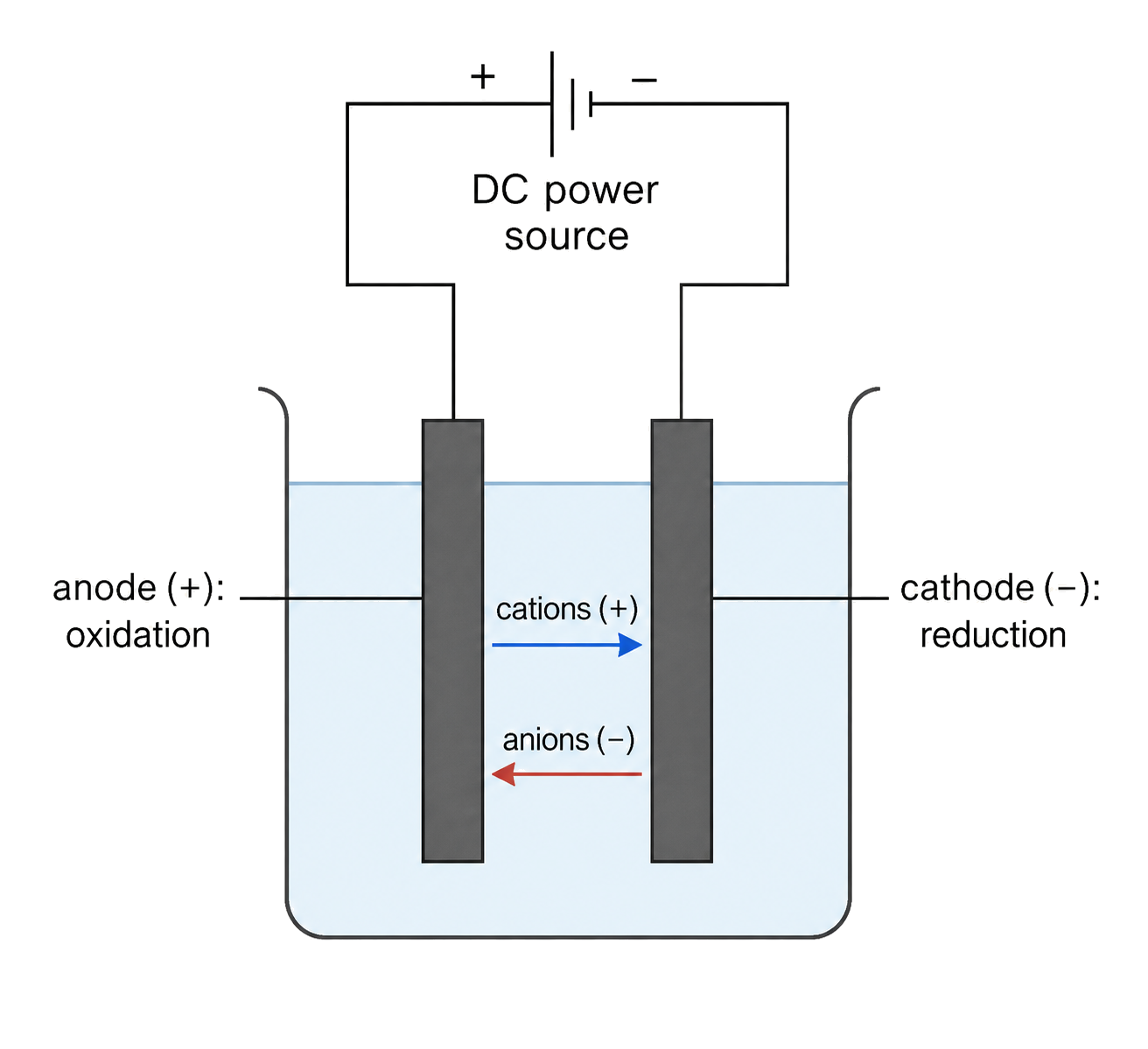
Name electrodes from the half-reactions before assigning signs. Electrons leave the anode and reach the cathode through the external circuit; a power supply reverses the polarities in an electrolytic cell but never changes where oxidation and reduction occur.

Labelling Electrochemical Cells

Assessment in practice

Representative question

Question 1

[Maximum number: 2]

Annotate the electrolytic cell with the terms anode and cathode, and show the direction of ion movement.

Voltaic Cells

A voltaic cell uses a spontaneous redox reaction to convert chemical energy to electrical energy. Electrons flow through the wire from anode to cathode; the salt bridge carries ions to maintain charge neutrality.
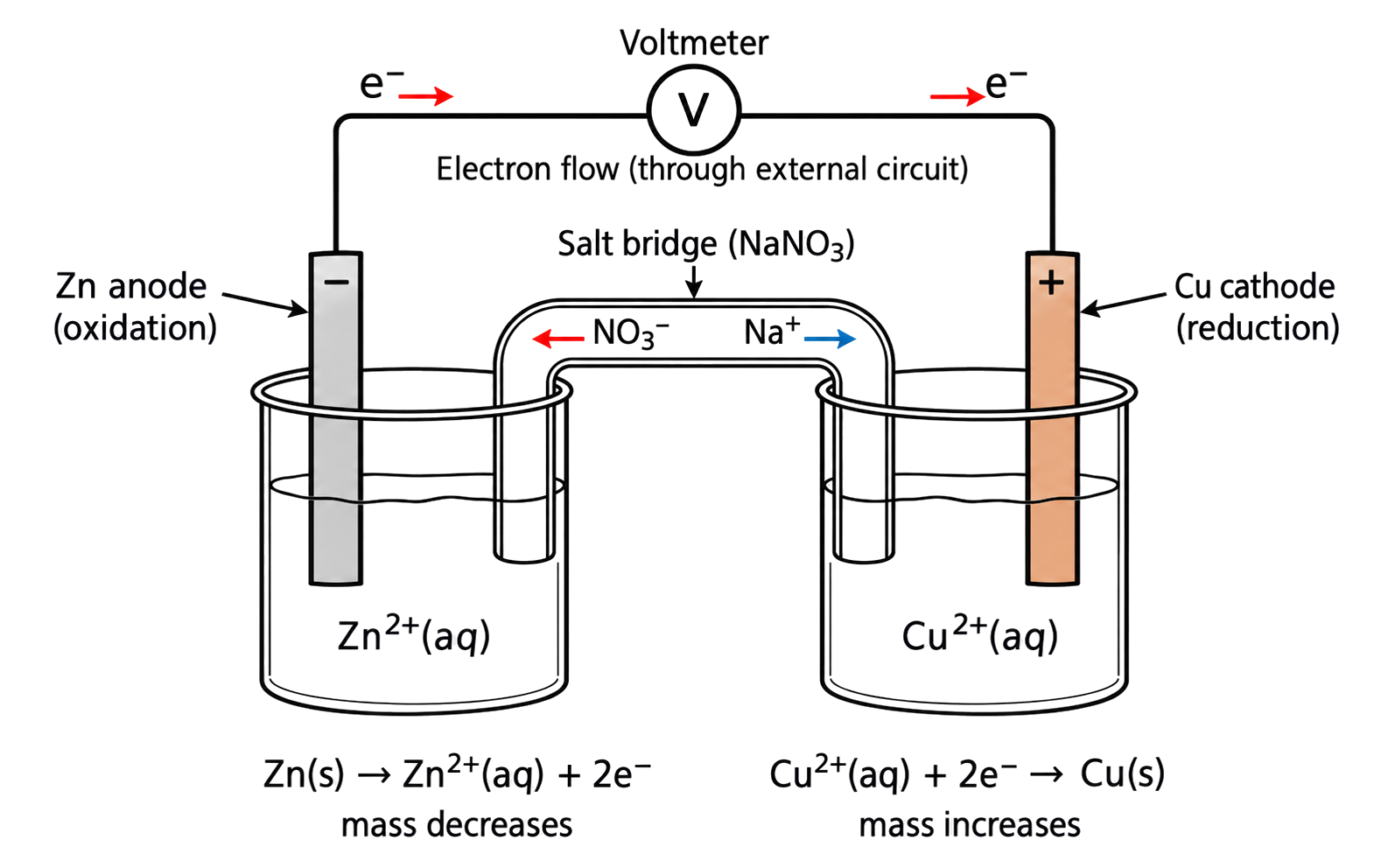
Both half-cells connect to the external circuit and the salt bridge must contact both solutions.

In a Zn|Zn²⁺ || Cu²⁺|Cu cell, Zn is oxidized at the negative anode and electrons travel through the wire to the positive Cu cathode, where Cu²⁺ is reduced. Salt-bridge anions migrate toward the anode compartment and cations toward the cathode compartment to prevent charge buildup; electrons do not flow through the bridge.

Completing a Voltaic-Cell Diagram

Assessment in practice

Representative question

Question 1

[Maximum number: 3]

Simple cells rely on differences in standard electrode potential values between different elements and their ions. The following is an incomplete diagram for measuring a cell potential between Mn2+(aq)/Mn\mathrm{Mn}^{2+}(\mathrm{aq}) / \mathrm{Mn} and Ni2+(aq)/Ni\mathrm{Ni}^{2+}(\mathrm{aq}) / \mathrm{Ni} half-cells.

Draw the missing components and fully label the diagram to show how the cell potential can be measured.

Primary, Secondary and Fuel Cells

Cell Energy direction Reuse
primary chemical → electrical not readily reversible
secondary chemical ⇌ electrical recharge by external power
fuel chemical → electrical while reactants are supplied refill fuel

Write the discharge half-equations first. Charging a secondary cell requires an external potential to drive their reverse, whereas a primary cell is not designed for safe efficient reversal and a fuel cell continues only while reactants are supplied. Rechargeability is a reaction-design property, not simply the presence of a power socket.

Explaining Rechargeability

Assessment in practice

Representative question

Question 1

[Maximum number: 1]

Outline how a rechargeable battery differs from a primary cell.

Molten-Salt Electrolysis

In molten salt there is no water: metal ions are reduced to metal at the cathode and anions are oxidized at the anode. For molten chloride, chloride forms chlorine gas.
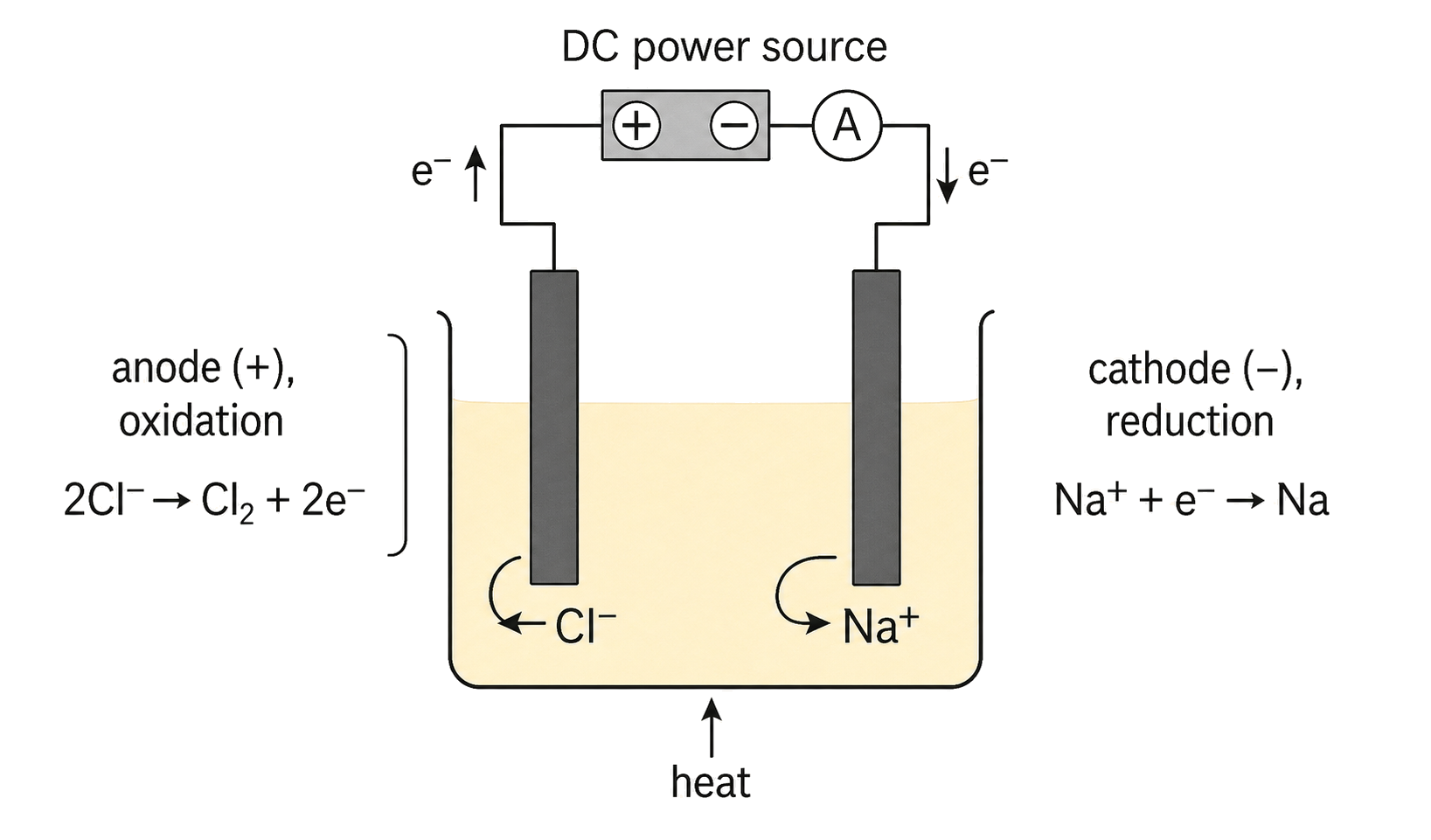
M(n+)+neMatcathode;2XX2+2eatanodeM^(n+) + ne− → M at cathode; 2X− → X2 + 2e− at anode

Molten MgCl₂ contains only Mg²⁺ and Cl⁻: Mg²⁺ + 2e⁻ → Mg at the cathode and 2Cl⁻ → Cl₂ + 2e⁻ at the anode. The melt conducts by ion migration; do not introduce H₂, O₂ or water-based competition into a molten-salt question.

Deducing Molten-Electrolysis Products

Assessment in practice

Representative question

Question 1

[Maximum number: 2]

Deduce the products of the electrolysis of molten cobalt(II) bromide, CoBr2(l)\mathrm{CoBr}_{2}(\mathrm{l}).

Product at anode:
Product at cathode:

Oxidation of Alcohols

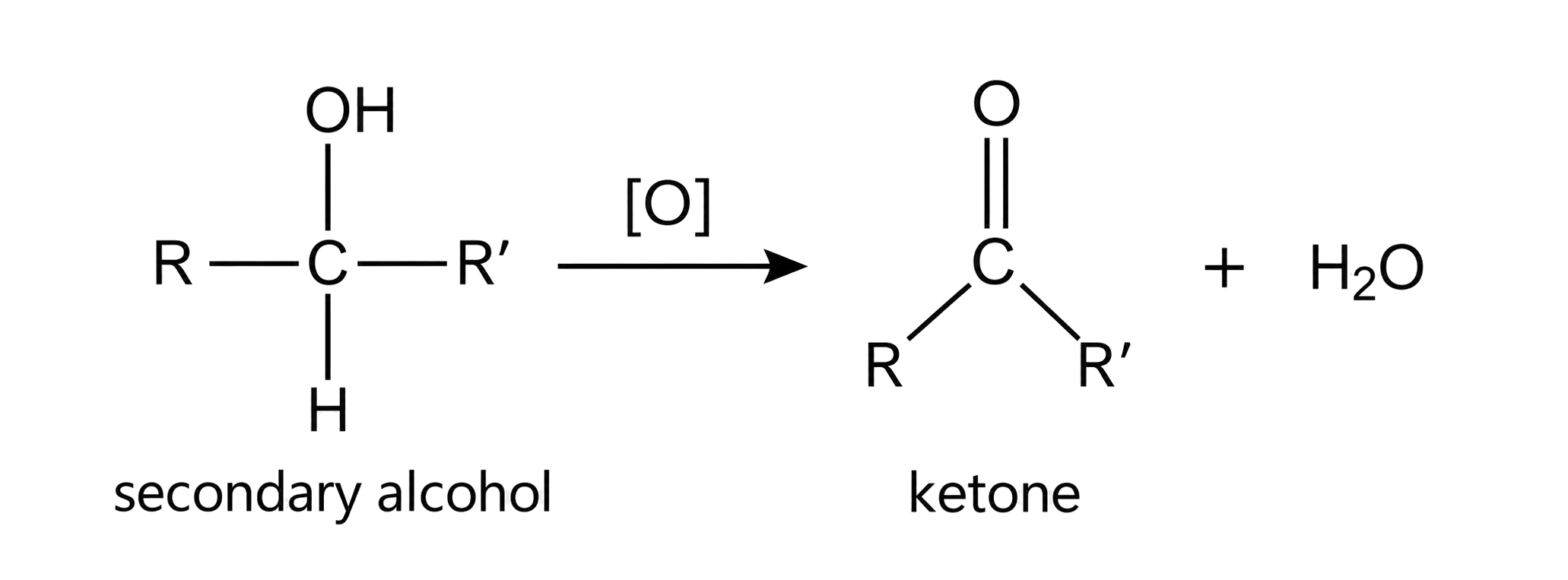
A primary alcohol oxidizes to an aldehyde and then a carboxylic acid; a secondary alcohol oxidizes to a ketone. Reflux supports further oxidation to the acid, while distillation can remove an aldehyde.
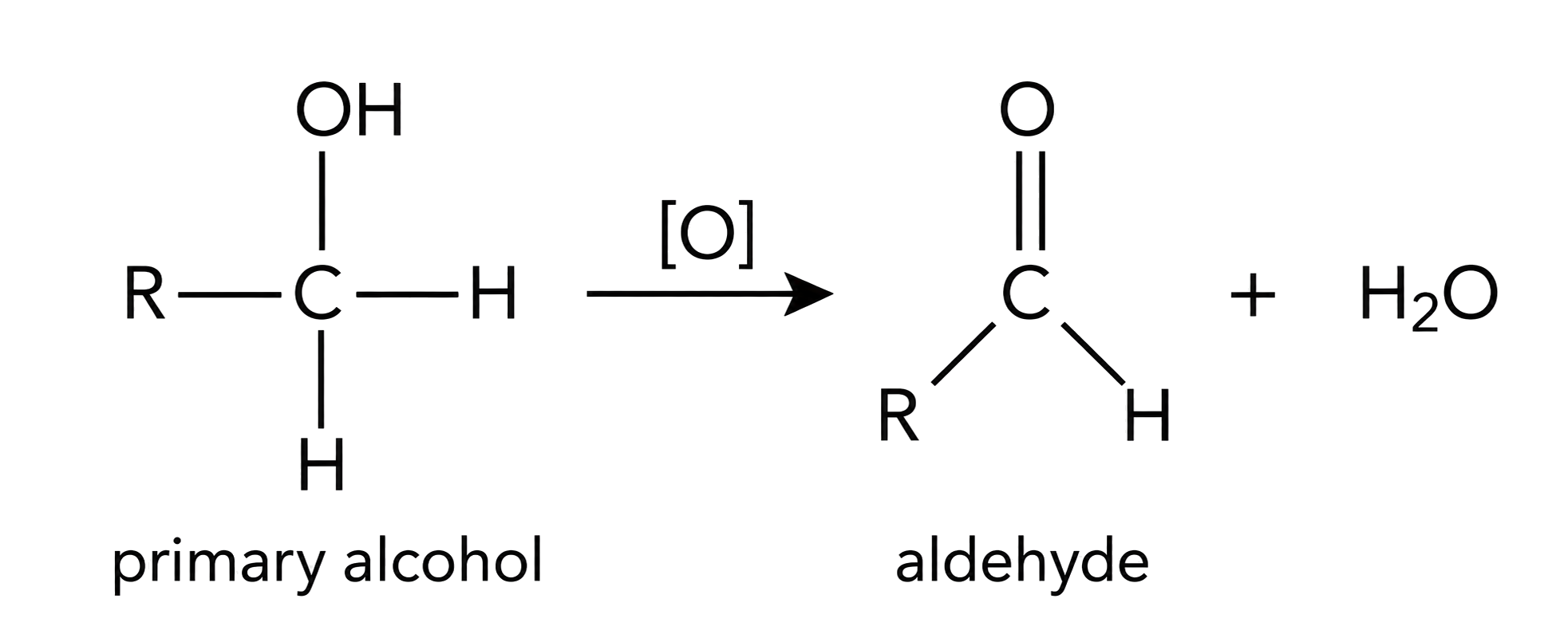
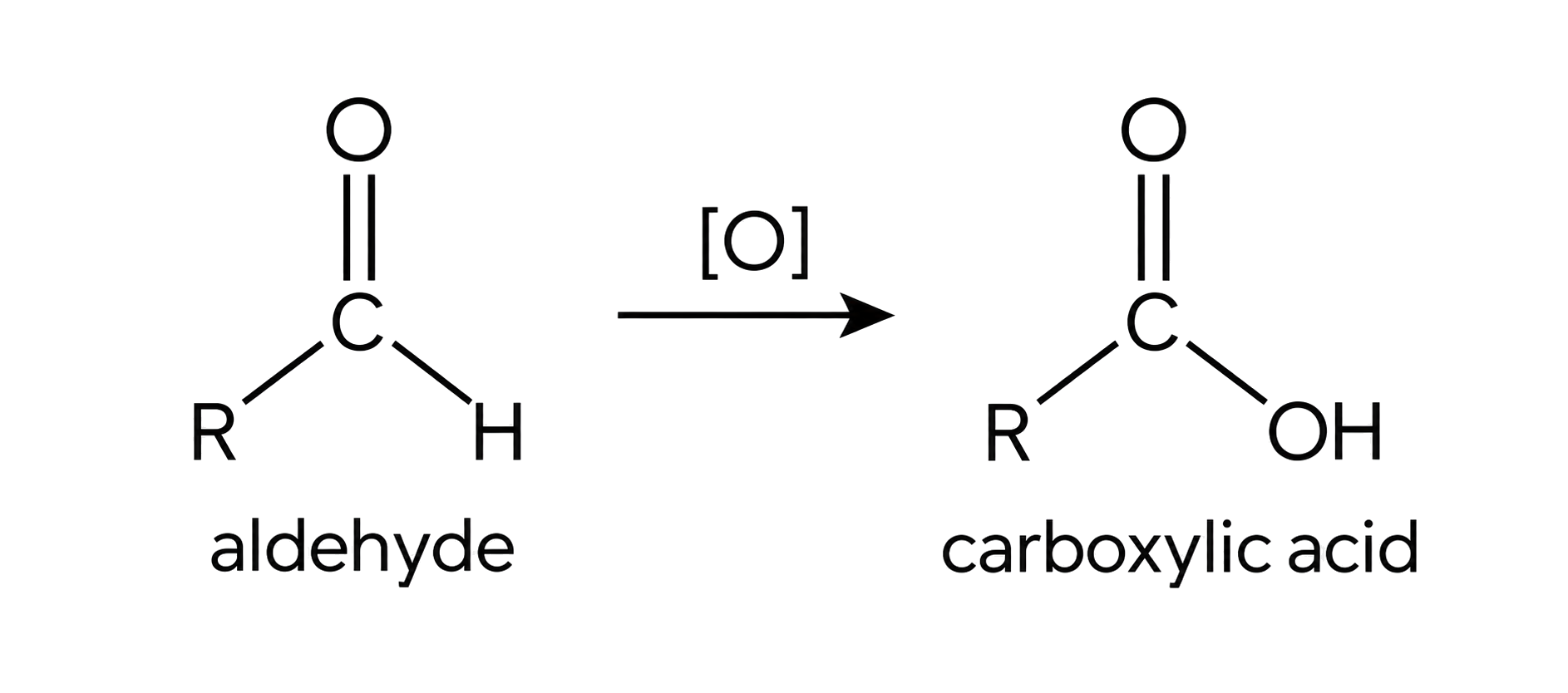
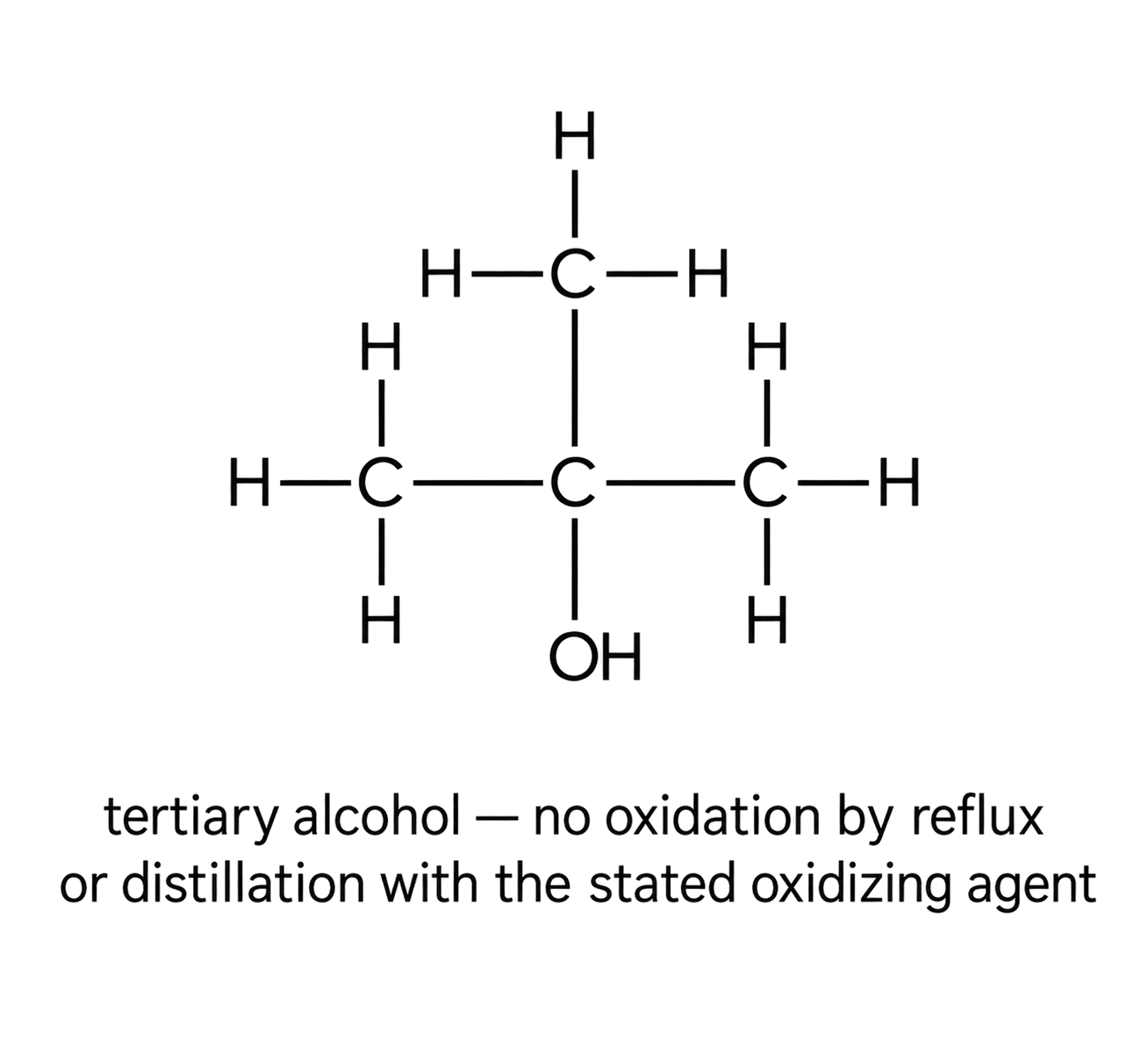
In a primary-alcohol experiment, distil the aldehyde as it forms to limit further oxidation; heat under reflux when the carboxylic acid is required. Tertiary alcohols lack the required hydrogen on the carbon bearing –OH and are not oxidized in the same way.

Choosing Alcohol-Oxidation Products

Assessment in practice

Representative question

Question 1

[Maximum number: 2]

Deduce the organic products when butan-1-ol and butan-2-ol are separately heated under reflux with acidified potassium dichromate(VI).

Butan-1-ol:
Butan-2-ol:

Reduction of Carbonyl Compounds

A carboxylic acid can be reduced through an aldehyde to a primary alcohol; a ketone is reduced to a secondary alcohol. Hydride ions supply the reduction equivalent in these transformations.
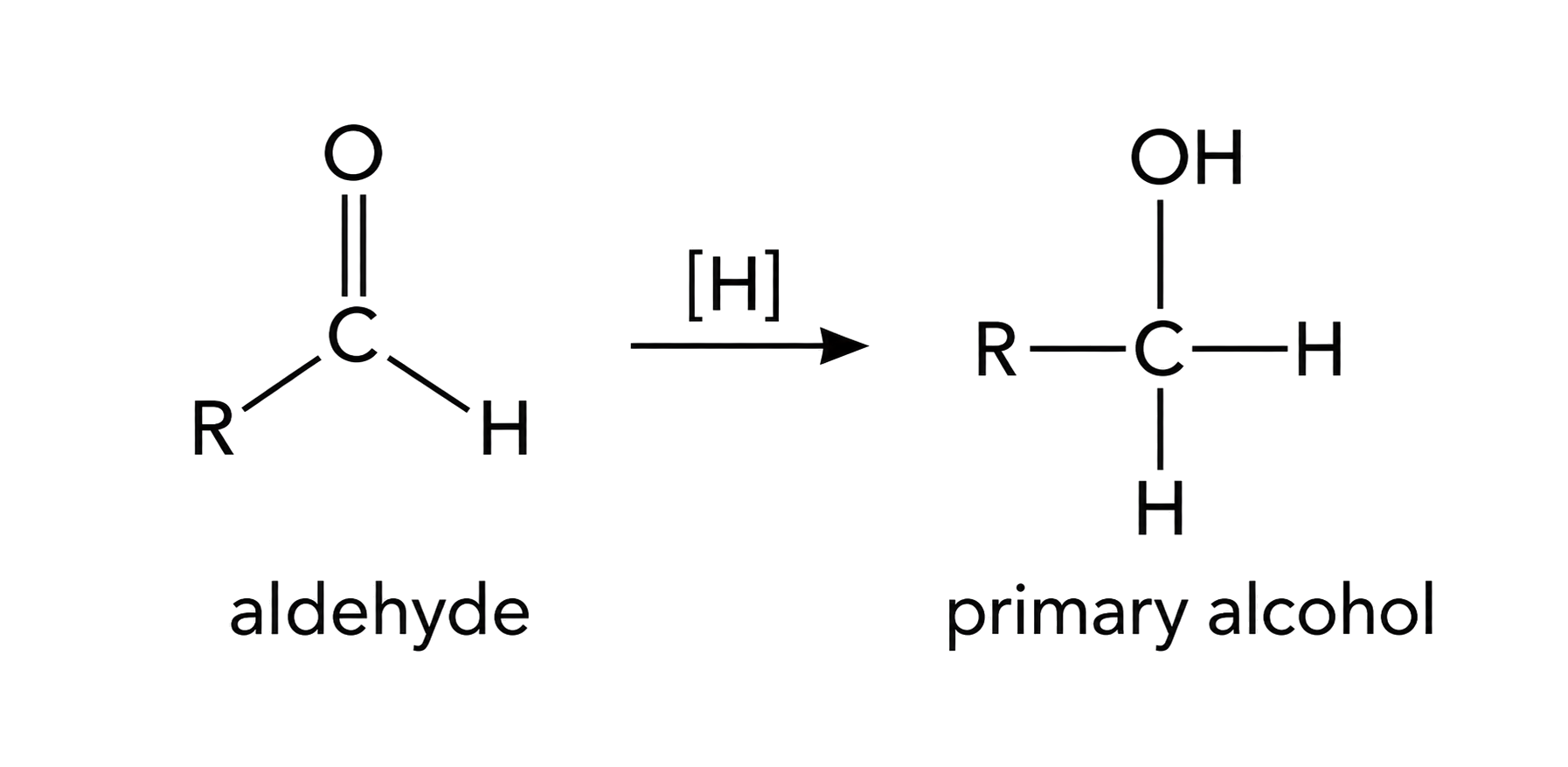
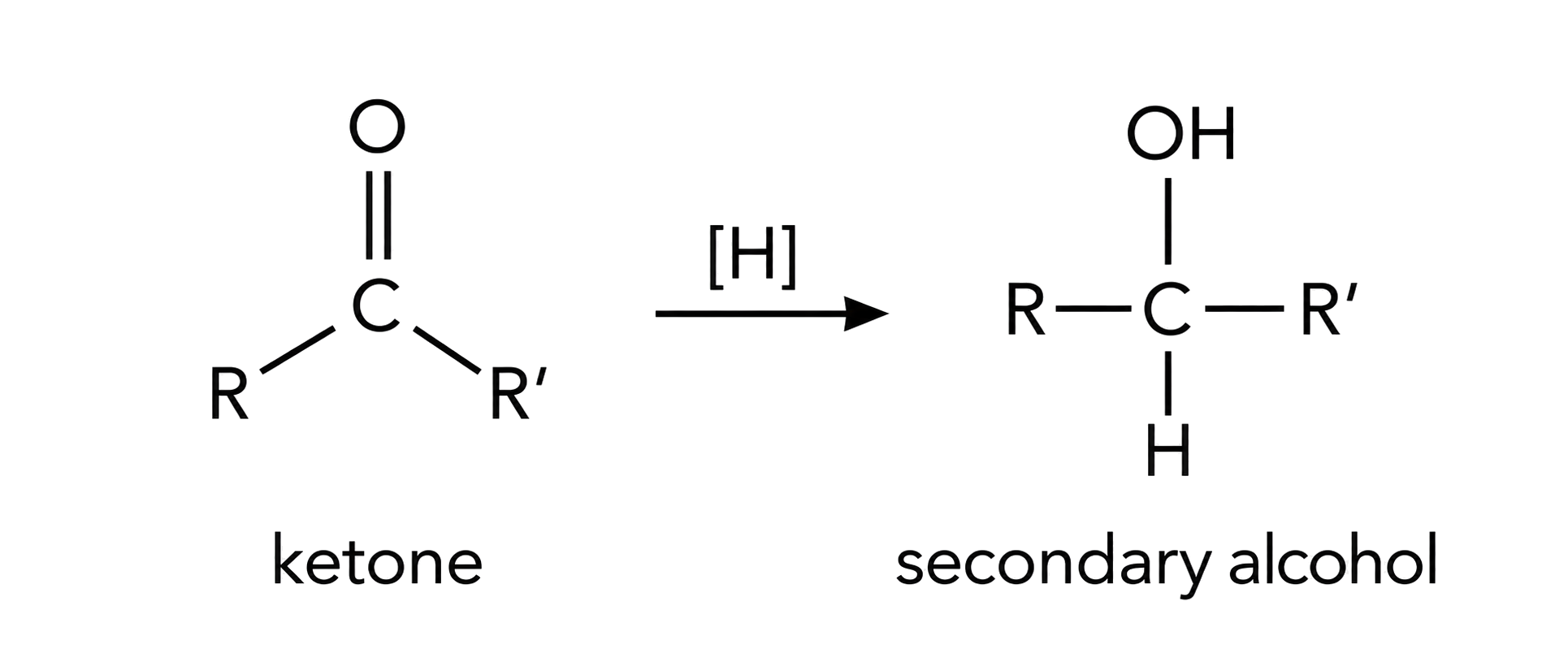
Track the carbon functional group rather than only the reagent: an aldehyde gives a primary alcohol and a ketone gives a secondary alcohol. Hydride supplies an electron-rich H unit to the carbonyl carbon; named reducing agents and detailed mechanisms are outside this objective.

Deducing Reduction Products

Assessment in practice

Representative question

Question 1

[Maximum number: 1]

Which product may be obtained by the reduction of CH3CH2COOH\mathrm{CH}_{3} \mathrm{CH}_{2} \mathrm{COOH} ?

A

CH3CH(OH)CH3\mathrm{CH}_{3} \mathrm{CH}(\mathrm{OH}) \mathrm{CH}_{3}

B

CH3CH2CH2OH\mathrm{CH}_{3} \mathrm{CH}_{2} \mathrm{CH}_{2} \mathrm{OH}

C

CH3CH2OCH3\mathrm{CH}_{3} \mathrm{CH}_{2} \mathrm{OCH}_{3}

D

CH3COOCH3\mathrm{CH}_{3} \mathrm{COOCH}_{3}

Hydrogenation of Alkenes and Alkynes

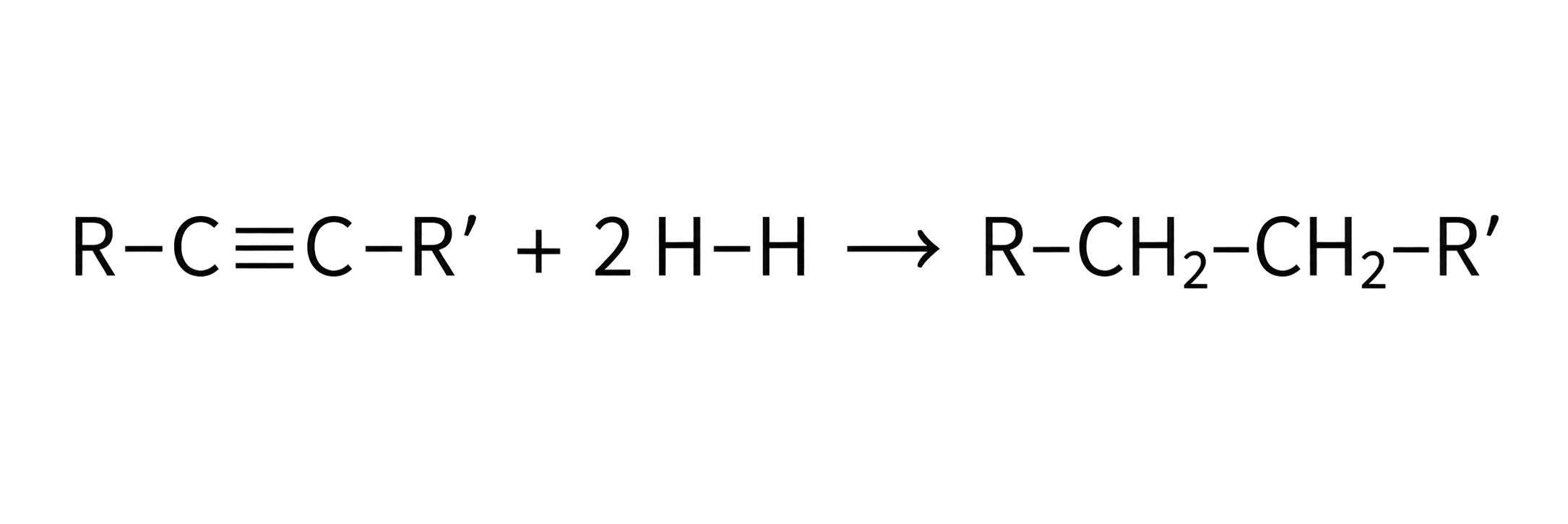
Hydrogenation adds H2 across π bonds. Continue addition until the required saturated product is formed; nickel, palladium or platinum catalysts with heat or pressure are typical conditions.
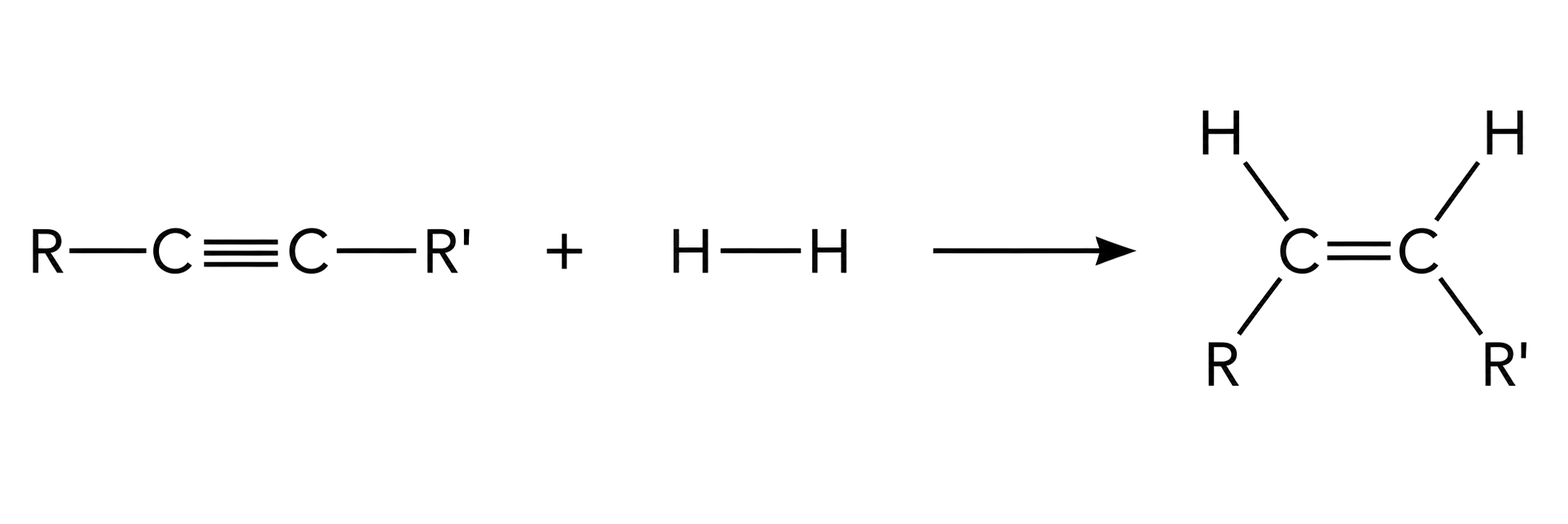
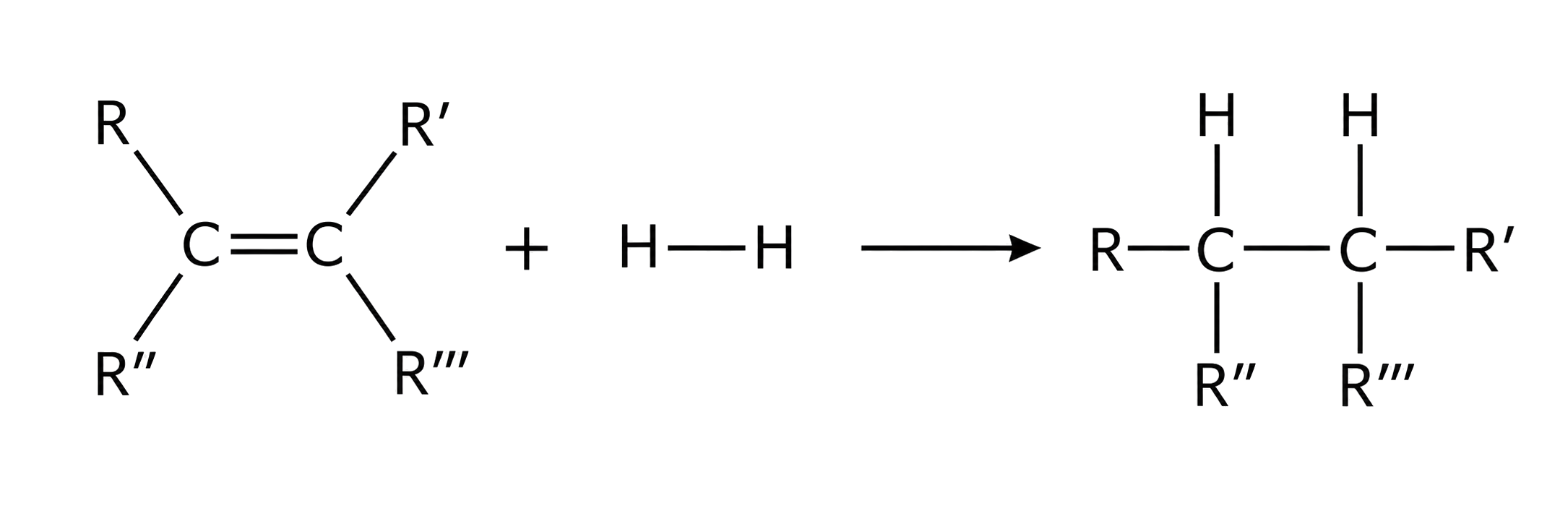
Count π bonds to determine hydrogen demand: one mole of H₂ saturates one C=C, while full conversion of one C≡C to C–C needs two moles of H₂. Keep the carbon skeleton unchanged when drawing the product.

Deducing Hydrogenation Products

Assessment in practice

Representative question

Question 1

[Maximum number: 2]

State the reagent and conditions needed and draw the structural formula of the product.

Electron Transfer Reactions Summary

Retrieve the route: assign oxidation states, balance half-equations, predict displacement, label cells, trace electrons and ions, follow organic redox pathways, calculate potentials and choose electrolysis products.

Check electron loss/gain, anode/cathode versus polarity, spontaneous sign, salt-bridge direction, ions present, organic functional-group direction and object-cathode placement.

Topic 3.3

3.3 Electron sharing reactions (Radicals)

Objectives in this topic

Free Radicals

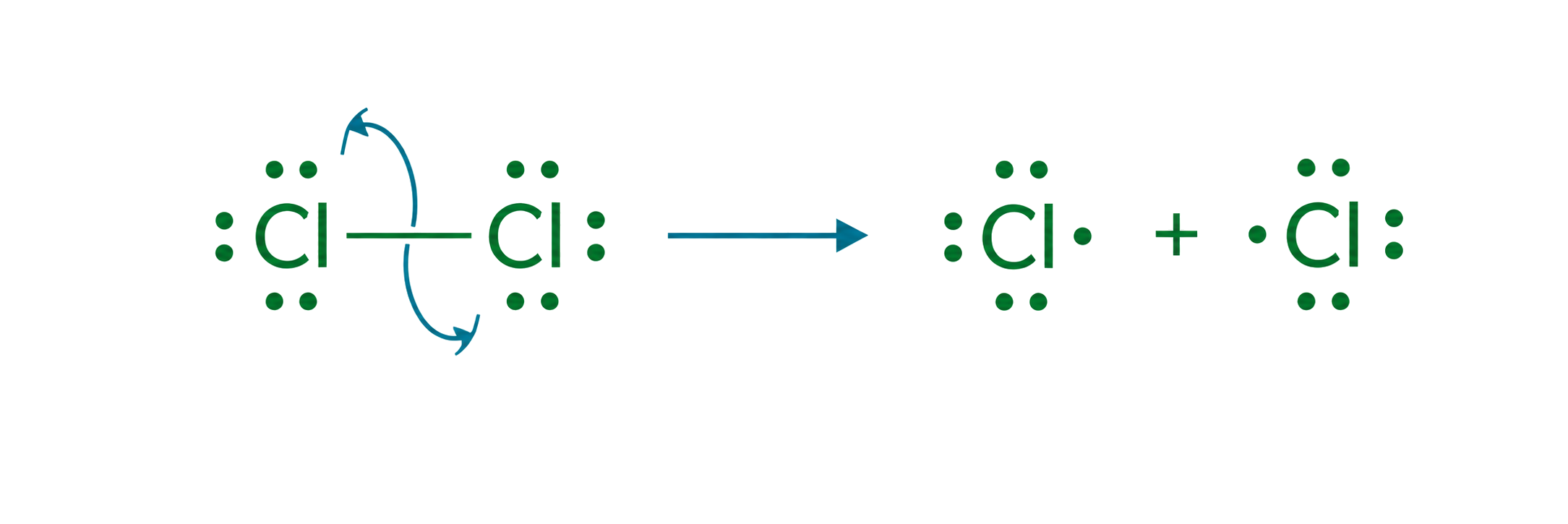
A radical is a highly reactive species containing an unpaired electron. Show the unpaired electron with a dot next to the atom that carries it.

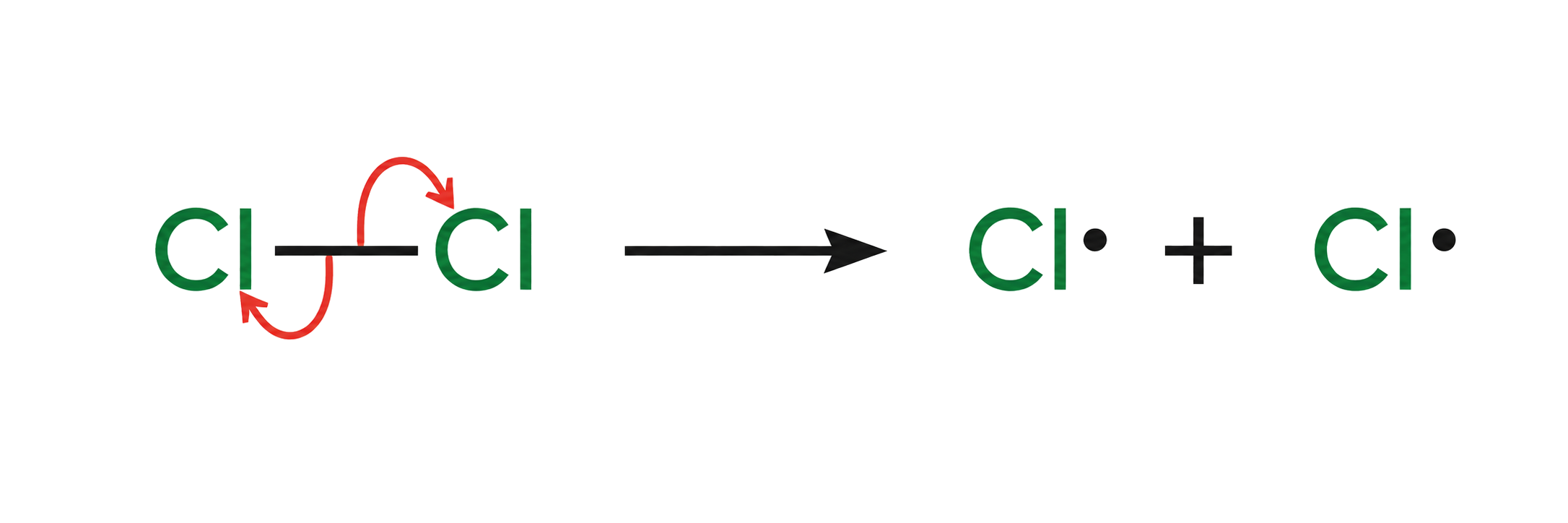
Homolytic fission creates radicals because each covalent-bond fragment retains one bonding electron.

The dot in Cl· or CH₃· represents one unpaired electron, not a positive or negative charge. Radicals react readily because pairing that electron can form a bond; track the dot through every equation so electron and atom accounting remain explicit.
Recognizing Radical Notation

Assessment in practice

Representative question

Question 1

[Maximum number: 1]

Which radical is most likely to form during the breakdown of one covalent bond of dichlorofluoromethane, CHCl2 F\mathrm{CHCl}_{2} \mathrm{~F}, in the upper atmosphere?

A

CHClF\cdot \mathrm{CHClF}

B

CCl2 F\cdot \mathrm{CCl}_{2} \mathrm{~F}

C

CHCl2\cdot \mathrm{CHCl}_{2}

D

CHCl2 F\cdot \mathrm{CHCl}_{2} \mathrm{~F}

Homolytic Fission and Initiation

Cl2(g)2Cl(g)underUVlightorheatCl2(g) → 2Cl·(g) under UV light or heat

Homolytic cleavage gives one electron to each fragment. Use single-electron arrows to show radical movement in the chain mechanism.

Draw two single-barbed arrows from the breaking X–X bond, one toward each atom, to account for both electrons. The UV or heat step creates radicals and is initiation; a step that consumes one radical and forms another belongs to propagation.

Writing the Initiation Step

Assessment in practice

Representative question

Question 1

[Maximum number: 1]

Write an equation for the initiation reaction.

Free-Radical Substitution

Initiation creates radicals; propagation abstracts H from an alkane and then regenerates the halogen radical; termination combines radicals. A mixture can form because substitution may occur at different positions.
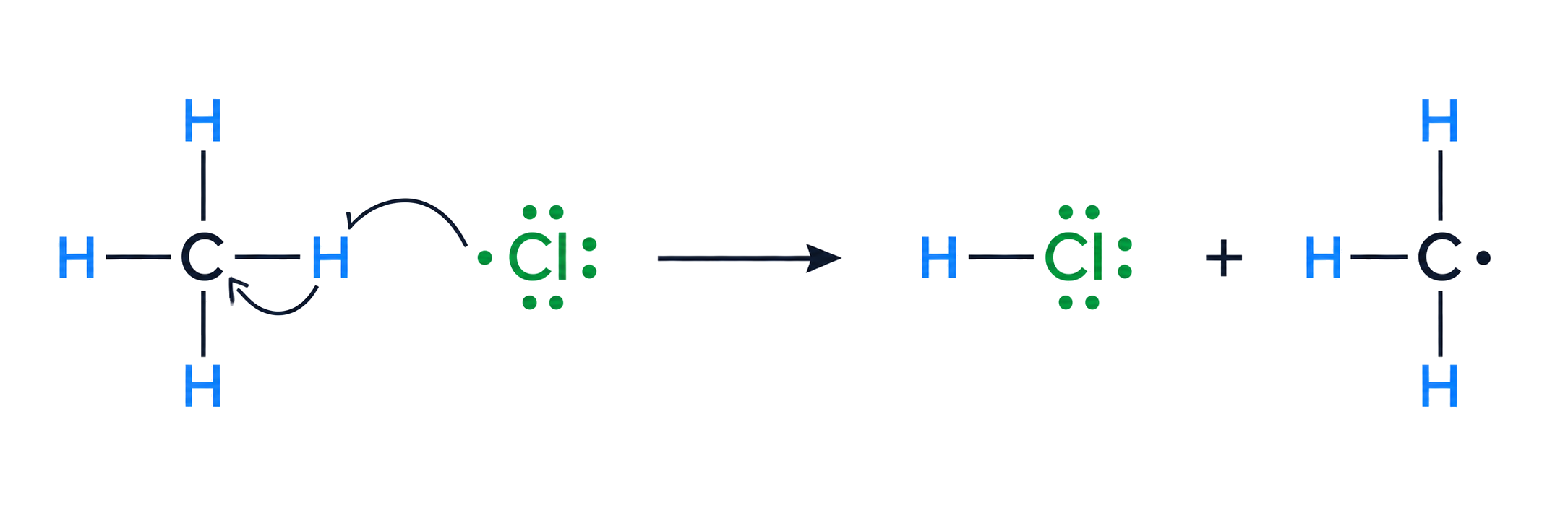
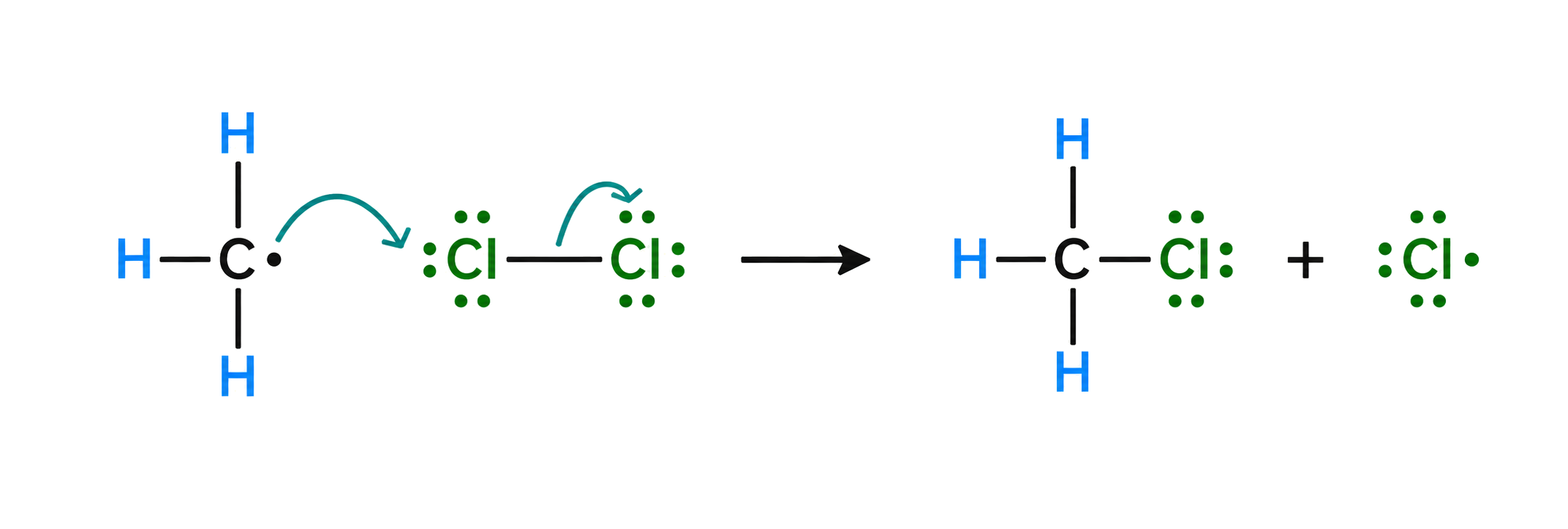
C2H6+ClC2H5+HCl;C2H5+Cl2C2H5Cl+ClC2H6 + Cl· → C2H5· + HCl; C2H5· + Cl2 → C2H5Cl + Cl·

For methane chlorination, initiation forms 2Cl· from Cl₂ under UV. Propagation uses Cl· + CH₄ → HCl + CH₃· and CH₃· + Cl₂ → CH₃Cl + Cl·; termination combines two radicals. Further substitution creates a mixture, so the mechanism does not guarantee only CH₃Cl.

Writing Chain-Substitution Equations

Assessment in practice

Representative question

Question 1

[Maximum number: 4]

Explain the reaction mechanism by writing equations for each step.

One initiation step:
Two propagation steps:

One termination step:

Radical Chain Summary

Retrieve the route: locate the unpaired electron, split the bond homolytically, initiate with UV or heat, propagate by single-electron steps and terminate by radical combination.

Every propagation step must regenerate a radical, and every radical symbol and single-electron movement must be shown where required.

Topic 3.4

3.4 Electron-pair sharing reactions

Objectives in this topic

Recognizing Nucleophiles

A nucleophile is an electron-rich species that donates an electron pair to an electron-deficient centre.
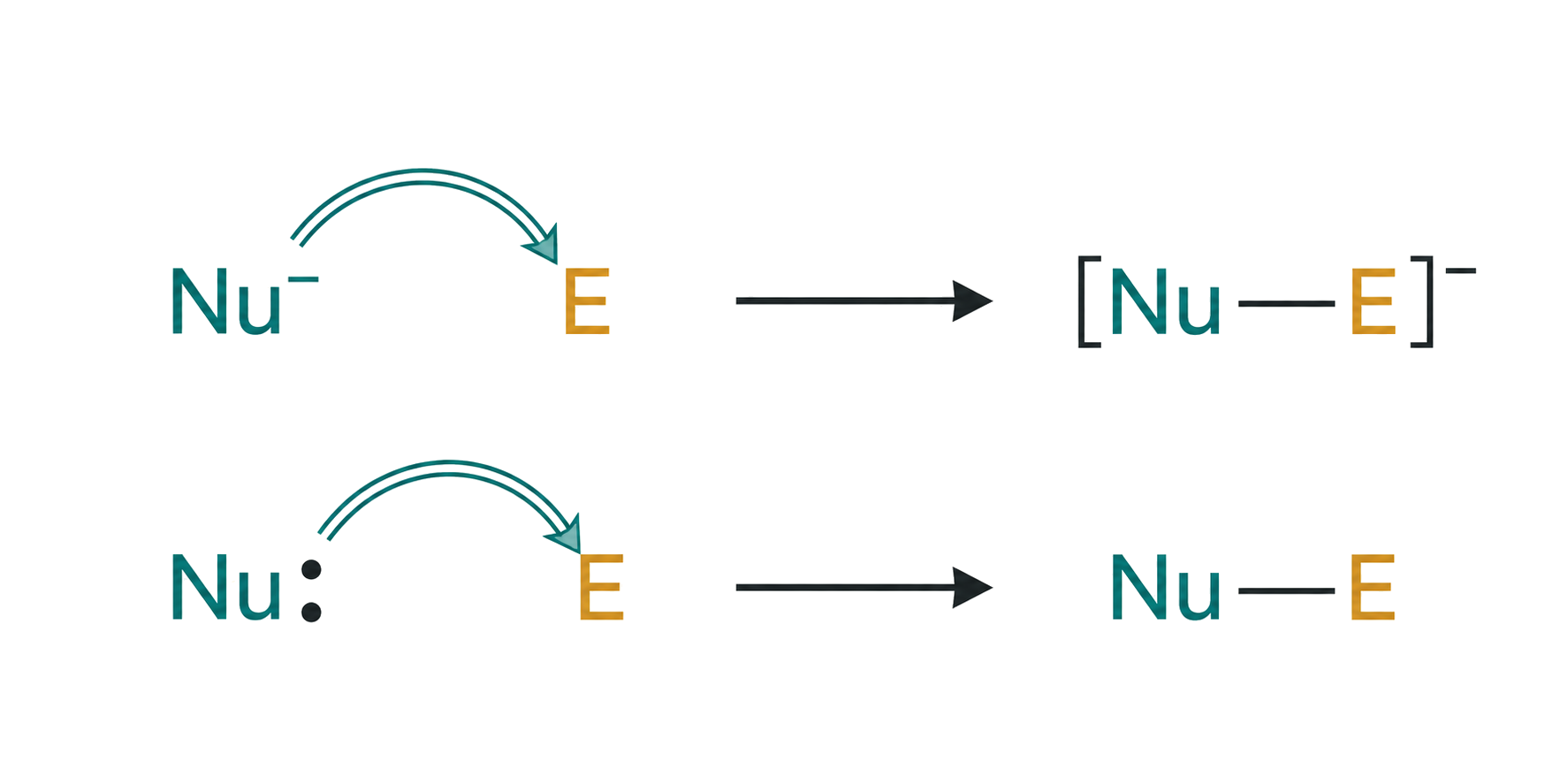
Look for an available electron pair: OH⁻ and CN⁻ use a negative charge and lone pair, while NH₃ uses a lone pair without being an anion. A curly arrow must start at that pair and point toward the atom where the new bond forms.

Identifying Nucleophiles

Assessment in practice

Representative question

Question 1

[Maximum number: 1]

Identify a nucleophile which could be used for this reaction.

Nucleophilic Substitution

The nucleophile donates a pair to carbon while the leaving group departs with its bonding pair. Deduce the product by replacing the leaving group with the nucleophile.
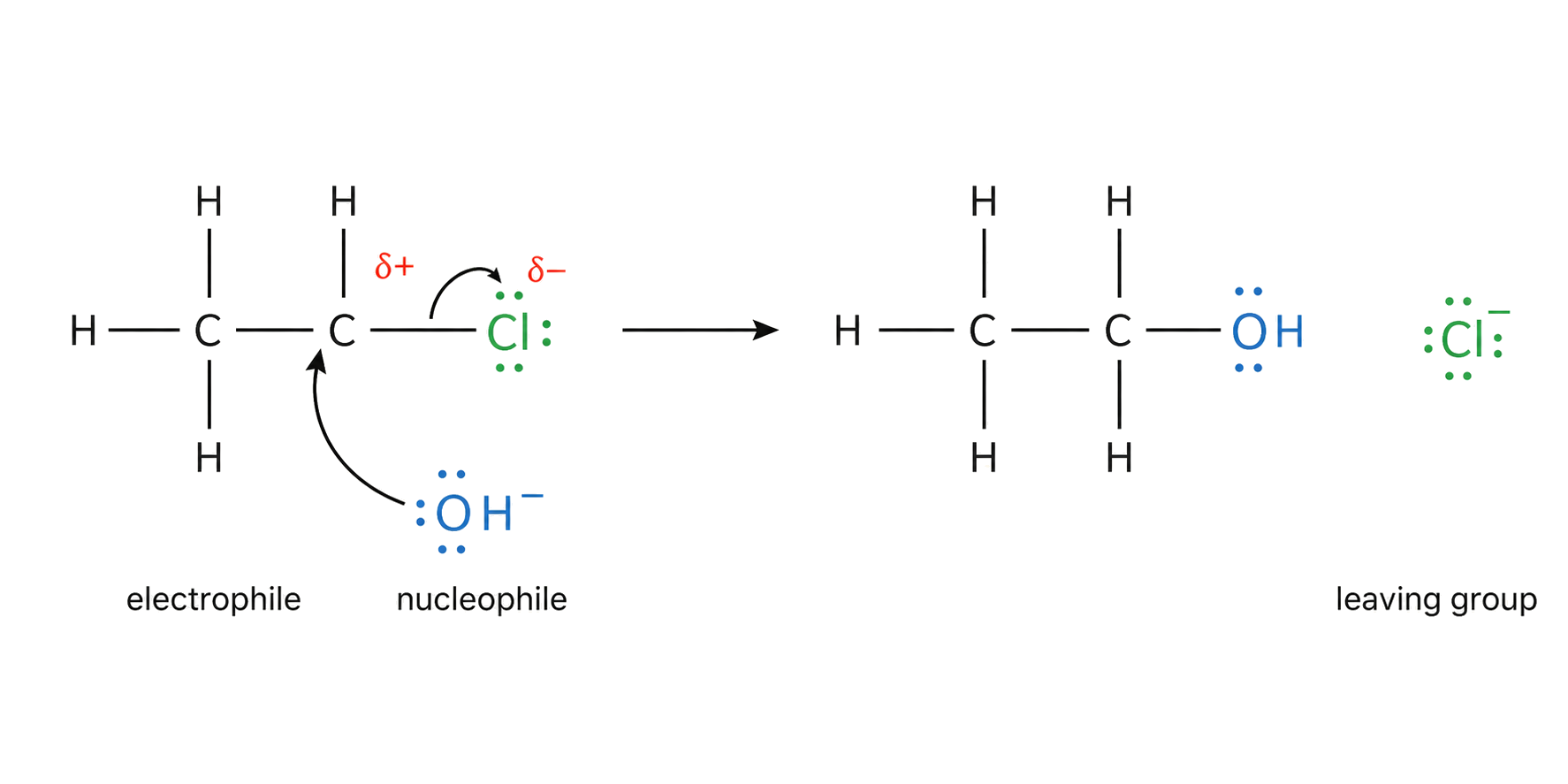
For CH₃CH₂Br + OH⁻, the C–O bond forms as the C–Br bond breaks, giving CH₃CH₂OH + Br⁻. Account for charge and every atom in the product; the leaving group takes the bonding pair rather than departing as a neutral bromine atom.

Deducing Substitution Products

Assessment in practice

Representative question

Question 1

[Maximum number: 4]

Explain the mechanism of the reaction, using curly arrows to represent the movement of electron pairs.

Heterolytic Fission

In heterolytic fission both bonding electrons remain with one fragment, producing ions. Curly arrows show movement of an electron pair.
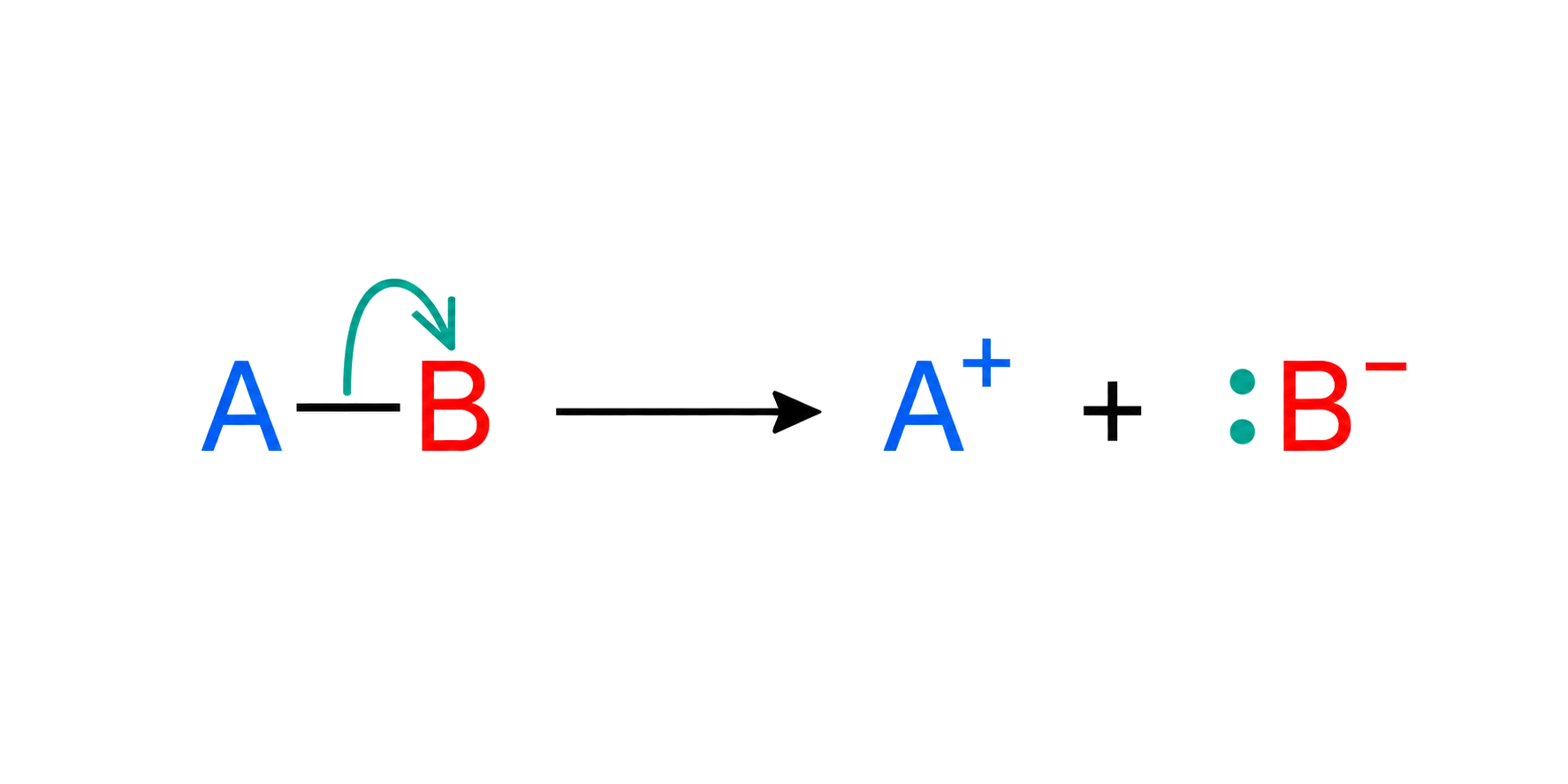
Place the curly-arrow tail on the bond being broken and its head on the fragment receiving both electrons. Then assign charges from electron ownership: heterolysis creates ions, unlike homolysis, which gives one electron to each radical.

Showing Electron-Pair Movement

Assessment in practice

Representative question

Question 1

[Maximum number: 2]

Contrast homolytic and heterolytic fission.

Homolytic fission:

Heterolytic fission:

Recognizing Electrophiles

An electrophile is an electron-deficient species that accepts an electron pair from a nucleophile.
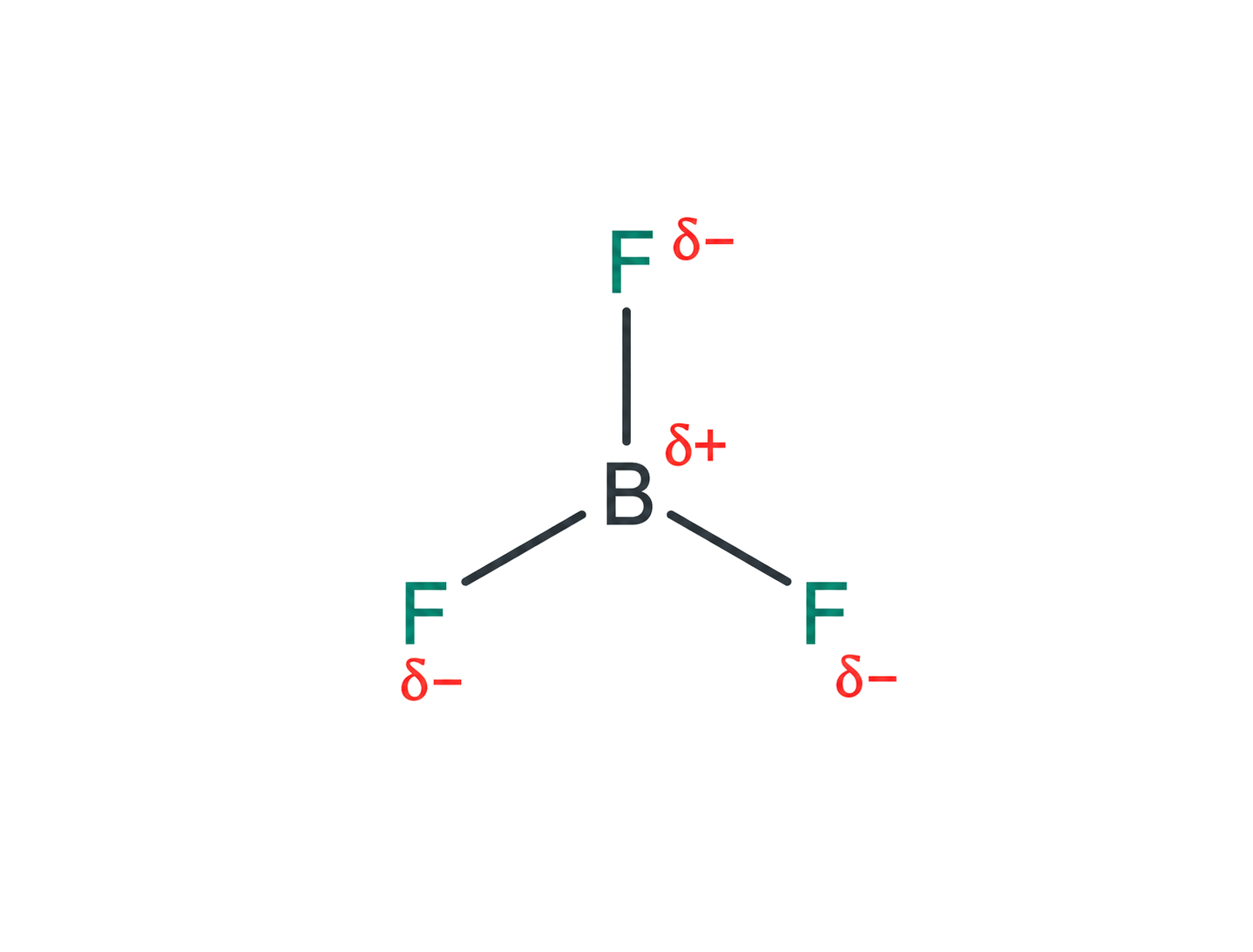
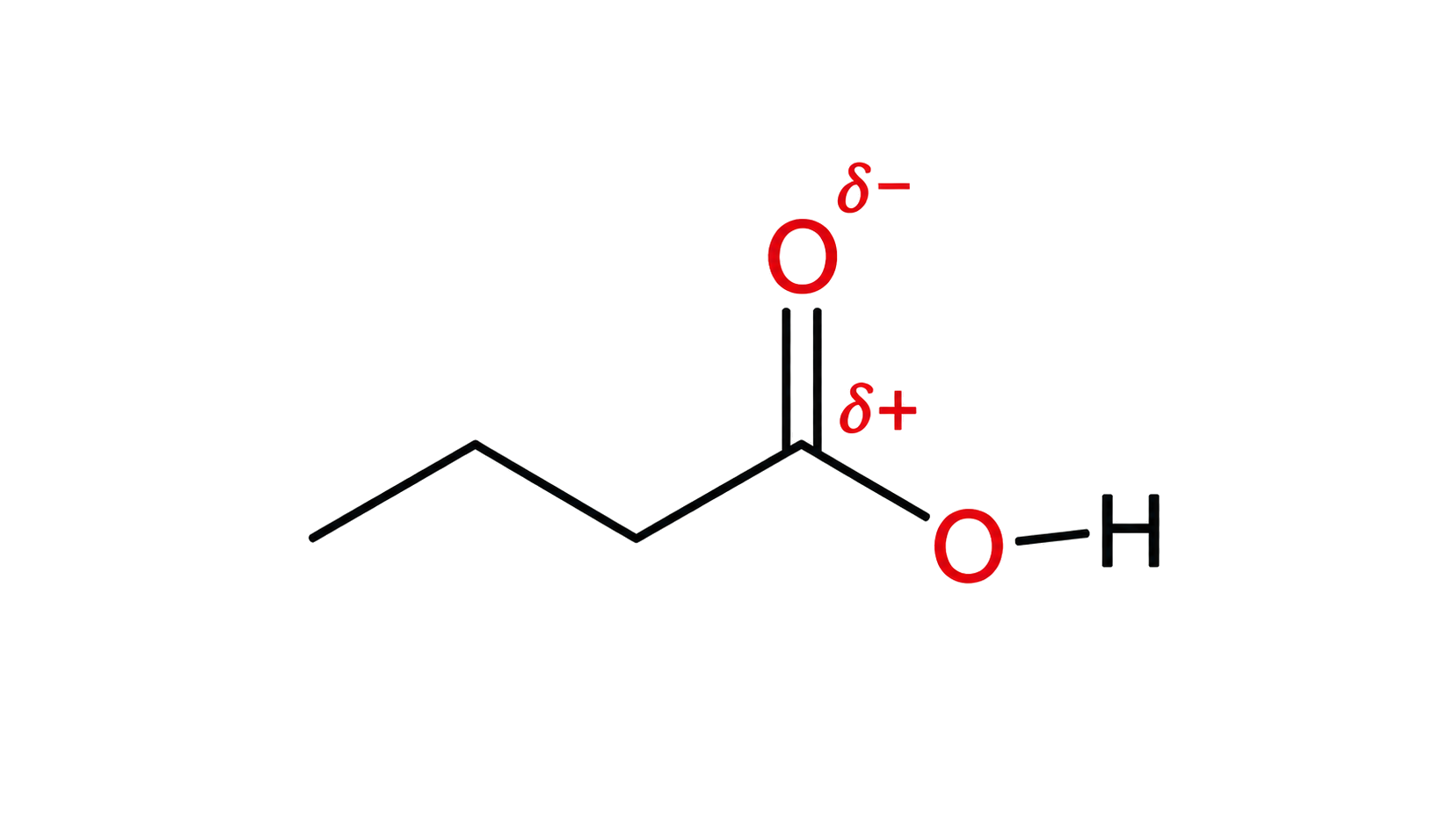
Identify the electron-poor atom, not merely a positive-looking formula. H⁺ and carbocations are electrophiles, and the δ⁺ carbon in a polar C–X bond can also accept a pair. The incoming curly arrow ends at this acceptor.

Recognizing Electrophiles

Assessment in practice

Representative question

Question 1

[Maximum number: 1]

Which species is the electrophile?

CH3Br+OHCH3OH+Br\mathrm{CH}_{3} \mathrm{Br}+\mathrm{OH}^{-} \rightarrow \mathrm{CH}_{3} \mathrm{OH}+\mathrm{Br}^{-}
A

OH\mathrm{OH}^{-}

B

Br\mathrm{Br}^{-} c. CH3OH\mathrm{CH}_{3} \mathrm{OH} D. CH3Br\mathrm{CH}_{3} \mathrm{Br}

Electrophilic Addition to Alkenes

The electron-rich C=C attacks an electrophile. Deduce addition products with water, halogens or hydrogen halides within the SL mechanism boundary.
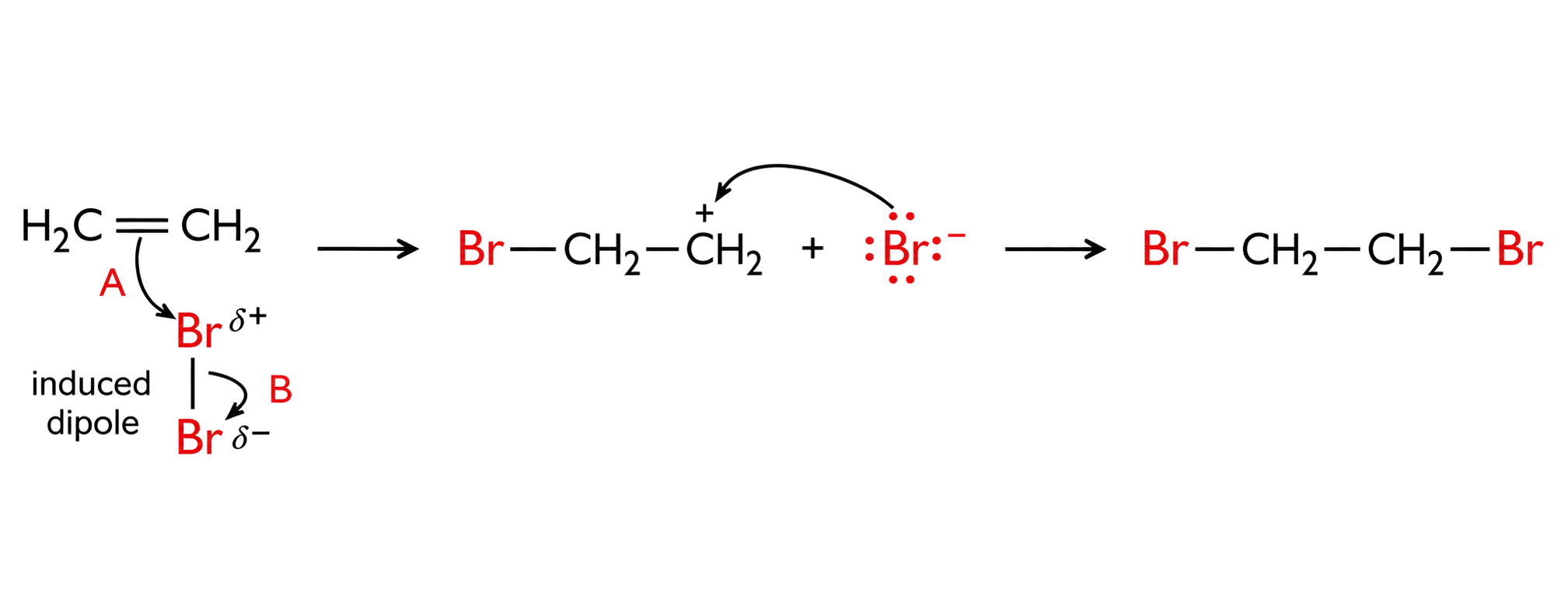
Treat the C=C as the reactive site and place the two added groups on its two carbon atoms. Bromine addition removes the double bond and forms a dibromoalkane; hydration forms an alcohol. At SL, deducing these products does not require a mechanism.

Reagent Groups added across C=C Product check
X₂ (for example Br₂) X and X vicinal dihalogenoalkane; C=C becomes C–C
HX H and X halogenoalkane; conserve the H and halogen from HX
H₂O/steam under acid-catalysed hydration conditions H and OH alcohol; conserve the carbon skeleton

At SL, use reagent and atom conservation to deduce products; curly-arrow mechanisms are not assessed in this card.

Deducing Alkene-Addition Products

Assessment in practice

Representative question

Question 1

[Maximum number: 1]

Predict the product of the reaction between ethene and bromine.

Lewis Acids and Bases

A Lewis acid accepts an electron pair; a Lewis base donates an electron pair. Nucleophiles correspond to Lewis bases and electrophiles to Lewis acids.

In BF₃ + NH₃ → F₃B←NH₃, NH₃ donates the pair and is the Lewis base; BF₃ accepts it and is the Lewis acid. Classify the roles from electron-pair movement rather than from whether H⁺ appears.

Classifying Lewis Acids and Bases

Assessment in practice

Representative question

Question 1

[Maximum number: 1]

What is the role of the CN\mathrm{CN}^{-}ion in the reaction of 1-chloropropane with excess KCN in ethanol?

C3H7Cl+KCNC3H7CN+KCl\mathrm{C}_{3} \mathrm{H}_{7} \mathrm{Cl}+\mathrm{KCN} \rightarrow \mathrm{C}_{3} \mathrm{H}_{7} \mathrm{CN}+\mathrm{KCl}
A

Electrophile and Lewis base

B

Nucleophile and Lewis acid

C

Electrophile and Lewis acid

D

Nucleophile and Lewis base

Coordination Bonds

A ligand acts as a Lewis base and donates an electron pair to a Lewis-acid transition-metal cation, forming a coordinate bond.
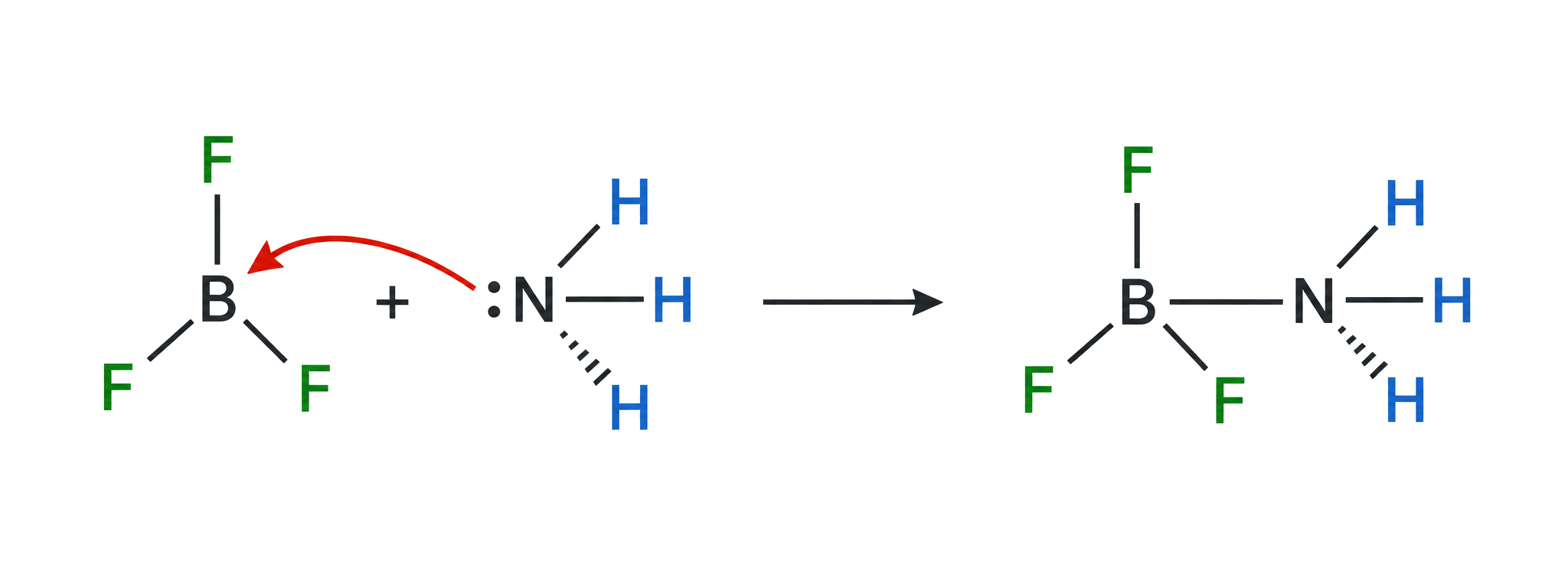
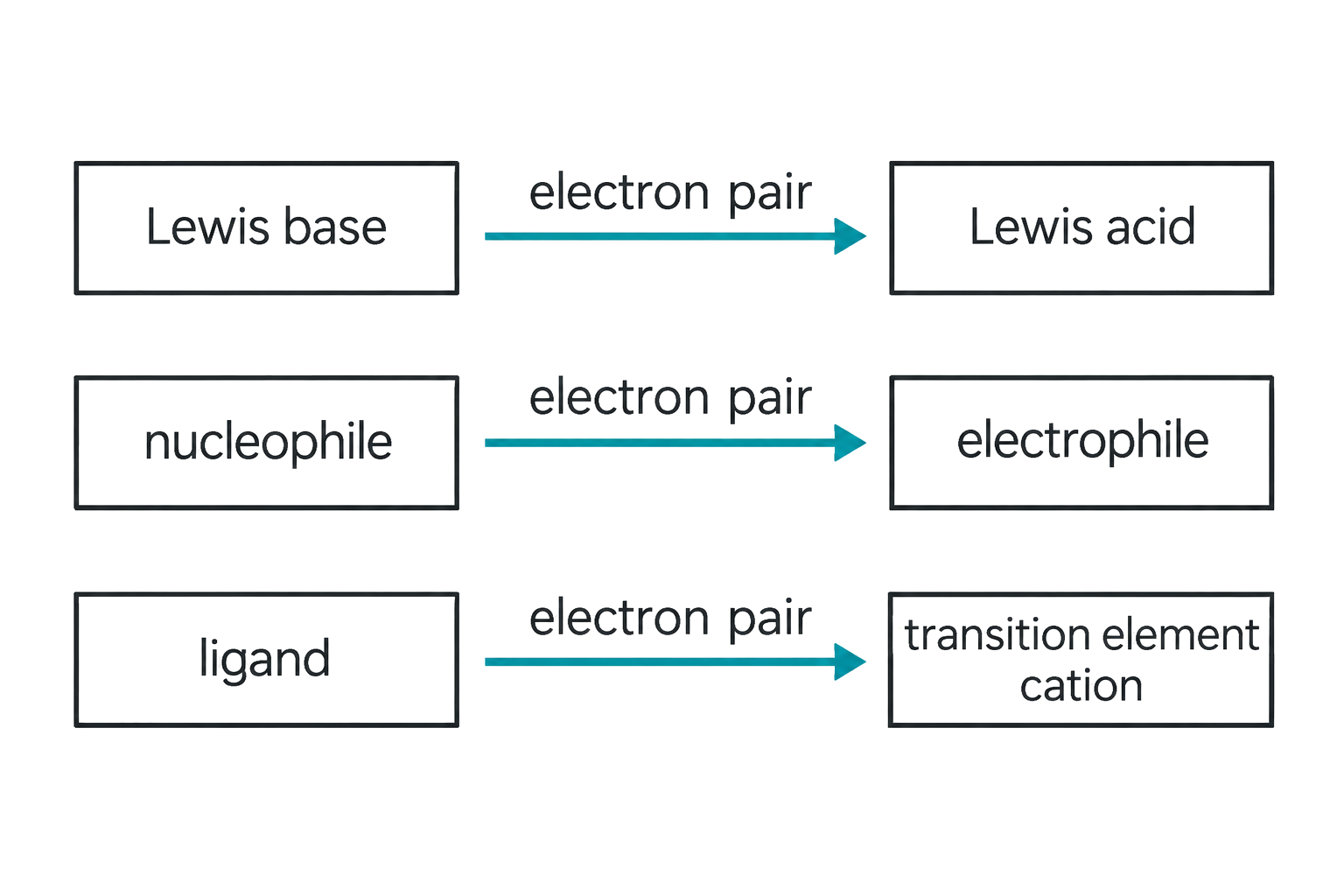
Show a coordination bond with an arrow from a ligand lone pair to the metal ion. The arrow records the origin of the shared pair; after formation the bond is not a different electrostatic species from other covalent bonds.

Explaining Coordinate-Bond Formation

Assessment in practice

Representative question

Question 1

[Maximum number: 1]

Outline how ammonia acts as a Lewis base when it forms the complex ion

[Cu(NH3)4(H2O)2]2+(aq).\left[\mathrm{Cu}\left(\mathrm{NH}_{3}\right)_{4}\left(\mathrm{H}_{2} \mathrm{O}\right)_{2}\right]^{2+}(\mathrm{aq}) .

Ligands and Complex Ions

Identify the central transition-metal cation and the surrounding ligands. Each ligand donates an electron pair to the metal centre.
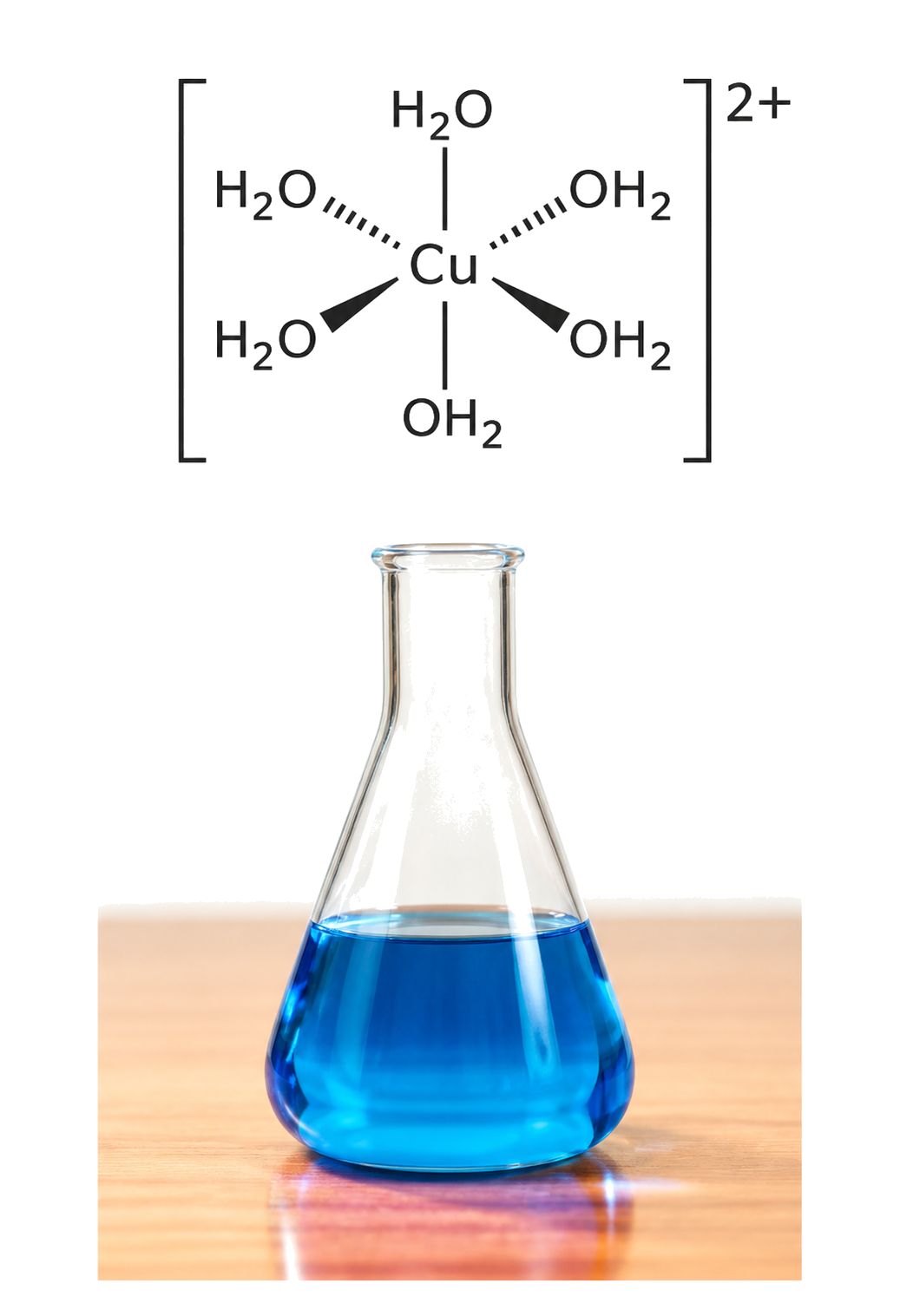
Read [Cu(NH₃)₄]²⁺ as one Cu centre with four NH₃ ligands and coordination number 4. Use ligand charges and the overall bracket charge to deduce the metal oxidation state; do not confuse coordination number with oxidation state.

Identifying Complex-Ion Components

Assessment in practice

Representative question

Question 1

[Maximum number: 1]

Which statements are correct for the complex ion [FeCl4]2\left[\mathrm{FeCl}_{4}\right]^{2-} ?

I. Chloride ions are behaving as ligands.
II. The oxidation state of iron is +3 .
III. Iron ion forms coordination bonds with chloride ions.

A

I and II only

B

I and III only

C

II and III only

D

I, II and III

Electron-Pair Sharing Summary

Retrieve the route: classify nucleophiles and electrophiles, show heterolysis, write substitution and addition mechanisms, map Lewis coordination, compare SN1/SN2, and restore aromaticity in benzene substitution.

Check electron-pair arrow origin and destination, leaving-group departure, intermediate identity, carbocation stability and the assessed mechanism boundary.