Reactivity 1. What drives chemical reactions?

Syllabus
First assessment 2025
Section
Level
SL

Exam analysis

No tagged past-paper evidence yet

Published Concept pages under this syllabus area do not have tagged past-paper appearances in the selected level yet.

Recent 5 years

In this section

Topic 1.1

1.1 Measuring enthalpy changes

Objectives in this topic

Energy Transfer in Reactions

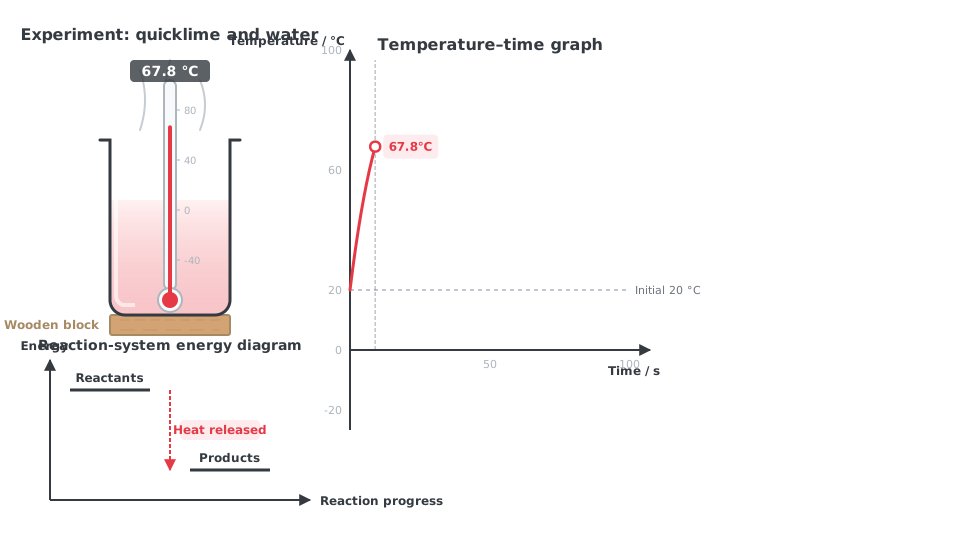
A chemical reaction transfers energy between the system and surroundings. Total energy is conserved. Heat is energy transferred because of a temperature difference; temperature describes the thermal state.

State which part is the system, which part is the surroundings, and the direction of energy transfer before interpreting a temperature change.

For an exothermic hand-warmer reaction, define the reacting chemicals as the system: energy leaves that system and enters your hand and the air as surroundings. A temperature rise is evidence about the surroundings, while heat names the energy crossing the boundary; neither quantity is 'stored temperature'.

Describing Energy Transfer

Assessment in practice

Representative question

Question 1

[Maximum number: 1]

Consider a reaction mixture that is in thermal equilibrium with the surroundings. When a reaction takes place, the temperature of the mixture decreases.

Which row correctly shows the changes in energy when the new thermal equilibrium is established?

Energy of system

Energy of surroundings

decreases

decreases

increases

increases

decreases

increases

increases

decreases

Endothermic and Exothermic

Type Energy direction Surroundings temperature
Endothermic Absorbed by the system Decreases
Exothermic Released by the system Increases

Classify from the direction of energy transfer, then check that the observed temperature change of the surroundings agrees.

Connect three representations: exothermic means energy flows out of the system, the surroundings warm, and ΔH for the system is negative; endothermic gives the opposite pattern and positive ΔH. State the observed part before inferring the reaction type.

Classifying Energy Changes

Assessment in practice

Representative question

Question 1

[Maximum number: 1]

Which statement about an exothermic reaction is correct?

A

Temperature decreases and the products have higher enthalpy than the reactants.

B

Temperature decreases and the products have lower enthalpy than the reactants.

C

Temperature increases and the products have higher enthalpy than the reactants.

D

Temperature increases and the products have lower enthalpy than the reactants.

Stability and Energy Profiles

Lower relative energy corresponds to greater relative stability. In an exothermic reaction the products are lower in energy than the reactants; in an endothermic reaction the products are higher.
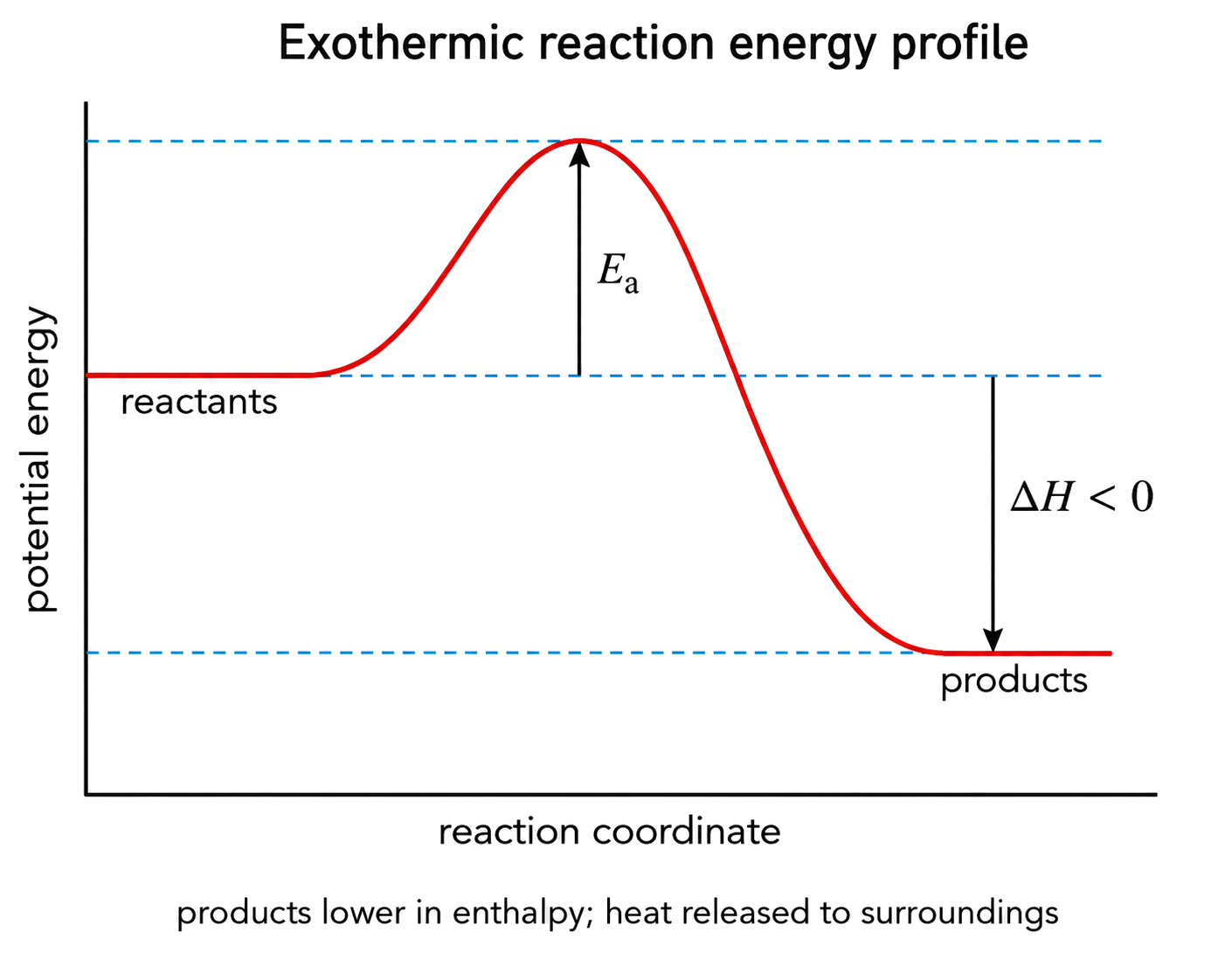
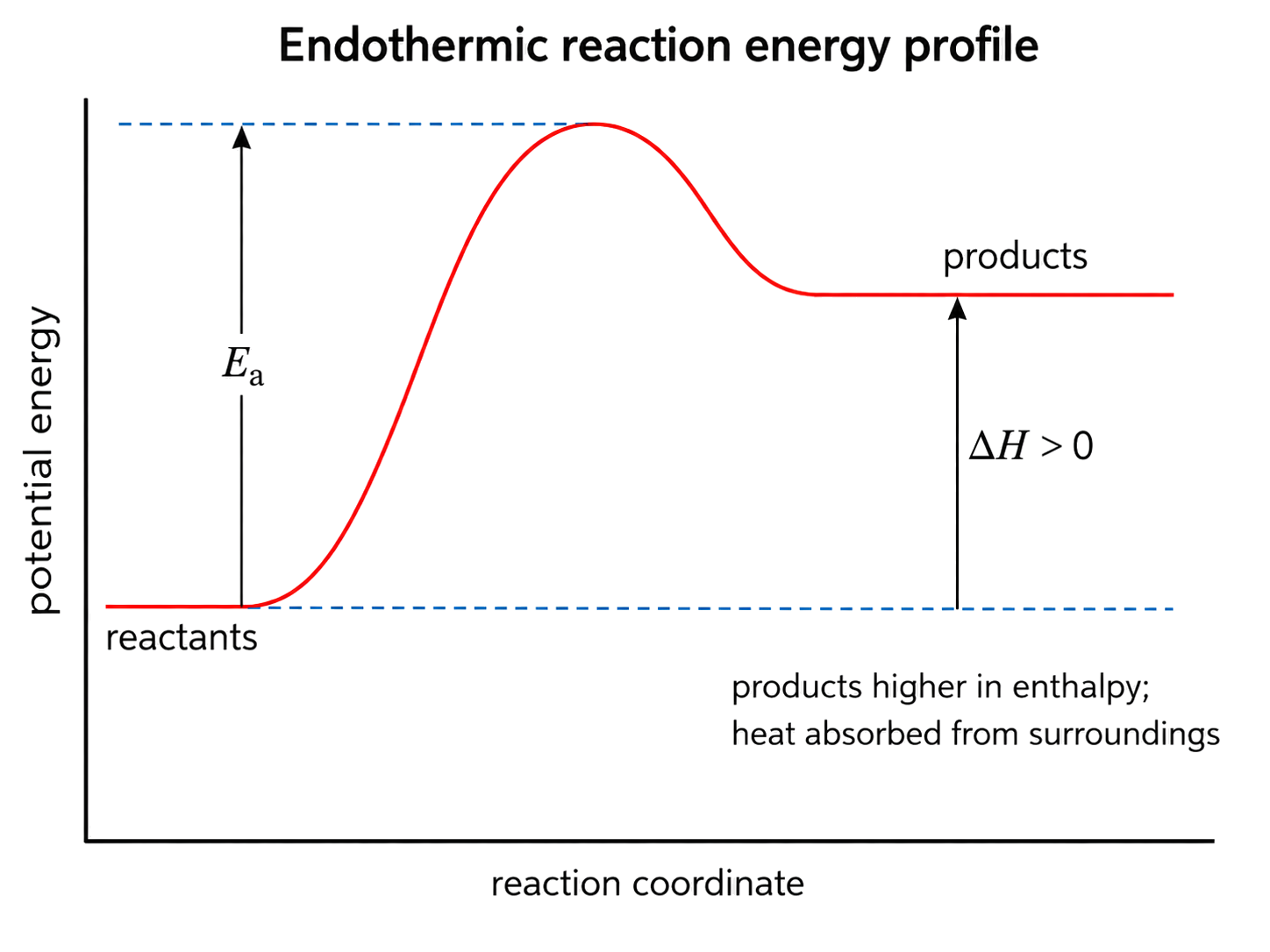
Label the horizontal axis reaction coordinate and the vertical axis potential energy. Then read reactant and product levels, identify the sign and direction of ΔH, and distinguish ΔH from activation energy.

On a profile, ΔH is the vertical difference between product and reactant levels, while activation energy rises from reactants to the peak. A catalyst lowers the peak by changing the pathway but leaves the two energy levels, ΔH and the relative stability of reactants and products unchanged.

An energy profile identifies an activation barrier but does not by itself determine an observed rate: temperature, particle concentrations/collision frequency and the available pathway also matter. Use the diagram to compare energetic barriers only when the profiles and conditions make that comparison valid.

Interpreting Energy Profiles

Assessment in practice

Representative question

Question 1

[Maximum number: 3]

The forward reaction is endothermic, uses iron(III) oxide as a catalyst, and takes place at 900 K .

Sketch the energy profile for the reaction, both with and without the catalyst, labelling ΔH\Delta H and the activation energies.

Standard Enthalpy from Calorimetry

Q=mcΔTandΔH=Q/nQ = mcΔT and ΔH = −Q/n

At constant pressure, calculate heat transferred from mass, specific heat capacity, and temperature change, then divide by reacting moles and apply the sign convention. Check standard conditions and units.

Worked calculation: if 100.0 g of solution warms by 6.0 K and c=4.18Jg1K1c=4.18\,\mathrm{J\,g^{-1}\,K^{-1}}, q(solution)=mcΔT=(100.0)(4.18)(6.0)=2.51×10³J=+2.51kJq(\mathrm{solution})=mc\Delta T=(100.0)(4.18)(6.0)=2.51\times10^3\,\mathrm{J}=+2.51\,\mathrm{kJ}. Therefore q(reaction)=2.51kJq(\mathrm{reaction})=-2.51\,\mathrm{kJ}. If 0.0500mol0.0500\,\mathrm{mol} of limiting reactant reacted, ΔH=2.51/0.0500=50.2kJmol1\Delta H=-2.51/0.0500=-50.2\,\mathrm{kJ\,mol^{-1}}: the negative sign means the reaction released energy. Heat loss or ignored calorimeter heat capacity usually makes the measured magnitude too small.

A standard molar enthalpy change belongs to the balanced reaction as written, with substances in their stated standard states under standard conditions. A classroom calorimetry value is an experimental estimate: report its conditions and uncertainty separately from a data-book or theoretical standard value. Heat loss to the surroundings or ignored calorimeter heat capacity commonly makes the measured magnitude too small.

Calculating Enthalpy Change

Assessment in practice

Representative question

Question 1

[Maximum number: 1]

What is the standard enthalpy change, ΔHcombustion \Delta H_{\text {combustion }}^{\ominus}, according to the data?

Amount of fuel burned =0.110 mol=0.110 \mathrm{~mol}
Mass of water =200 g=200 \mathrm{~g}
Initial temperature of water =21.0C=21.0^{\circ} \mathrm{C}
Final temperature of water =25.0C=25.0^{\circ} \mathrm{C}
Specific heat capacity of water, cw=4.18 J g1 K1c_{\mathrm{w}}=4.18 \mathrm{~J} \mathrm{~g}^{-1} \mathrm{~K}^{-1}Q=mcΔTQ=m c \Delta T

A

2110 kJ mol1-2110 \mathrm{~kJ} \mathrm{~mol}^{-1}

B

30.4 kJ mol1-30.4 \mathrm{~kJ} \mathrm{~mol}^{-1}

C

+30.4 kJ mol1+30.4 \mathrm{~kJ} \mathrm{~mol}^{-1}

D

+2110 kJ mol1+2110 \mathrm{~kJ} \mathrm{~mol}^{-1}

Measuring Enthalpy Summary

Retrieve the route: define system/surroundings transfer, classify endothermic or exothermic, read stability from energy profiles, then calculate Q and ΔH with the correct sign.

Check the energy direction, surroundings temperature, reactant/product levels, moles, units, and ΔH sign.

Topic 1.2

1.2 Energy cycles

Objectives in this topic

Average Bond Energies

ΔHΣ(bondsbroken)Σ(bondsformed)ΔH ≈ Σ(bonds broken) − Σ(bonds formed)

Breaking bonds absorbs energy; forming bonds releases energy. Count every bond with its stoichiometric multiplicity before applying the signed sum.

For H₂ + Cl₂ → 2HCl, break one H–H and one Cl–Cl bond, then form two H–Cl bonds. Average bond enthalpies give an estimate because the tabulated value averages that bond across different gaseous molecules.

Worked example — bond enthalpies: for CX2HX4(g)+HBr(g)CX2HX5Br(g)\ce{C2H4(g) + HBr(g) -> C2H5Br(g)}, the local course book gives CH=414\ce{C-H}=414, C=C=614\ce{C=C}=614, HBr=366\ce{H-Br}=366, CC=346\ce{C-C}=346 and CBr=285kJmol1\ce{C-Br}=285\,\mathrm{kJ\,mol^{-1}}. ΔH=[4(414)+614+366][5(414)+346+285]=26362701=65kJmol1\Delta H=[4(414)+614+366]-[5(414)+346+285]=2636-2701=-65\,\mathrm{kJ\,mol^{-1}}. The negative estimate means the bonds formed release more energy than the bonds broken absorb; it remains approximate because the values are gaseous averages.

Calculating from Bond Energies

Assessment in practice

Representative question

Question 1

[Maximum number: 3]

Calculate the enthalpy change for the reaction, ΔH\Delta H. Use section 12 of the data booklet.

Hess's Law

Hess's law states that enthalpy change is independent of reaction pathway. Enthalpy values can therefore be combined through a balanced cycle.
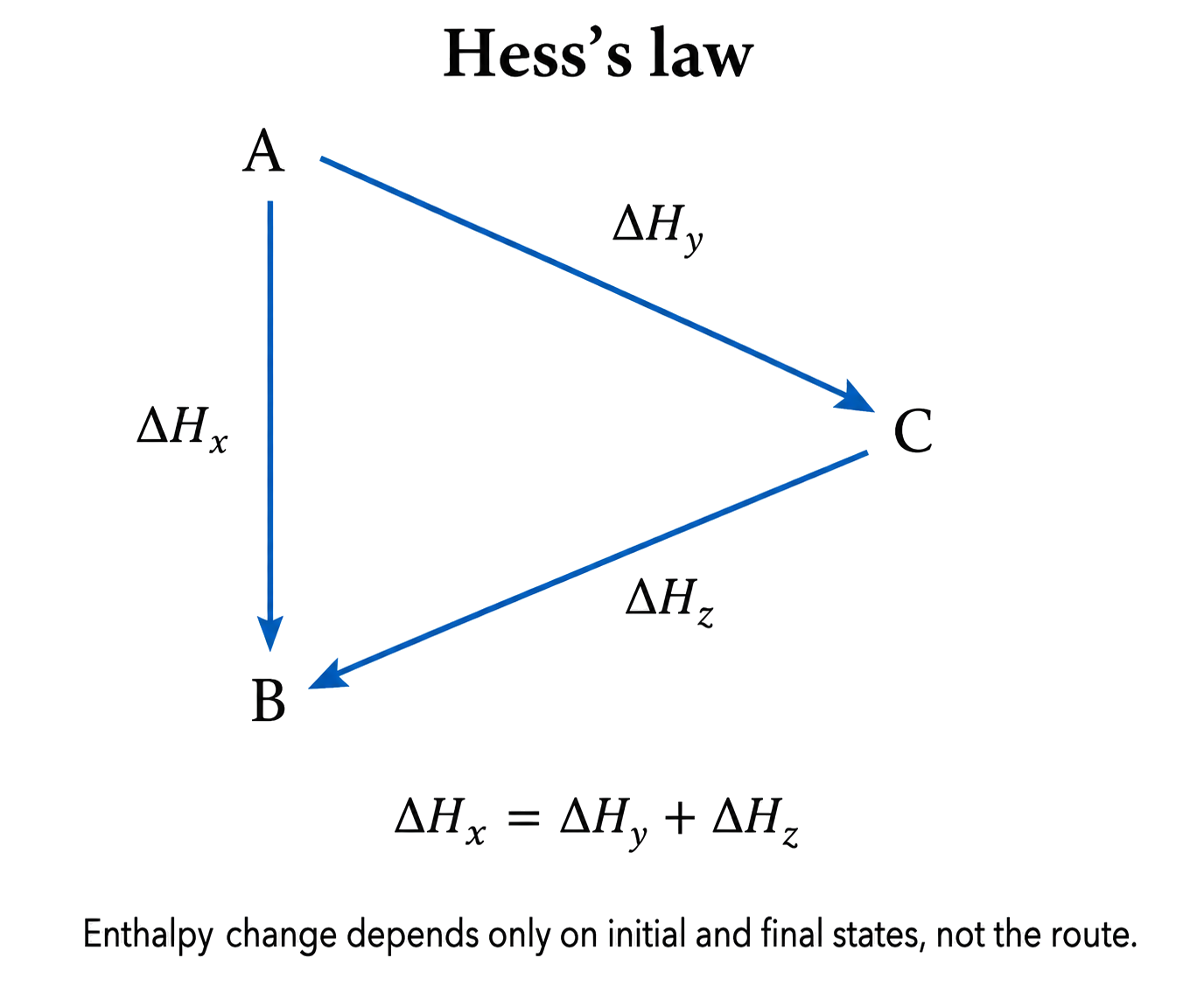
Reverse an entire balanced equation by changing the sign of ΔH; scale every coefficient and ΔH by the same factor; then add equations and cancel identical species in identical physical states. Never change a chemical subscript, formula or state symbol merely to force cancellation. The surviving equation must exactly match the target before enthalpies are summed.

Treat chemical equations like algebra: reverse a step and reverse its ΔH sign; multiply all coefficients and ΔH by the same factor; then add and cancel species. The surviving overall equation must exactly match the target before the enthalpies are summed.

Worked example — Hess's law: target C(s)X2+HX2(g)X1+/2OX2(g)CHX3OH(l)\ce{C(s)+2H2(g)+1/2O2(g)->CH3OH(l)}. Use CX+OX2COX2\ce{C+O2->CO2}, ΔH=394kJmol1\Delta H=-394\,\mathrm{kJ\,mol^{-1}}; double HX2X+1/2OX2HX2O(l)\ce{H2+1/2O2->H2O(l)} to give 572kJmol1-572\,\mathrm{kJ\,mol^{-1}}; reverse methanol combustion to give +726kJmol1+726\,\mathrm{kJ\,mol^{-1}}. After cancelling COX2\ce{CO2} and HX2O\ce{H2O}, ΔH=394572+726=240kJmol1\Delta H=-394-572+726=-240\,\mathrm{kJ\,mol^{-1}} for the target equation.

Solving Hess Cycles

Assessment in practice

Representative question

Question 1

[Maximum number: 1]

Determine the enthalpy change, ΔH\Delta H, in kJmol1\mathrm{kJ} \mathrm{mol}^{-1}, for the hydration of solid anhydrous magnesium sulfate, MgSO4\mathrm{MgSO}_{4}.

Energy Cycles Summary

Retrieve the route: count bond breaking/forming, manipulate Hess equations, define standard formation/combustion values, apply product–reactant sums, and track every Born–Haber energy term.

Check equation direction, coefficients, signs, standard states, lattice enthalpy convention, and one-versus-two-electron steps.

Topic 1.3

1.3 Energy from fuels

Objectives in this topic

Complete Combustion

In complete combustion with excess oxygen, carbon forms CO₂ and hydrogen forms H₂O. The fuel's other elements must also appear in the products.

Write the correct products first, then balance C, H and any other atoms before balancing O₂ last. Check every atom and state symbol.

For ethanol, write C₂H₅OH + 3O₂ → 2CO₂ + 3H₂O by balancing C, then H, then oxygen. Complete combustion specifies products, not automatically conditions or state symbols; use the question's conditions to decide whether water is liquid or vapour.

Writing Complete-Combustion Equations

Assessment in practice

Representative question

Question 1

[Maximum number: 1]

Write an equation for the complete combustion of methane.

Incomplete Combustion

When oxygen is limited, carbon may form CO and/or elemental carbon instead of only CO₂. The available oxygen and the fuel's elements determine the product set.

Include the products specified by the question, then balance all atoms. Do not replace a required CO or C product with CO₂ simply because the fuel contains carbon.

One valid carbon-monoxide equation is 2CH₄ + 3O₂ → 2CO + 4H₂O; with still less oxygen, elemental carbon can also form. Use the product set named by the question and rebalance from scratch—there is no single universal incomplete-combustion equation.

The product change has chemical consequences: carbon monoxide binds strongly to haemoglobin and reduces oxygen transport, while fine carbon particulates damage respiratory health and can alter atmospheric heating. Incomplete combustion also releases less usable energy per mole of fuel than complete conversion to CO₂ and H₂O; distinguish these separate health, environmental and energy claims.

Deducing Incomplete-Combustion Products

Assessment in practice

Representative question

Question 1

[Maximum number: 1]

Which products may form when propane undergoes incomplete combustion?

A

CO2\mathrm{CO}_{2} and H2\mathrm{H}_{2} only

B

CO, C and H2\mathrm{H}_{2}

C

CO2,H2O\mathrm{CO}_{2}, \mathrm{H}_{2} \mathrm{O} and H2\mathrm{H}_{2}

D

CO2,CO\mathrm{CO}_{2}, \mathrm{CO} and C

Comparing Fossil Fuels

Compare coal, crude oil and natural gas using carbon dioxide released per unit of useful energy, energy output, and pollutants such as CO, particulates and volatile organic compounds from incomplete combustion.

A lower carbon footprint is a specific comparison, not a blanket claim that a fuel causes no pollution. Include methane leakage when evaluating natural gas.

Compare fuels on a common service basis such as kilograms of CO₂ per megajoule of useful energy, not per mole of fuel. Natural gas can have a lower combustion CO₂ intensity than coal yet lose part of that advantage through upstream methane leakage; define the system boundary before ranking.

Greenhouse link: atmospheric CO₂ absorbs selected outgoing infrared wavelengths and re-emits energy in multiple directions, reducing net energy loss to space at those wavelengths. A sustained increase in CO₂ changes Earth's energy balance until a warmer state restores balance. This mechanism is separate from comparing absolute fuel emissions or emissions per unit useful energy.

Evaluating Fossil-Fuel Choices

Assessment in practice

Representative question

Question 1

[Maximum number: 2]

Outline why the combustion of methane has a lower environmental impact than gasoline.

Biofuels as Renewable Fuels

Biofuels are renewable when their carbon is replenished through biological carbon fixation, such as photosynthesis, on a relevant timescale.

Evaluate both sides: possible benefits include renewable supply and lower net carbon or sulfur emissions; disadvantages include land competition with food production and other production impacts. State the evidence for each claim.

Test a carbon-neutral claim with a life-cycle boundary: count cultivation, fertilizer, processing, transport, land-use change and combustion, then credit carbon taken up during regrowth on the relevant timescale. Renewable describes replenishment, not automatically low impact or zero net emissions.

Evaluating Biofuel Advantages and Disadvantages

Assessment in practice

Representative question

Question 1

[Maximum number: 2]

Outline two advantages of using ethanol as a fuel instead of gasoline (petrol).

Fuel-Cell Energy Conversion

A fuel cell converts chemical energy from a spontaneous redox reaction directly into electrical energy. Oxidation occurs at the anode and reduction at the cathode.
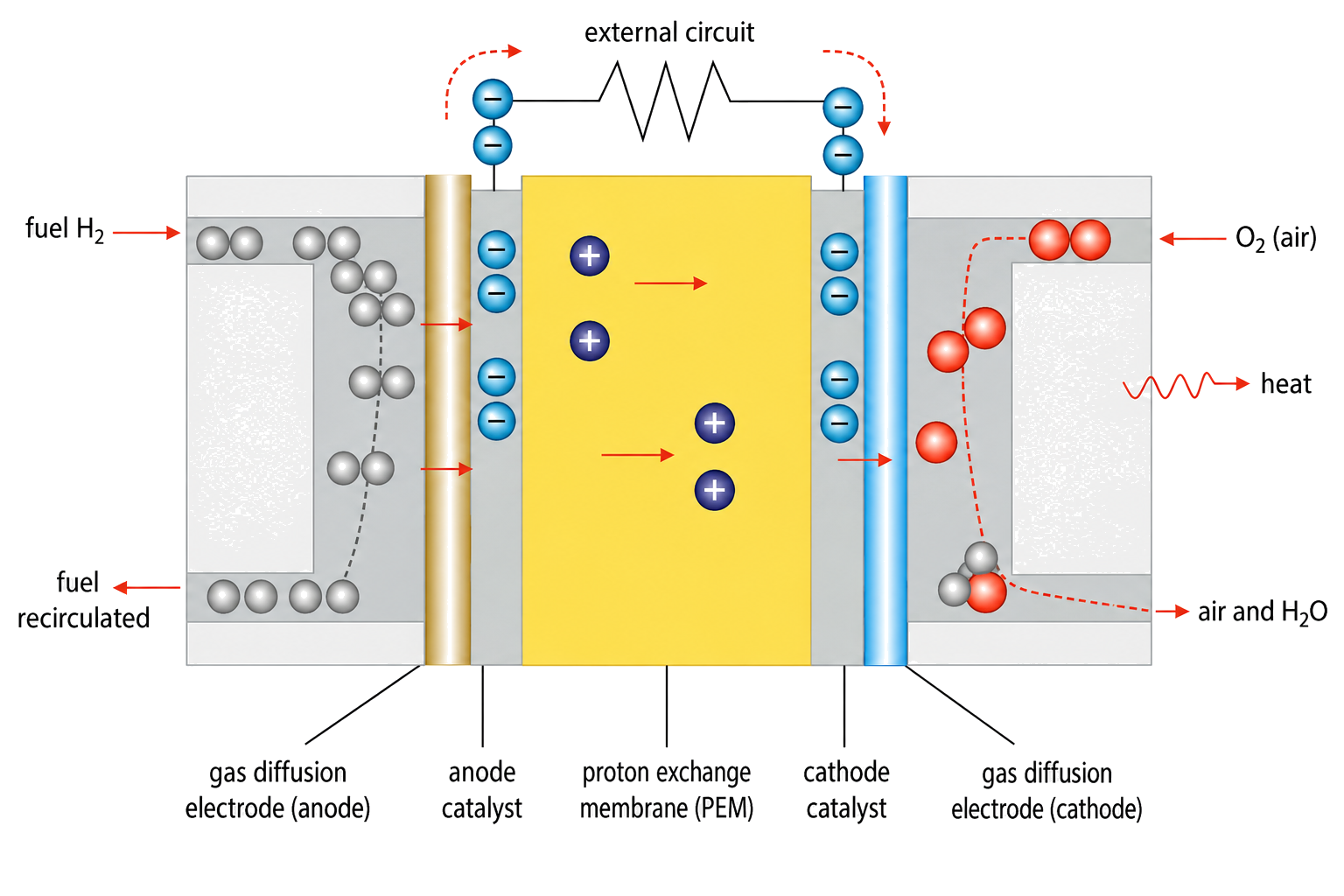
Deduce each half-equation from the fuel-cell reactants and electrolyte context, balance atoms and charge, then add the half-equations to obtain the overall reaction. Hydrogen and methanol cells require different oxidation half-equations.

For a hydrogen fuel cell, oxidation of H₂ supplies electrons at the anode and O₂ gains electrons at the cathode; the half-equations must match the acidic or alkaline electrolyte before they are added to 2H₂ + O₂ → 2H₂O. Direct electrical conversion does not remove the need to evaluate fuel production and storage.

A fuel cell operates while fuel and oxidant are supplied continuously from outside; a conventional battery stores a finite set of reactants internally. Point-of-use water from a hydrogen cell is not a complete environmental assessment—fuel manufacture, transport, storage and electricity source remain inside a lifecycle comparison.

Worked equations — acidic hydrogen cell: anode HX2(g)2HX+(aq)+2eX\ce{H2(g) -> 2H+(aq) + 2e-}; cathode OX2(g)+4HX+(aq)+4eX2HX2O(l)\ce{O2(g) + 4H+(aq) + 4e- -> 2H2O(l)}. Double the anode equation before adding, giving 2HX2+OX22HX2O\ce{2H2 + O2 -> 2H2O}. Direct-methanol cell: anode CHX3OH(aq)+HX2O(l)COX2(g)+6HX+(aq)+6eX\ce{CH3OH(aq) + H2O(l) -> CO2(g) + 6H+(aq) + 6e-}; cathode 32OX2(g)+6HX+(aq)+6eX3HX2O(l)\ce{3/2O2(g) + 6H+(aq) + 6e- -> 3H2O(l)}. Adding and cancelling gives CHX3OH+32OX2COX2+2HX2O\ce{CH3OH + 3/2O2 -> CO2 + 2H2O}. Match each half-equation to the stated electrolyte; proton-exchange-membrane construction details are not assessed.

Writing Fuel-Cell Half-Equations

Assessment in practice

Representative question

Question 1

[Maximum number: 3]

Deduce half-equations for the reactions at the two electrodes and hence the equation for the overall reaction.

Anode (negative electrode):

Cathode (positive electrode):

Overall:

Combustion and Thermodynamics Summary

Retrieve the route: identify complete or incomplete combustion products, compare fuels and biofuels, balance fuel-cell half-equations, calculate ΔS° and ΔG°, then use ΔG, Q and K to reason about spontaneity and equilibrium.

Check products before balancing, evidence before evaluation, oxidation versus reduction, kelvin and unit consistency, the sign of ΔG, and whether Q is below, equal to, or above K.