Structure 2. Models of bonding and structure
- Syllabus
- First assessment 2025
- Section
- —
- Level
- SL
| Atom tendency | Electron change | Ion formed |
|---|---|---|
| Metal atom | Loses electrons | Positive cation |
| Non-metal atom | Gains electrons | Negative anion |
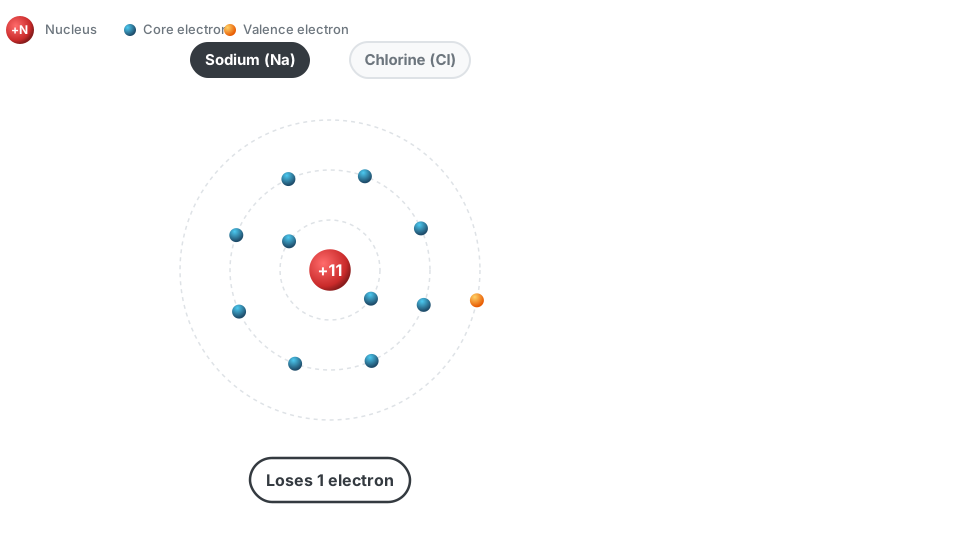
Use the electron configuration to see how many electrons are needed to reach the relevant stable arrangement. The number lost or gained determines the magnitude of the ion charge.
Loss of electrons leaves more protons than electrons and gives a positive charge. Gain of electrons gives more electrons than protons and gives a negative charge.
Read the outer-shell electrons before predicting charge: Al loses three electrons to form Al³⁺, while O gains two to form O²⁻. Check the sign by recounting protons and electrons after transfer; do not assume that every metal, especially a transition metal, has only one possible charge.
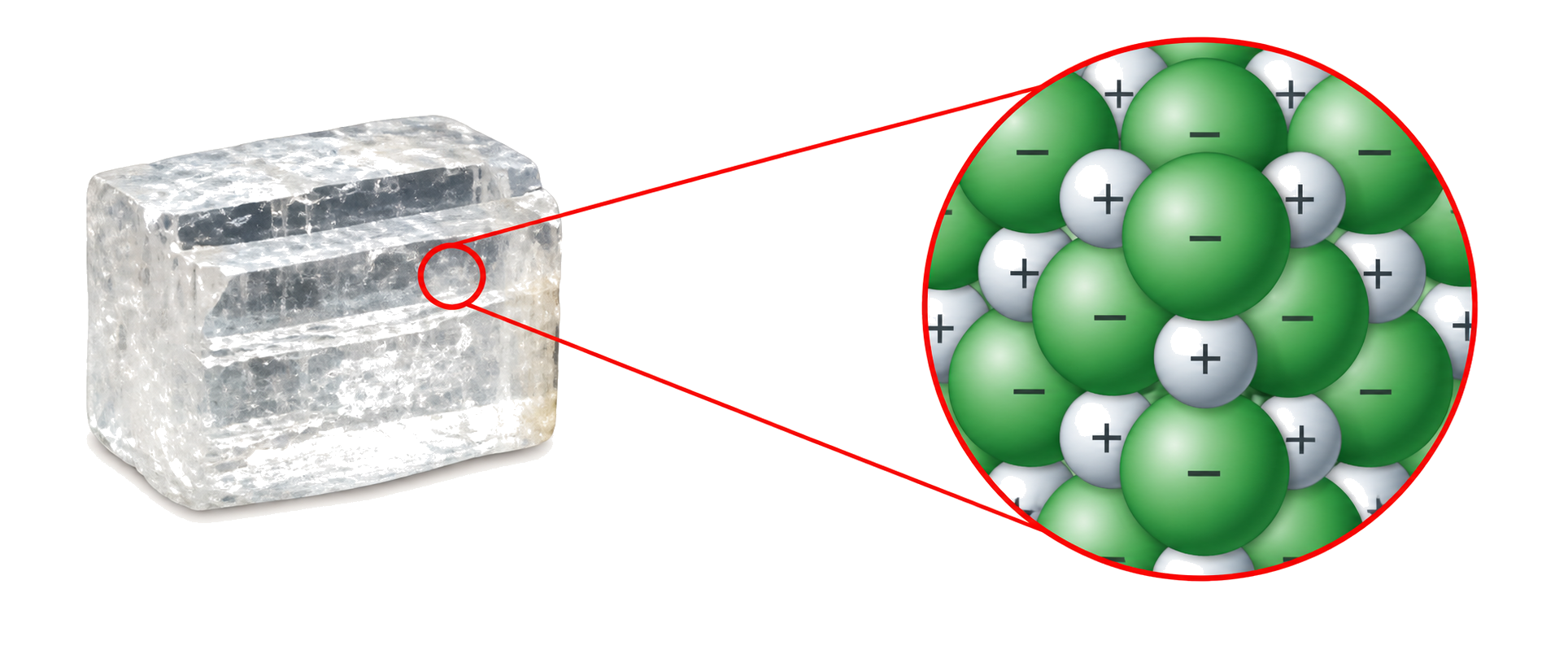
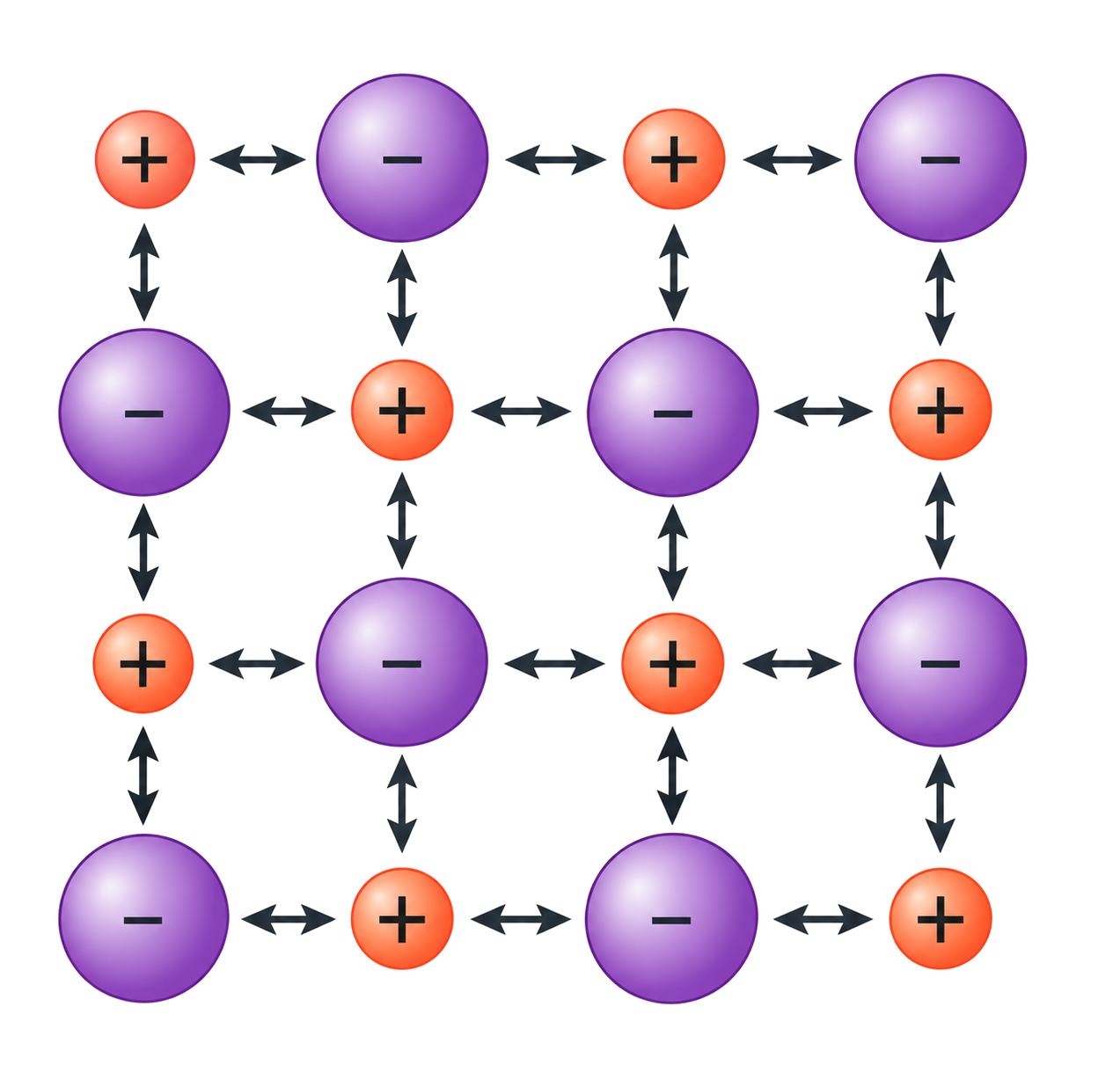
Ionic bonding is the electrostatic attraction between oppositely charged cations and anions. Electron transfer can create the ions, but it is not by itself the definition of the bond.
| Task | Check |
|---|---|
| Formula | Choose subscripts so total positive and negative charge is zero |
| Name | State the cation first, then the anion; binary anions use the -ide ending |
| Polyatomic ion | Keep the ion together and use brackets when more than one is needed |
For a metal ion and a polyatomic ion, balance the charges rather than copying the numerical charge into a subscript without checking the whole formula.
Balance total charge, not ion numbers. Al³⁺ and O²⁻ require 2(+3) + 3(−2) = 0, giving Al₂O₃; Ca²⁺ and NO₃⁻ give Ca(NO₃)₂. These formulae state the simplest ion ratio in a lattice, not the composition of one molecule.
An ionic lattice is a three-dimensional, repeating arrangement of cations and anions. Its empirical formula gives the simplest whole-number ion ratio, not a molecule.
Lattice dissociation enthalpy is the positive enthalpy change for separating one mole of a solid lattice into gaseous ions. It becomes larger when ionic charges are higher or ionic radii are smaller, because the electrostatic attraction is stronger.
| Property | Structure-based explanation |
|---|---|
| High melting point / low volatility | Strong electrostatic attractions act throughout the lattice |
| Brittle | A layer shift can bring like charges together, causing repulsion and fracture |
| Solid conductivity | Ions are fixed and cannot carry charge through the solid |
| Molten/aqueous conductivity | Ions are mobile and can carry charge |
| Solubility | Depends on the balance between lattice attraction and ion–solvent attraction |
Use charge density to compare lattice strength: MgO has stronger attractions than NaCl because both ions carry ±2 rather than ±1, so its melting point is higher. For conductivity, the presence of charged particles is not enough—solid NaCl does not conduct until its ions can move. Water often hydrates ions, but solubility still depends on the energy balance rather than on polarity alone.
A covalent bond is the electrostatic attraction between a shared electron pair and the nuclei of the bonded atoms. Lewis formulas show valence electrons and shared pairs.
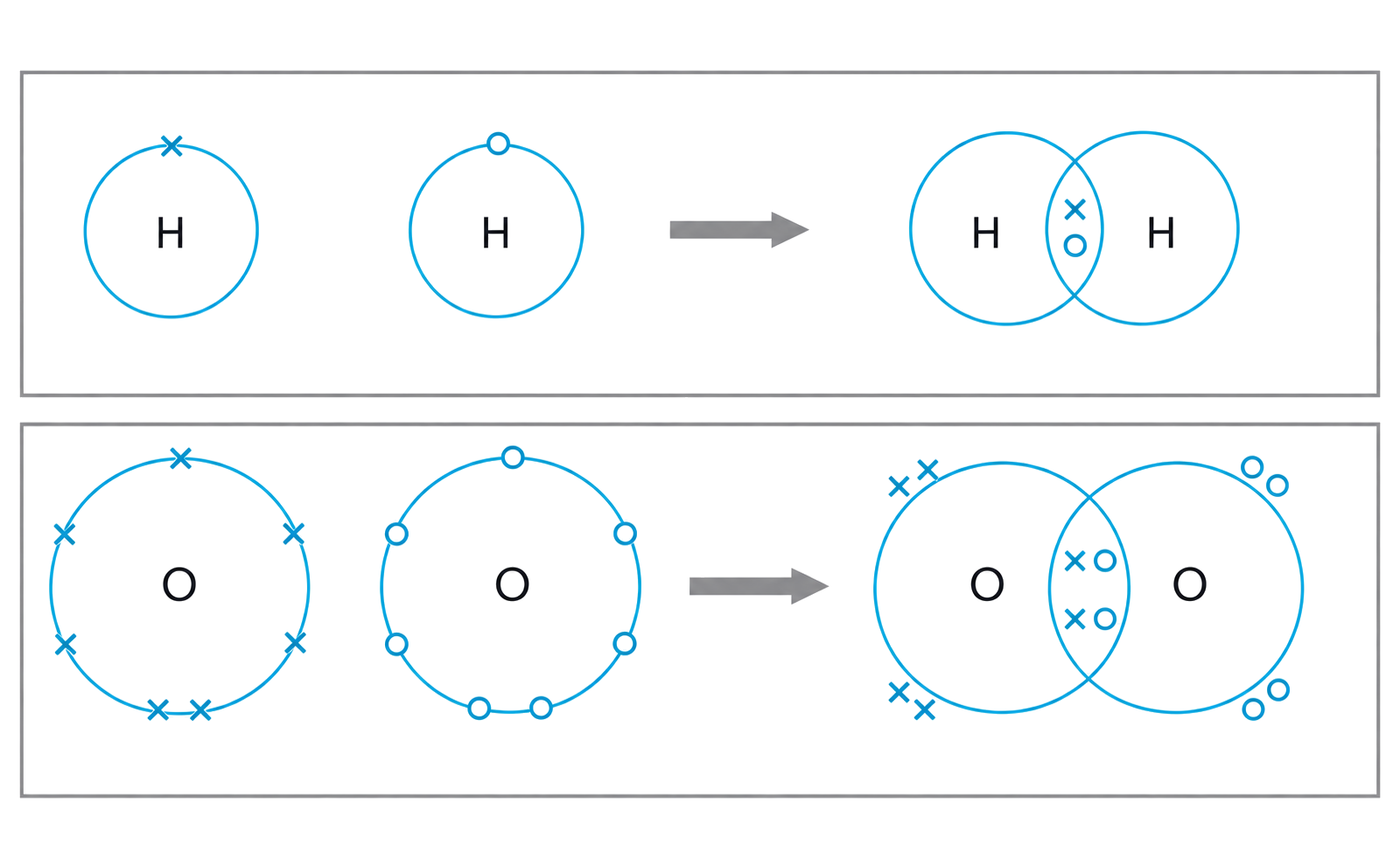
Use the octet tendency to place shared and lone pairs, while remembering that the assessed Lewis scope allows up to four electron pairs around an atom.
Build a Lewis formula by counting all valence electrons, choosing a skeleton, completing outer octets and placing any remainder on the central atom. Then recount electrons and formal charge; a shared pair contributes to the attraction between both nuclei rather than belonging exclusively to either atom.
Charged-species check: NH₄⁺ has 5 + 4(1) − 1 = 8 valence electrons, so draw four N–H shared pairs, no lone pair on N, enclose the ion in brackets and write the overall + charge. A final audit must match the available electron total, complete the required outer-shell arrangements and reproduce the species charge; lone pairs, shared pairs and formal charges answer different parts of that audit.
In a coordination bond, both electrons in the shared pair come from the same atom. The bond can be represented by an arrow from the electron-pair donor to the acceptor.
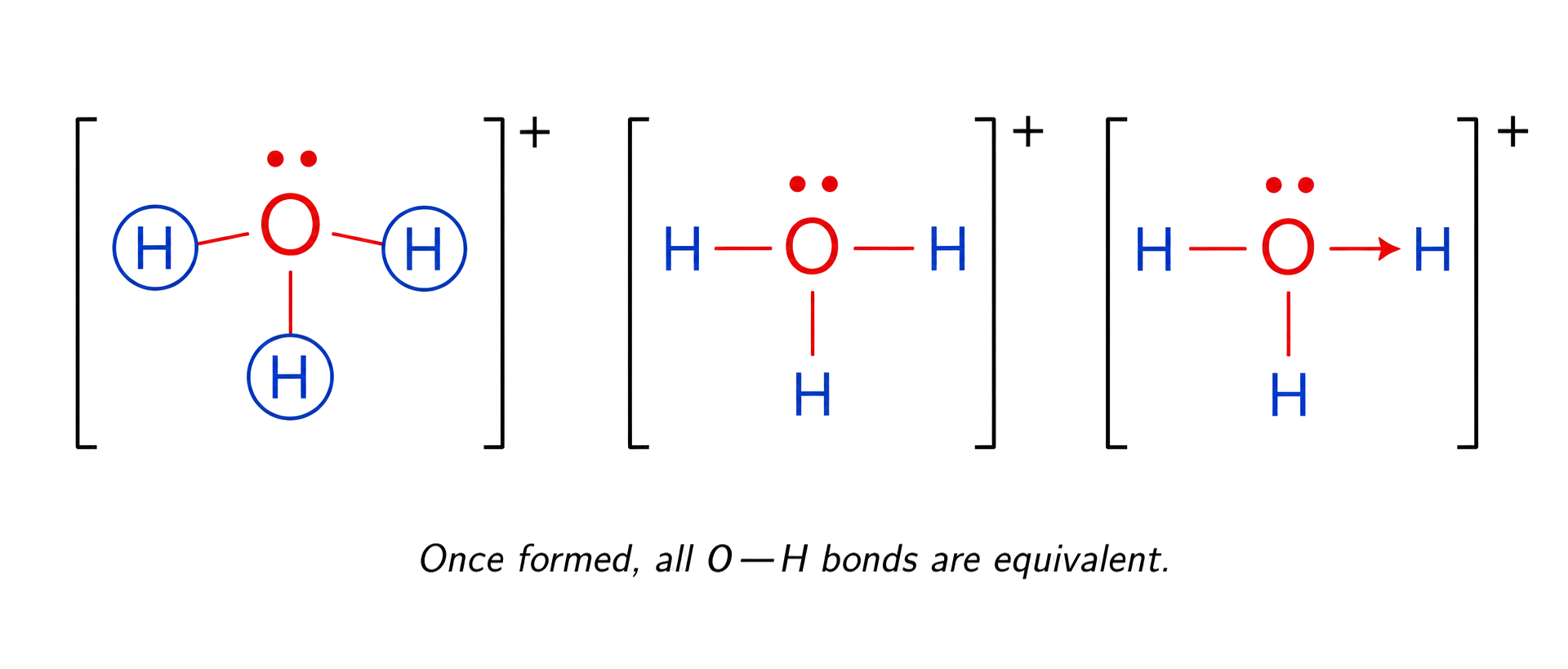
Identify the donor atom or ligand and the acceptor, including coordination bonds in transition-element complexes at HL.
In NH₃→BF₃ the nitrogen lone pair supplies both bonding electrons, so the arrow starts at N and ends at B. The arrow records how the pair originated; after formation it is a shared covalent pair, and in a complex the same donor logic identifies each ligand–metal bond.
VSEPR predicts molecular shape by arranging electron domains around a central atom to minimize repulsion. Lone pairs repel more strongly than bonding pairs and therefore alter common bond angles.
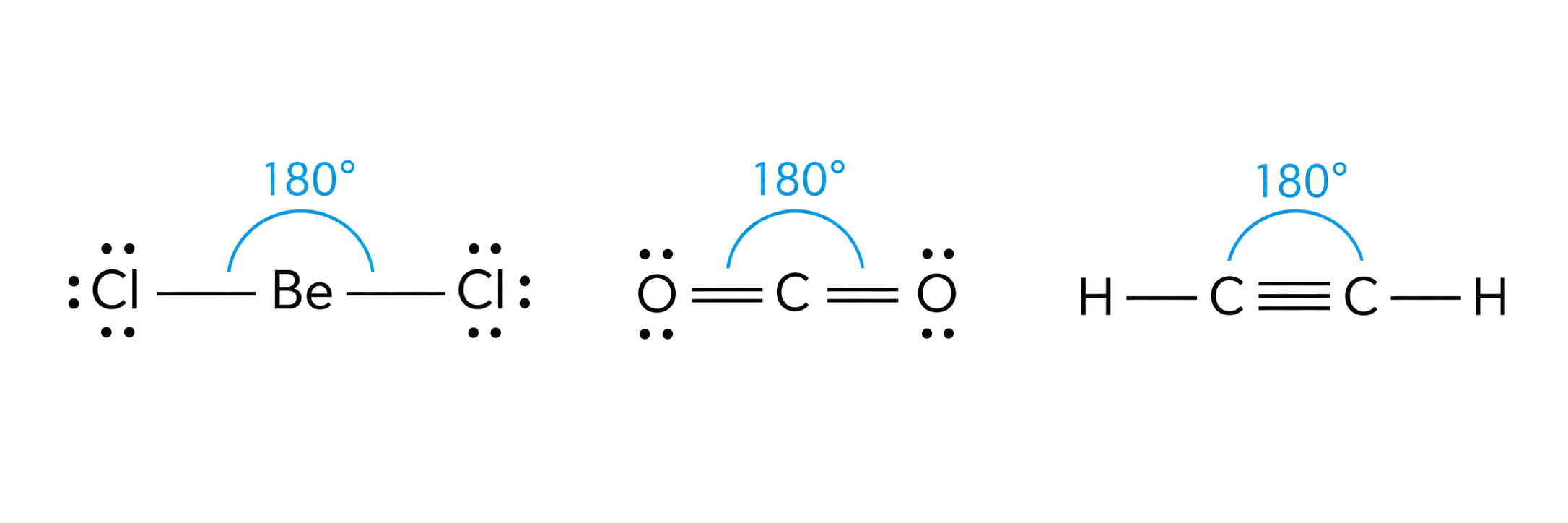
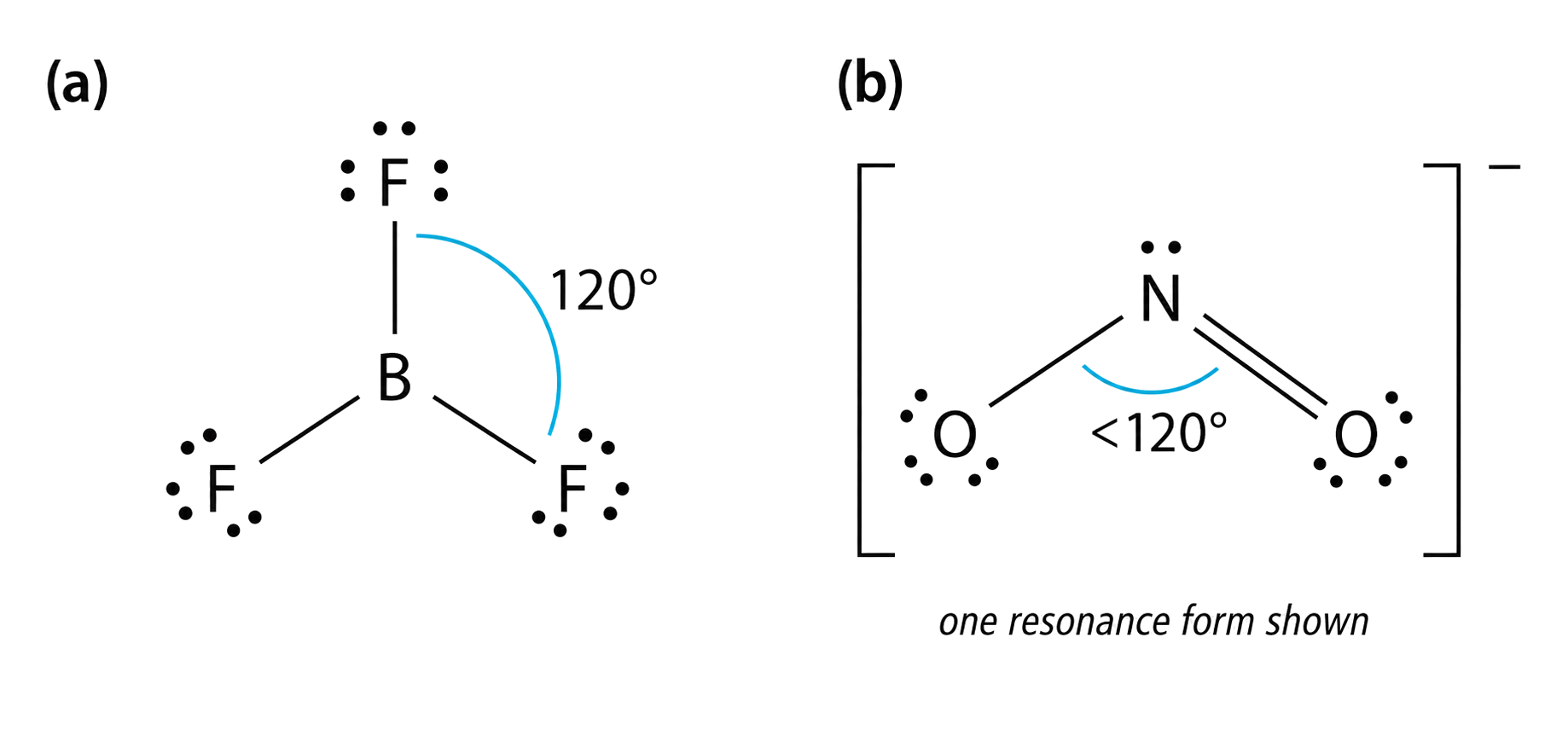
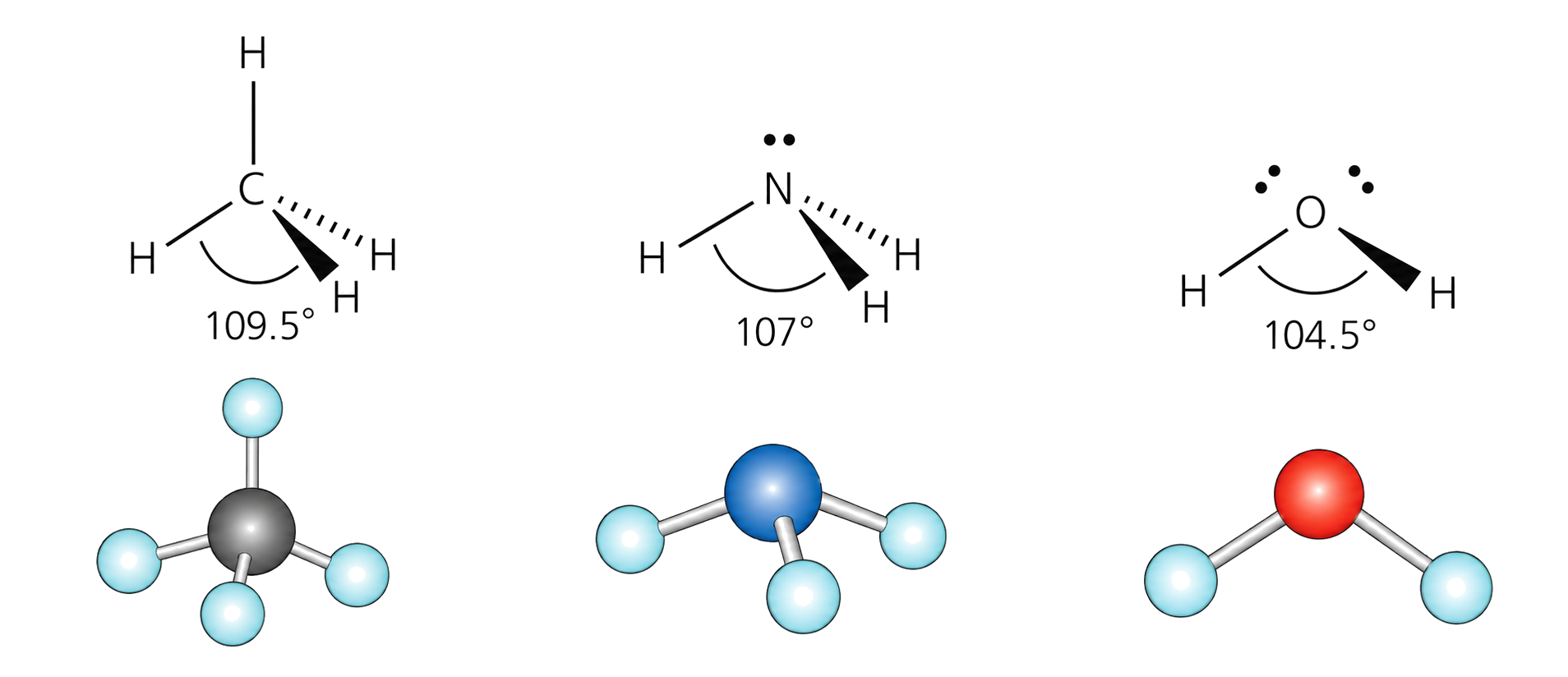
| Step | Decision |
|---|---|
| 1 | Count bonding and lone-pair electron domains |
| 2 | Assign electron-domain geometry |
| 3 | Ignore lone pairs when naming molecular geometry |
| 4 | Adjust expected bond angles for lone-pair repulsion |
NH₃ has four electron domains around N, so its electron-domain geometry is tetrahedral but its molecular shape is trigonal pyramidal; the lone pair compresses the H–N–H angle below 109.5°. Count a double bond as one domain and distinguish electron geometry from the shape named using atoms only.
A bond is polar when a difference in electronegativity gives unequal sharing of the bonding electrons. The more electronegative atom carries partial negative character.
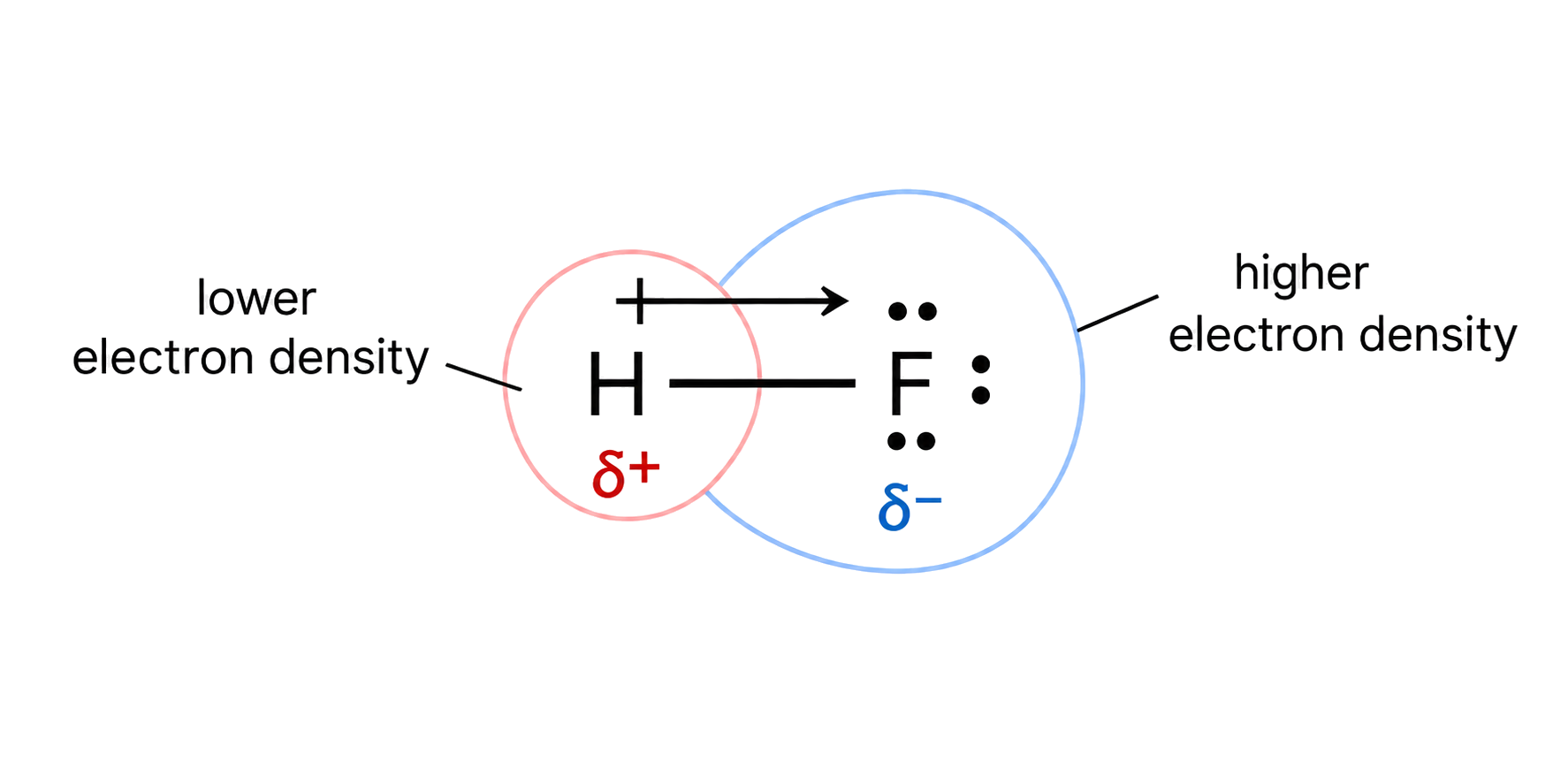
Compare electronegativities, assign partial charges, and draw the bond-dipole arrow toward the more electronegative atom.
For H–Cl, chlorine is more electronegative, so label Hδ⁺–Clδ⁻ and point the dipole arrow toward Cl. Electronegativity difference predicts unequal sharing within that bond; it does not by itself decide the polarity of the whole molecule.
Molecular polarity depends on both the polarity of individual bonds and the three-dimensional geometry of the molecule or ion. Bond dipoles can cancel or produce a net dipole moment.
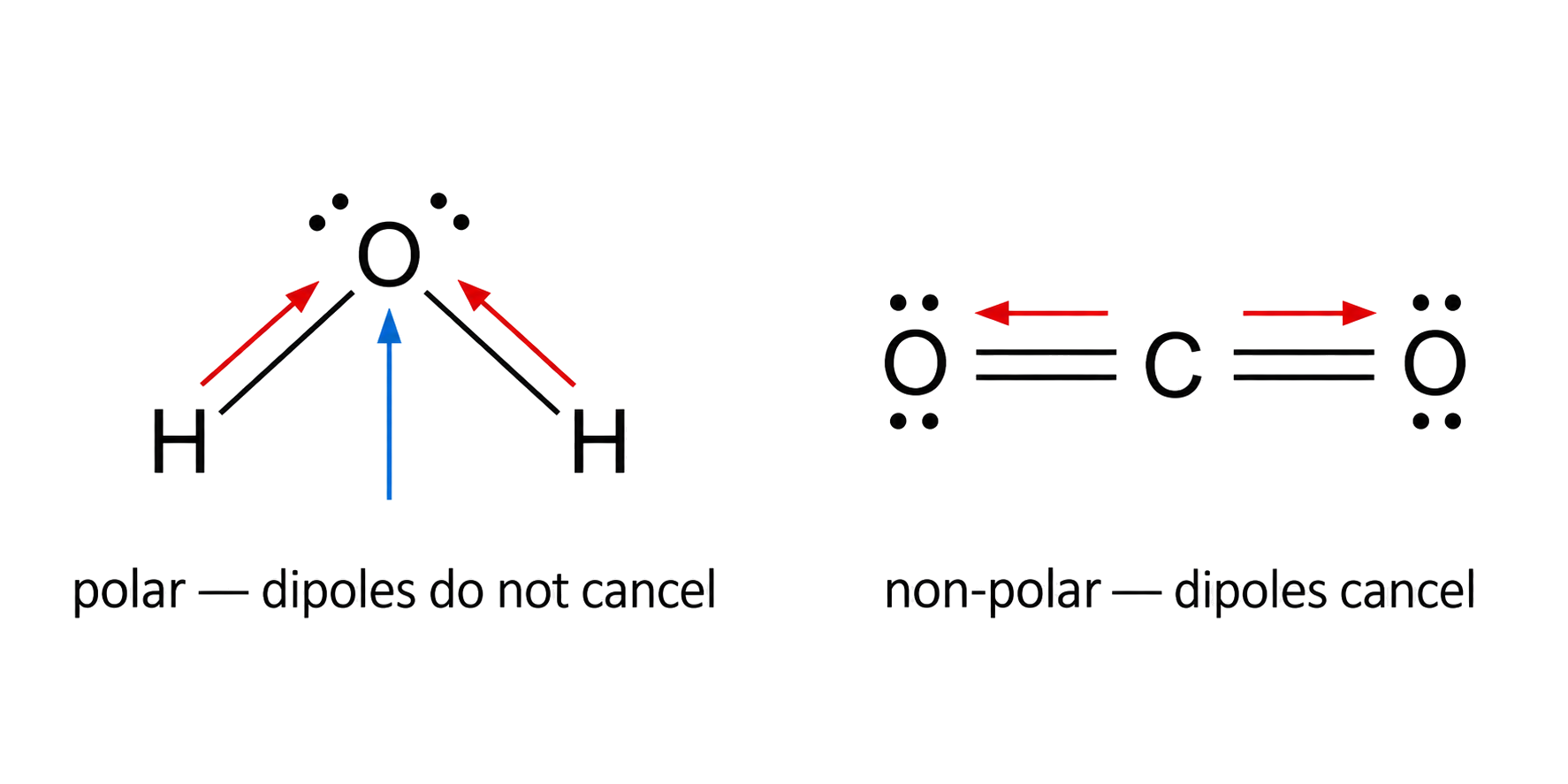
Draw or infer the geometry, place each bond dipole, and check whether the vector sum is zero. Do not decide molecular polarity from a single bond alone.
CO₂ contains polar C=O bonds, but their equal opposite dipoles cancel in a linear molecule. In bent H₂O they do not cancel, so the molecule has a net dipole. Always establish the three-dimensional geometry before adding dipoles as vectors.
| Material | Structural evidence | Property or use explained |
|---|---|---|
| Diamond | each C covalently bonded in a rigid 3D network | very hard; high melting point; no mobile charge carriers |
| Graphite | strong covalent sheets with delocalized electrons; weak attractions between sheets | conducts along sheets; layers slide, so it is soft/lubricating |
| Graphene | one atom-thick covalent sheet with delocalized electrons | strong, light and electrically conducting |
| Fullerenes | finite carbon cages or tubes rather than an infinite 3D network | molecular shape and intermolecular contacts give properties distinct from diamond/graphite |
| Silicon | extended covalent structure with limited charge mobility | semiconductor behaviour; detailed doping is outside this card |
| Silicon dioxide | 3D Si–O covalent network, not discrete SiO₂ molecules | hard and high-melting because many strong covalent bonds must be overcome |
Decide conductivity by available mobile charges, not by the word covalent alone.
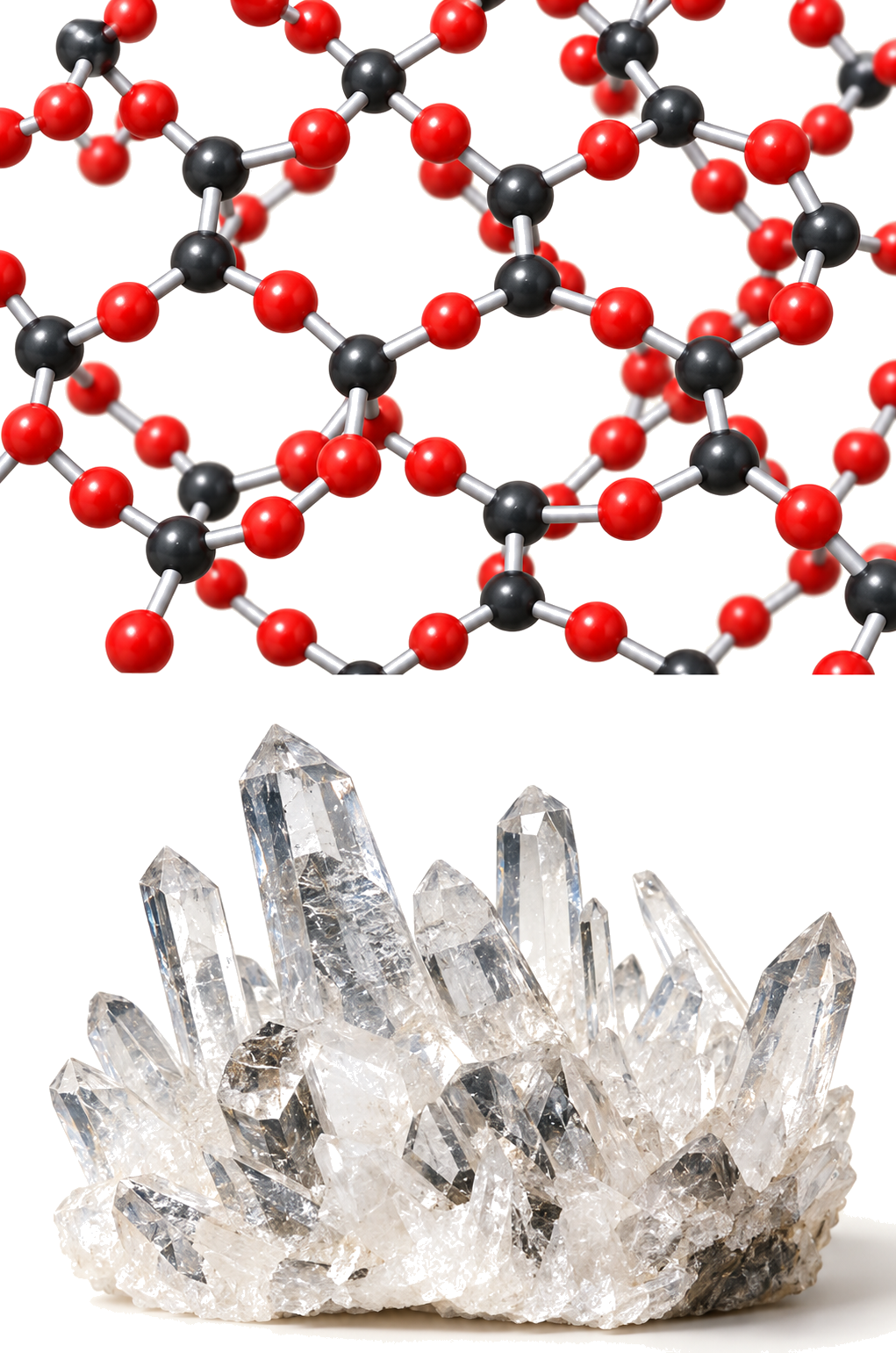
Explain a network material property by connecting the structure and bonding arrangement to the relevant mobility, strength, or dimensional feature.
Diamond is hard because each carbon is held in a three-dimensional covalent network, while graphite conducts along layers through delocalized electrons and its layers can slide. Silicon dioxide is also an extended network: describe network atoms, not discrete SiO₂ molecules, when explaining its high melting point.
| Force | Evidence used to identify it |
|---|---|
| London dispersion | Present; increases with molecular size and electron count |
| Dipole-induced dipole | A permanent dipole induces a dipole in a neighbour |
| Dipole-dipole | Permanent dipoles attract |
| Hydrogen bonding | Hydrogen bonded to a strongly electronegative atom creates the required interaction |
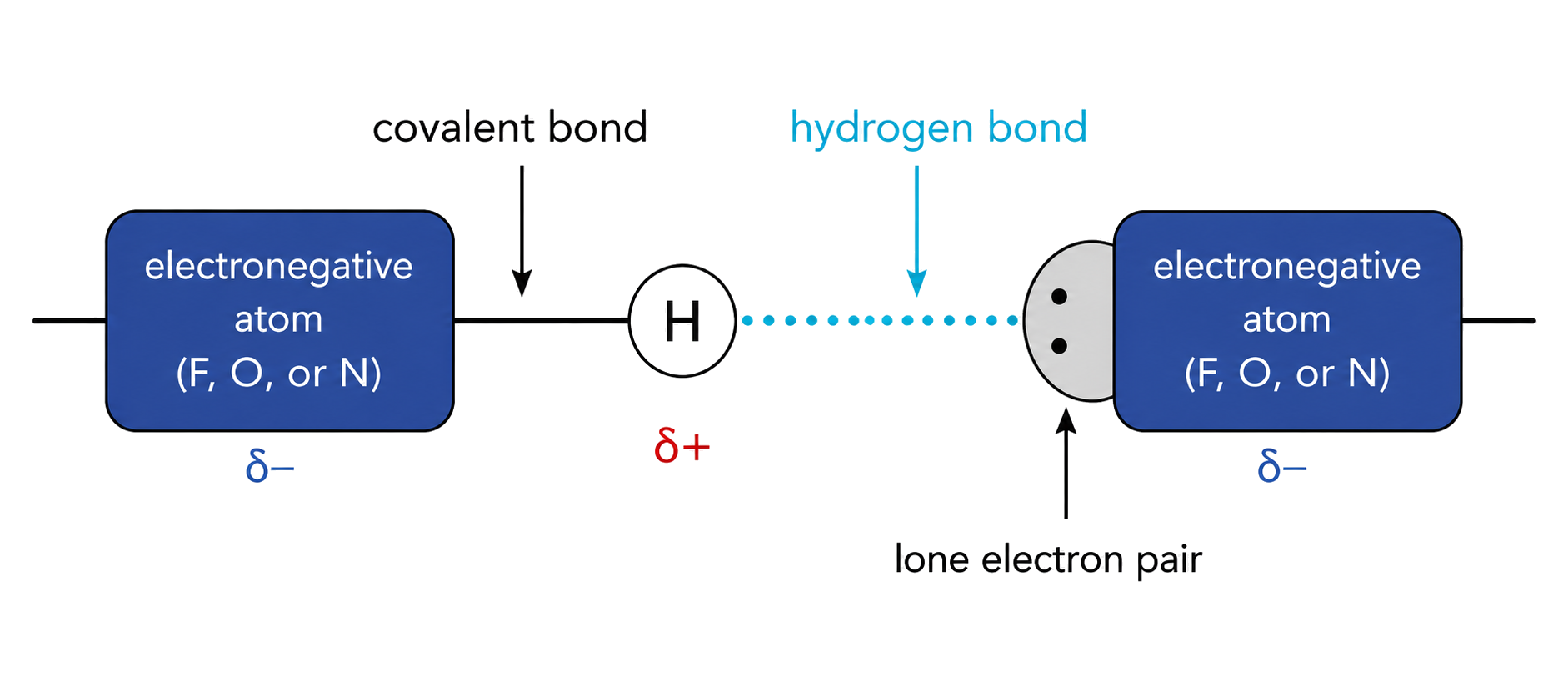
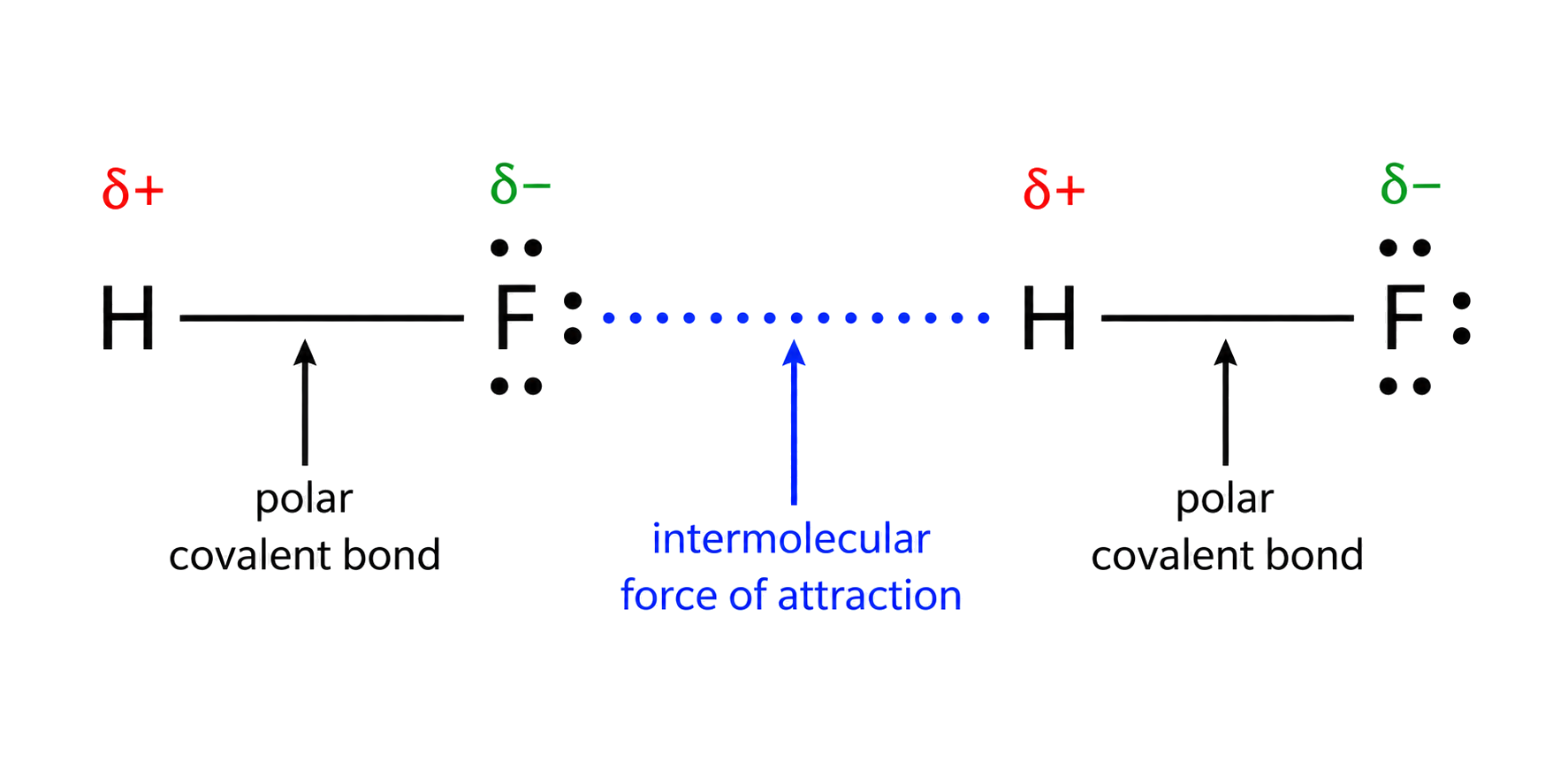
Start with molecular size and polarity, then check for the structural requirement for hydrogen bonding. More than one IMF can be present.
All molecules have London dispersion forces. Add permanent dipole–dipole attraction when a net molecular dipole exists, and add hydrogen bonding only when the required H–N, H–O or H–F environment and an acceptor lone pair are present. Name every relevant force before deciding which dominates.
Chromatography separates components because they have different attractions to the stationary and mobile phases. A component that is more strongly attracted to the mobile phase travels farther.
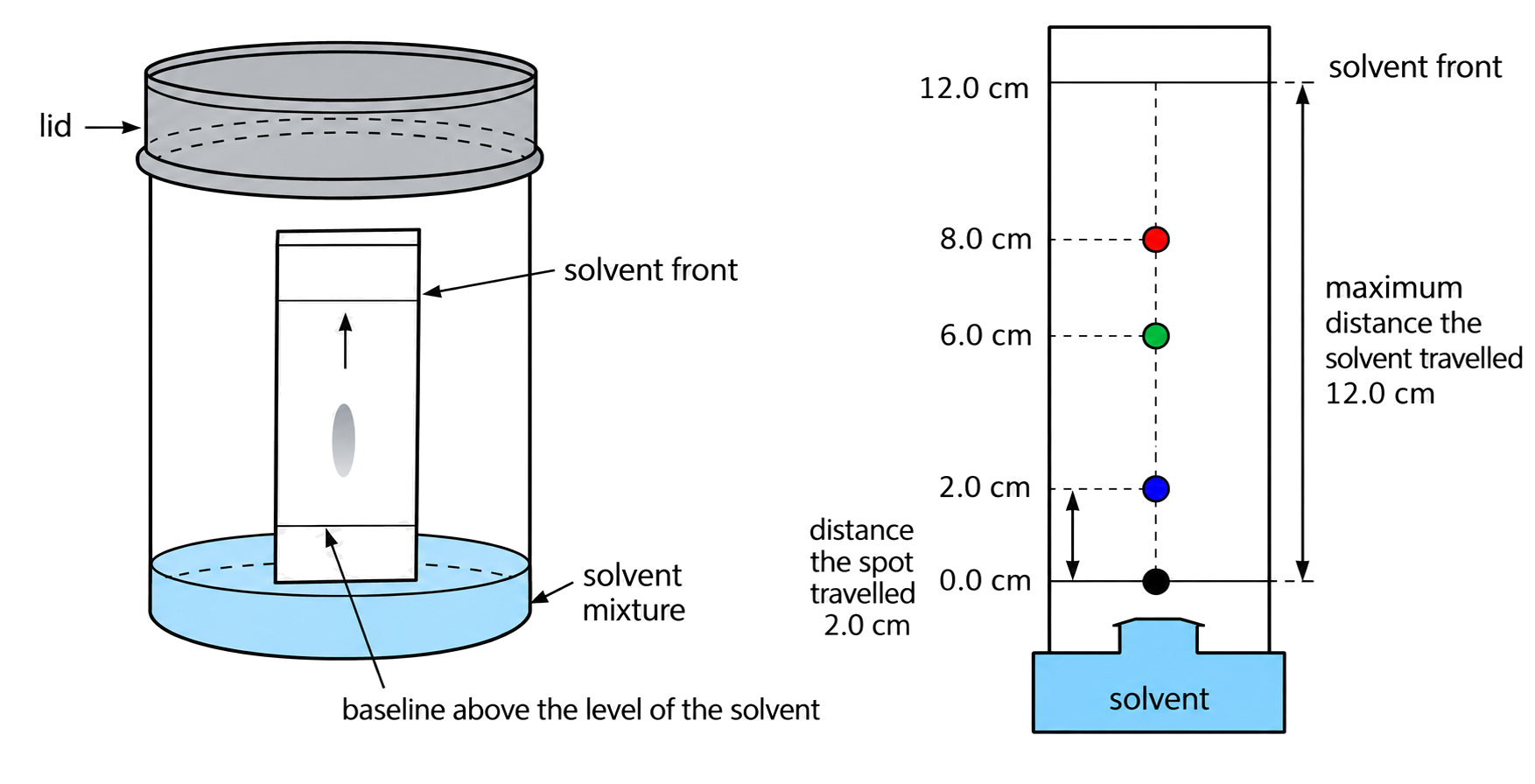
Rf is a dimensionless ratio of distances measured from the same origin under the same conditions. Because a component cannot pass the solvent front, a valid result lies from 0 to 1; a value above 1 signals a distance or origin error. Operational details beyond the separation principle are not assessed here.
If a spot moves 3.2 cm while the solvent front moves 8.0 cm, Rf = 0.40. A larger Rf means greater relative affinity for the mobile phase under those conditions, but values from different solvents, stationary phases or temperatures are not directly interchangeable.
Metallic bonding is the electrostatic attraction between a lattice of positive metal ions and delocalized electrons.
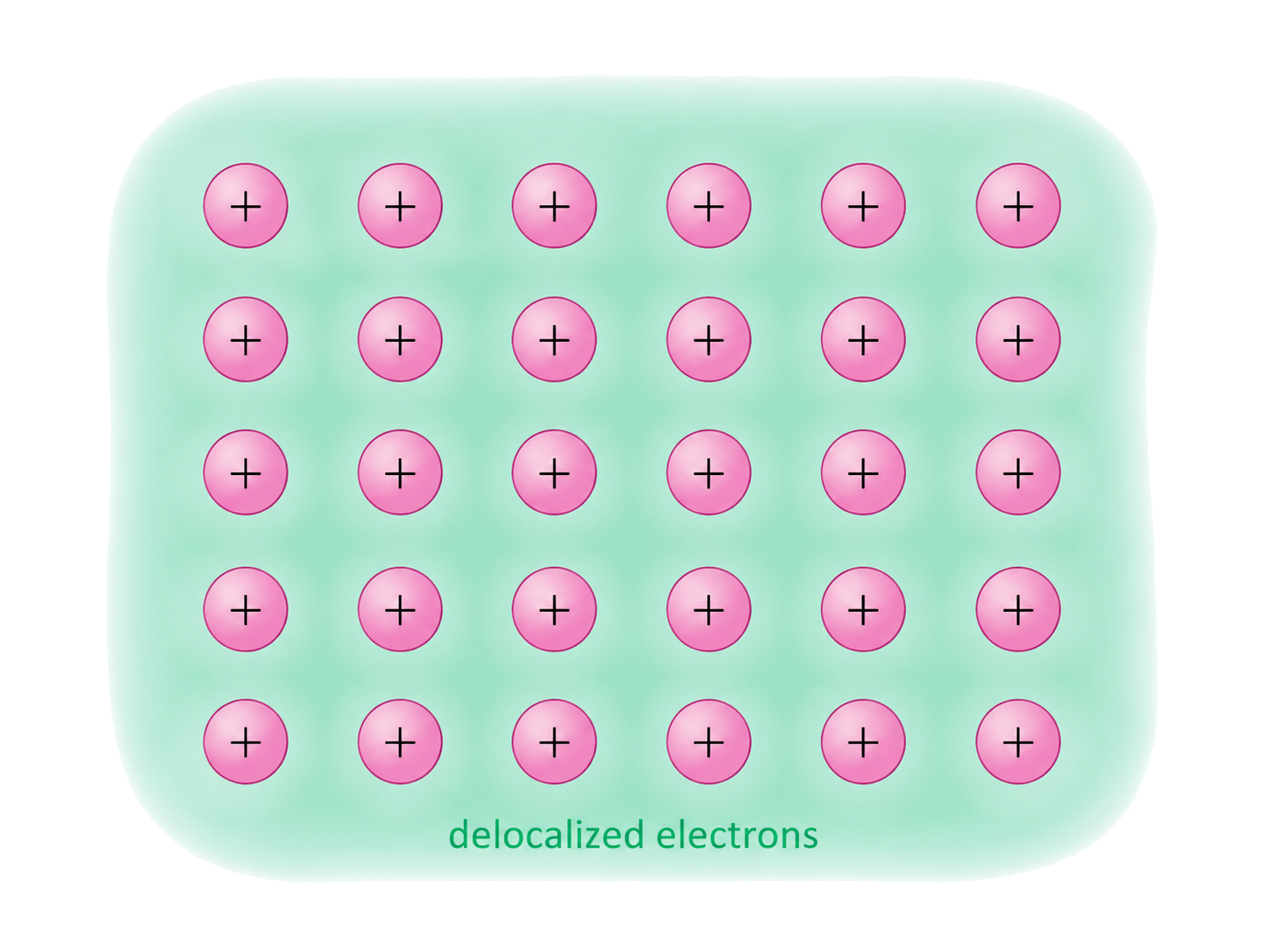
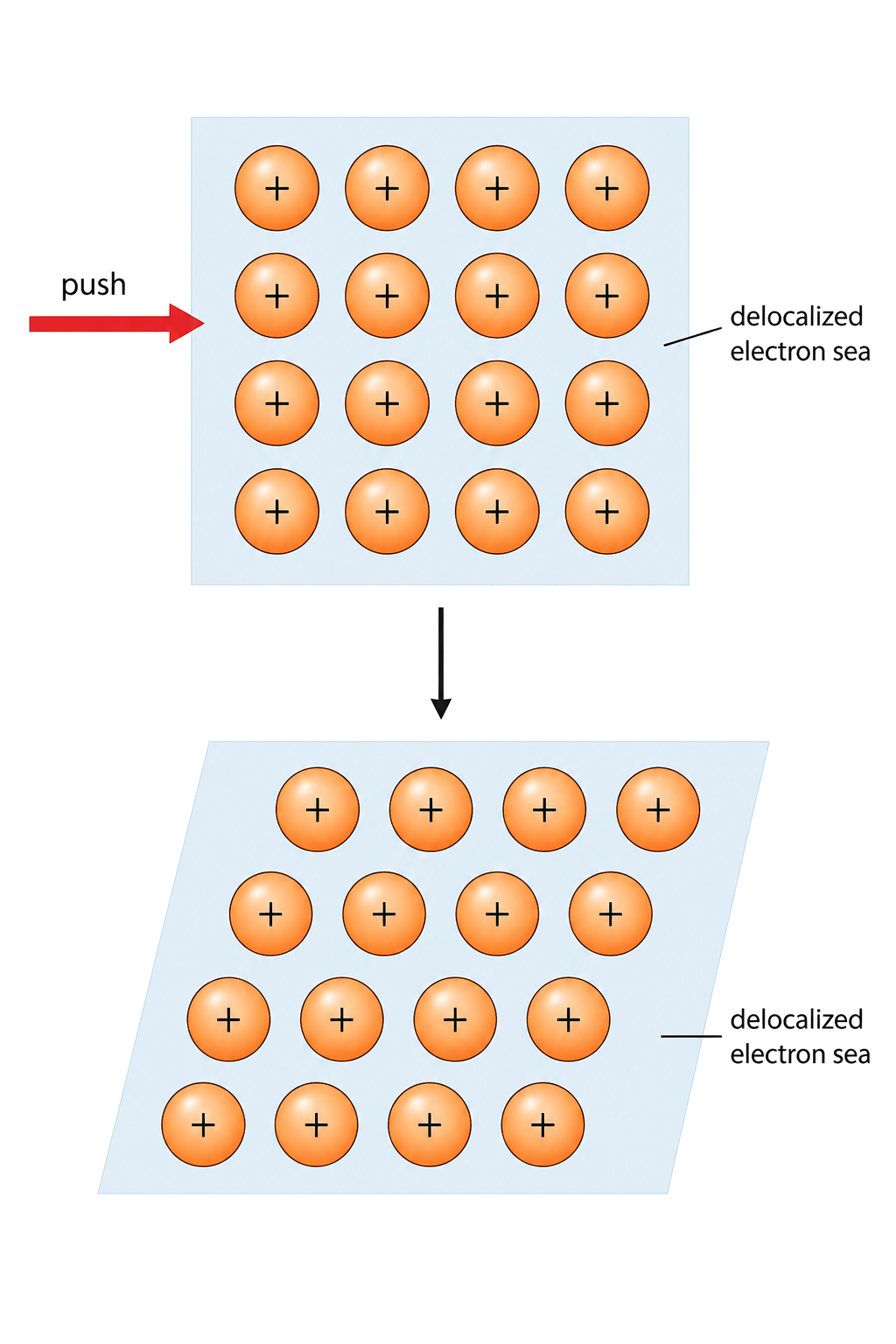
Delocalized electrons can move through the structure and carry charge and thermal energy. Non-directional attraction allows layers of cations to slide while the bonding remains.
When a potential difference is applied, delocalized electrons drift through the fixed cation lattice and carry charge; the positive ions do not travel through the metal. When layers shift under force, non-directional attraction to the electron sea persists, explaining malleability rather than brittle fracture.
Property-to-use link: copper is used for electrical wiring because its delocalized electrons carry charge through the solid; aluminium can be rolled into foil because ion layers can shift while non-directional metallic attraction is maintained. A use must be justified by the relevant property, not merely by stating that the substance is a metal.
Ionic, covalent, and metallic bonding are models whose contributions can vary across materials. The bonding continuum represents mixed character rather than completely separate categories.
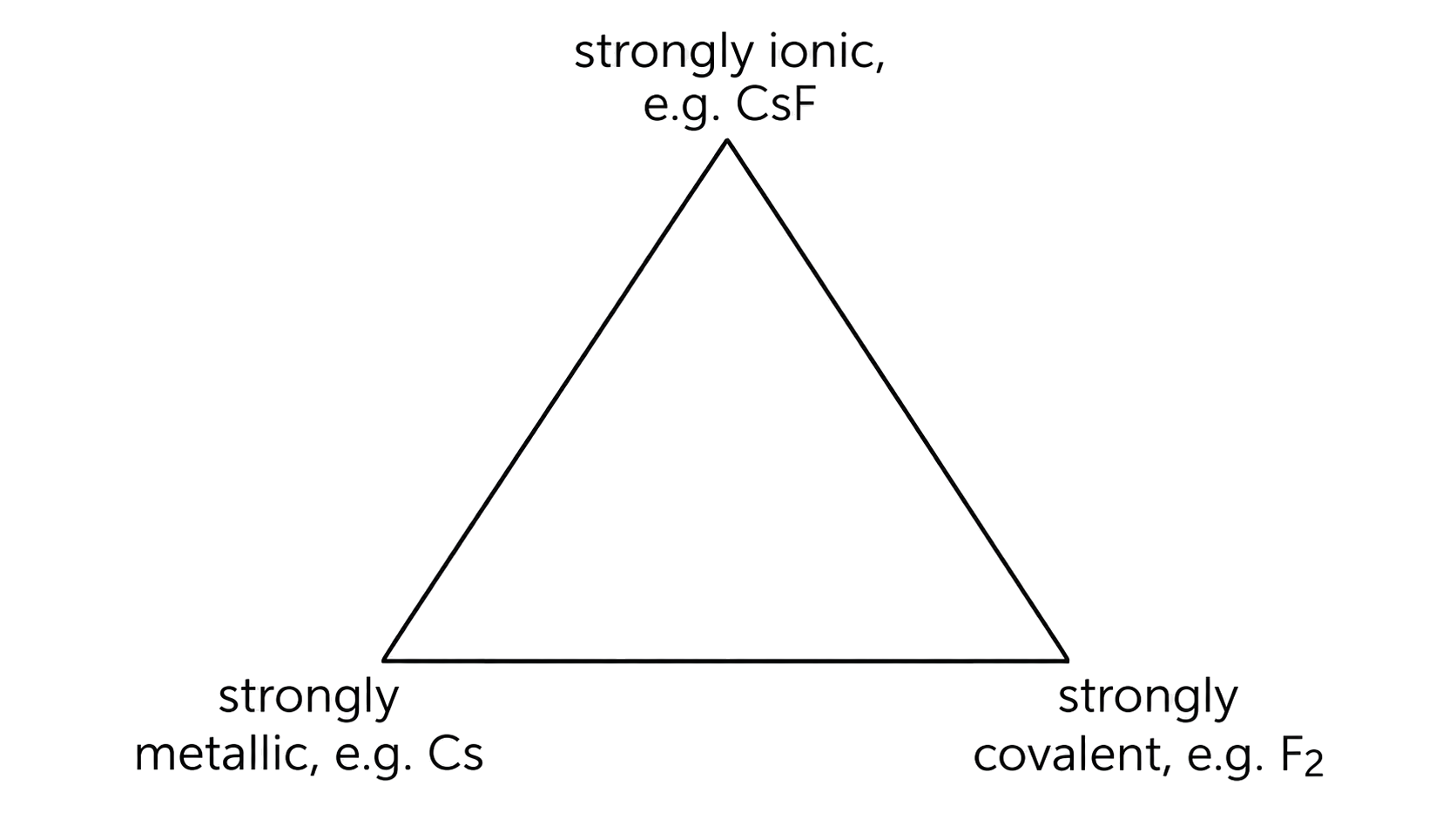
Use the relative contributions of the three bonding types to explain a material's position and its likely properties.
Treat the three bonding models as coordinates rather than sealed boxes. A material may combine electron sharing with partial charge separation, so its properties can fall between idealized categories. Explain which model contribution accounts for each observed property instead of assigning one label and stopping.
The bonding triangle is a model for mixed ionic, covalent and metallic character. Its horizontal coordinate uses average electronegativity and its vertical coordinate uses electronegativity difference.
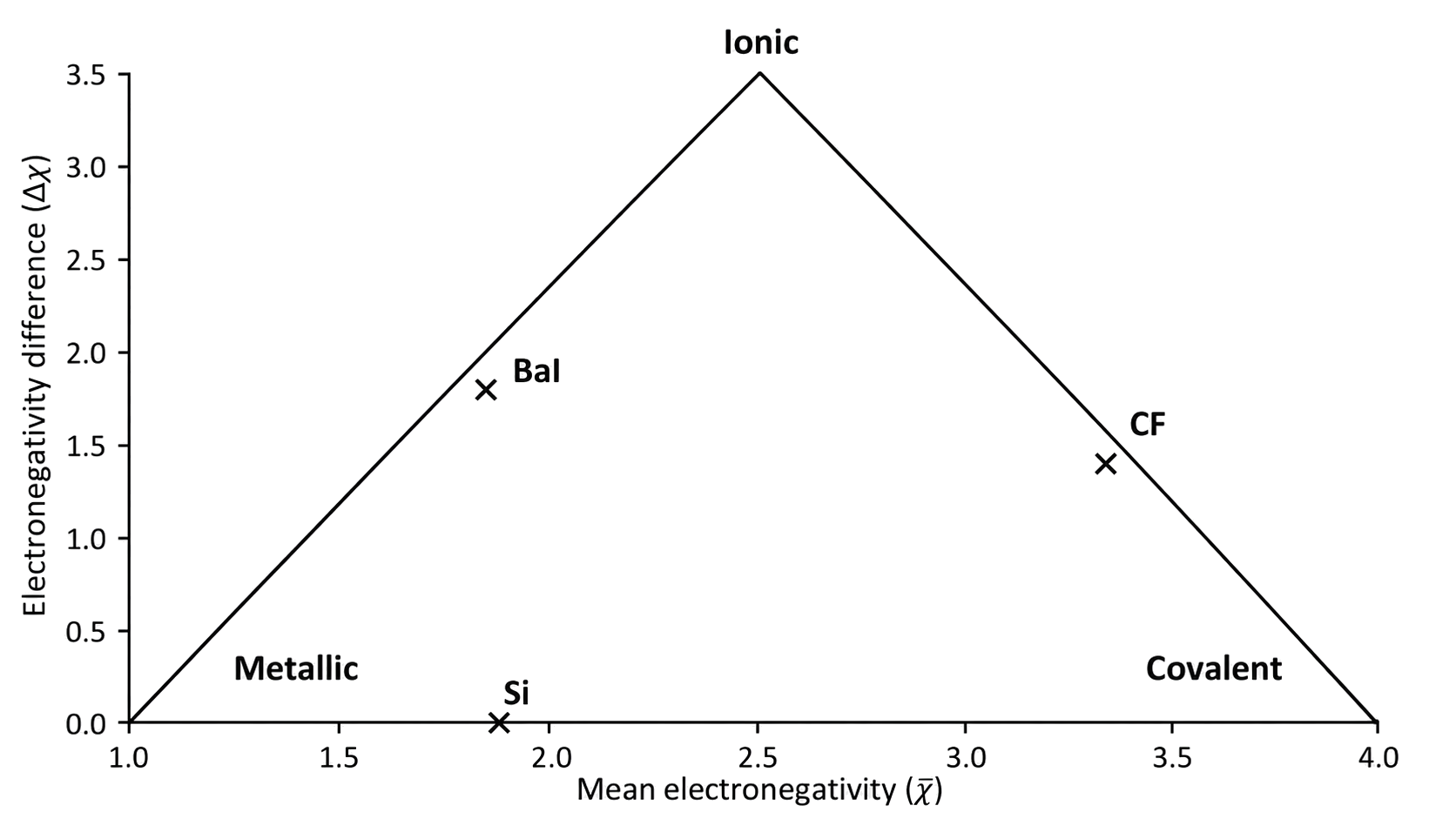
Calculate the two coordinates from the supplied electronegativities, place the substance, then check whether the predicted properties fit the indicated bonding contribution. The triangle is a qualitative model, not a requirement to memorise percentage boundaries.
For NaCl, using χ(Na)=0.9 and χ(Cl)=3.2 gives average χ = (0.9+3.2)/2 = 2.05 and Δχ = 3.2−0.9 = 2.3. The large difference places it near the ionic apex; that placement is consistent with a high-melting lattice and conduction only when ions can move.
Use the coordinates to compare materials rather than treating labels as absolute. A small Δχ can still sit at different average electronegativities, so metallic versus covalent character depends on both axes. Test the interpretation against conductivity, melting behaviour and mechanical response.
An alloy is a mixture containing a metal and one or more other metals or non-metals. Different-sized atoms disrupt the regular lattice, making layer sliding more difficult while non-directional metallic bonding remains.
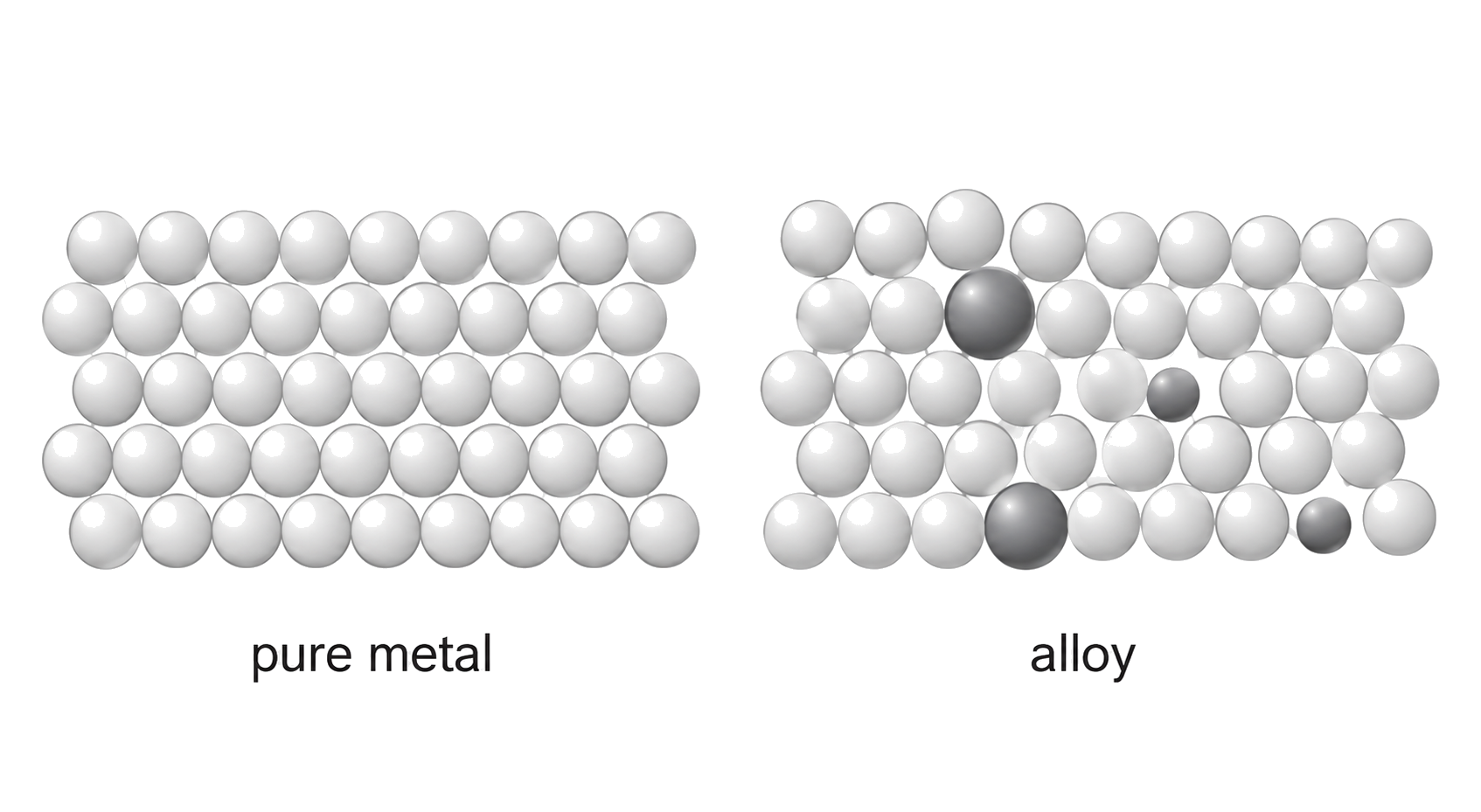
Explain an alloy property by referring to composition, lattice disruption, and the restricted movement of layers; do not call the alloy a compound.
In brass, differently sized Cu and Zn atoms disturb regular layer alignment, so dislocations move less easily and the alloy can be harder than pure copper. Material choice still involves trade-offs—an alloy may gain strength while losing ductility or conductivity—and its variable composition confirms that it is a mixture.
A polymer is a macromolecule built from repeating monomer-derived units. Chain structure and cross-links influence plastic properties.
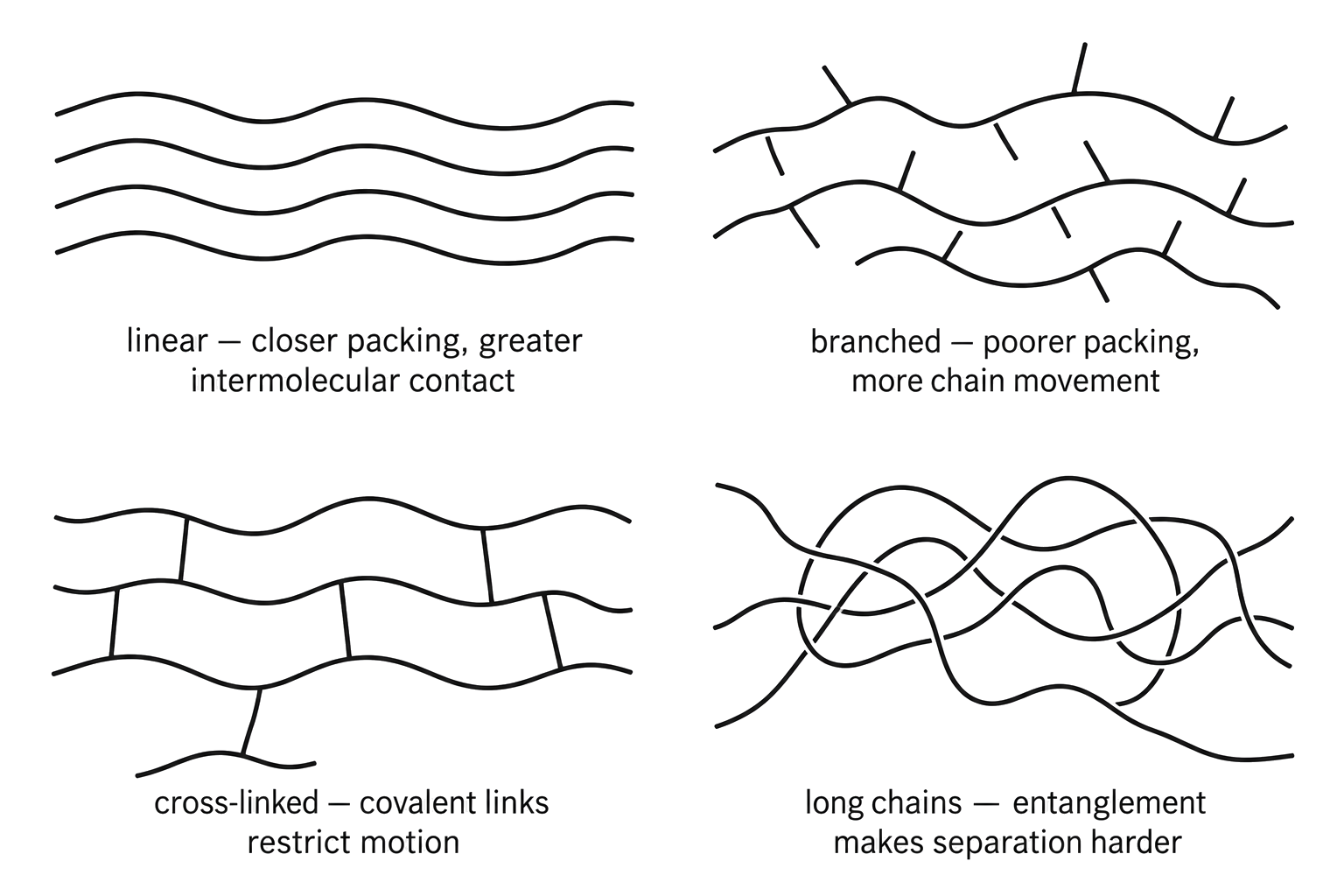
| Chain feature | Molecular-motion or packing effect | Typical qualitative consequence |
|---|---|---|
| Long, relatively linear chains | can pack more closely when chain chemistry permits | stronger intermolecular contact and often greater strength/density |
| More branching | can hinder close, regular packing | often lowers packing efficiency and can increase flexibility |
| Few/no cross-links | chains can move past one another more readily on heating | thermoplastic softening and reshaping |
| Dense cross-linking | strongly restricts chain movement | rigid thermoset behaviour; does not simply melt and reshape |
These are conditional structure–property trends: functional groups, chain length and processing history also matter.
Compare chain mobility: weakly interacting, unlinked chains can soften and be reshaped, whereas extensive cross-linking restricts movement and gives thermoset behaviour. A useful structure–property explanation names the repeat-chain feature, the permitted molecular motion and the resulting macroscopic response.
Cellulose is a natural polymer, whereas polyethene is synthetic. Both are macromolecules with repeating units, but origin alone does not determine a plastic's properties or biodegradability: chain structure, functional groups, intermolecular attractions, branching and cross-linking control packing and molecular motion.
Addition polymerization forms a chain by opening the monomer C=C bond. The substituents remain attached to the backbone carbons and continuation bonds show the repeating unit extends.
![panel a preserves CH2=CHCl and converts it to [–CH2–CHCl–]n; panel b preserves CH2=CHCH3 and converts it to [–CH2–CH(CH3)–]n; both monomer C=C bonds become polymer-backbone C–C single bonds; all substituents remain on the correct backbone carbon.](https://cheese-dev-public.oss-accelerate.aliyuncs.com/interactive-content/images/chemistry/ib-knowledge-cards/v1/batch-022/addition-polymer-figure26-v1.png)
Remove the double bond in the monomer, preserve every substituent, and draw bonds out of the repeating unit at both ends.
Propene forms the repeat unit [–CH₂–CH(CH₃)–]ₙ: open the C=C, keep CH₃ on the same backbone carbon and draw continuation bonds through the brackets. No small molecule is eliminated, so atom accounting should match the monomer exactly.
