2.3 The metallic model

Syllabus
First assessment 2025
Topic
2.3
Level
SL

Metallic Bonding

Metallic bonding is the electrostatic attraction between a lattice of positive metal ions and delocalized electrons.
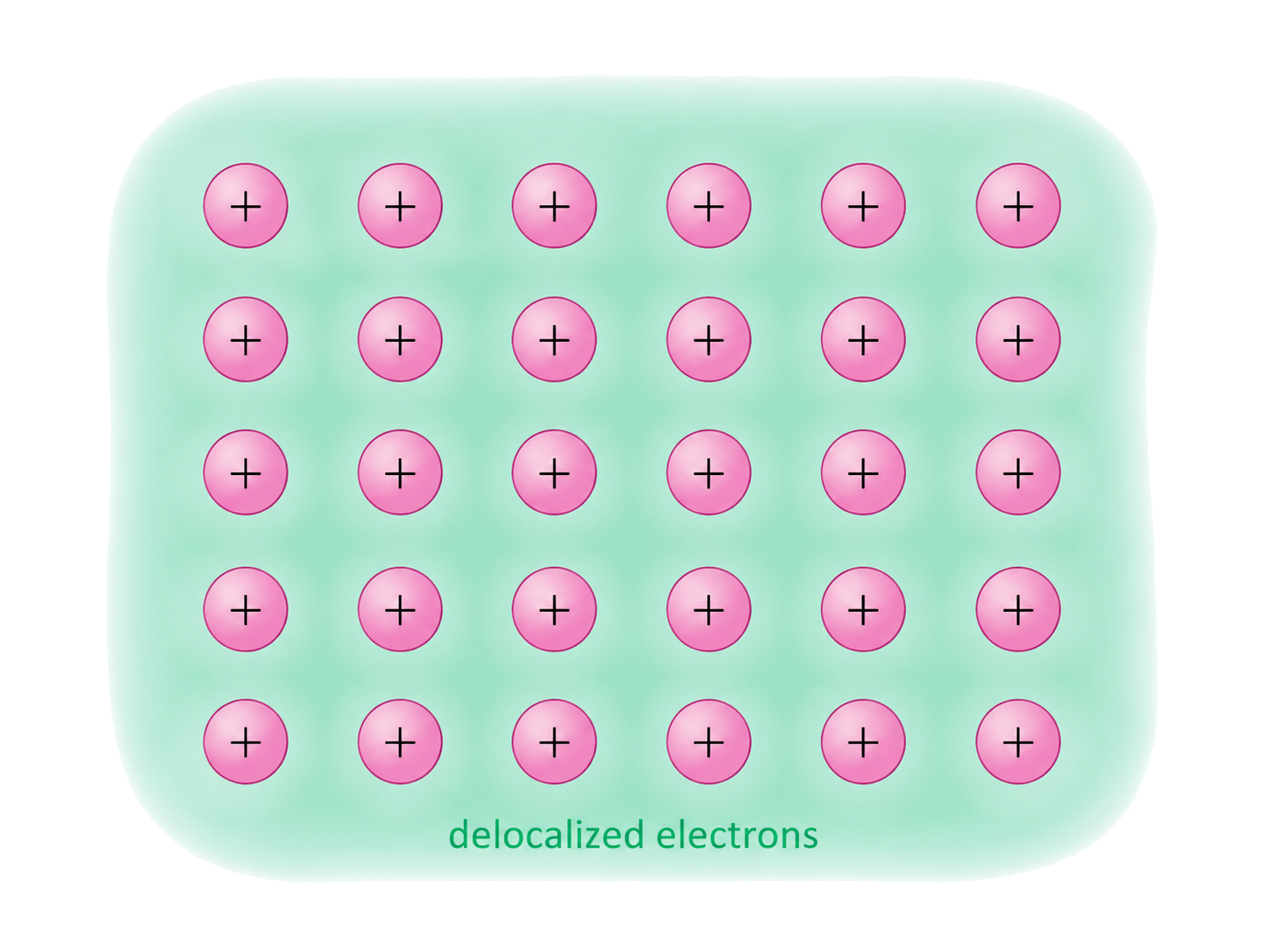
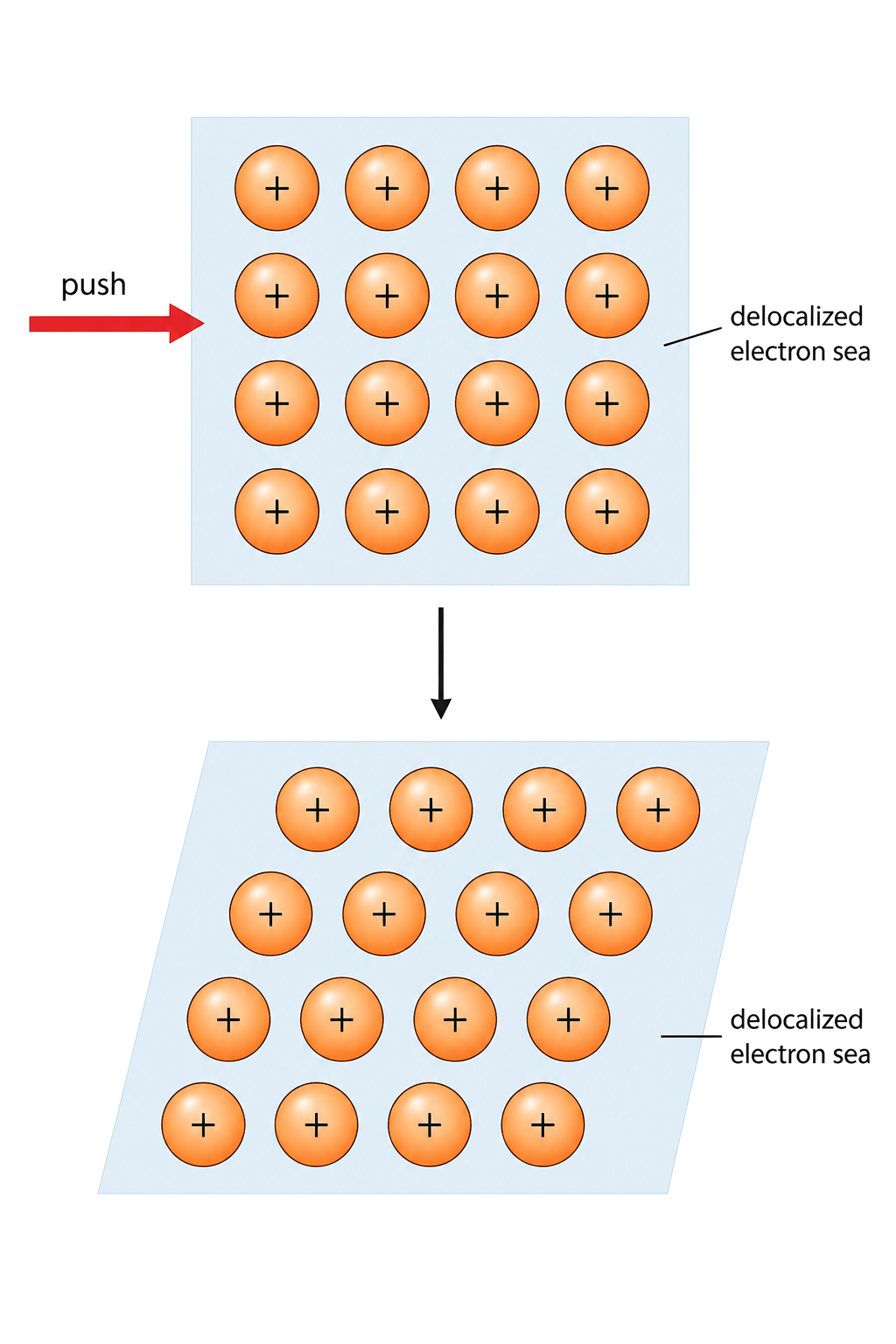
Delocalized electrons can move through the structure and carry charge and thermal energy. Non-directional attraction allows layers of cations to slide while the bonding remains.

When a potential difference is applied, delocalized electrons drift through the fixed cation lattice and carry charge; the positive ions do not travel through the metal. When layers shift under force, non-directional attraction to the electron sea persists, explaining malleability rather than brittle fracture.

Property-to-use link: copper is used for electrical wiring because its delocalized electrons carry charge through the solid; aluminium can be rolled into foil because ion layers can shift while non-directional metallic attraction is maintained. A use must be justified by the relevant property, not merely by stating that the substance is a metal.

Explaining Metallic Properties

Assessment in practice

Representative question

Question 1

[Maximum number: 3]

Describe metallic bonding and how it contributes to electrical conductivity.

Metallic-Bond Strength

Metallic-bond strength depends on the attraction between metal ions and delocalized electrons. Ion charge, ion radius, and the number of delocalized electrons affect charge density and attraction.

A larger ion radius generally lowers attraction; greater charge or more delocalized electrons can strengthen metallic bonding. Use the stated comparison rather than a memorized trend alone.

Compare Na and Mg using the model: Mg supplies more delocalized electrons and forms smaller, more highly charged ions, giving stronger attraction and a higher melting point. State all relevant factors before predicting; across broader sets, lattice structure can prevent a perfectly smooth trend.

Comparing Metallic Strength

Assessment in practice

Representative question

Question 1

[Maximum number: 2]

Explain why the melting points of the group 1 metals (LiCs)(\mathrm{Li} \rightarrow \mathrm{Cs}) decrease down the group.

The Metallic Model Summary

Retrieve the model: positive ions attract delocalized electrons; electron mobility explains conductivity and non-directional bonding explains malleability; charge, radius, and d-electron contribution explain strength trends.

A complete property explanation should name the cation lattice, delocalized electrons, and the specific structural change relevant to the property.