2.4 From models to materials
- Syllabus
- First assessment 2025
- Topic
- 2.4
- Level
- SL
Ionic, covalent, and metallic bonding are models whose contributions can vary across materials. The bonding continuum represents mixed character rather than completely separate categories.
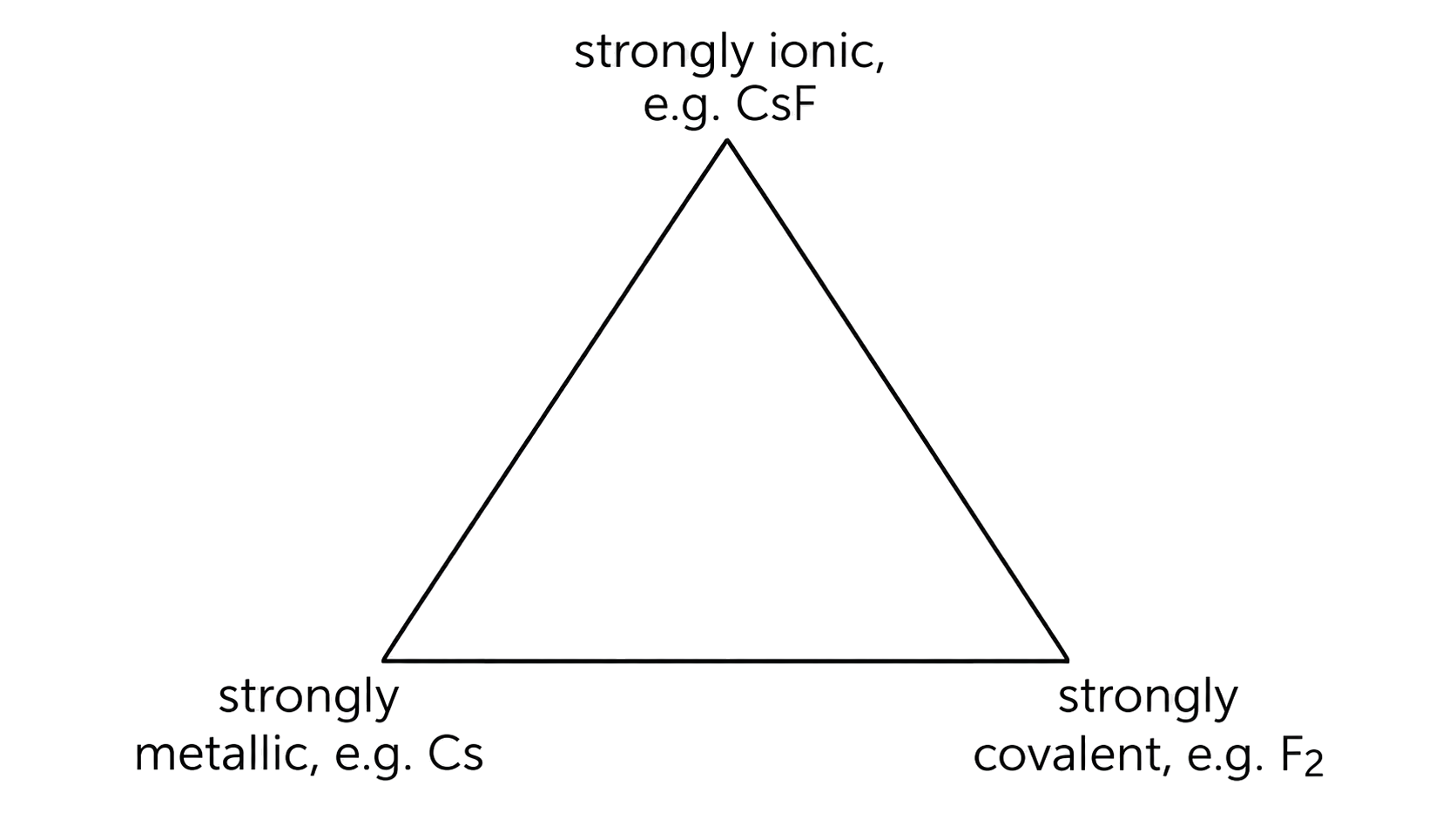
Use the relative contributions of the three bonding types to explain a material's position and its likely properties.
Treat the three bonding models as coordinates rather than sealed boxes. A material may combine electron sharing with partial charge separation, so its properties can fall between idealized categories. Explain which model contribution accounts for each observed property instead of assigning one label and stopping.
The bonding triangle is a model for mixed ionic, covalent and metallic character. Its horizontal coordinate uses average electronegativity and its vertical coordinate uses electronegativity difference.
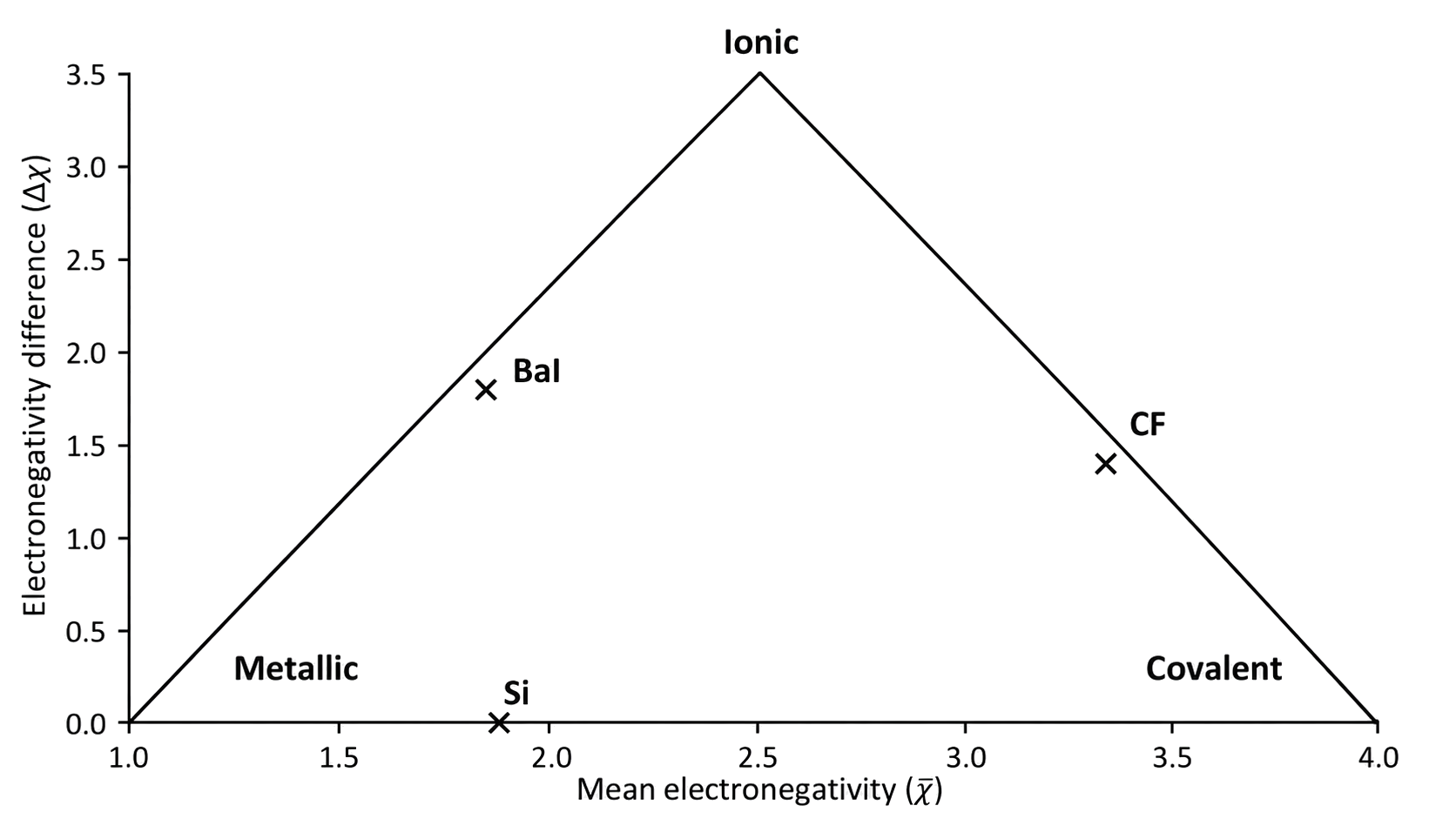
Calculate the two coordinates from the supplied electronegativities, place the substance, then check whether the predicted properties fit the indicated bonding contribution. The triangle is a qualitative model, not a requirement to memorise percentage boundaries.
For NaCl, using χ(Na)=0.9 and χ(Cl)=3.2 gives average χ = (0.9+3.2)/2 = 2.05 and Δχ = 3.2−0.9 = 2.3. The large difference places it near the ionic apex; that placement is consistent with a high-melting lattice and conduction only when ions can move.
Use the coordinates to compare materials rather than treating labels as absolute. A small Δχ can still sit at different average electronegativities, so metallic versus covalent character depends on both axes. Test the interpretation against conductivity, melting behaviour and mechanical response.
An alloy is a mixture containing a metal and one or more other metals or non-metals. Different-sized atoms disrupt the regular lattice, making layer sliding more difficult while non-directional metallic bonding remains.
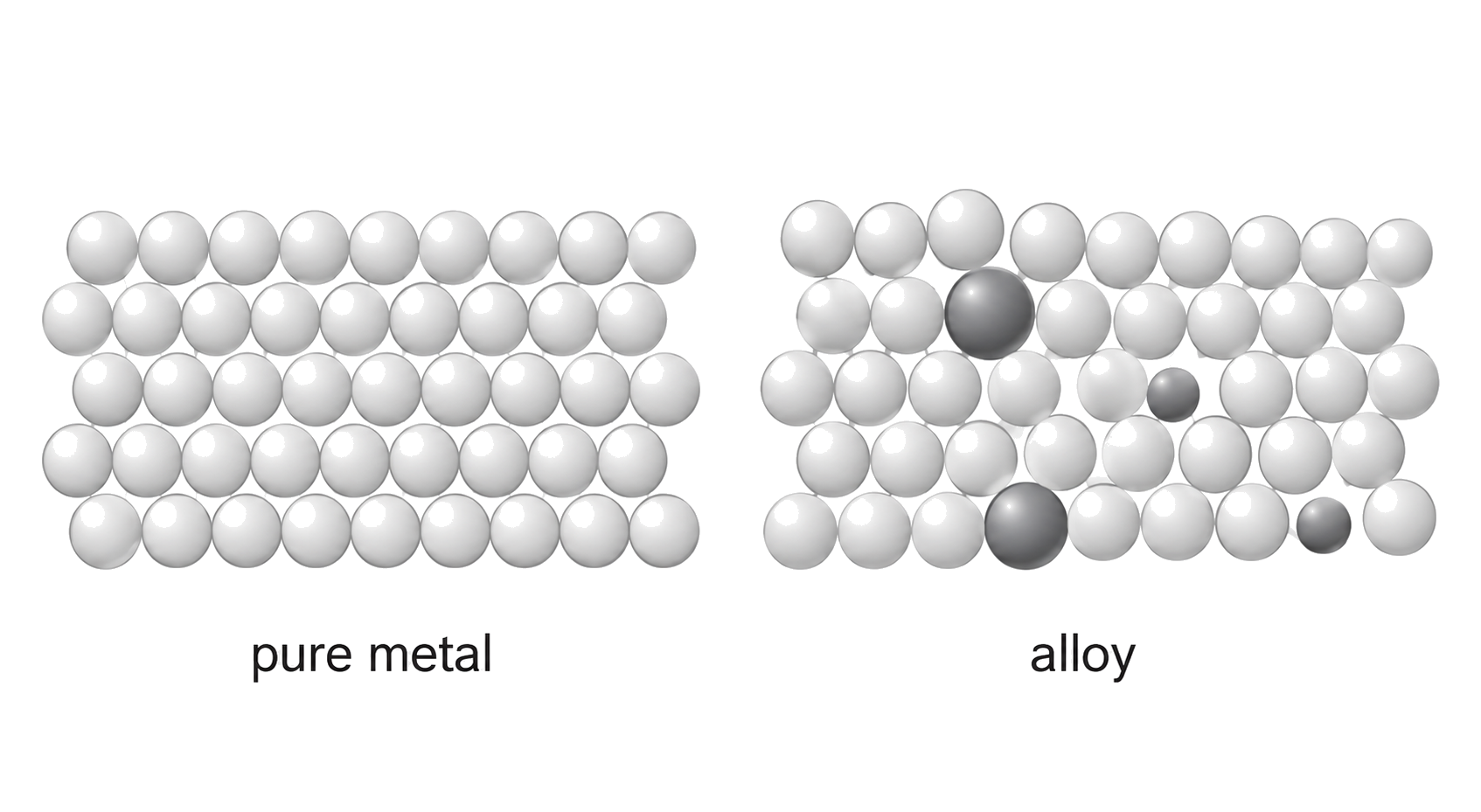
Explain an alloy property by referring to composition, lattice disruption, and the restricted movement of layers; do not call the alloy a compound.
In brass, differently sized Cu and Zn atoms disturb regular layer alignment, so dislocations move less easily and the alloy can be harder than pure copper. Material choice still involves trade-offs—an alloy may gain strength while losing ductility or conductivity—and its variable composition confirms that it is a mixture.
A polymer is a macromolecule built from repeating monomer-derived units. Chain structure and cross-links influence plastic properties.
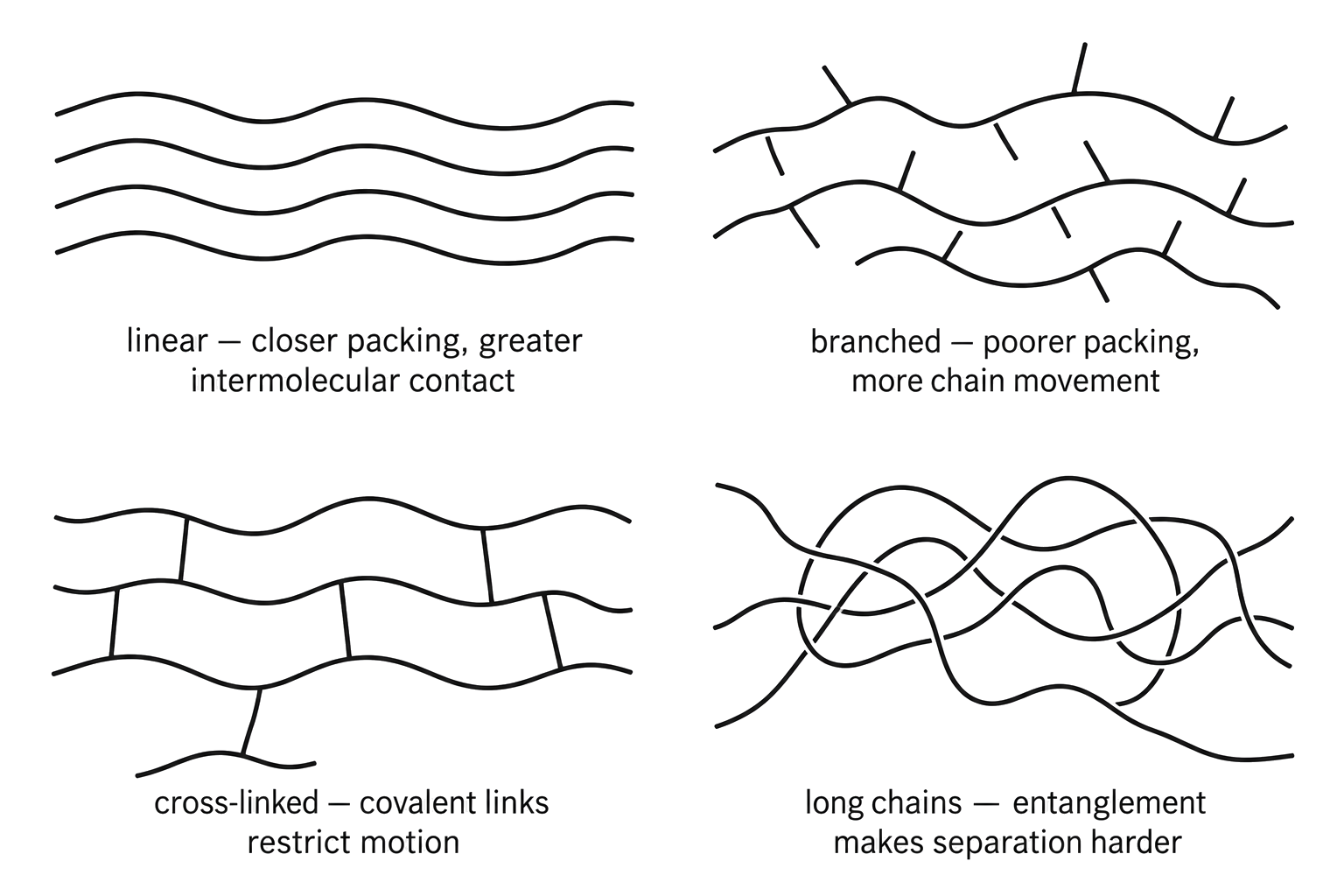
| Chain feature | Molecular-motion or packing effect | Typical qualitative consequence |
|---|---|---|
| Long, relatively linear chains | can pack more closely when chain chemistry permits | stronger intermolecular contact and often greater strength/density |
| More branching | can hinder close, regular packing | often lowers packing efficiency and can increase flexibility |
| Few/no cross-links | chains can move past one another more readily on heating | thermoplastic softening and reshaping |
| Dense cross-linking | strongly restricts chain movement | rigid thermoset behaviour; does not simply melt and reshape |
These are conditional structure–property trends: functional groups, chain length and processing history also matter.
Compare chain mobility: weakly interacting, unlinked chains can soften and be reshaped, whereas extensive cross-linking restricts movement and gives thermoset behaviour. A useful structure–property explanation names the repeat-chain feature, the permitted molecular motion and the resulting macroscopic response.
Cellulose is a natural polymer, whereas polyethene is synthetic. Both are macromolecules with repeating units, but origin alone does not determine a plastic's properties or biodegradability: chain structure, functional groups, intermolecular attractions, branching and cross-linking control packing and molecular motion.
Addition polymerization forms a chain by opening the monomer C=C bond. The substituents remain attached to the backbone carbons and continuation bonds show the repeating unit extends.
![panel a preserves CH2=CHCl and converts it to [–CH2–CHCl–]n; panel b preserves CH2=CHCH3 and converts it to [–CH2–CH(CH3)–]n; both monomer C=C bonds become polymer-backbone C–C single bonds; all substituents remain on the correct backbone carbon.](https://cheese-dev-public.oss-accelerate.aliyuncs.com/interactive-content/images/chemistry/ib-knowledge-cards/v1/batch-022/addition-polymer-figure26-v1.png)
Remove the double bond in the monomer, preserve every substituent, and draw bonds out of the repeating unit at both ends.
Propene forms the repeat unit [–CH₂–CH(CH₃)–]ₙ: open the C=C, keep CH₃ on the same backbone carbon and draw continuation bonds through the brackets. No small molecule is eliminated, so atom accounting should match the monomer exactly.