2.2.10—Chromatography
- Syllabus
- First assessment 2025
- Objective
- 2.2.10
- Level
- SL
Chromatography separates components because they have different attractions to the stationary and mobile phases. A component that is more strongly attracted to the mobile phase travels farther.
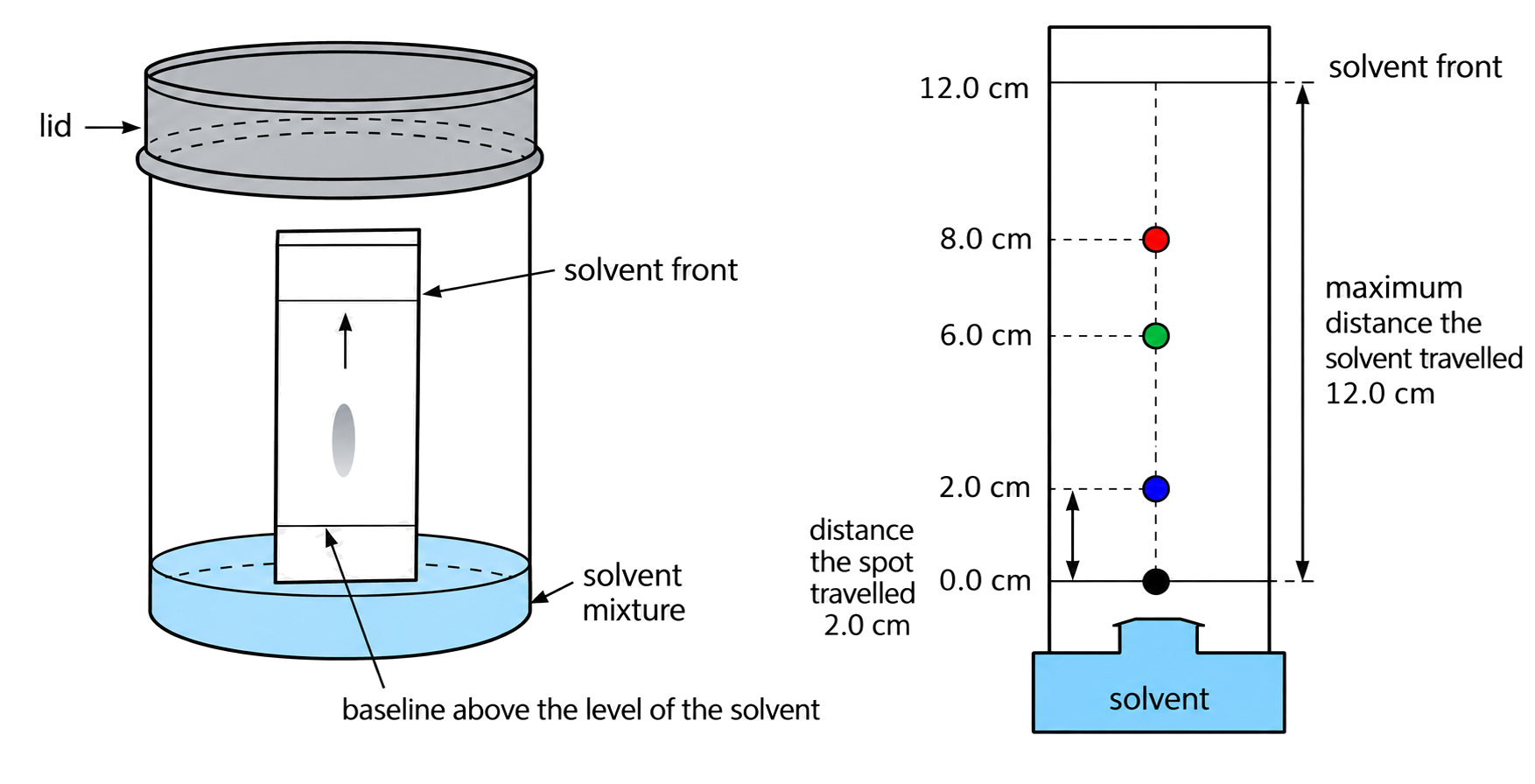
Rf=distancetravelledbycomponent/distancetravelledbysolventfront
Rf is a dimensionless ratio of distances measured from the same origin under the same conditions. Because a component cannot pass the solvent front, a valid result lies from 0 to 1; a value above 1 signals a distance or origin error. Operational details beyond the separation principle are not assessed here.
If a spot moves 3.2 cm while the solvent front moves 8.0 cm, Rf = 0.40. A larger Rf means greater relative affinity for the mobile phase under those conditions, but values from different solvents, stationary phases or temperatures are not directly interchangeable.
Representative question
Explain how the separation of inks is achieved using paper chromatography.
«inks» have different attraction to mobile phase AND stationary phase OR
«inks» separated based on solubilities in/affinities to the two phases OR
separations based on polarities/polar attractions
continuous cycle of adsorption and desorption/dissolution
OR
ink/sample/solute moves when in solvent AND does not move when on paper
Marking guidance:
Allow answers in terms of an equilibrium/partitioning for M1.
Retrieve the covalent pathway: shared pairs and bond order lead to geometry, polarity and molecular polarity; structure determines network properties, IMF behaviour and chromatography; HL representations extend to resonance, formal charge, sigma/pi bonds and hybridization.
Check the representation first, then count domains, apply geometry, identify polarity or forces, and connect the structure to the requested property or HL bonding description.