B4.1.7—Biomes
Biomes group ecosystems with similar communities because similar climate and abiotic conditions produce comparable vegetation and adaptations worldwide across continents.
- Syllabus
- First assessment 2025
- Objective
- B4.1.7
- Level
- SL
Biomes group ecosystems with similar communities because similar climate and abiotic conditions produce comparable vegetation and adaptations worldwide across continents.

Coverage 2011–2015 · Updated 15 Jul 2026

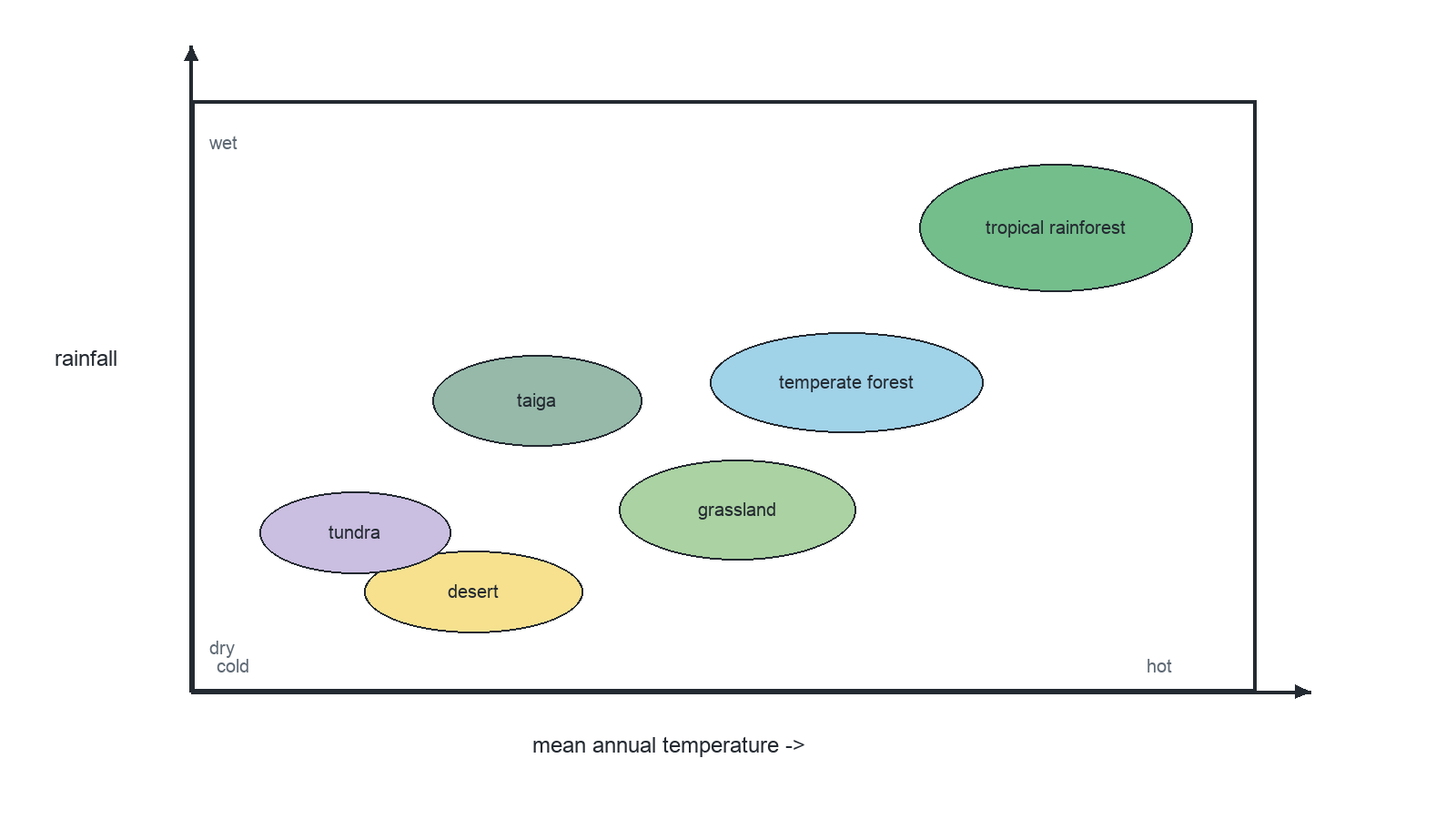
Terrestrial biome distribution can be predicted mainly from temperature and rainfall; seasonality and insolation refine the prediction because they change water availability and photosynthetic productivity.
| Biome | Typical climate |
|---|---|
| Tropical forest | Warm year-round; very high rainfall |
| Temperate forest | Moderate rainfall; warm summers and cold winters |
| Taiga | Long cold winters; short cool summers; moderate precipitation, often snow |
| Grassland | Moderate or strongly seasonal rainfall, insufficient for closed forest |
| Tundra | Very cold; low precipitation; very short growing season |
| Hot desert | Very low rainfall; high insolation and hot days |
High temperature plus year-round high rainfall supports tropical forest, whereas high temperature plus very low rainfall predicts hot desert. Similar abiotic conditions on different continents can favour convergent body forms and communities.
A biome is a group of ecosystems with similar communities and climate, not one ecosystem or a fixed political region. Local soil, altitude, disturbance and seasonality can shift the realized boundary.
This objective is assessed through structured response, commonly using Outline / Distinguish / Identify.
Outline / Distinguish / Identify / State
Build the answer around this relationship: Biomes are groups of ecosystems with similar communities and abiotic conditions.
Defining the biosphere instead of a biome, or failing to distinguish the two.
Representative question
State what a biome is.
a. groups/types of ecosystems / ecosystems with similar communities;
b. with similar/characteristic abiotic/climatic conditions/rainfall/temperatures;
c. convergent evolution (produces similarities between ecosystems in a biome);
2
Marking guidance:
max
A strong answer defines the place as a habitat or microhabitat, names the abiotic factor, and shows how it limits distribution through a tolerance range. Named examples then secure the marks: coral reefs require specific light, temperature, salinity, pH, and clear shallow water; biomes are predicted from temperature, rainfall, and insolation; desert and rainforest organisms show adaptations matched to their environmental pressures.