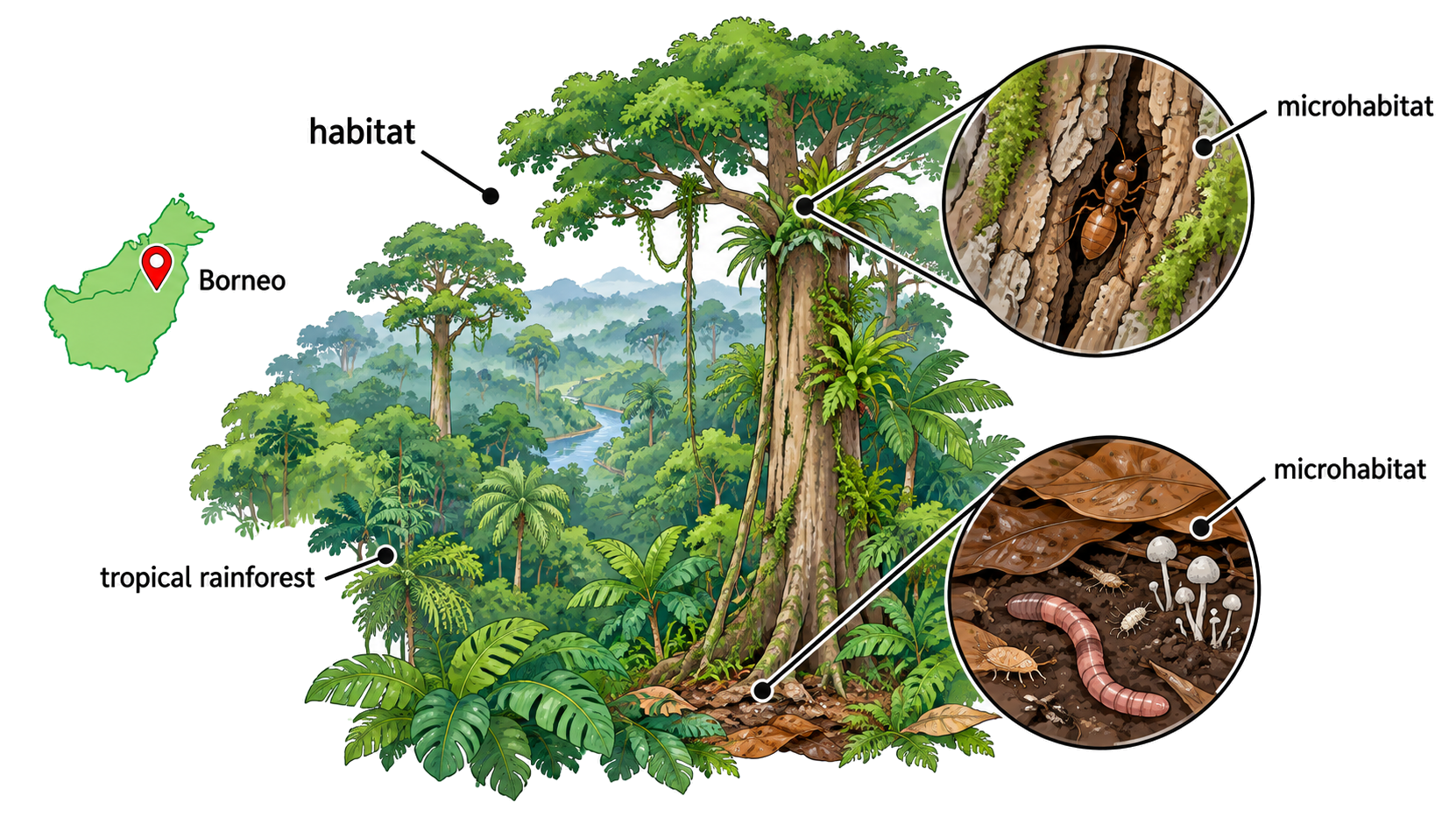
B4.1.1—Habitat definition
A habitat is the physical place or environment where an organism, population, species or community lives and obtains conditions for survival.
- Syllabus
- First assessment 2025
- Objective
- B4.1.1
- Level
- SL
A habitat is the physical place or environment where an organism, population, species or community lives and obtains conditions for survival.

Coverage 2025–2025 · Updated 15 Jul 2026
A habitat is the physical and biological environment in which an organism lives, including the resources and conditions it experiences.
Temperature, water, light, shelter, competitors, predators and food all shape whether a population can persist. A habitat is therefore more than a named place; it is the set of conditions and interactions there.
Describe a habitat by naming location plus key abiotic conditions, resources and interactions.
A pond habitat includes water chemistry, light, dissolved oxygen, plants, prey, predators and seasonal temperature—not just the word ‘pond’.
Habitat is not the same as niche: habitat is the place and conditions; niche includes how the organism uses them.
This objective is assessed through structured response, commonly using Define.
Define
Build the answer around this relationship: A habitat is the place where an organism, population, species or community lives.
Representative question
Define habitat.
(physical) place/environment where a community/species/population/organism lives;
OWTTE
Marking guidance:
Do not accept e.g. "an organism's environment" without stating that it is where it lives.
A strong answer defines the place as a habitat or microhabitat, names the abiotic factor, and shows how it limits distribution through a tolerance range. Named examples then secure the marks: coral reefs require specific light, temperature, salinity, pH, and clear shallow water; biomes are predicted from temperature, rainfall, and insolation; desert and rainforest organisms show adaptations matched to their environmental pressures.