Population Density vs Population Distribution: IB Biology
Compare population density and population distribution in IB Biology, then practise with syllabus-linked ecology questions in the EduNinja Question Bank.
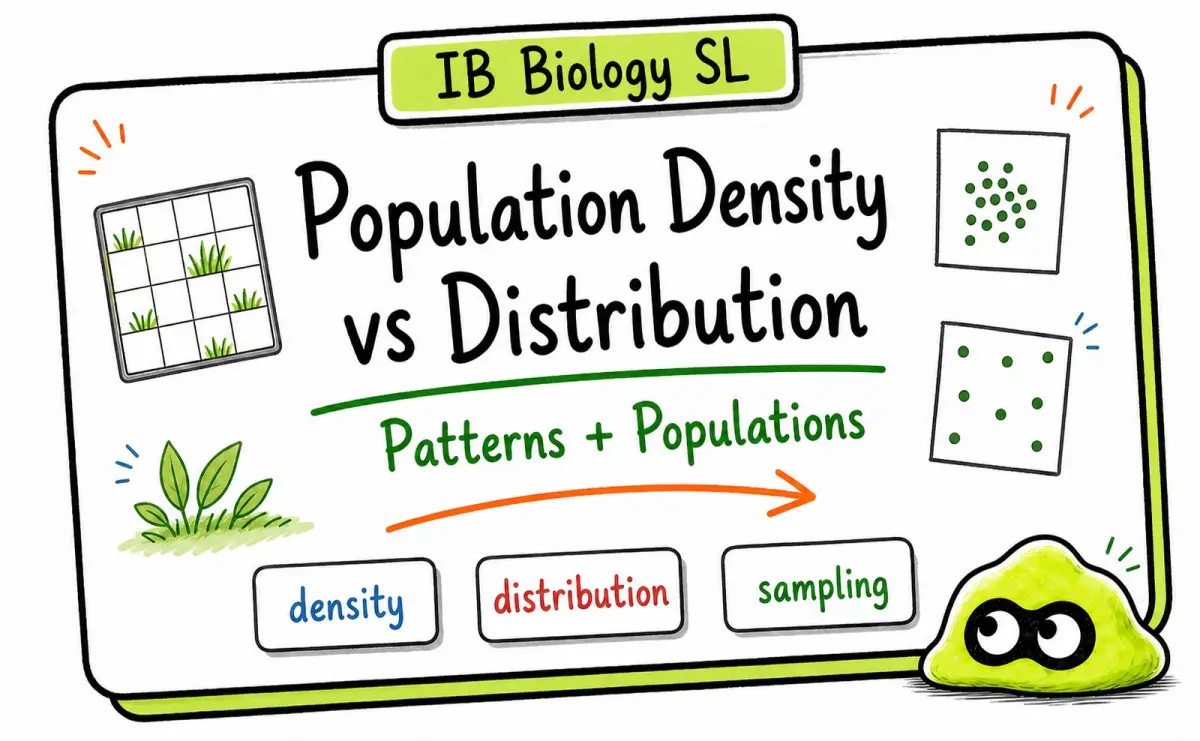
Population density vs population distribution is a common IB Biology ecology comparison because both terms describe populations, but they answer different questions. Population density means how many individuals are found in a measured area. Population distribution means how those individuals are arranged across the habitat.
If you remember one line, use this: density is how many; distribution is where. After you understand the wording, practise it with one short ecology question set rather than rereading the same definition.
Quick Answer
| Concept | What it means | Exam wording |
|---|---|---|
| Population density | Number of individuals per unit area or volume | How many organisms are in a measured space |
| Population distribution | Pattern of individuals across a habitat | How organisms are arranged or spaced out |
Use a number and unit for density. Use a pattern word and reason for distribution.
What Population Density Means
Population density is a numerical measure. It tells you how many individuals of one species are found in a specific area or volume.
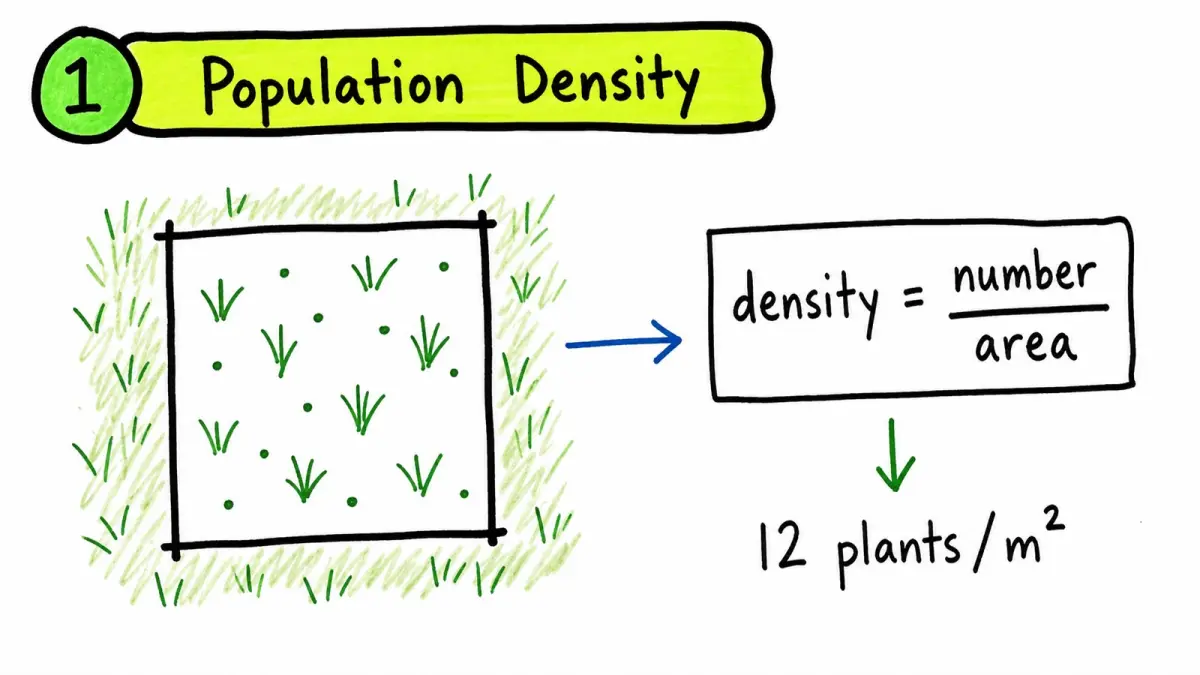
For example, if 40 plants are counted in 10 square metres, the population density is 4 plants per square metre. The unit matters because density is not just the total number of organisms. It is the number compared with space.
In IB Biology questions, population density often appears with quadrats, transects, sampling tables or estimated population size. If data is given, the examiner usually wants you to calculate or interpret the number per unit area.
What Population Distribution Means
Population distribution is about pattern, not total number. It describes how individuals are spread across a habitat.
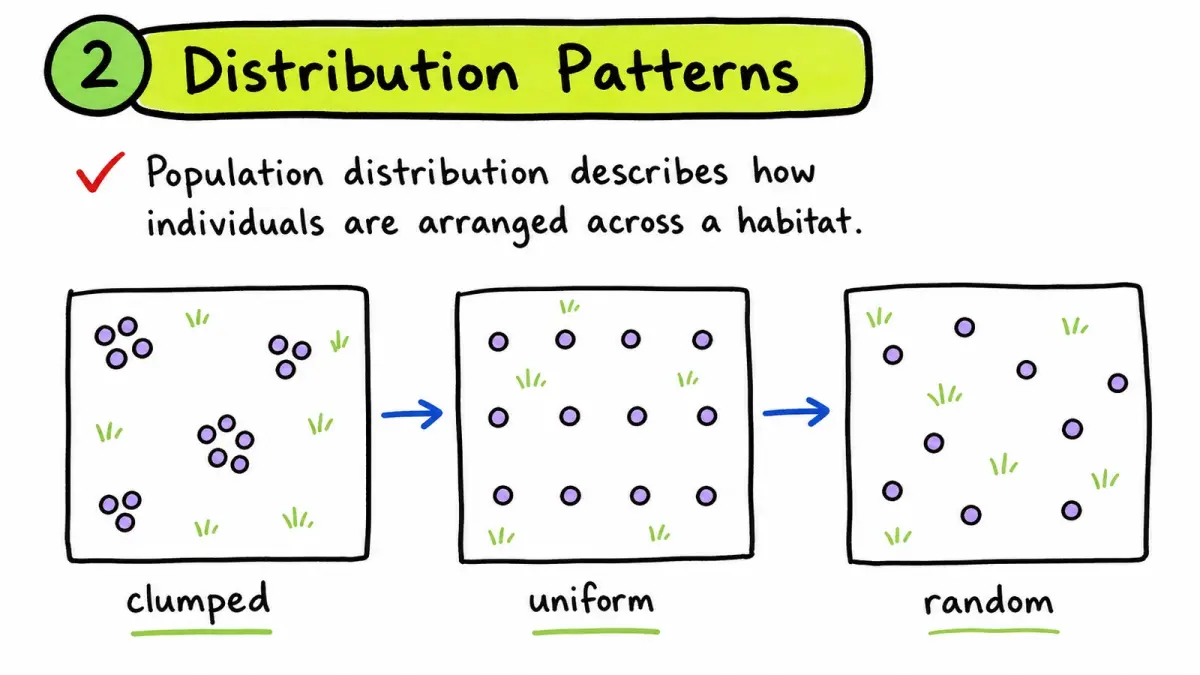
The same 40 plants could have different distributions. They might be clumped near a water source, evenly spaced because of competition, or randomly scattered if conditions are similar across the habitat.
| Pattern | What it looks like | Possible reason |
|---|---|---|
| Clumped | Individuals occur in groups | Uneven resources, shelter, social behaviour or seed dispersal |
| Uniform | Individuals are evenly spaced | Competition or territorial behaviour |
| Random | No clear spacing pattern | Similar conditions across the habitat |
This is why distribution questions often ask you to describe a diagram and suggest an ecological reason.
Population Density vs Population Distribution in Exams
IB Biology questions usually test the difference in one of four ways:
- Distinguish between population density and population distribution.
- Calculate population density from quadrat data.
- Identify whether a distribution pattern is clumped, uniform or random.
- Suggest why organisms show a particular distribution in a habitat.
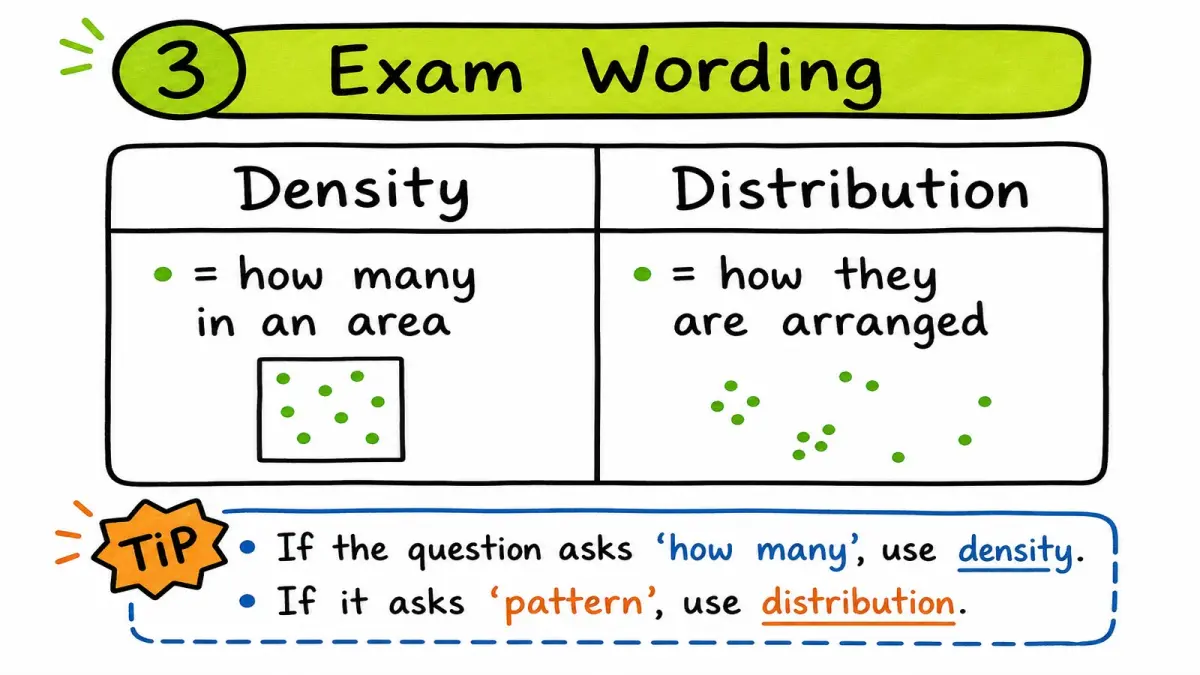
For a definition question, keep the answer short and precise. For a data question, use the numbers. For an explanation question, link the pattern to a biological or environmental cause.
Markscheme Translation
| Markscheme phrase | Student-friendly meaning | Better answer wording |
|---|---|---|
| Number per unit area | How many organisms are in a set space | The density is 4 plants per m2. |
| Spatial pattern | How organisms are arranged | The plants show a clumped distribution. |
| Clumped distribution | Organisms occur in groups | They may be grouped near water or nutrients. |
| Uniform distribution | Organisms are evenly spaced | Competition may keep individuals apart. |
| Random distribution | No clear pattern | Conditions may be similar across the habitat. |
The key is not to use the words loosely. If the question asks for density, include a number and unit. If it asks for distribution, describe the pattern.
Common Mistakes
| Mistake | Why it loses marks | Better wording |
|---|---|---|
| Saying density means where organisms live | That describes distribution, not density | Density is the number per unit area. |
| Saying distribution means the total number | That describes population size | Distribution is the arrangement across the habitat. |
| Forgetting density units | Density must include area or volume | 12 plants per m2 |
| Naming a pattern without explaining it | Suggest questions need a cause | The distribution is clumped because resources are uneven. |
One small wording habit helps a lot: answer density questions with number + area, and answer distribution questions with pattern + reason.
Practice This Topic
Try this exam-style question:
A student places five 1 m2 quadrats randomly in a grassland and counts 8, 12, 10, 6 and 14 daisies. Calculate the mean population density of daisies and state one way the student could describe the distribution pattern across the site.
Answer guide:
- Add the quadrat counts and divide by five to find the mean density.
- The mean population density is 10 daisies per m2.
- Use a distribution word such as clumped, uniform or random when describing the pattern.
- Link the pattern to evidence from the quadrat counts, not just a guess.
Practice this exact topic
Random quadrat sampling question bank
Some questions may require an EduNinja membership.
Browse broader practice
Browse the full IB Biology Question Bank
Use this if you want to explore more available practice by topic.
Related Articles
- IB Biology Ecology Revision Guide
- IB Biology SL Ecology: Energy Flow, Carbon and Climate
- IB Biology SL Ecosystems: Sampling, Food Webs and Carbon
- IB Biology Photosynthesis Guide
FAQ
What is the difference between population density and population distribution?
Population density is the number of individuals per unit area or volume. Population distribution is the pattern of where individuals are found in a habitat. Density answers "how many are in this space?", while distribution answers "how are they arranged?".
Is population density the same as population size?
No. Population size is the total number of individuals in a population. Population density compares that number with area or volume, so it tells you how crowded or concentrated the population is in a measured space.
What are the three types of population distribution?
The three common distribution patterns are clumped, uniform and random. Clumped means individuals occur in groups, uniform means they are evenly spaced, and random means there is no clear spacing pattern.
How do I answer population distribution questions in IB Biology?
First describe the pattern shown in the data or diagram. Then suggest a reason using ecology, such as resource availability, competition, territorial behaviour, seed dispersal or environmental conditions.
Related Study Links
Final Takeaway
Use this memory line: density is how many; distribution is where. If you include the right units for density and the right pattern language for distribution, this topic becomes a quick source of marks.
Practise this next: use one populations and communities question set, mark it, then rewrite any missing density or distribution wording.
Put ecology back into your full IB Biology SL study plan.
Return to the complete course overview, or move directly into the most relevant study tool.
Related articles
More course notes, updates and study resources from the EduNinja blog.

IB Biology SL Assessment and Grade Boundaries: How 55 + 50 + 24 Marks Become Your Final Grade
Learn how IB Biology SL Paper 1, Paper 2 and the scientific investigation combine through weighted assessment, how grade boundaries work and how to plan component-level revision.
Diploidy and Haploidy Explained
Revise diploid and haploid chromosome sets, meiosis, fertilisation and common IB Biology mistakes.
What Are Producers in an Ecosystem? IB Biology Guide
Learn what producers are in IB Biology ecosystems, how they start food chains, and how to use exam-safe trophic level wording.