IB Biology Photosynthesis: Light-Dependent and Calvin Cycle Guide
Revise IB Biology photosynthesis with light-dependent reactions, Calvin cycle, ATP, reduced NADP, limiting factors, and exam explanation chains.
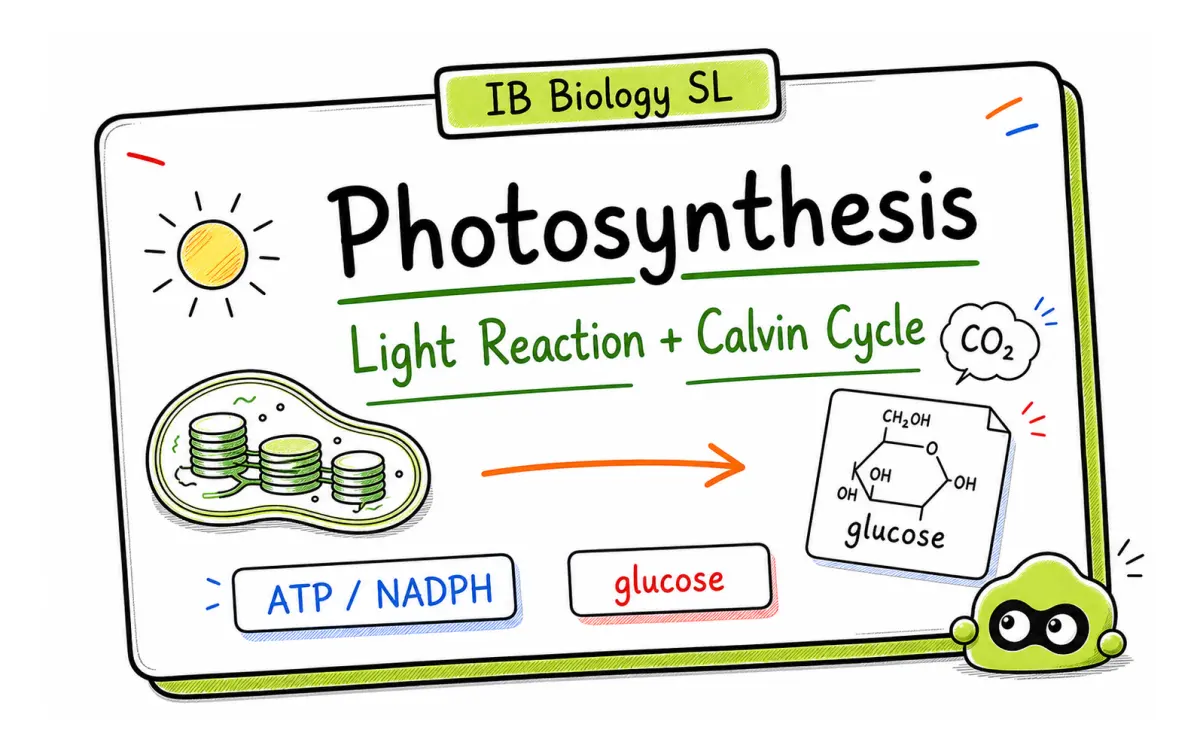
IB Biology photosynthesis can feel like two topics glued together: one part about light, membranes, electrons, ATP, and NADPH, and another about carbon fixation and the Calvin cycle. The challenge is not just remembering names. It is explaining how energy transfer links the two stages.
This guide gives you a clean way to revise photosynthesis for IB Biology without drowning in labels.
Current syllabus map: This article is aligned to the IB Biology first assessment 2025 roadmap, especially C1.3 photosynthesis and related molecule, membrane and plant-level ideas.
Use the relevant EduNinja course pages as your base:
Do not open every link at once. Start with the notes or topic page, then move into question practice and use any PDF resource only when it helps clarify the exact idea you are revising.
Quick Answer
Photosynthesis is easier when you split it into two linked stages.
- Light-dependent reactions happen in the thylakoid membranes.
- Light energy is used to produce ATP and reduced NADP/NADPH.
- Oxygen is produced from the splitting of water.
- The Calvin cycle uses carbon dioxide and products from the light-dependent reactions.
- Carbon fixation builds carbohydrate molecules.
- Limiting factors include light intensity, carbon dioxide concentration, and temperature.
- Practise with the IB Biology Question Bank.
Core Concept That Gets Marks
Photosynthesis answers score when energy transfer is tied to location. The useful route is light absorption, electron movement, ATP and NADPH production, then carbon fixation in the Calvin cycle.
What Photosynthesis Tests
Photosynthesis questions often test process order, location, inputs and outputs, or limiting factors. A strong answer does not simply say plants make food. It explains how light energy is converted into chemical energy, and how that energy supports carbon fixation.
For wider revision, use IB Biology Study resources and the IB Biology Question Bank to practise data-based and explanation questions.
Light-Dependent Reactions
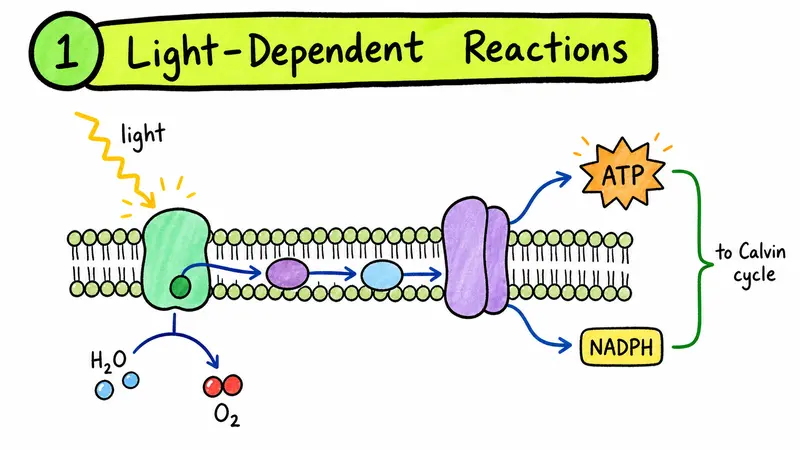
The light-dependent reactions occur in the thylakoid membranes of chloroplasts. Light energy is absorbed by photosynthetic pigments, electrons move through carriers, and energy is used to produce ATP. Water is split, releasing oxygen.
A simple way to remember the stage is: light in, water split, ATP and NADPH out, oxygen released.
| Input | Output | Why it matters |
|---|---|---|
| Light | Excited electrons | Starts energy transfer |
| Water | Oxygen | Source of replacement electrons |
| ADP and phosphate | ATP | Energy for Calvin cycle |
| NADP | NADPH | Reducing power for carbon fixation |
Calvin Cycle
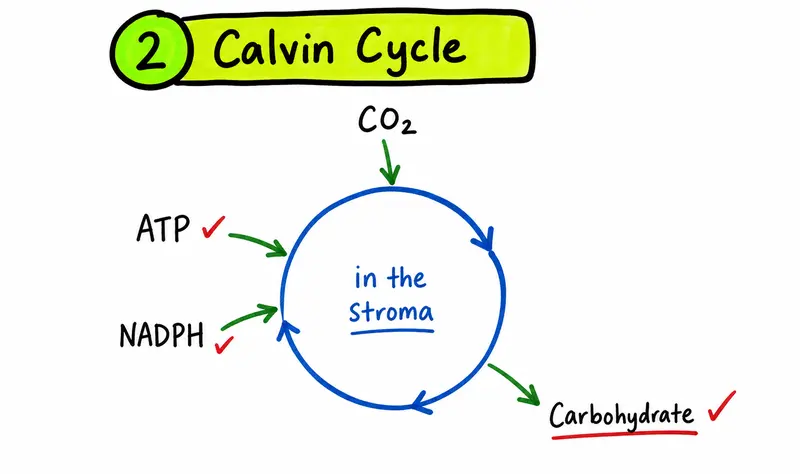
The Calvin cycle does not directly need light, but it depends on ATP and NADPH from the light-dependent reactions. Carbon dioxide is fixed and converted through a cycle of reactions to build carbohydrate.
Students often call it the dark reaction, but that wording can be misleading. The safer exam idea is that it is light-independent, not that it only happens in darkness.
Limiting Factors
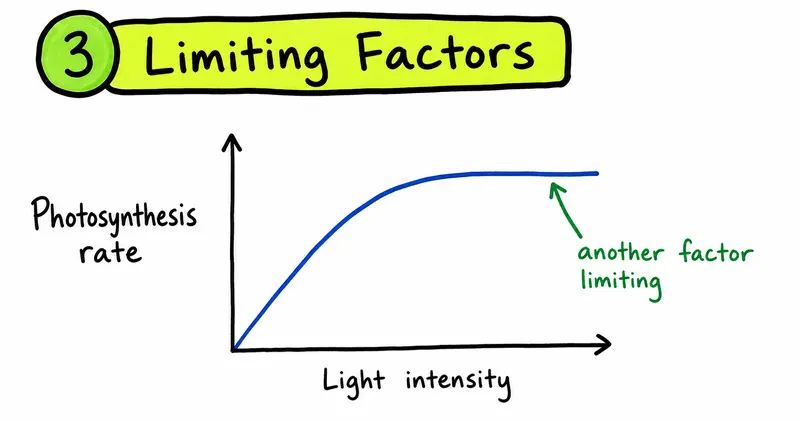
Limiting factor questions are common because they connect biology to data interpretation. If light intensity is low, increasing carbon dioxide may not increase the rate much. If temperature is too low, enzyme-controlled reactions slow down. If carbon dioxide is limiting, adding light may not help after a point.
Use limiting factor practice and limiting factors investigation to practise graph language.
Common Mistakes That Cost Marks
| Mistake | Better answer |
|---|---|
| Saying oxygen comes from carbon dioxide | Oxygen comes from water splitting |
| Treating Calvin cycle as fully independent | It depends on ATP and NADPH |
| Mixing ATP and glucose as the same product | ATP transfers energy; glucose stores chemical energy |
| Ignoring limiting factors in graphs | Identify the factor preventing further increase |
| Writing vague process descriptions | Use location, input, output, and purpose |
Topic-Specific Revision Route
Draw one chloroplast. Label thylakoids and stroma. Write the light-dependent inputs and outputs on one side, then the Calvin cycle inputs and outputs on the other. Finish with two graph questions about limiting factors.
Use EduNinja Notes to rebuild the process, then test it immediately with topic questions. If you miss a mark, turn the missing phrase into a flashcard.
Worked Example 1
Worked Example 1: Move From Definition to Application
Question: A student can define Photosynthesis but loses marks in exam questions. What should they add?
Worked answer: Add the specific structure, process, or evidence from the question. In Biology, a definition is rarely enough by itself. The answer should connect the named concept to function, data, or an example in the stimulus.
Markscheme-style answer: Correct biological term used; relevant structure or process identified; answer linked to the question context; no unsupported general statement.
Worked Example 2: Use Data or a Diagram Precisely
Question: How should a student answer a Photosynthesis question that includes a diagram, graph, or table?
Worked answer: First describe what the data shows, then explain it using biology. If there are numbers, quote them. If there is a diagram, name the labelled structure and explain its role instead of writing a memorised paragraph.
Markscheme-style answer: Uses evidence from the figure or data; includes a correct biological explanation; compares values where relevant; avoids copying the question wording without analysis.
Question-Type Breakdown
Photosynthesis questions usually test whether you can separate stages, locations, products, and limiting factors. Start by identifying the type of prompt.
| Question type | What it is really asking | First move | Common trap |
|---|---|---|---|
| Light-dependent reactions | How light energy becomes chemical energy | Name thylakoid membranes, ATP, and reduced NADP | Writing only "light makes energy" |
| Calvin cycle | How carbon dioxide becomes carbohydrate | Name stroma, carbon fixation, and reduced GP | Forgetting that light is not used directly here |
| Limiting factors | Why rate stops increasing | Check light, carbon dioxide, and temperature | Saying one factor is always limiting |
| Chloroplast structure | Link structure to function | Match thylakoids, grana, stroma, and pigments | Naming parts without their role |
| Graph interpretation | Explain a rate change | Describe the trend, then explain the limiting factor | Ignoring the plateau |
Weak Answer vs Mark-Worthy Answer
Weak answer:
- Plants use light to make glucose.
Mark-worthy answer:
- Chlorophyll absorbs light energy in the light-dependent reactions. This energy is used to produce ATP and reduced NADP, which provide energy and reducing power for the Calvin cycle to fix carbon dioxide into carbohydrate.
Weak answer:
- Temperature affects photosynthesis because enzymes work better when it is warm.
Mark-worthy answer:
- Temperature affects enzyme-controlled reactions in photosynthesis. As temperature rises, reaction rate may increase until the enzymes approach their optimum; above this, enzyme activity falls and the rate can decrease.
For revision, do one light-dependent question, one Calvin cycle question, and one limiting-factor graph. That set is more useful than rereading the whole topic without testing which stage you are confusing.
Exam-Ready Mini Checklist
| Check | What good work looks like |
|---|---|
| location named | checked before moving on |
| reactants included | checked before moving on |
| products connected | checked before moving on |
| cycle sequence clear | checked before moving on |
| limiting factor explained | checked before moving on |
How EduNinja Helps
A clean revision loop is easier when the tools sit in one place. Rebuild the idea in EduNinja Notes, test it in the Questionbank, then turn every missed mark into a flashcard or a follow-up AI Tutor prompt. That keeps the article's method practical: learn the concept, answer a real question, mark it, and fix the exact weakness.
Practice This Topic
Try an exam-style question on this exact topic, then check the worked guidance in the Question Bank.
Practice this topic: Practise IB Biology photosynthesis questions
FAQ
What happens in the light-dependent reactions of photosynthesis?
Light-dependent reactions use light energy to split water, move electrons through carriers, and produce ATP and reduced NADP. Oxygen is released as a by-product.
What happens in the Calvin cycle?
The Calvin cycle uses carbon dioxide, ATP, and reduced NADP to produce carbohydrate. It does not directly require light, but it depends on products from the light-dependent reactions.
Why do students confuse ATP and reduced NADP in photosynthesis?
Both come from the light-dependent reactions, but they do different jobs. ATP provides energy, while reduced NADP provides reducing power for carbon fixation and carbohydrate formation in the Calvin cycle.
How should I explain limiting factors in photosynthesis?
Name the factor, explain how it limits the rate, and state what happens when another factor becomes limiting. Common factors include light intensity, carbon dioxide concentration, and temperature.
Related Study Links
- Explore the IB Biology SL Study Hub
- IB Biology Question Bank
- Limiting factor practice
- Carbon cycle diagrams
Exam Strategy
Photosynthesis answers improve when you write in linked cause-and-effect sentences. Instead of listing ATP, NADPH, carbon dioxide, and glucose, explain how the products of the light-dependent stage are used in the Calvin cycle. In graph questions, identify the limiting factor first, then describe the evidence from the curve. Avoid saying a factor is limiting unless the graph actually supports it.
For data-based questions, use numbers from the graph and biological language in the same answer.
Put photosynthesis back into your full IB Biology SL study plan.
Return to the complete course overview, or move directly into the most relevant study tool.
Related articles
More course notes, updates and study resources from the EduNinja blog.
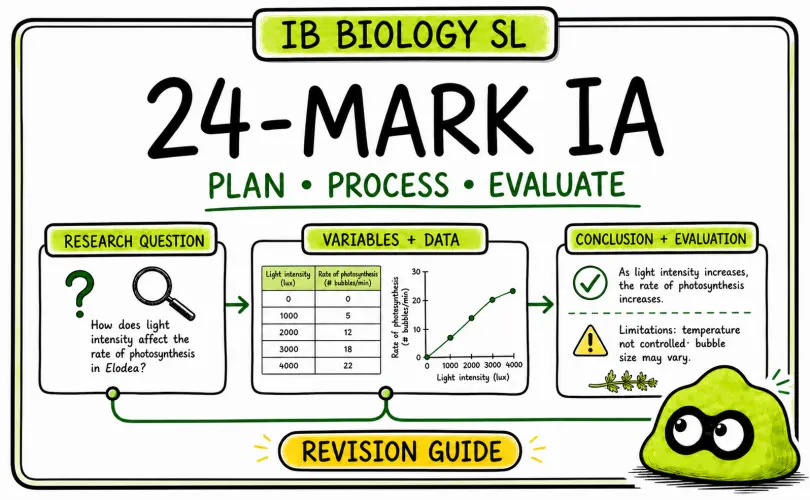
IB Biology Scientific Investigation Guide: How to Build a Strong 24-Mark IA
A practical IB Biology guide to the 24-mark Scientific Investigation: choose a workable research question, control variables, process data, draw a supported conclusion and evaluate limitations with specific improvements.
Abiotic Factors Explained | IB Biology SL
Revise IB Biology SL abiotic factors, tolerance ranges, limiting factors and how environmental variables affect distribution.
Active Transport vs Passive Transport | A-Level Biology
Revise A-Level Biology active and passive transport with concentration gradients, ATP, carrier proteins, examples, common mistakes and practice.