Arrhenius Equation Explained: IB Chemistry
Revise the Arrhenius equation, activation energy, Kelvin temperature and Arrhenius plot wording before practising IB Chemistry rate questions.
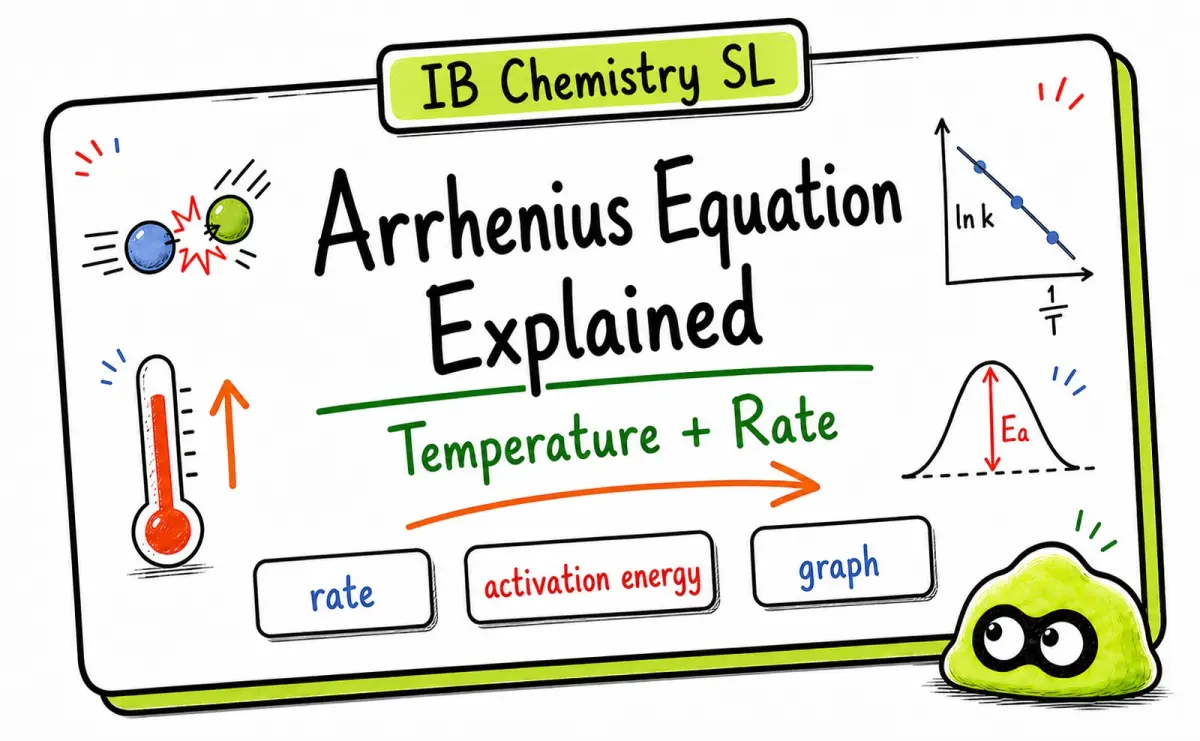
The Arrhenius equation explains how temperature affects the rate constant of a reaction. In IB Chemistry, it is most useful for linking temperature, activation energy and reaction rate in a clear exam answer.
Use this rule first: higher temperature means a larger fraction of particles have enough energy to overcome activation energy. Then practise the graph and wording in the IB Chemistry rate of chemical change question bank.
Quick Answer
| Idea | What it means | Exam wording |
|---|---|---|
| k | Rate constant | Changes with temperature |
| Ea | Activation energy | Minimum energy needed for successful reaction |
| T | Temperature in Kelvin | Must be converted from Celsius |
| Arrhenius plot | ln k against 1/T | Slope is related to activation energy |
The equation is useful because it turns a rate-temperature idea into a graph and calculation method.
What the Arrhenius Equation Means
The Arrhenius equation links the rate constant to activation energy and temperature. In simple terms, it explains why reactions usually happen faster at higher temperatures.
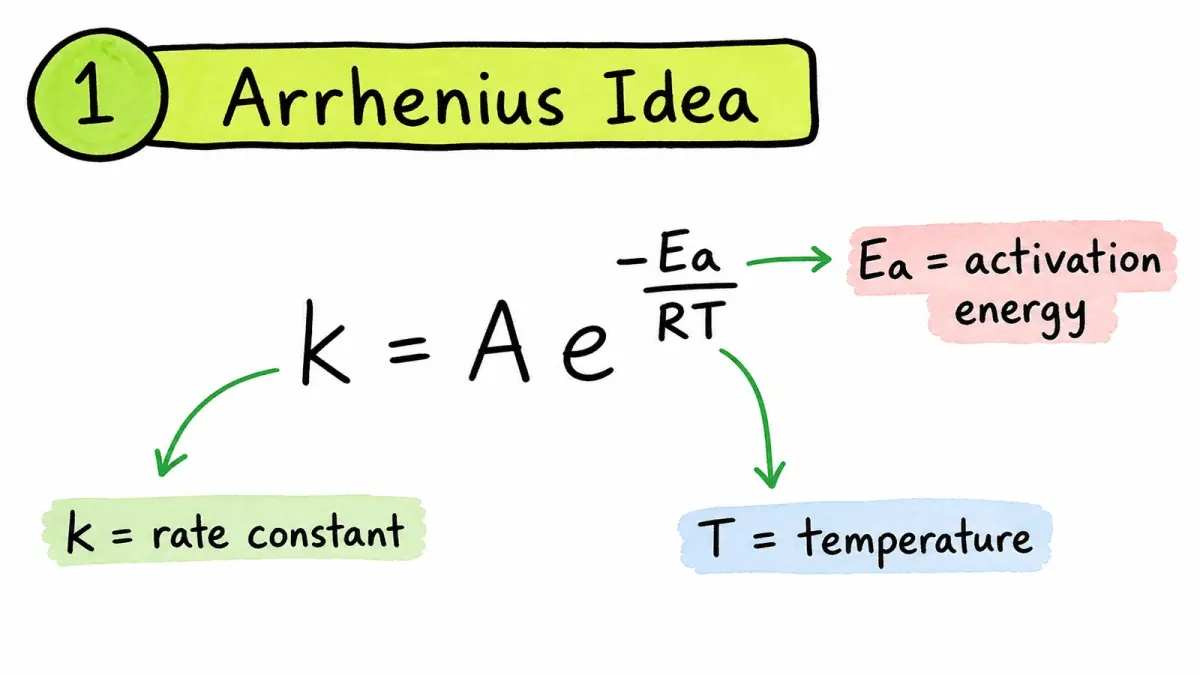
You do not need to turn every Arrhenius question into a full derivation. Most exam answers need you to connect higher temperature with more successful collisions and a larger rate constant.
How Arrhenius Plots Work
An Arrhenius plot usually places ln k on the y-axis and 1/T on the x-axis. The line slopes down because as 1/T decreases, temperature increases and k gets larger.
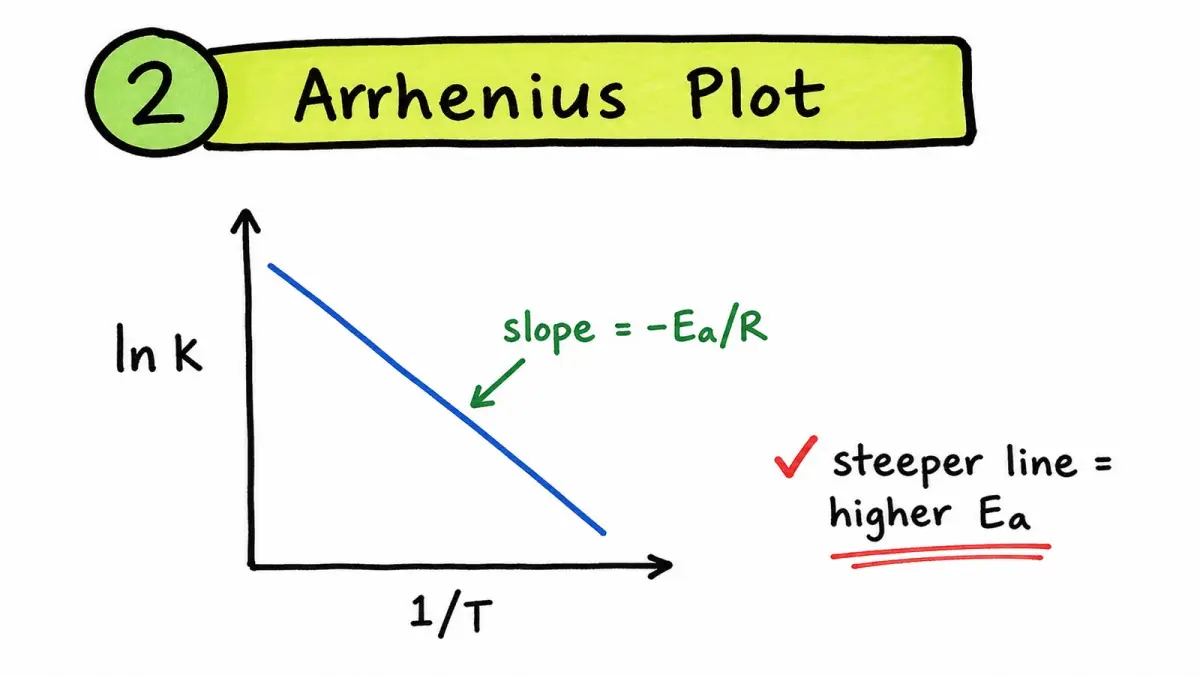
The slope is related to activation energy. A steeper negative line means a larger activation energy. This is why graph wording matters: do not just say "the line goes down"; explain what the slope represents.
How Exams Usually Ask This
IB Chemistry questions usually test the Arrhenius equation in four ways:
- explain why increasing temperature increases rate
- interpret an Arrhenius plot
- calculate or compare activation energy from slope
- avoid using Celsius when Kelvin is required
For graph questions, identify the axes first. Then connect the slope or gradient to activation energy.
Markscheme Translation
| Markscheme phrase | Student-friendly meaning | Better answer wording |
|---|---|---|
| Larger fraction exceeds Ea | More particles have enough energy to react | More particles have energy greater than activation energy. |
| Rate constant increases | k gets larger as temperature rises | Increasing temperature increases the rate constant. |
| Slope = -Ea/R | Gradient gives activation energy | A steeper negative slope indicates a larger activation energy. |
The safest answer pattern is: temperature change -> particle energy -> successful collisions -> rate constant.
Common Mistakes
| Mistake | Why it loses marks | Better wording |
|---|---|---|
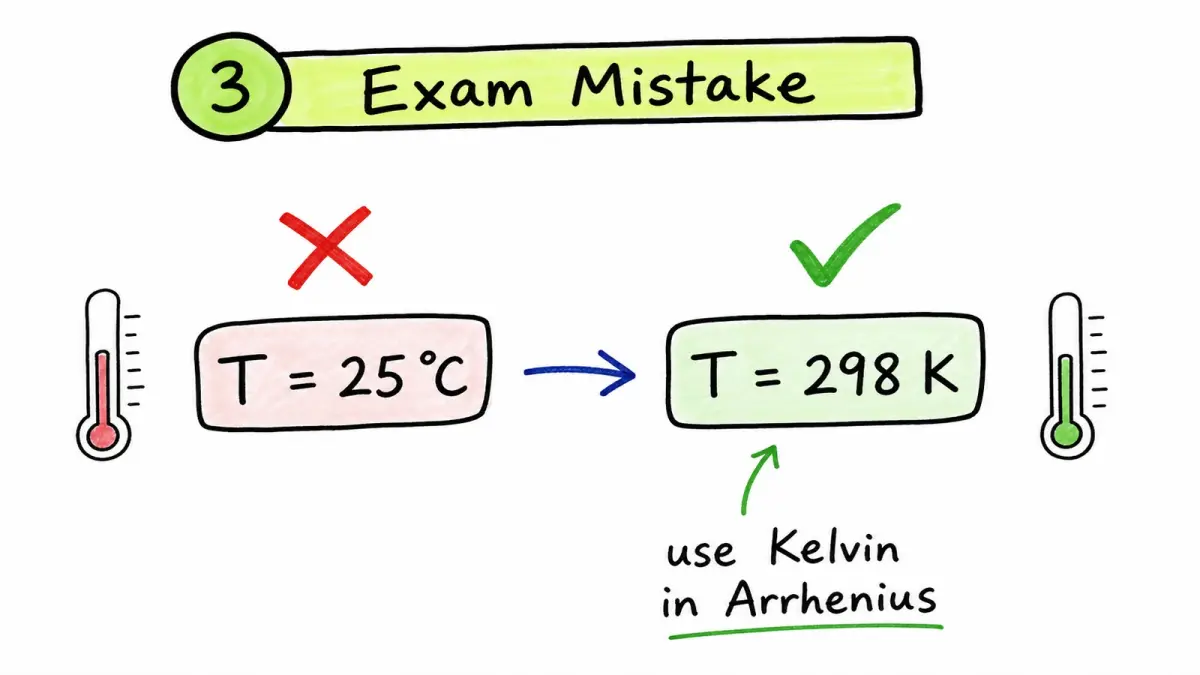
| Using Celsius in the equation | T must be in Kelvin | 25 C should be converted to 298 K. |
| Saying particles move faster only | That misses activation energy | More particles exceed activation energy. |
| Ignoring graph axes | The slope meaning depends on ln k and 1/T | The gradient of ln k vs 1/T is related to Ea. |
Practice This Topic
Try this exam-style question:
Define activation energy, Ea, and explain why increasing temperature usually increases the rate constant of a reaction.
Answer guide:
- Activation energy is the minimum energy needed for reacting particles to start a reaction.
- At a higher temperature, a larger fraction of particles has energy greater than Ea.
- More successful collisions occur, so the rate constant usually increases.
Practice this exact topic
Activation energy question bank
Some questions may require an EduNinja membership.
Browse broader practice
Browse the full IB Chemistry Question Bank
Use this if you want to explore more available practice by topic.
Related Articles
- IB Chemistry SL Strong and Weak Acids Guide
- Electronegativity Trend Across a Period
- Inert Gas vs Noble Gas: IB Chemistry Group 18 Guide
FAQ
What is the Arrhenius equation used for?
The Arrhenius equation is used to link temperature, activation energy and the rate constant of a reaction. In exam questions, it often helps explain why increasing temperature increases reaction rate or how activation energy can be found from a graph.
Why must temperature be in Kelvin in the Arrhenius equation?
Temperature must be in Kelvin because the equation uses absolute temperature. Celsius values can give the wrong mathematical relationship, so convert by adding 273 before using T in Arrhenius calculations.
What does an Arrhenius plot show?
An Arrhenius plot usually shows ln k against 1/T. The slope is related to activation energy, so students can use the gradient to compare or calculate Ea when the axes are set up correctly.
Why does higher temperature increase reaction rate?
Higher temperature increases the fraction of particles with energy greater than activation energy. That means more collisions are successful, so the rate constant and reaction rate usually increase.
Final Takeaway
For Arrhenius equation questions, keep the chain clear: higher temperature -> more particles exceed Ea -> more successful collisions -> larger k.
Related Study Links
Put arrhenius equation back into your full IB Chemistry SL study plan.
Return to the complete course overview, or move directly into the most relevant study tool.
Related articles
More course notes, updates and study resources from the EduNinja blog.
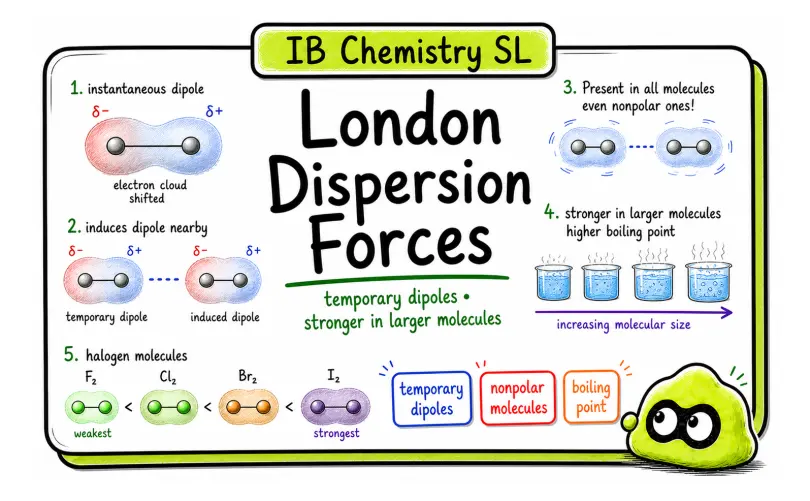
London Dispersion Forces Explained for IB Chemistry
Learn London dispersion forces for IB Chemistry with temporary dipoles, induced dipoles, molecular size, boiling point trends, examples and practice.
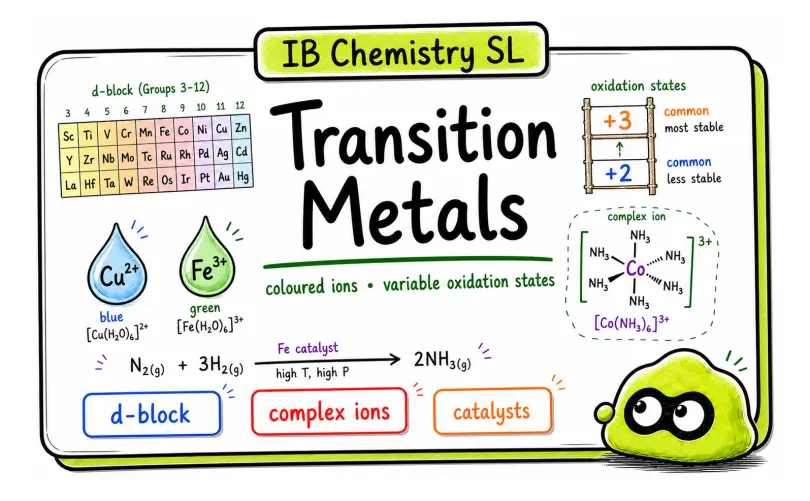
Transition Metals Explained for IB Chemistry
Revise transition metals in IB Chemistry, including coloured ions, variable oxidation states, complex ions, catalysts and common exam mistakes.
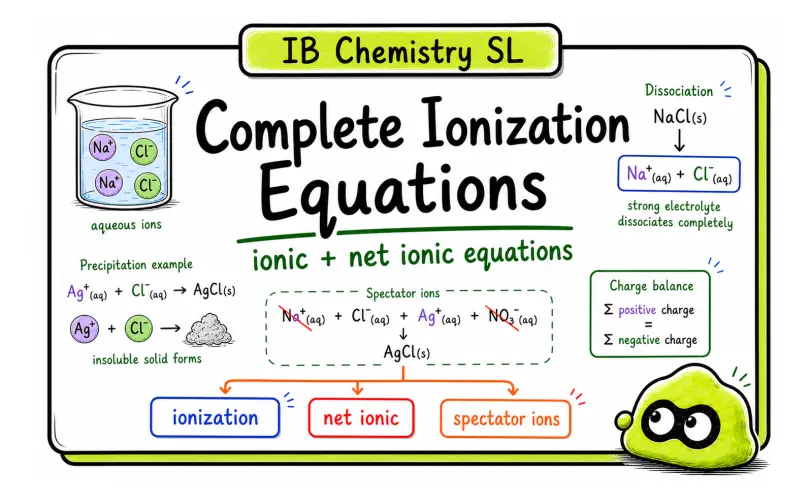
How to Complete Ionization and Net Ionic Equations
Learn complete ionization and net ionic equations for IB Chemistry, with ion charges, state symbols, spectator ions, worked examples and practice.