IB Biology SL A4/C4 Ecosystems: Sampling, Food Webs and Carbon
Revise IB Biology 2025 SL A4/C4 ecosystems with species, sampling, food webs, energy flow, carbon cycling and exam explanations.
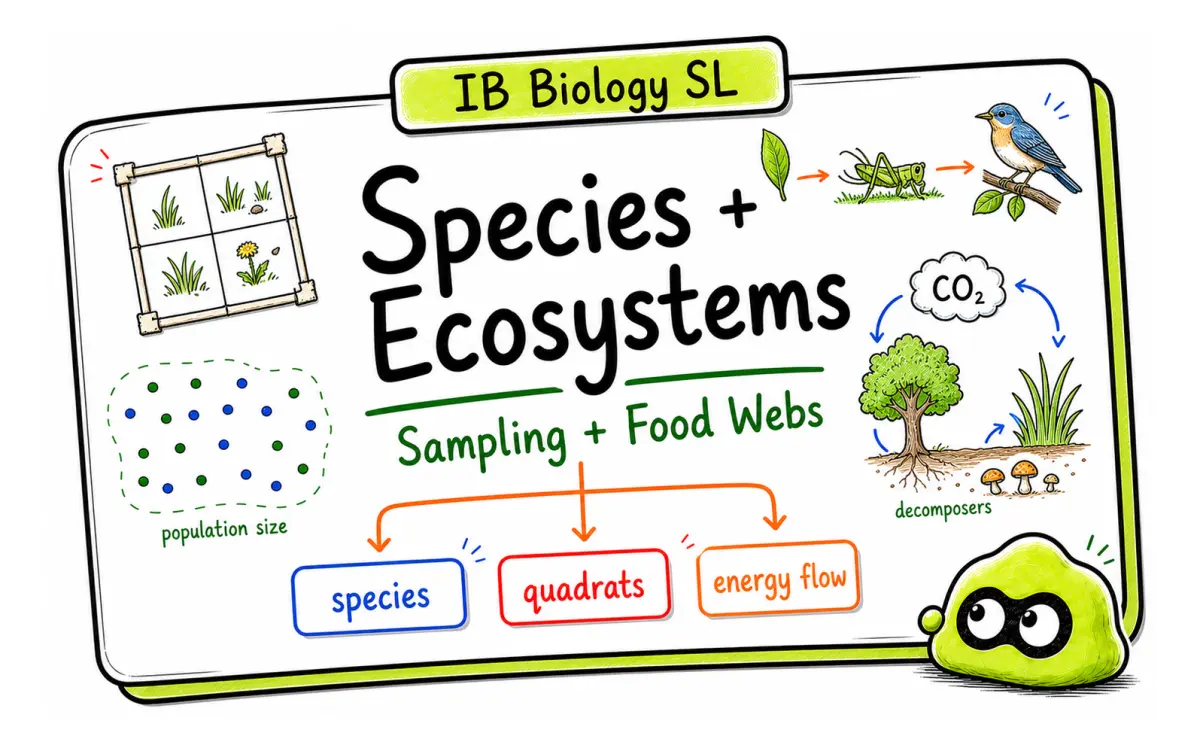
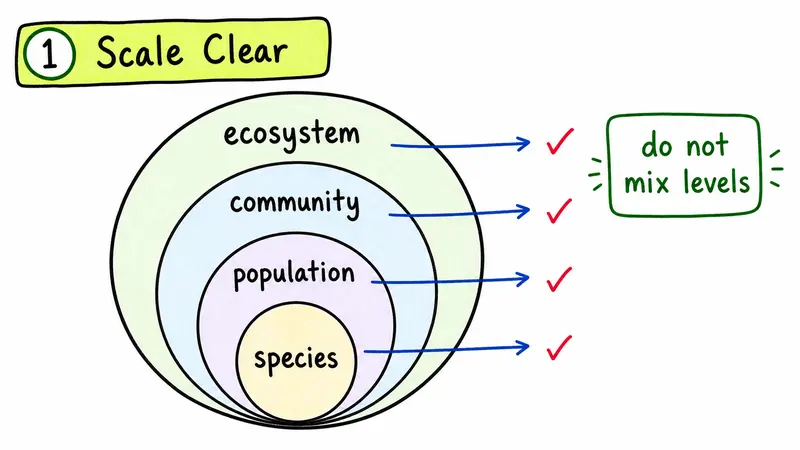
IB Biology SL ecosystems questions usually test whether you can keep scale, method and process separate. A species is one interbreeding group. A population is one species in one area. A community is different populations living together. An ecosystem is that community plus the abiotic environment. Once those terms are secure, the exam usually moves into sampling, food webs, energy transfer and carbon cycling.
For the 2025 syllabus, this page sits around A4 and C4 ideas. In simple terms, A4/C4 ecosystems questions often connect ecological scale with carbon cycling, energy flow and sampling evidence. Use it as a student revision guide, not as an official IB syllabus document. Your teacher's current subject guide still decides the exact assessment detail.
Useful starting points:
Start with Notes if the terms feel rusty. Move to the Question Bank once you can define the terms without looking. Ecosystems is a topic where students often know the idea but lose marks because the answer lacks method, units, direction or evidence.
What Should You Know First for IB Biology SL Ecosystems?
- A species is a group of organisms that can interbreed and produce fertile offspring.
- A population is one species in one area.
- A community is all the populations of different species in the area.
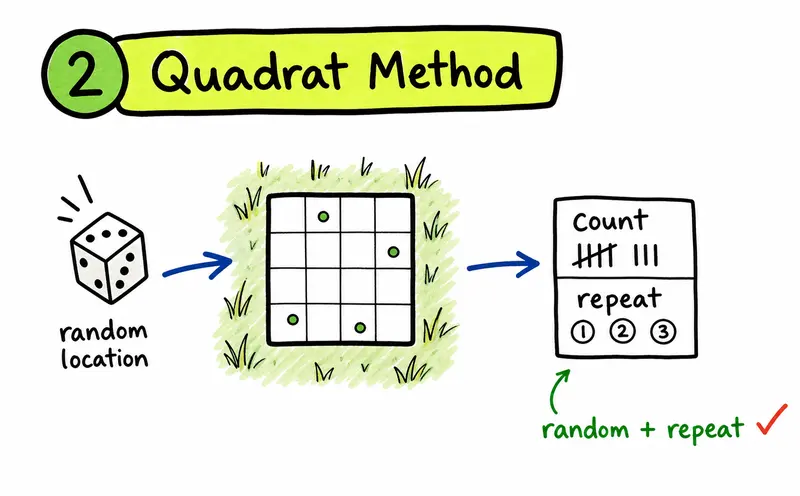
- Quadrat questions need random placement, repeats, a mean and a sensible limitation.
- Abiotic factors are non-living conditions such as light, temperature, water, pH or soil minerals.
- Transects are useful when sampling change across an environmental gradient.
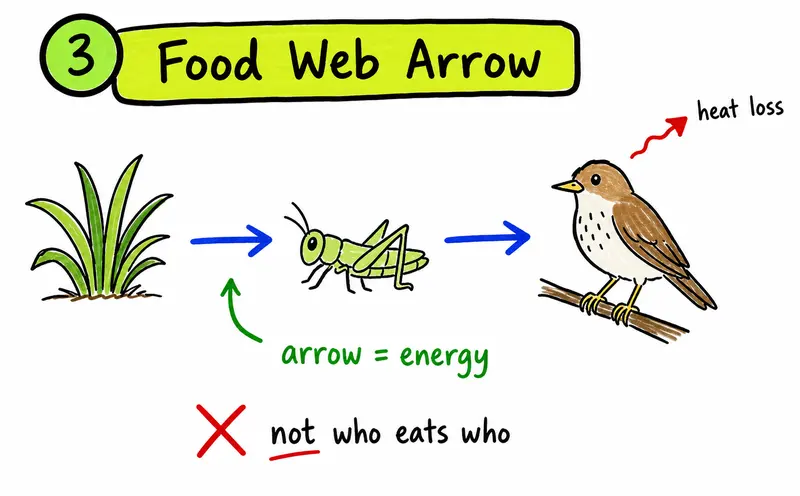
- Food web arrows show energy transfer from food to feeder.
- Energy flows through ecosystems. Nutrients and carbon cycle through ecosystems.
- Carbon cycle answers usually need photosynthesis, respiration, decomposition, combustion or fossilisation.
For most ecosystem answers, use this order: name the scale, describe the method or process, then explain the consequence.
Species, Population, Community: Keep the Scale Clear
| Term | What it means | Common mistake |
|---|---|---|
| Species | Organisms that can interbreed to produce fertile offspring | Saying "look similar" as the whole definition |
| Population | Members of one species in one area | Using it when the question asks about a whole community |
| Community | Populations of different species living in the same area | Forgetting that it includes more than one species |
| Habitat | The place where an organism lives | Mixing it with niche |
| Niche | The organism's role, resources and conditions | Writing only "where it lives" |
| Ecosystem | A community and its abiotic environment | Leaving out abiotic factors such as light, temperature or water |
Definitions matter here because IB can build a longer question from one small word. If the question says "population", do not answer as if every organism in the habitat counts.
Abiotic or Biotic: Name the Factor Before the Effect
Ecosystem questions often ask why a population changes. Start by deciding whether the factor is abiotic or biotic.
| Factor type | Examples | How it affects populations |
|---|---|---|
| Abiotic | Light, temperature, water availability, pH, soil minerals, oxygen concentration | Changes survival, growth, reproduction or distribution |
| Biotic | Predation, competition, disease, food availability, mates | Changes birth rate, death rate, feeding success or population size |
A stronger answer names the factor and the consequence.
Weak:
- The population changes because the environment changes.
Better:
- Lower light intensity reduces photosynthesis, so plant growth decreases and fewer plants survive in that area.
Quadrat Sampling: Method Marks Come From Control
Sampling questions test method more than memory. A safe quadrat answer usually includes five parts:
| Step | What to write |
|---|---|
| Choose sampling area | Identify the habitat or transect line |
| Place quadrats | Use random coordinates or a systematic method |
| Record data | Count individuals or estimate percentage cover |
| Repeat | Use several quadrats to improve reliability |
| Calculate | Find the mean per quadrat or per unit area, then estimate the total |
A good answer also says why the method works. Random placement reduces bias. Repeats make the estimate more reliable. A larger sample size gives a better estimate of the population in the habitat.
Do not write "put quadrats around the field" and stop. The examiner cannot award much for that because the method has no randomisation, no repeated sampling and no calculation.
When Should You Use a Transect?
Use a transect when you want to sample how distribution changes across an environmental gradient, such as distance from a path, distance from water, shore height, light intensity or soil moisture.
A safe transect answer includes:
- Place a tape measure across the gradient.
- Put quadrats at regular intervals or at marked points along the tape.
- Record abundance or percentage cover in each quadrat.
- Repeat with more than one transect if possible.
- Compare the pattern with the changing abiotic factor.
The difference is simple: random quadrats estimate abundance in an area, while transects show how abundance changes across a gradient.
Worked example 4: transect across a light gradient
Question: A student wants to investigate how plant abundance changes from the edge of a wooded area into an open field. Describe a suitable transect method.
Mark-worthy answer:
Place a tape measure from the wooded area into the open field. Put quadrats at regular intervals along the tape, such as every 2 metres. Count the plants or estimate percentage cover in each quadrat. Measure light intensity at each point if equipment is available. Repeat with more than one transect, then compare plant abundance with distance from the trees or light intensity.
Why it works:
The answer uses a transect because the habitat changes across a gradient. It also gives intervals, data collection, repeats and a comparison with an abiotic factor.
Worked example 1: quadrat estimate
Question: A student wants to estimate the number of daisies in a grass field. Describe a suitable method.
Mark-worthy answer:
Use random coordinates to place quadrats in the field. Count the daisies in each quadrat, repeat with several quadrats, then calculate the mean number of daisies per quadrat. Multiply this mean by the total number of quadrat areas that would fit into the field.
Why it works:
The answer tells the examiner how the student avoids bias, collects enough data and turns the sample into an estimate. Many weak answers only describe counting plants.
Food Webs: Read the Arrow as Energy Transfer
In a food web, the arrow points from the organism being eaten to the organism that eats it. That arrow shows energy transfer. Students lose easy marks when they follow the arrow backwards.
For example, if grass points to rabbit, energy transfers from grass to rabbit. The rabbit is the consumer. The grass is the producer. If rabbit points to fox, the fox receives energy when it eats the rabbit.
For a short answer, write the relationship in plain language before adding the biology:
| Question focus | Better answer move |
|---|---|
| Predator and prey | Name who eats whom |
| Competition | Name the shared resource |
| Energy transfer | Follow the arrow from food to feeder |
| Trophic level | Identify producer, primary consumer or secondary consumer |
| Population change | Explain how one change affects another population |
Avoid vague lines like "everything is connected". IB usually wants the exact connection.
Worked example 2: energy loss between trophic levels
Question: Explain why less energy reaches higher trophic levels.
Mark-worthy answer:
Organisms use energy during respiration. Some energy transfers to the surroundings as heat. Not all biomass is eaten, and not all eaten material is digested. Less energy remains available for the next trophic level.
Why it works:
The answer gives more than one biological reason without turning into a memorised paragraph. It also keeps the direction clear: energy moves to the next trophic level, but less is available each time.
Pyramids of number and biomass: what the bars show
A pyramid of number shows how many organisms are at each trophic level. It can look unusual if one producer supports many consumers, such as one tree feeding many insects.
A pyramid of biomass shows the total mass of living material at each trophic level. It usually narrows at higher trophic levels because energy transfer is inefficient.
When explaining a pyramid, do not only say the bar is smaller. Say what the bar represents and link it to energy transfer, biomass or feeding relationships.
Energy Flows, Carbon Cycles
This is one of the most useful distinctions in ecosystems.
| Idea | Correct wording | Wording to avoid |
|---|---|---|
| Energy | Energy flows through ecosystems | Energy cycles |
| Carbon | Carbon cycles between stores | Carbon disappears |
| Nutrients | Nutrients are recycled by decomposers | Nutrients are created by decomposers |
Energy enters most ecosystems through light captured by producers during photosynthesis. It passes through feeding relationships and leaves as heat. Carbon moves between organisms, the atmosphere, water, soil, fossil fuels and rocks through processes such as photosynthesis, respiration, decomposition and combustion.
That difference helps with longer answers. If the question is about energy, follow trophic levels. If the question is about carbon, name the process moving carbon from one store to another.
Carbon Cycle Phrases That Actually Score
Carbon cycle questions reward process words. Do not answer with a list of stores only.
| Process | Carbon movement |
|---|---|
| Photosynthesis | Carbon dioxide moves from the atmosphere or water into organic molecules in producers |
| Feeding | Carbon compounds pass from one organism to another |
| Respiration | Carbon dioxide returns to the atmosphere or water |
| Decomposition | Decomposers break down dead organisms and waste, releasing carbon compounds |
| Combustion | Burning biomass or fossil fuels releases carbon dioxide |
| Fossilisation | Some carbon can remain stored for long periods under specific conditions |
If a diagram has arrows, use the arrows as your sentence plan. Pick the arrow, name the process, name the carbon store before and after.
Decomposers matter because they break down dead organisms and waste. This returns carbon compounds and mineral nutrients to the environment. Without decomposers, nutrients would remain locked in dead biomass and producers would have fewer recycled minerals available for growth.
Worked example 3: carbon dioxide and plants
Question: Explain how carbon dioxide in the atmosphere can become part of an animal's biomass.
Mark-worthy answer:
Plants take in carbon dioxide and use it during photosynthesis to make carbon compounds such as glucose. An animal eats the plant, so carbon compounds pass into the animal and can be used to build biomass.
Why it works:
The answer links the atmosphere, producer and consumer in the correct order. It also names the process instead of saying carbon "moves into life".
Common Mistakes in IB Biology SL Ecosystems
- Calling a community a population.
- Defining species as organisms that look the same.
- Forgetting random sampling in quadrat methods.
- Giving no repeats or mean calculation.
- Reading food web arrows backwards.
- Saying energy cycles through an ecosystem.
- Naming carbon stores without naming photosynthesis, respiration, decomposition or combustion.
- Ignoring units when estimating population size.
The fix is not to write longer notes. Write the missing sentence. For example: "Random coordinates reduce bias because the student does not choose areas with more plants."
Data Questions: Quote the Number Before the Biology
For ecosystem data questions, describe the pattern first, support it with figures from the graph or table, then give a biological explanation.
A strong answer often follows this order:
- State the trend.
- Quote data with units.
- Link the trend to a factor or process.
Weak:
- More plants grew in the sunny area.
Better:
- Plant abundance increased from 4 to 18 plants per quadrat as light intensity increased from 20 to 80 arbitrary units. This may be because higher light intensity increases the rate of photosynthesis, allowing more growth.
Where Ecosystems Shows Up in IB Questions
| Question type | First move | What to include |
|---|---|---|
| Define | Write the exact biological meaning | Fertile offspring, one species, same area or abiotic factors where needed |
| Describe a method | Give the practical steps in order | Randomisation, repeats, measurement and calculation |
| Explain | Link cause to effect | Use because, therefore or "this means" |
| Interpret a food web | Follow the arrows | Producer, consumer, predator, prey or shared resource |
| Interpret data | Describe the pattern first | Evidence from the graph, then a biological reason |
For data questions, quote numbers when the graph gives them. A trend without evidence often looks unfinished.
Ecosystems Revision Route
- Write six definitions from memory: species, population, community, habitat, niche and ecosystem.
- Practise one quadrat method answer.
- Read one food web and write two predator-prey sentences.
- Explain why energy transfer is inefficient.
- Trace one carbon atom through photosynthesis, feeding and respiration.
- Mark one past question and copy the missing markscheme phrase into your error log.
This order works because it starts with the terms, then moves into method, diagrams and explanations.
Ecosystems Practice Loop in EduNinja
Use the notes page to rebuild the idea, then test the idea in the question bank. Do not wait until the notes feel perfect. Ecosystems questions often expose small wording problems only after you answer a real question.
Good next links:
- IB Biology SL question bank
- IB Biology notes
- IB Biology study hub
Make a small error log for this topic. Keep separate lines for definitions, sampling method, food web direction, energy transfer and carbon cycle processes. That is more useful than rereading the same page three times.
FAQ
How should I revise IB Biology SL ecosystems?
Start with definitions, then practise sampling, food web and carbon cycle questions. Mark your answers for missing method words, direction of arrows and process names.
What is the difference between a population and a community?
A population is one species in one area. A community includes the populations of different species living in the same area.
Do quadrat answers need random sampling?
Usually, yes. Random placement reduces bias. A complete method should also include repeats and a calculation such as a mean.
Does energy cycle in an ecosystem?
No. Energy flows through an ecosystem and leaves as heat. Carbon and nutrients cycle through different stores.
When should I use a transect instead of random quadrats?
Use a transect when you are investigating how organisms are distributed across a gradient, such as light, moisture, shore height or distance from a path. Use random quadrats when estimating abundance in a whole area.
What is the role of decomposers in ecosystems?
Decomposers break down dead organisms and waste. They recycle nutrients and return carbon compounds to the environment through decomposition and respiration.
Closing
Ecosystems gets easier when you stop treating it as a vocabulary list. Define the term, follow the arrow or process, then write the sentence that explains the biological reason. That is where many of the marks sit.
Related Study Links
Put PDF source back into your full IB Biology SL study plan.
Return to the complete course overview, or move directly into the most relevant study tool.
Related articles
More course notes, updates and study resources from the EduNinja blog.
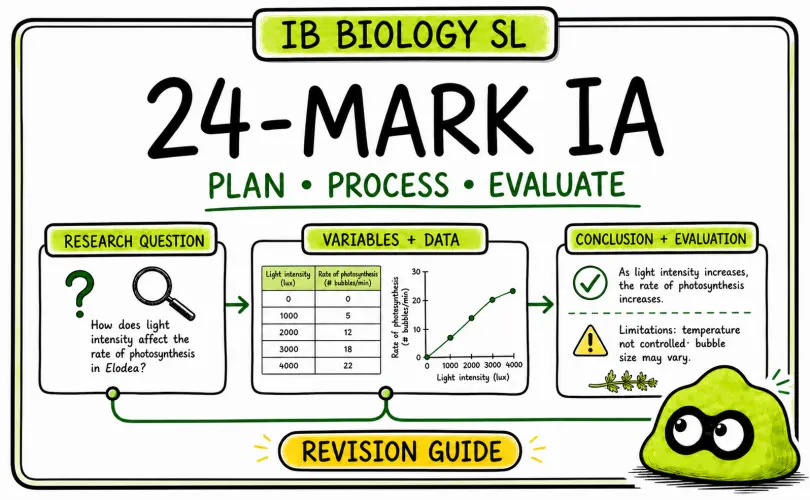
IB Biology Scientific Investigation Guide: How to Build a Strong 24-Mark IA
A practical IB Biology guide to the 24-mark Scientific Investigation: choose a workable research question, control variables, process data, draw a supported conclusion and evaluate limitations with specific improvements.
Abiotic Factors Explained | IB Biology SL
Revise IB Biology SL abiotic factors, tolerance ranges, limiting factors and how environmental variables affect distribution.
Active Transport vs Passive Transport | A-Level Biology
Revise A-Level Biology active and passive transport with concentration gradients, ATP, carrier proteins, examples, common mistakes and practice.