Topoisomerase vs Helicase: DNA Replication Guide
Compare topoisomerase vs helicase in DNA replication, including DNA unwinding, supercoiling, enzyme roles, exam mistakes and IB Biology practice.
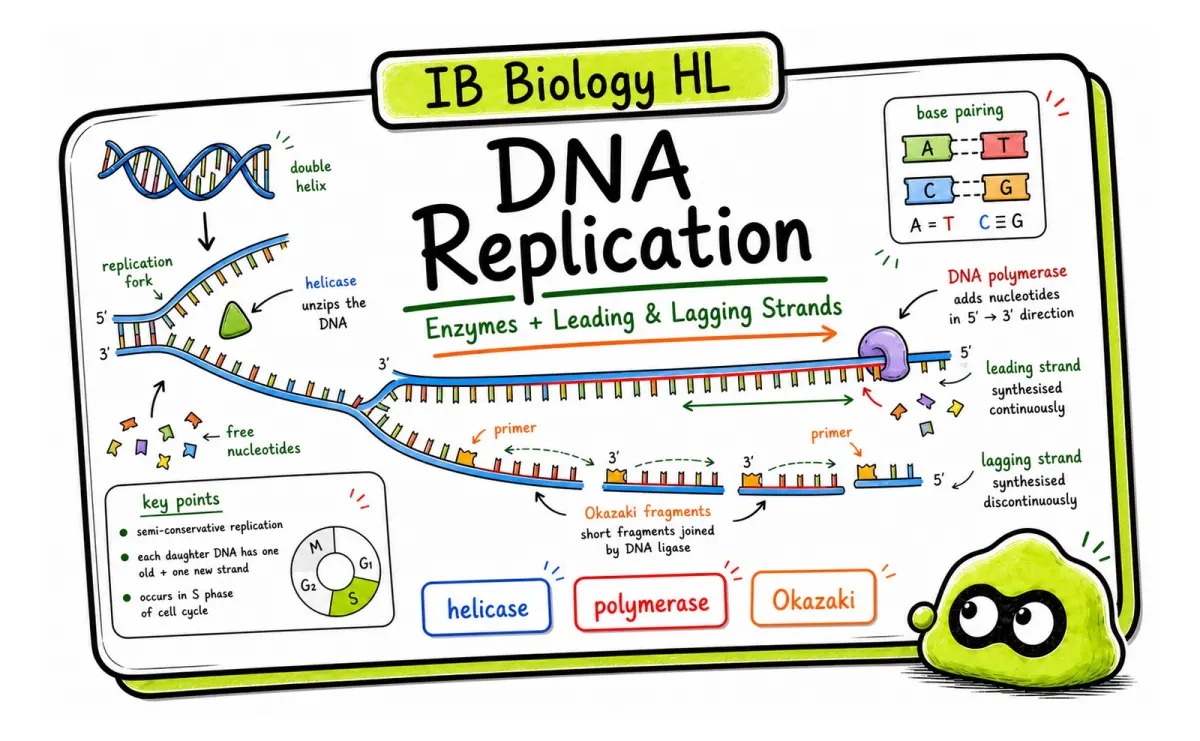
Students often mix up topoisomerase and helicase because both enzymes are described near the replication fork. They are not doing the same job.
Helicase separates the DNA strands. Topoisomerase reduces the twisting stress ahead of the fork. If you can keep that difference clear, DNA replication questions become much easier to answer in IB Biology.
Quick Answer
Helicase unwinds the DNA double helix at the replication fork by breaking hydrogen bonds between complementary base pairs. Topoisomerase works ahead of the replication fork to relieve supercoiling and torsional strain caused by unwinding.
The short version is:
| Enzyme | Main role | Best exam wording |
|---|---|---|
| Helicase | Separates DNA strands | Breaks hydrogen bonds between complementary bases at the replication fork |
| Topoisomerase | Relieves twisting stress | Cuts, swivels and rejoins DNA to reduce supercoiling ahead of the fork |
Do not write that topoisomerase unzips the DNA strands. That is helicase.
Why DNA Gets Twisted During Replication
DNA is a double helix, so opening it is not like pulling apart a straight zip. When helicase separates the strands at the replication fork, the DNA ahead of the fork becomes more tightly twisted. This extra twisting is called supercoiling.
If the twisting stress is not relieved, the replication fork cannot move smoothly. Topoisomerase solves this problem before helicase reaches that section of DNA.
Think of it like this:
- helicase works at the fork
- topoisomerase works ahead of the fork
- helicase separates strands
- topoisomerase manages twist and tension
That location difference is one of the easiest ways to avoid mixing them up.
What Helicase Does
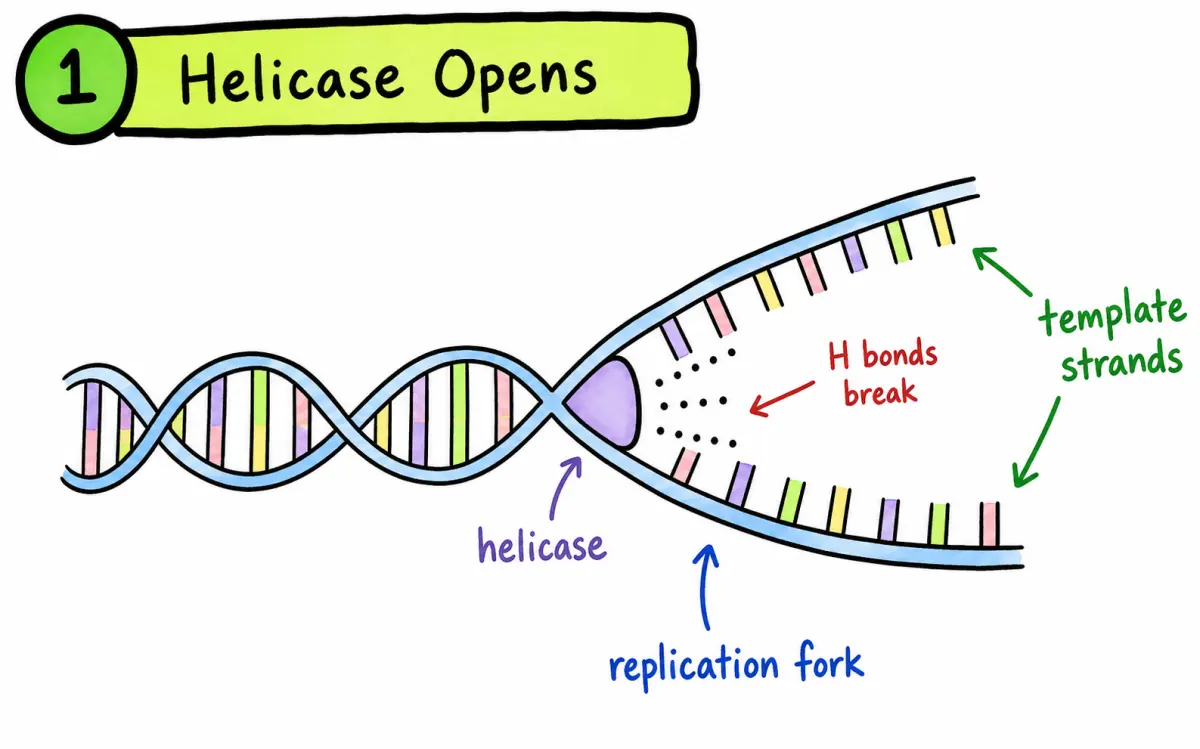
Helicase opens the DNA double helix by breaking hydrogen bonds between complementary base pairs. These are the bonds between A and T, and between C and G.
Helicase does not break the sugar-phosphate backbone. The backbone is held together by covalent phosphodiester bonds, and breaking those would cut the DNA strand itself.
Good exam wording:
Helicase breaks hydrogen bonds between complementary base pairs, separating the two DNA strands so that each strand can act as a template.
Weak exam wording:
Helicase breaks DNA.
That is too vague. It does not say which bond is broken, and it can sound as if helicase breaks the backbone.
What Topoisomerase Does
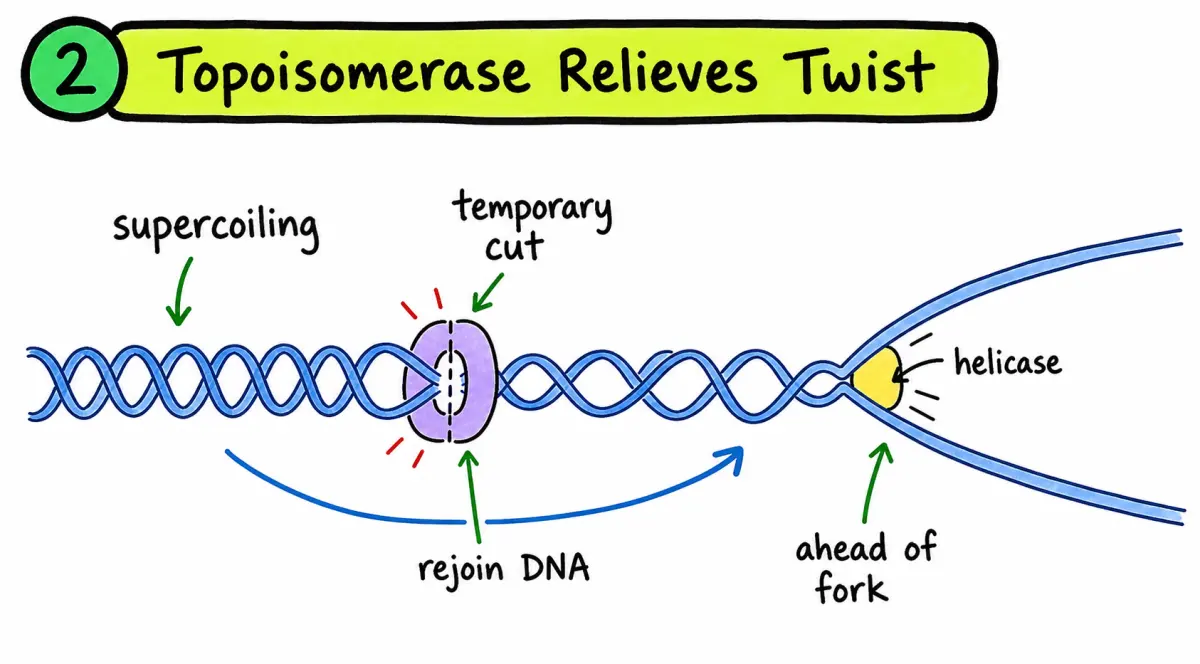
Topoisomerase prevents the DNA ahead of the replication fork from becoming too tightly coiled. It does this by making a temporary cut in the DNA, allowing the DNA to rotate or relax, and then rejoining the strand.
In IB Biology answers, the key idea is not to memorise a long enzyme mechanism. The key idea is to explain why the enzyme is needed:
- helicase unwinding creates torsional strain
- DNA ahead of the fork becomes supercoiled
- topoisomerase relieves this strain
- replication can continue without the DNA becoming overtwisted
Good exam wording:
Topoisomerase relieves supercoiling ahead of the replication fork by temporarily cutting and rejoining DNA.
Topoisomerase vs Helicase: The Difference That Gets Marks
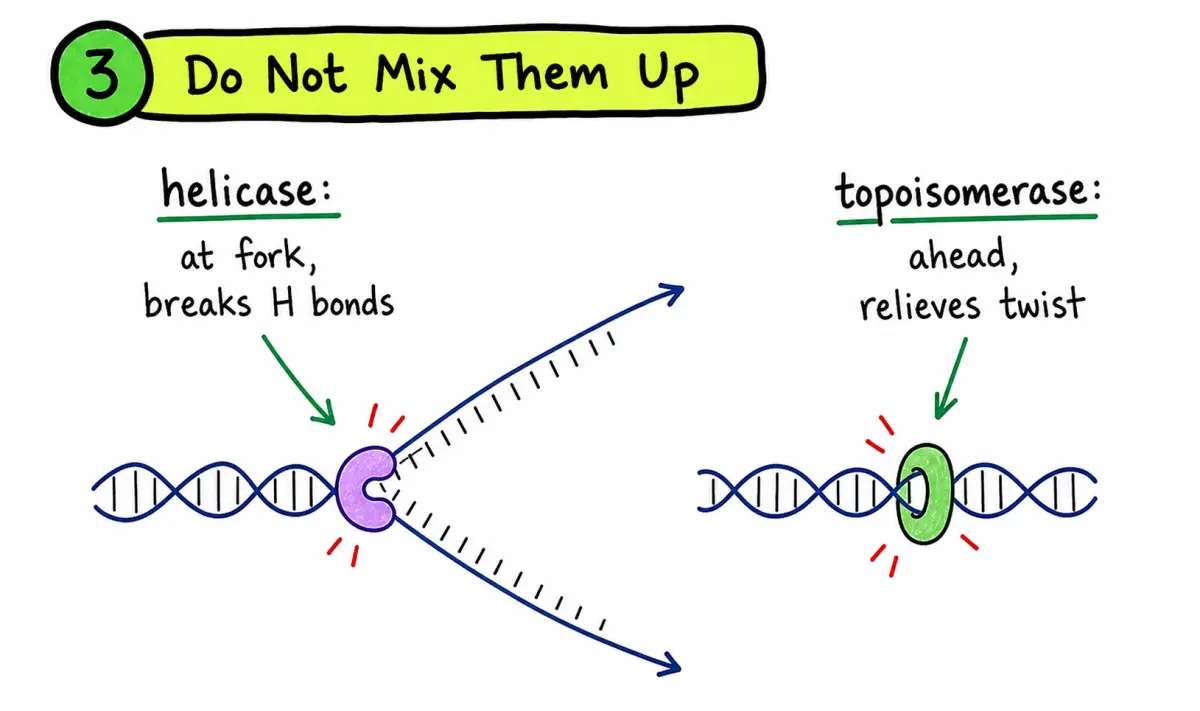
The simplest comparison is action plus location.
| Feature | Helicase | Topoisomerase |
|---|---|---|
| Where it acts | At the replication fork | Ahead of the replication fork |
| What problem it solves | Strands must be separated | DNA becomes overtwisted |
| Bond/action | Breaks hydrogen bonds | Temporarily cuts and rejoins DNA |
| Result | Template strands are exposed | Supercoiling is reduced |
| Common mistake | Saying it breaks the backbone | Saying it unzips the strands |
If a question asks for enzyme roles, write one sentence for each enzyme instead of using one vague sentence for both.
Worked Example
Question: Distinguish between the roles of helicase and topoisomerase during DNA replication.
Markscheme-style answer: Helicase separates the two DNA strands at the replication fork by breaking hydrogen bonds between complementary bases. Topoisomerase acts ahead of the replication fork to relieve supercoiling caused by unwinding, by temporarily cutting and rejoining DNA.
Why this scores: The answer gives a different role, location and action for each enzyme.
Common Exam Mistakes
The most common errors are small wording errors:
- saying topoisomerase breaks hydrogen bonds
- saying helicase relieves supercoiling
- saying helicase breaks phosphodiester bonds
- forgetting that topoisomerase acts ahead of the fork
- explaining both enzymes as simply "unwinding DNA"
If you catch those mistakes before the exam, this becomes a quick mark topic.
How to Revise This Topic
Use a three-step revision loop:
- Draw a replication fork.
- Label helicase at the fork.
- Label topoisomerase ahead of the fork.
Then write two short enzyme-role sentences from memory. If your sentence does not include hydrogen bonds for helicase or supercoiling for topoisomerase, revise it again.
For targeted practice, use IB Biology HL DNA replication questions. If you need to rebuild the base-pairing foundation first, use IB Biology nucleic acids questions and the DNA and RNA structure guide.
Practice This Topic
Try this exam-style question:
During DNA replication, explain how helicase and topoisomerase help the replication fork move without damaging the DNA molecule.
Answer guide:
- Helicase separates the two DNA strands at the replication fork.
- Helicase breaks hydrogen bonds between complementary base pairs, not the sugar-phosphate backbone.
- Unwinding creates twisting strain or supercoiling ahead of the fork.
- Topoisomerase relieves this strain by temporarily cutting, relaxing and rejoining DNA.
Practice this exact topic
Role of helicase and DNA polymerase question bank
Some questions may require an EduNinja membership.
Browse broader practice
Browse the full IB Biology HL Question Bank
Use this if you want to explore more available practice by topic.
Related Study Links
- Review the complete syllabus Study Hub
- IB Biology Molecular Biology revision guide
- IB Biology Question Bank
FAQ
Is topoisomerase the same as helicase?
No. Helicase separates DNA strands by breaking hydrogen bonds between complementary bases. Topoisomerase relieves supercoiling ahead of the replication fork by temporarily cutting and rejoining DNA.
Does helicase break phosphodiester bonds?
No. Helicase breaks hydrogen bonds between base pairs, not phosphodiester bonds in the sugar-phosphate backbone. This distinction is a common markscheme point.
Why is topoisomerase needed in DNA replication?
Topoisomerase is needed because helicase unwinding creates twisting stress ahead of the replication fork. Topoisomerase reduces this supercoiling so the fork can continue moving.
Where does topoisomerase act?
Topoisomerase acts ahead of the replication fork, where DNA becomes overtwisted as helicase opens the double helix.
Final Takeaway
Use this memory line: helicase unzips; topoisomerase untwists. Helicase exposes the template strands. Topoisomerase prevents the DNA ahead of the fork from becoming too tightly coiled.
Put DNA replication back into your full IB Biology HL study plan.
Return to the complete course overview, or move directly into the most relevant study tool.
Related articles
More course notes, updates and study resources from the EduNinja blog.

IB Biology SL Assessment and Grade Boundaries: How 55 + 50 + 24 Marks Become Your Final Grade
Learn how IB Biology SL Paper 1, Paper 2 and the scientific investigation combine through weighted assessment, how grade boundaries work and how to plan component-level revision.
Diploidy and Haploidy Explained
Revise diploid and haploid chromosome sets, meiosis, fertilisation and common IB Biology mistakes.
What Are Producers in an Ecosystem? IB Biology Guide
Learn what producers are in IB Biology ecosystems, how they start food chains, and how to use exam-safe trophic level wording.