IB Biology Ecology Revision Guide: Primary Consumers and Energy Flow
Revise IB Biology ecology with primary consumer examples, energy flow, food webs, carbon cycle, population density and common exam mistakes.
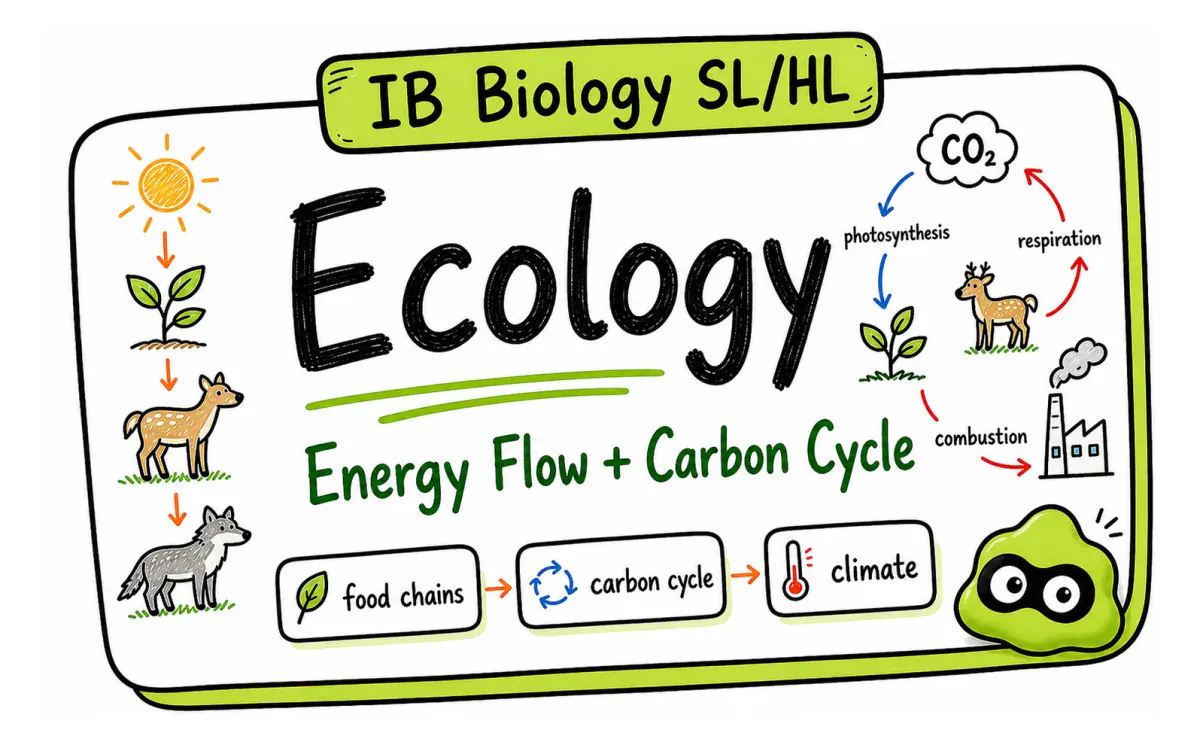
IB Biology ecology answers get stronger when you separate the basic terms early. A primary consumer is an organism that feeds on producers, such as a rabbit eating grass or zooplankton feeding on phytoplankton. Producers are usually the first trophic level, primary consumers are the second trophic level, and higher consumers feed later in the sequence.
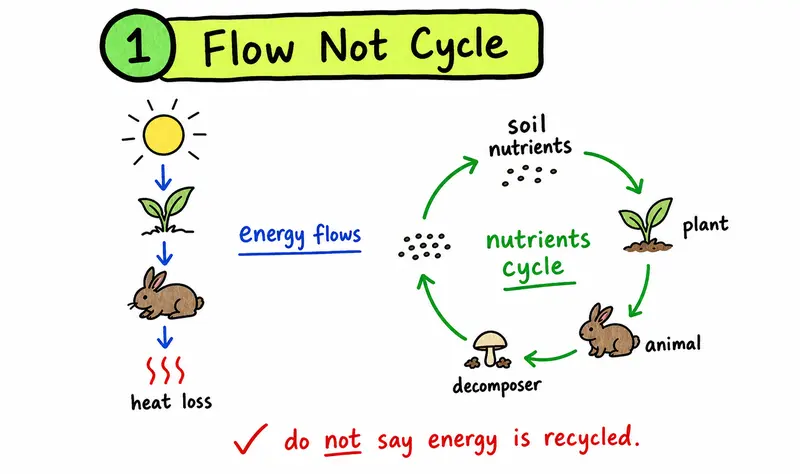
The bigger ecology rule is this: energy flows, but nutrients cycle. Energy enters most ecosystems as light, is converted into chemical energy by producers, passes through feeding relationships, and is lost at each trophic transfer as heat, movement, waste, and uneaten biomass. Nutrients such as carbon move between living organisms and non-living stores, so they can be reused.
Start With This Exam Answer
Energy flow is the transfer of energy through feeding relationships in an ecosystem. Producers convert light energy into chemical energy, primary consumers obtain energy by feeding directly on producers, and energy is lost at each trophic level through respiration, heat loss, movement, waste, and uneaten biomass. Nutrients cycle, but energy is not recycled.
A primary consumer is an organism that feeds directly on producers. Examples include rabbits eating grass, caterpillars eating leaves, and zooplankton feeding on phytoplankton.
In an exam, write it in this order:
- State where the energy enters.
- Explain how it moves through trophic levels.
- State why less energy is available at higher levels.
What Is an Ecosystem?
An ecosystem is a community of organisms and the abiotic environment they interact with. That last part matters. If you leave out the abiotic environment, the definition is too thin.
| Term | Exam-safe meaning | Common mistake |
|---|---|---|
| Species | Organisms that can interbreed to produce fertile offspring | Calling similar-looking organisms a species |
| Population | Members of one species in the same area at the same time | Describing every organism in an area |
| Community | Interacting populations in the same area | Forgetting interaction |
| Habitat | The place where an organism normally lives | Treating it as the same thing as niche |
| Ecosystem | A community plus its abiotic environment | Leaving out abiotic factors |
If a question asks for an ecosystem, include organisms and abiotic factors such as light, water, soil, temperature, pH, mineral ions, or dissolved gases.
Energy Flow Is Not Nutrient Cycling
This is the distinction students should learn first.
Energy flows through ecosystems and is eventually lost as heat. Nutrients cycle through organisms, dead matter, decomposers, soil, water, and the atmosphere.
Use this sentence:
Energy flows and is lost as heat. Nutrients cycle and are reused.
That one sentence fixes a lot of ecology answers.
How Does Energy Move Through Trophic Levels?
A trophic level is the position an organism occupies in a feeding sequence. Producers are usually trophic level 1. Primary consumers feed on producers. Secondary consumers feed on primary consumers. Tertiary consumers feed higher in the chain.
What is a primary consumer?
A primary consumer is an organism that feeds on a producer. In a food chain, producers are usually plants, algae, or photosynthetic microorganisms. Primary consumers are often herbivores, but the key exam point is not the animal label. The key point is that they get energy by eating producers.
Examples of primary consumers include:
- a rabbit eating grass
- a caterpillar eating leaves
- a snail feeding on algae
- zooplankton feeding on phytoplankton
- a grasshopper feeding on crop plants
Exam-safe wording:
- A primary consumer feeds directly on producers and is usually at the second trophic level.
Avoid saying that a primary consumer is "the first organism in a food chain." Producers usually occupy the first trophic level, so that wording can lose precision.
Energy transfer between trophic levels is inefficient because energy is lost through:
- respiration and heat loss
- movement and other life processes
- uneaten biomass
- faeces and egested material
- excreted nitrogenous waste
- biomass not converted into new consumer biomass
This is why food chains are usually short.
Worked Example: Why Are Food Chains Short?
Question: Explain why food chains rarely contain many trophic levels.
Markscheme-style answer: Energy is lost at each trophic transfer through respiration, heat loss, movement, waste, and uneaten biomass. Less energy is available to the next trophic level, so there may not be enough biomass or energy to support many higher-level consumers.
Why this works: It names routes of energy loss and links them to the size of higher trophic levels.
What Do Pyramids Show?
A pyramid of energy shows energy available at each trophic level. It is usually upright because energy is lost between levels.
A pyramid of biomass shows the mass of living material at each trophic level. A pyramid of numbers shows the number of organisms at each level.
When explaining a pyramid, do not just say the bar is smaller. Say what the bar represents and why it changes.
| Pyramid type | What it shows | Better exam wording |
|---|---|---|
| Energy | Energy available at each trophic level | Energy decreases because energy is lost during transfer |
| Biomass | Mass of living material | Less biomass is supported at higher trophic levels |
| Numbers | Number of organisms | Shape can vary depending on organism size |
Carbon Cycle: Learn Process Arrows
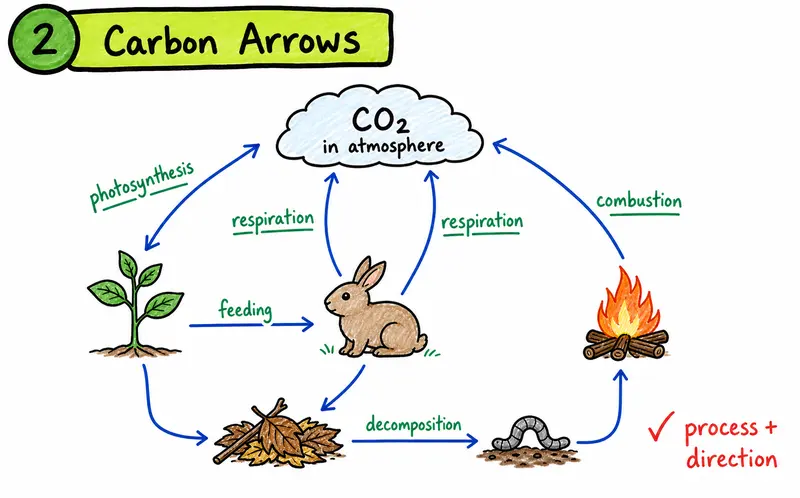
The carbon cycle is not just a diagram to memorize. It is a set of process arrows showing carbon moving between stores.
| Process | Direction of carbon movement |
|---|---|
| Photosynthesis | Carbon dioxide into organic compounds in producers |
| Feeding | Organic carbon moves through food chains |
| Respiration | Organic carbon returns as carbon dioxide |
| Decomposition | Dead organic matter is broken down and carbon is released or recycled |
| Fossilisation or storage | Carbon is stored long-term under certain conditions |
| Combustion | Carbon in biomass or fossil fuels returns to the atmosphere as carbon dioxide |
| Ocean exchange | Carbon dioxide dissolves into or leaves ocean water |
For a short-answer question, write the process and the direction. A labelled arrow is usually better than a decorative diagram with vague labels.
What Do Decomposers Do?
Decomposers break down dead organisms and waste. This returns carbon compounds and mineral nutrients to the environment. Without decomposers, nutrients would remain locked in dead biomass and would not be recycled for producers.
For IB wording, mention the process, the material, and the result:
- Decomposers break down dead organic matter.
- Carbon is released or recycled.
- Mineral nutrients become available again.
Greenhouse Gases and Climate Change
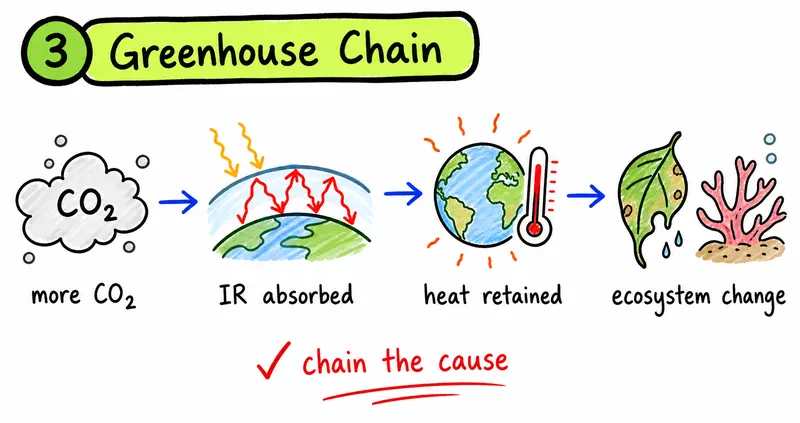
Greenhouse gases absorb outgoing long-wave infrared radiation and re-emit energy, reducing heat loss from Earth. The natural greenhouse effect helps keep Earth warm enough for life. The enhanced greenhouse effect happens when greenhouse gas concentrations rise.
Important greenhouse gases include carbon dioxide, methane, water vapour, and nitrous oxide. Do not treat all gases as identical; they differ in concentration, persistence, and warming effect.
Use this chain:
more greenhouse gas -> more infrared absorbed -> more heat retained -> temperature patterns change -> ecosystem effects
Possible ecosystem effects include altered species distributions, changed rainfall, sea-level rise, coral stress, habitat loss, productivity changes, and increased extinction risk.
Ocean Acidification
Ocean acidification is not just pollution. It is linked to carbon dioxide dissolving in seawater.
More carbon dioxide dissolves in seawater, forms carbonic acid, lowers pH, and reduces carbonate ion availability. Corals and shell-forming molluscs need carbonate ions to build or maintain calcium carbonate structures.
Worked Example: Carbon Dioxide and Shells
Question: Explain how increased atmospheric carbon dioxide can affect marine organisms with calcium carbonate shells.
Markscheme-style answer: More carbon dioxide dissolves in seawater and forms carbonic acid, lowering pH. This reduces carbonate ion availability, making it harder for organisms to form or maintain calcium carbonate shells or skeletons.
Why this works: It links atmospheric carbon dioxide to dissolved carbon dioxide, pH, carbonate availability, and the biological structure affected.
Sampling, Niches, and Applied Ecology
Quadrats estimate the abundance or distribution of sessile organisms, such as plants or organisms that do not move quickly. Random sampling reduces bias. Repeated sampling improves reliability.
Use transects when you want to sample change across an environmental gradient, such as distance from water, shore height, soil moisture, light intensity, or distance from a path.
| Method | Use it when | Exam detail to include |
|---|---|---|
| Random quadrats | Estimating abundance in an area | Random placement, repeats, mean |
| Transect | Studying distribution across a gradient | Tape line, regular intervals, compare with abiotic factor |
A niche is the role of a species in its ecosystem. A habitat is the place it lives. Keep those separate.
Population density vs population distribution
Population density and population distribution are related, but they do not mean the same thing.
| Term | Meaning | Example |
|---|---|---|
| Population density | Number of individuals per unit area or volume | 40 plants per square metre |
| Population distribution | How individuals are spread across an area | clustered, random, or uniform pattern |
If a question asks you to differentiate between population density and population distribution, use paired wording:
- Population density measures how many individuals are present per unit area, whereas population distribution describes the pattern of where those individuals are found.
This is stronger than saying both are "about where organisms live."
Biomagnification and Pollution
Biomagnification is the increase in concentration of a substance at higher trophic levels. It matters for substances that are persistent, not easily broken down, and not easily excreted.
Bioaccumulation happens within one organism over time. Biomagnification happens across trophic levels.
| Term | Scale | Simple wording |
|---|---|---|
| Bioaccumulation | One organism | Substance builds up in tissues over time |
| Biomagnification | Food chain | Substance concentration increases at higher trophic levels |
Top predators can be most affected because they eat many contaminated organisms from lower trophic levels.
How This Appears in IB Biology Questions
IB Biology ecology questions usually ask you to:
- Define a term such as ecosystem, habitat, niche, trophic level, or biomagnification.
- Explain a process using a flow chart or a chain of cause and effect.
- Interpret a graph, table, food web, or sampling result.
In data questions, use this order:
- State the trend.
- Quote data with units if available.
- Link the trend to a biological process or factor.
What Students Usually Miss
| Mistake | Better habit |
|---|---|
| Saying energy is recycled | Say energy flows and is lost as heat |
| Defining ecosystem without abiotic factors | Include the non-living environment |
| Drawing carbon arrows without process names | Label photosynthesis, respiration, decomposition, combustion, and feeding |
| Treating habitat and niche as the same | Habitat is place; niche is role |
| Explaining ocean acidification as generic pollution | Link carbon dioxide, pH, carbonate ions, and calcium carbonate |
| Confusing bioaccumulation and biomagnification | One organism over time vs higher trophic levels |
What the Markscheme Wants
A strong ecology answer usually includes:
- The correct term.
- The direction of movement or transfer.
- A named process.
- A biological consequence or example.
Example:
- Photosynthesis moves carbon dioxide from the atmosphere into organic compounds in producers.
- Respiration returns carbon dioxide to the atmosphere.
- Decomposition releases carbon from dead organic matter.
This is stronger than "carbon moves around the ecosystem."
A 45-Minute Ecology Study Routine
Use this routine when the chapter feels too broad:
- Draw the hierarchy from species to ecosystem.
- Make a two-column list: energy flow vs nutrient cycling.
- Draw one food chain and annotate every route of energy loss.
- Rebuild the carbon cycle using process arrows only.
- Answer one greenhouse gas question using the mechanism chain.
- Write one ocean acidification answer from memory.
- Mark your answers for missing process words.
- Turn each missing process word into a flashcard.
EduNinja is independently developed and is not endorsed by the International Baccalaureate Organization.
Related Study Links
FAQ
What is the difference between energy flow and nutrient cycling?
Energy flows one way and is eventually lost as heat. Nutrients cycle through organisms, dead matter, decomposers, soil, water, and the atmosphere.
Why are pyramids of energy usually upright?
Energy is lost at each trophic transfer, so less is available to the next level.
What should I memorize for the carbon cycle?
Memorize the process arrows: photosynthesis, feeding, respiration, decomposition, fossilisation or long-term storage, combustion, and ocean exchange.
What is a primary consumer?
A primary consumer is an organism that feeds directly on producers. In IB Biology ecology, examples include rabbits eating grass, caterpillars eating leaves, snails feeding on algae, and zooplankton feeding on phytoplankton. Primary consumers are usually at the second trophic level.
What is the difference between population density and population distribution?
Population density is the number of individuals per unit area or volume. Population distribution is the pattern of where those individuals are found, such as clumped, random, or uniform. In exams, define both terms separately before comparing them.
How do I answer greenhouse gas questions better?
Start with the mechanism: greenhouse gases absorb and re-emit outgoing infrared radiation.
Are diagrams enough for IB Biology ecology revision?
No. Diagrams help organize the system, but marks come from labels, process words, and explanations.
Related Resources
- IB Biology Ecology Question Bank
- IB Biology Ecology practice
- IB Biology HL Question Bank
- IB Biology SL Concept pages
- IB Biology Water Revision Guide
- IB Biology Photosynthesis Guide
- IB Biology Cellular Respiration Guide
Choose a course and continue studying.
Pick your curriculum and subject, then continue into the right question bank or notes.
Related articles
More course notes, updates and study resources from the EduNinja blog.
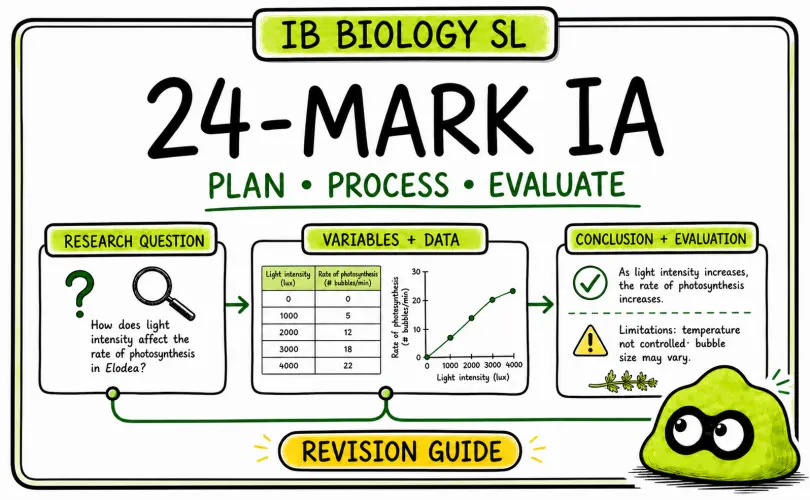
IB Biology Scientific Investigation Guide: How to Build a Strong 24-Mark IA
A practical IB Biology guide to the 24-mark Scientific Investigation: choose a workable research question, control variables, process data, draw a supported conclusion and evaluate limitations with specific improvements.
Abiotic Factors Explained | IB Biology SL
Revise IB Biology SL abiotic factors, tolerance ranges, limiting factors and how environmental variables affect distribution.
Active Transport vs Passive Transport | A-Level Biology
Revise A-Level Biology active and passive transport with concentration gradients, ATP, carrier proteins, examples, common mistakes and practice.