IB Biology Photosynthesis Equation: Calvin Cycle
Revise the photosynthesis equation in IB Biology with light-dependent reactions, carbon fixation, exam wording and practice questions.
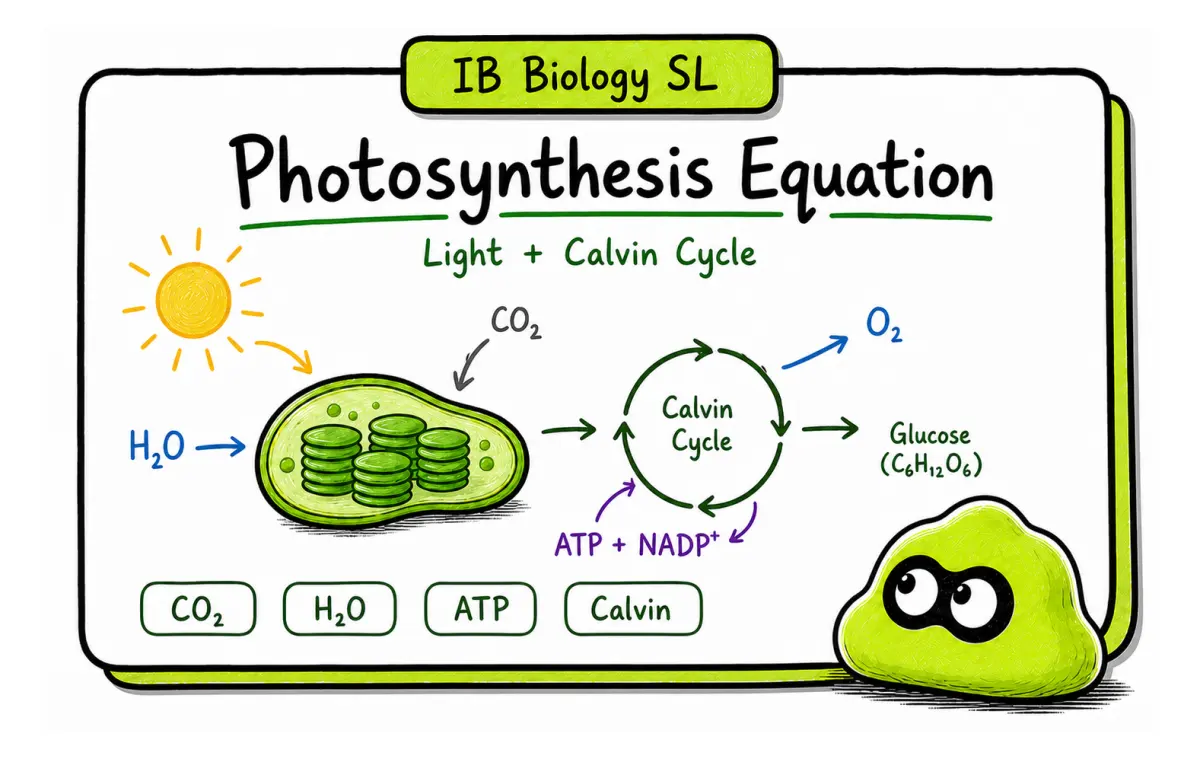
If you are searching for the photosynthesis equation in IB Biology, the important point is not only the word equation. You need to connect carbon dioxide and water becoming glucose and oxygen to the light-dependent reactions, ATP, reduced NADP, and carbon fixation in the Calvin cycle.
This page is a short bridge between the search query and exam-style practice. It focuses on the wording students need when a question moves from the equation to energy transfer, chloroplast structure, or limiting factors.
Quick Answer
| Search idea | Exam-safe answer |
|---|---|
| Photosynthesis equation | Carbon dioxide and water are used to form glucose and oxygen |
| Energy source | Light energy is absorbed by photosynthetic pigments |
| Light-dependent reactions | Produce ATP and reduced NADP |
| Calvin cycle | Uses carbon dioxide to build carbohydrates |
| Common trap | Do not describe photosynthesis as simply making energy |
What the Photosynthesis Equation Really Shows
The simple word equation is:
carbon dioxide + water -> glucose + oxygen
This is useful, but IB Biology questions often expect more than memorising the equation. Photosynthesis converts light energy into chemical energy in organic molecules. The oxygen released comes from the splitting of water, while carbon dioxide is fixed into carbohydrate during the Calvin cycle.
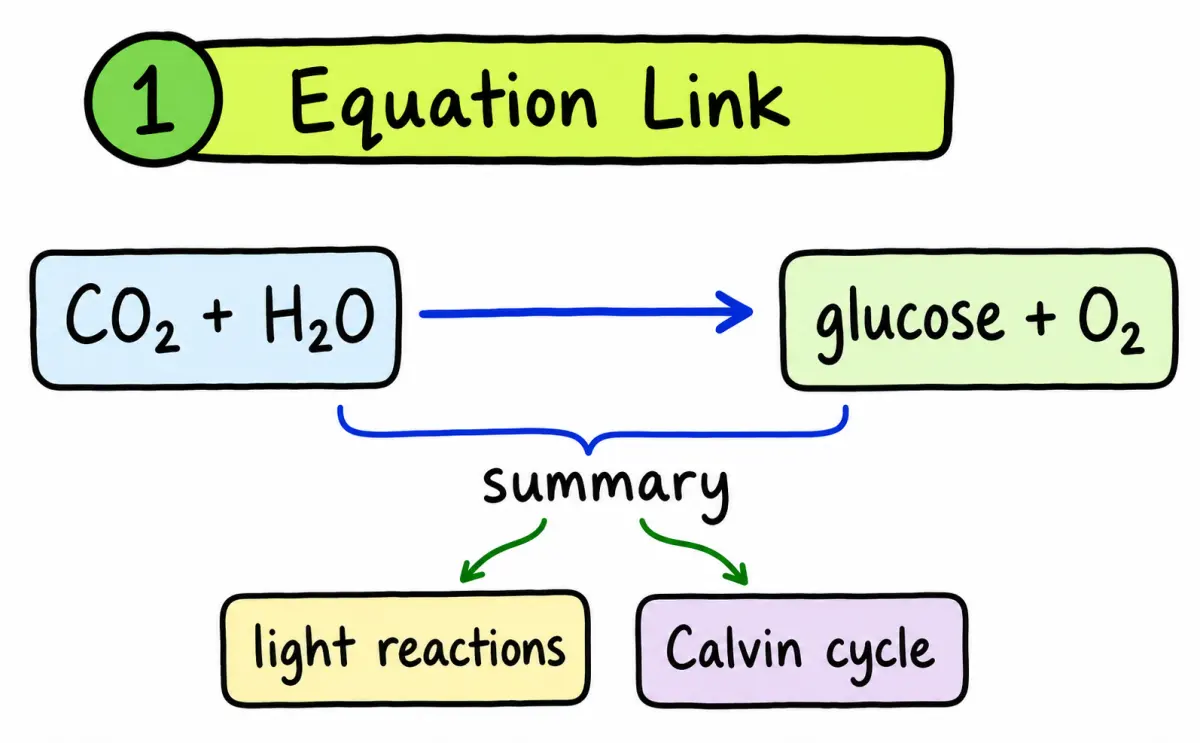
A safer exam answer says that light-dependent reactions generate ATP and reduced NADP, then the Calvin cycle uses these products to reduce carbon dioxide and form carbohydrates. That makes the equation feel less like a slogan and more like a process.
Worked Example
Question: Explain why the equation for photosynthesis alone is not enough to describe how plants make carbohydrates.
Answer: The equation shows the overall reactants and products, but it does not show the stages. In the light-dependent reactions, light energy is absorbed and used to produce ATP and reduced NADP. In the Calvin cycle, carbon dioxide is fixed and reduced to form carbohydrate. Therefore, the equation summarises the process, but the stages explain how it happens.
Why this scores: The answer starts with the equation, then adds stage-specific biology. It avoids the weak phrase "plants make energy," which can be misleading because energy is transferred and stored rather than created.
Equation-to-Process Trap
| Weak wording | Why it is risky | Better wording |
|---|---|---|
| Photosynthesis makes energy | Energy is transferred, not created | Light energy is converted to chemical energy |
| Oxygen comes from carbon dioxide | The oxygen released comes from water | Water is split in the light-dependent reactions |
| Glucose appears directly from light | Carbon dioxide is fixed through biochemical reactions | The Calvin cycle forms carbohydrate |
| The equation explains everything | It hides the stages | Use the equation plus process wording |
The topic-specific move is to translate the equation into stages. If a question asks for a definition, the word equation may be enough. If it asks for explanation, you need light absorption, ATP, reduced NADP, carbon fixation and carbohydrate formation.
Exam-Safe Wording
Use this chain when writing about photosynthesis:
- Light energy is absorbed by photosynthetic pigments.
- The light-dependent reactions produce ATP and reduced NADP.
- Water is split, releasing oxygen.
- Carbon dioxide is fixed in the Calvin cycle.
- Carbohydrate is produced and chemical energy is stored.
This chain is deliberately more precise than "plants use sunlight to make food." That phrase may be fine for a younger level, but it is too vague for IB Biology exam answers.
Common Mistakes
| Mistake | Why it loses marks | Better wording |
|---|---|---|
| Only writing the equation | Many questions ask for explanation | Link equation to stages |
| Saying sunlight is a reactant | Light is the energy source, not a substance in the equation | Light energy is absorbed |
| Confusing ATP with the final product | ATP is used during the process | Carbohydrates store chemical energy |
| Ignoring carbon fixation | Carbon dioxide must be incorporated into organic molecules | CO2 is fixed in the Calvin cycle |
Mini Practice Set
- Write the word equation for photosynthesis.
- Explain why oxygen is produced during photosynthesis.
- Describe how the light-dependent reactions support the Calvin cycle.
- State one reason "photosynthesis makes energy" is not exam-safe wording.
Practice This Topic
Try this exam-style question:
A student writes: "Photosynthesis makes glucose from sunlight." Improve this answer so it explains the role of carbon dioxide, water, light-dependent reactions and the Calvin cycle.
Answer guide:
- State that carbon dioxide and water are reactants in the overall process.
- Explain that light energy is absorbed and used in the light-dependent reactions.
- Mention ATP and reduced NADP as products that support the Calvin cycle.
- Say that carbon dioxide is fixed and used to form carbohydrate.
Practice this exact topic
Practise IB Biology photosynthesis questions
Some questions may require an EduNinja membership.
Browse broader practice
Browse the full IB Biology SL Question Bank
Use this if you want to explore more available practice by topic.
Related Study Links
- Explore the IB Biology SL Study Hub
- IB Biology Cellular Respiration Guide
- IB Biology Ecology Revision Guide
- Natural Selection in IB Biology
- Explore the IB Biology Question Bank
FAQ
What is the photosynthesis equation in IB Biology?
The photosynthesis equation is carbon dioxide plus water forming glucose and oxygen. In IB Biology, you should also understand that this equation summarises a multi-stage process. Stronger answers connect it to light-dependent reactions, ATP, reduced NADP and carbon fixation in the Calvin cycle.
Is light a reactant in the photosynthesis equation?
Light is not usually written as a chemical reactant in the photosynthesis equation. It is the energy source absorbed by photosynthetic pigments. A common exam mistake is treating sunlight like a substance; safer wording says that light energy drives reactions that lead to carbohydrate formation.
Where does the oxygen in photosynthesis come from?
The oxygen released in photosynthesis comes from water, not directly from carbon dioxide. This matters because students often read the overall equation too quickly. IB Biology answers should link oxygen release to the splitting of water during the light-dependent reactions.
How is the Calvin cycle linked to the photosynthesis equation?
The Calvin cycle explains how carbon dioxide is used to form carbohydrate. The overall equation shows carbon dioxide becoming part of glucose, but the Calvin cycle gives the process detail. It uses products from the light-dependent reactions to reduce fixed carbon into carbohydrate.
What is the biggest photosynthesis exam mistake?
The biggest mistake is writing a simple equation without explaining the process the question asks for. If the command word is explain or outline, add stage-specific wording. Mention light absorption, ATP, reduced NADP, carbon fixation, water splitting or carbohydrate formation where relevant.
Final Takeaway
The photosynthesis equation is only the starting point. For IB Biology marks, turn it into a process: light energy absorbed, water split, ATP and reduced NADP made, carbon dioxide fixed, and carbohydrate produced.
Put topic practice back into your full IB Biology SL study plan.
Return to the complete course overview, or move directly into the most relevant study tool.
Related articles
More course notes, updates and study resources from the EduNinja blog.

IB Biology SL Assessment and Grade Boundaries: How 55 + 50 + 24 Marks Become Your Final Grade
Learn how IB Biology SL Paper 1, Paper 2 and the scientific investigation combine through weighted assessment, how grade boundaries work and how to plan component-level revision.
Diploidy and Haploidy Explained
Revise diploid and haploid chromosome sets, meiosis, fertilisation and common IB Biology mistakes.
What Are Producers in an Ecosystem? IB Biology Guide
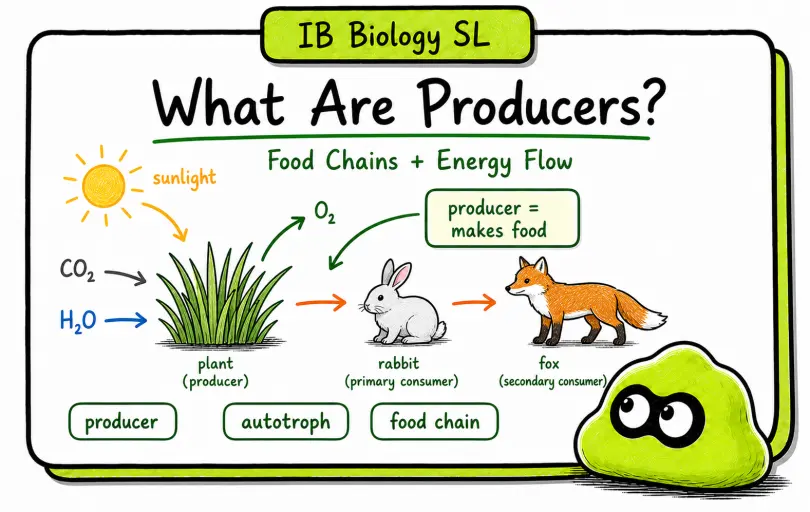
Learn what producers are in IB Biology ecosystems, how they start food chains, and how to use exam-safe trophic level wording.