IB Biology SL Assessment and Grade Boundaries: How 55 + 50 + 24 Marks Become Your Final Grade
Learn how IB Biology SL Paper 1, Paper 2 and the scientific investigation combine through weighted assessment, how grade boundaries work and how to plan component-level revision.

IB Biology SL uses three assessment components: Paper 1, Paper 2 and the scientific investigation. Their raw marks are not simply added together to produce the final subject grade. Each component is converted through its assessment weighting, and the resulting total is then interpreted using the grade boundaries for the relevant examination session.
Quick Answer
For the current IB Biology SL assessment model, Paper 1 is marked out of 55 and contributes 36%, Paper 2 is marked out of 50 and contributes 44%, and the scientific investigation is marked out of 24 and contributes 20%. The final grade is based on the weighted combination, not on adding 55 + 50 + 24 as if the three components had equal value.
Assessment Structure

Paper 1 contains Paper 1A multiple-choice questions and Paper 1B data-based questions. Paper 2 includes data-based and short-answer questions in Section A, followed by extended-response questions in Section B. The scientific investigation is one individual investigation assessed through a written report.
The components measure overlapping but different skills. Paper 1 rewards accurate recall and the ability to interpret unfamiliar data quickly. Paper 2 asks students to connect biological knowledge to data, explanations and longer responses. The scientific investigation tests the planning, analysis, conclusion and evaluation of an investigation.
Raw Marks vs Weighted Contribution

The raw mark tells you how many marks you earned within one component. The weighting tells you how strongly that component contributes to the final subject result. A mark in Paper 2 cannot be compared directly with a mark in the scientific investigation without considering the different maximum marks and component weightings.
How Grade Boundaries Work
Grade boundaries are the minimum scaled marks required for each IB grade in a particular examination session. They are not permanent percentages and should not be copied from an older assessment model without checking the syllabus and exam session.
The IB explains that grade boundaries are set through a grade-award process that considers candidate work and grade descriptors. The boundary for one session may differ from another. Use grade-boundary information as a planning reference, not as a promise that a future examination will use the same cut-offs. Your school IB coordinator is the appropriate source for official result information for your session.
What Each Paper Demands
Paper 1: fast decisions and data reading
Paper 1 is not only a memory test. Paper 1A checks precise understanding through multiple-choice questions, while Paper 1B requires students to read data and identify the biological relationship or conclusion supported by it. Practise short retrieval sets, unfamiliar graphs and quick elimination of distractors.
Paper 2: explanation and application
Paper 2 rewards answers that connect a biological idea to the question context. A strong response names the process, explains the mechanism and links the mechanism to the data or outcome. For extended responses, plan a logical sequence before writing so that the answer does not become a list of disconnected facts.
Scientific investigation: evidence and evaluation
The scientific investigation is assessed using four criteria: research design, data analysis, conclusion and evaluation. Each criterion contributes six marks, giving a total of 24 marks. A clear investigation question, appropriate variables, traceable data processing and evidence-bounded conclusions matter more than decorative detail.
Revision Priorities

Different components need different practice behaviours:
- Paper 1: retrieve key knowledge, then practise unfamiliar data and distractor analysis.
- Paper 2: write short mechanism explanations and extended responses from unfamiliar contexts.
- Scientific investigation: review variables, processing choices, conclusions and specific limitations.
Use a component-based error log. Record whether an error came from knowledge recall, data interpretation, explaining a mechanism, using evidence or evaluating a limitation. This shows what to practise next more clearly than a single overall percentage.
Common Mistakes That Cost Marks
- Adding all raw marks directly and treating the components as equally weighted.
- Using a grade boundary from the old Biology assessment model for a current-model result.
- Treating Paper 1 as pure recall and ignoring Paper 1B data-based questions.
- Describing a trend without explaining the biological mechanism or evidence.
- Writing a conclusion that goes beyond the data collected in the scientific investigation.
- Giving a vague evaluation without explaining how the change would improve the investigation.
Worked Example
Question: Why is it misleading to compare a Paper 1 mark directly with a scientific-investigation mark?
Answer: The two components have different maximum raw marks, different assessment purposes and different weightings in the final subject grade. A direct comparison ignores how each raw mark is converted into a weighted contribution. Progress should therefore be reviewed by component and by the skill being assessed.
Practice This Topic
Try an IB Biology SL assessment question by first identifying the component skill being tested: recall, data interpretation, biological explanation, analysis, conclusion or evaluation.
Practice this topic
Practise IB Biology SL Question Bank questions
FAQ
Are Paper 1, Paper 2 and the scientific investigation equally weighted?
No. They have different raw-mark totals and different contributions to the final subject grade. Use the current assessment model rather than adding raw marks directly.
Does a grade boundary stay the same every year?
No. Grade boundaries are set for an examination session and can change when the assessment model, candidate performance or grade-award evidence changes.
Should I use old IB Biology papers?
Older questions may still help with biological knowledge and some response skills, but check whether the paper structure and question demand match the current assessment model. Do not treat an old Paper 3 or old component boundary as current-model evidence.
What is the best way to improve my Biology grade?
Track Paper 1, Paper 2 and scientific-investigation performance separately. Then practise the weakest skill, such as data interpretation, mechanism explanations or evaluation, instead of repeating the same question type across the whole course.
Related Study Links
- Review IB Biology SL concepts
- Practise IB Biology SL questions
- Explore the EduNinja Blog
- Read the IB assessment FAQ
Final Takeaway
IB Biology SL is built from Paper 1, Paper 2 and the scientific investigation, but their raw marks do not have equal meaning. Convert each component through its weighting, compare grade-boundary information only within the correct syllabus and examination session, and use component-level practice to decide what to revise next.
Put assessment back into your full IB Biology SL study plan.
Return to the complete course overview, or move directly into the most relevant study tool.
Related articles
More course notes, updates and study resources from the EduNinja blog.
Diploidy and Haploidy Explained
Revise diploid and haploid chromosome sets, meiosis, fertilisation and common IB Biology mistakes.
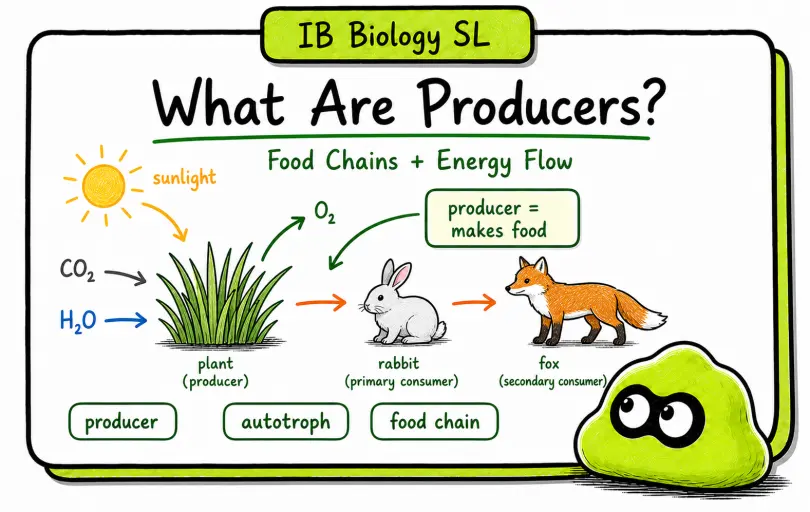
What Are Producers in an Ecosystem? IB Biology Guide
Learn what producers are in IB Biology ecosystems, how they start food chains, and how to use exam-safe trophic level wording.
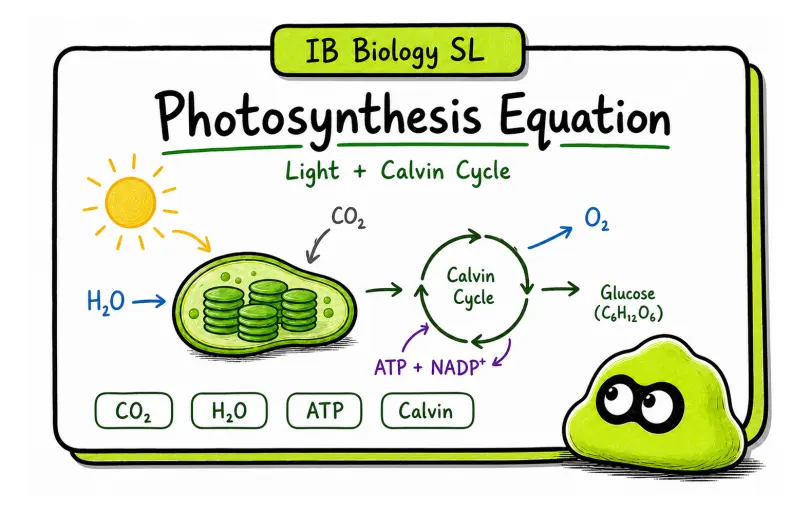
IB Biology Photosynthesis Equation: Calvin Cycle
Revise the photosynthesis equation in IB Biology with light-dependent reactions, carbon fixation, exam wording and practice questions.