Diploidy and Haploidy Explained
Revise diploid and haploid chromosome sets, meiosis, fertilisation and common IB Biology mistakes.
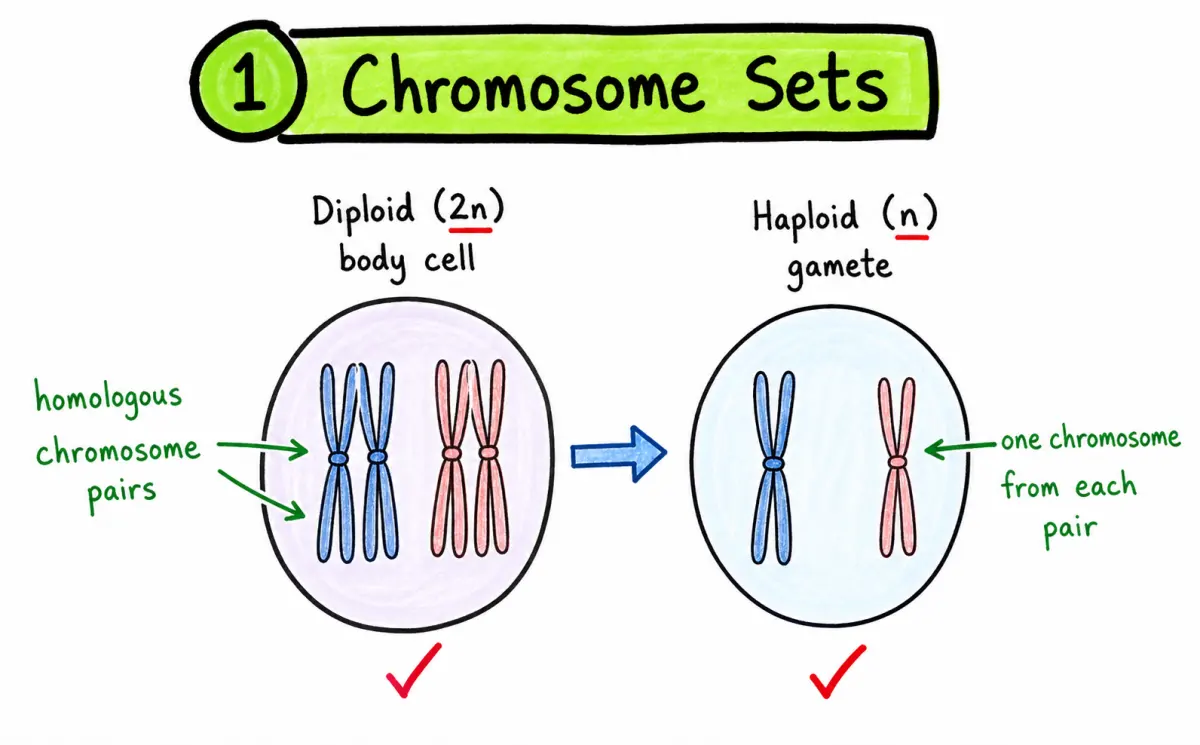
Diploidy and haploidy describe how many sets of chromosomes a cell contains. A diploid cell has two sets, while a haploid cell has one set. This distinction is essential when explaining meiosis, fertilisation and inheritance in IB Biology.
Quick Answer
| Term | Meaning | Symbol | Typical example |
|---|---|---|---|
| Diploid | Two sets of chromosomes | 2n | Body cell |
| Haploid | One set of chromosomes | n | Gamete |
Diploid Cells
Diploid cells contain homologous pairs of chromosomes: one chromosome in each pair came from each parent. The symbol 2n means two complete chromosome sets. In humans, most body cells are diploid with 46 chromosomes.
Haploid Cells
Haploid cells contain one chromosome from each homologous pair. The symbol n means one complete set. Human sperm and egg cells are haploid with 23 chromosomes, so fertilisation restores the diploid number.
Why Meiosis Produces Haploid Cells
Meiosis is a reduction division. It starts with a diploid cell and produces haploid cells, reducing the chromosome number from 2n to n. This prevents chromosome number from doubling every generation.
Common Mistakes
- Haploid does not mean half the number of chromatids in every situation; it refers to chromosome sets.
- A replicated chromosome is still one chromosome until sister chromatids separate.
- Fertilisation joins two haploid gametes to form a diploid zygote.
Practice This Topic
Try this exam-style task: Explain why meiosis must produce haploid gametes before sexual reproduction.
Answer guide: Meiosis reduces the chromosome number from diploid to haploid. Fertilisation then combines two haploid nuclei and restores the diploid number.
Practise IB Biology SL inheritance questions
Related Study Links
FAQ
What does diploid mean?
Diploid means that a cell has two complete sets of chromosomes, written as 2n.
What does haploid mean?
Haploid means that a cell has one complete chromosome set, written as n.
Why are gametes haploid?
Gametes are haploid so that fertilisation can combine two cells without doubling the chromosome number each generation.
Final Takeaway
Remember the core relationship: body cells are generally diploid, gametes are haploid, and meiosis reduces 2n to n.
Put topic practice back into your full IB Biology SL study plan.
Return to the complete course overview, or move directly into the most relevant study tool.
Related articles
More course notes, updates and study resources from the EduNinja blog.

IB Biology SL Assessment and Grade Boundaries: How 55 + 50 + 24 Marks Become Your Final Grade
Learn how IB Biology SL Paper 1, Paper 2 and the scientific investigation combine through weighted assessment, how grade boundaries work and how to plan component-level revision.
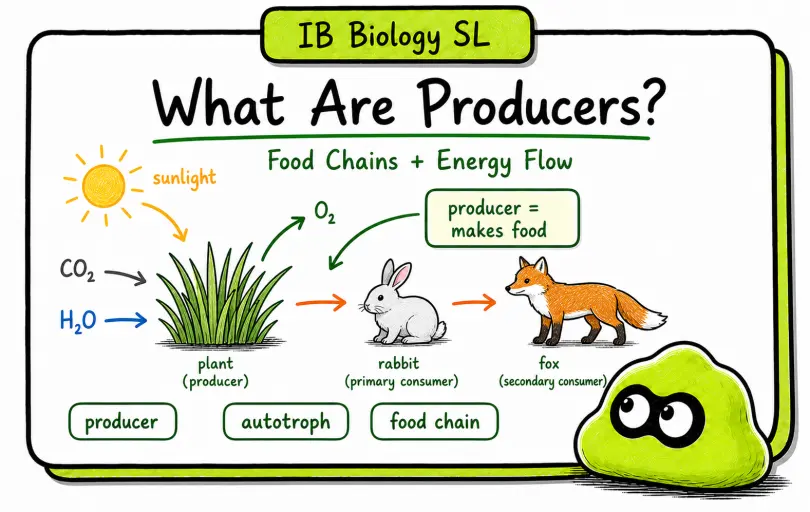
What Are Producers in an Ecosystem? IB Biology Guide
Learn what producers are in IB Biology ecosystems, how they start food chains, and how to use exam-safe trophic level wording.
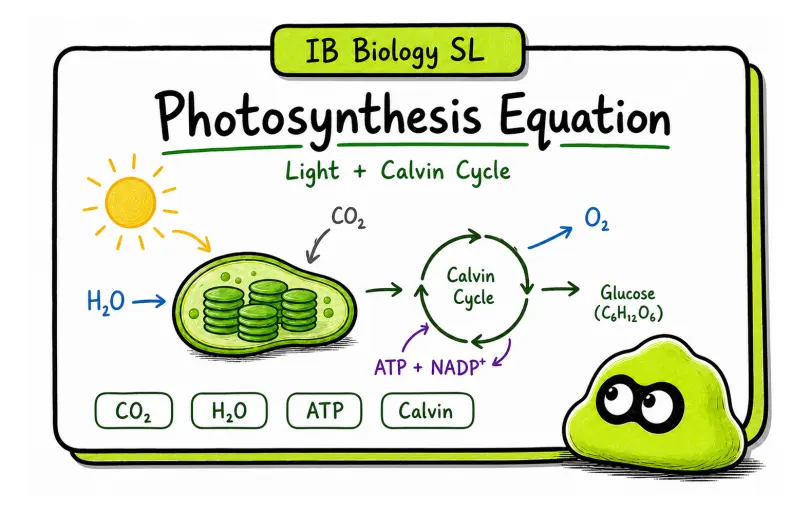
IB Biology Photosynthesis Equation: Calvin Cycle
Revise the photosynthesis equation in IB Biology with light-dependent reactions, carbon fixation, exam wording and practice questions.