Natural Selection in IB Biology: Definition and Examples
Revise natural selection in IB Biology with definition wording, selection pressure, allele frequency change, worked examples and practice questions.
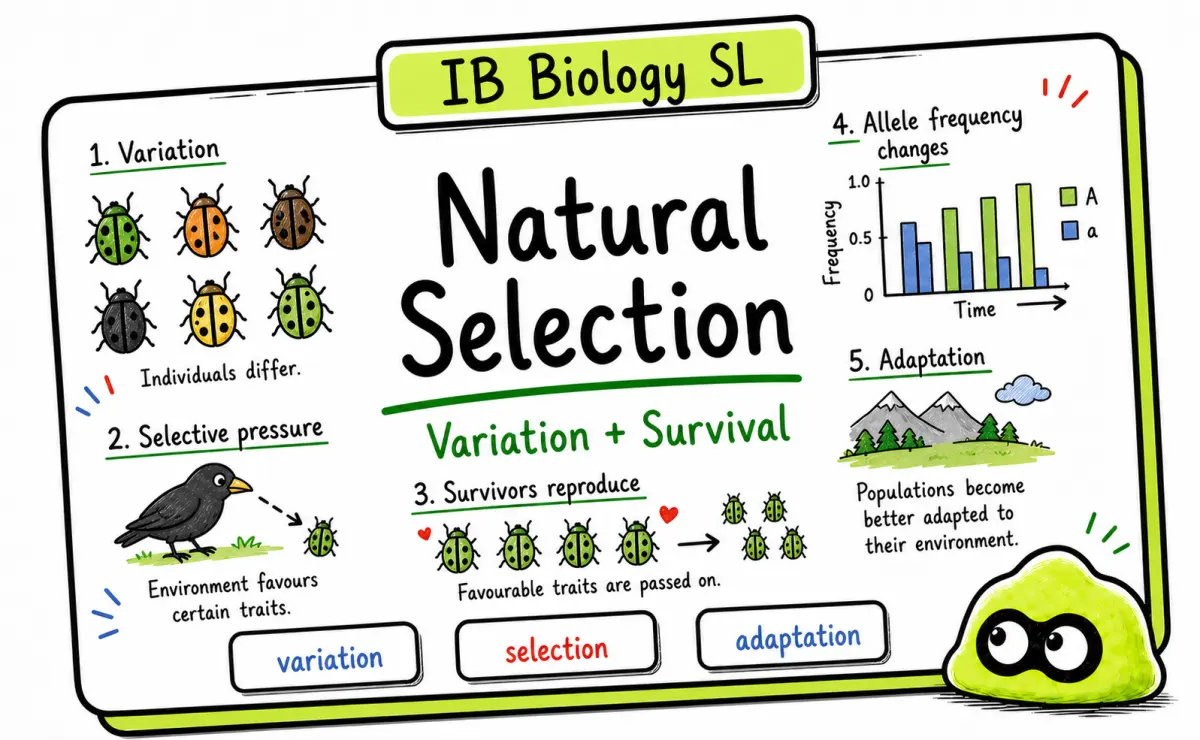
Natural selection is one of those IB Biology ideas that sounds easy until the exam asks you to explain it using precise wording. The keyword is not just survival. The mark-worthy idea is that individuals with advantageous heritable variation are more likely to survive, reproduce, and pass on alleles.
If you are searching for a natural selection definition, learn it as a process rather than a single sentence. That makes examples and data questions much easier.
Quick Answer
| Idea | What it means | Examiner wording |
|---|---|---|
| Variation | Individuals in a population are not identical | Some variation is heritable |
| Selection pressure | Environmental factor affects survival | Predation, disease, competition, climate |
| Differential reproduction | Some individuals leave more offspring | Advantageous alleles are passed on |
| Allele frequency | Alleles become more or less common | The population changes over generations |
What Natural Selection Means
Natural selection is the process where organisms with advantageous inherited traits are more likely to survive and reproduce in a particular environment. Over time, the alleles linked to those traits become more common in the population.
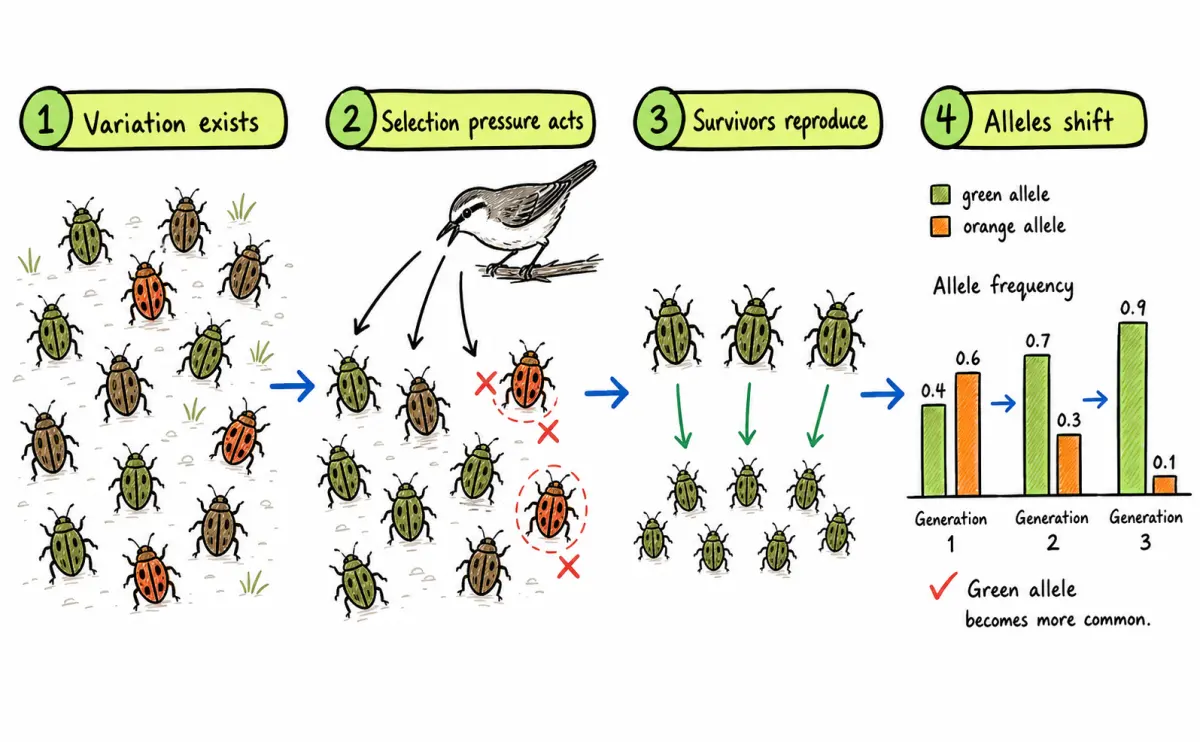
The full exam answer chain is:
variation -> heritable traits -> selection pressure -> differential survival and reproduction -> allele frequency changes over generations
This chain is useful because it stops the answer from becoming vague. Natural selection is not simply "the strongest survives". It is about which inherited traits increase reproductive success in a specific environment.
Worked Example: Antibiotic Resistance
A population of bacteria contains some individuals with a mutation that gives resistance to an antibiotic. When the antibiotic is used, susceptible bacteria are killed or cannot reproduce as successfully. Resistant bacteria survive and reproduce, passing on the resistance allele or genetic variant.
Over several generations, resistant bacteria become a larger proportion of the population. The population has evolved because allele frequencies have changed. The individual bacteria did not choose to become resistant after the antibiotic appeared.
Common Mistakes
| Mistake | Why it loses marks | Better wording |
|---|---|---|
| Saying individuals evolve | Individuals do not evolve during life | Populations change over generations |
| Forgetting inheritance | Survival alone is not enough | Advantageous alleles are passed on |
| Saying organisms choose to adapt | Natural selection is not intentional | Selection pressure favours some traits |
| Ignoring reproduction | Survival must connect to offspring | Survivors reproduce more successfully |
| Writing "strongest survive" | Strength may not be the selected trait | Best adapted to that environment |
Weak vs Exam-Safe Wording
| Weak wording | Exam-safe wording |
|---|---|
| The beetles changed colour to survive. | Some beetles already had heritable colour variation. |
| The strongest beetles survived. | Beetles with better camouflage were less likely to be eaten. |
| The species adapted because it needed to. | The selection pressure increased the frequency of advantageous alleles. |
| The bird made the beetles evolve. | Predation changed which individuals survived and reproduced. |
The safest answers stay population-level and generation-level.
Markscheme-Style Wording
Use wording like this:
- There is heritable variation in the population.
- A selection pressure acts on the population.
- Individuals with advantageous traits have higher survival and reproductive success.
- These individuals pass on advantageous alleles to offspring.
- Allele frequency changes over generations.
Mini Practice Set
- Explain why variation is needed for natural selection.
- Describe how a selection pressure can change allele frequency.
- Give one example of an advantageous trait in a specific environment.
- Explain why individuals do not evolve, but populations can.
Practice This Topic
Try this exam-style question:
A population contains insects with green and brown body colour. Birds can see brown insects more easily on green leaves. Explain how natural selection may affect the frequency of the green-colour allele over several generations.
Answer guide:
- There is heritable variation in body colour within the population.
- Bird predation acts as a selection pressure.
- Green insects are better camouflaged, so they are more likely to survive and reproduce.
- Alleles for green colour are passed to offspring and become more common over generations.
Practice this exact topic
Practice natural selection questions
Some questions may require an EduNinja membership.
Browse broader practice
Browse the full IB Biology SL Question Bank
Use this if you want to explore more available practice by topic.
Related Study Links
- IB Biology SL revision hub
- IB Biology Ecology Revision Guide
- IB Biology SL Plant Biology Revision Guide
- IB Biology DNA and RNA Structure Revision Guide
FAQ
What is natural selection in IB Biology?
Natural selection is the process where individuals with advantageous heritable traits are more likely to survive and reproduce. Over generations, the alleles for those traits can become more common in the population. In exams, include variation, selection pressure, differential reproduction and allele frequency change. That full chain is safer than only saying "survival of the fittest".
Do individuals evolve by natural selection?
No, individuals do not evolve by natural selection during their lifetime. Natural selection changes populations over generations because some individuals reproduce more successfully than others. A safer answer says that allele frequencies in a population change over time, not that one organism decides to adapt. This is one of the most common wording traps.
What is a selection pressure?
A selection pressure is an environmental factor that affects which individuals survive and reproduce. Examples include predation, disease, competition, temperature, drought or antibiotics. The key exam move is to explain how the pressure favours one heritable variation over another. Always link the pressure to survival, reproduction and allele frequency change.
Why is heritable variation important?
Heritable variation is important because natural selection can only change a population over generations if traits can be passed to offspring. If a difference is not inherited, it may affect one individual, but it will not directly change allele frequencies in the next generation. This is why "useful trait" alone is not enough.
What is the most common natural selection exam mistake?
The most common mistake is writing that organisms adapt because they need to. That sounds intentional and can lose marks. A stronger answer explains that random variation already exists, and the environment selects individuals with traits that improve survival or reproduction. Keep the wording non-intentional, evidence-based and population-level throughout the answer.
Final Takeaway
For natural selection, use this chain: variation, selection pressure, survival, reproduction, allele frequency. If your answer misses one link, it may sound right but lose marks.
Put topic practice back into your full IB Biology SL study plan.
Return to the complete course overview, or move directly into the most relevant study tool.
Related articles
More course notes, updates and study resources from the EduNinja blog.

IB Biology SL Assessment and Grade Boundaries: How 55 + 50 + 24 Marks Become Your Final Grade
Learn how IB Biology SL Paper 1, Paper 2 and the scientific investigation combine through weighted assessment, how grade boundaries work and how to plan component-level revision.
Diploidy and Haploidy Explained
Revise diploid and haploid chromosome sets, meiosis, fertilisation and common IB Biology mistakes.
What Are Producers in an Ecosystem? IB Biology Guide
Learn what producers are in IB Biology ecosystems, how they start food chains, and how to use exam-safe trophic level wording.