Momentum and Conservation of Momentum | IB Physics SL
Learn IB Physics SL momentum with p = mv, vector direction, conservation in collisions, impulse, force-time graphs and exam practice.
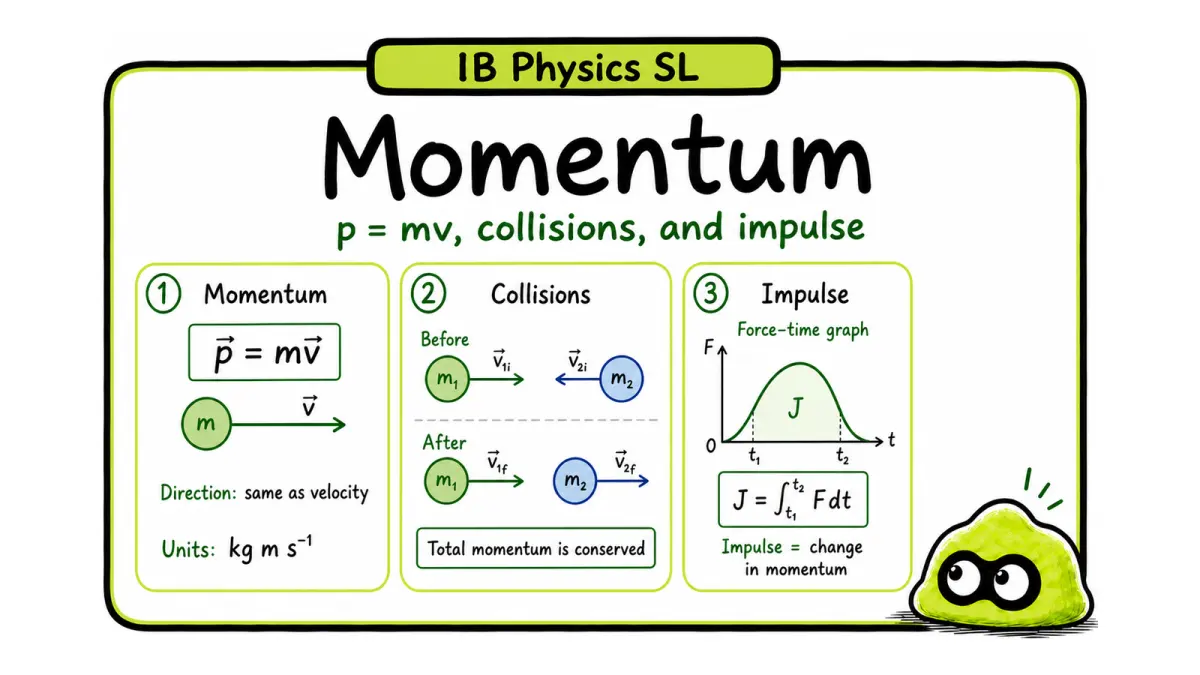
Momentum questions often look like collision stories, but the calculation starts with one simple idea: a moving object's momentum depends on its mass and velocity. In IB Physics SL, strong answers keep the vector direction, system boundary, and before-and-after equation clear.
Quick Answer
- Momentum is p = mv, so it depends on mass and velocity.
- Momentum is a vector; its direction is the direction of velocity.
- For an isolated system, total momentum before an interaction equals total momentum after it.
- Impulse is the change in momentum: J = Delta p.
- The area under a force-time graph gives impulse.
IB Physics SL places linear momentum conservation, impulse, and impulse-momentum change in the forces and momentum section. In an exam, define the positive direction before assigning signs to velocities.
Momentum as a Vector
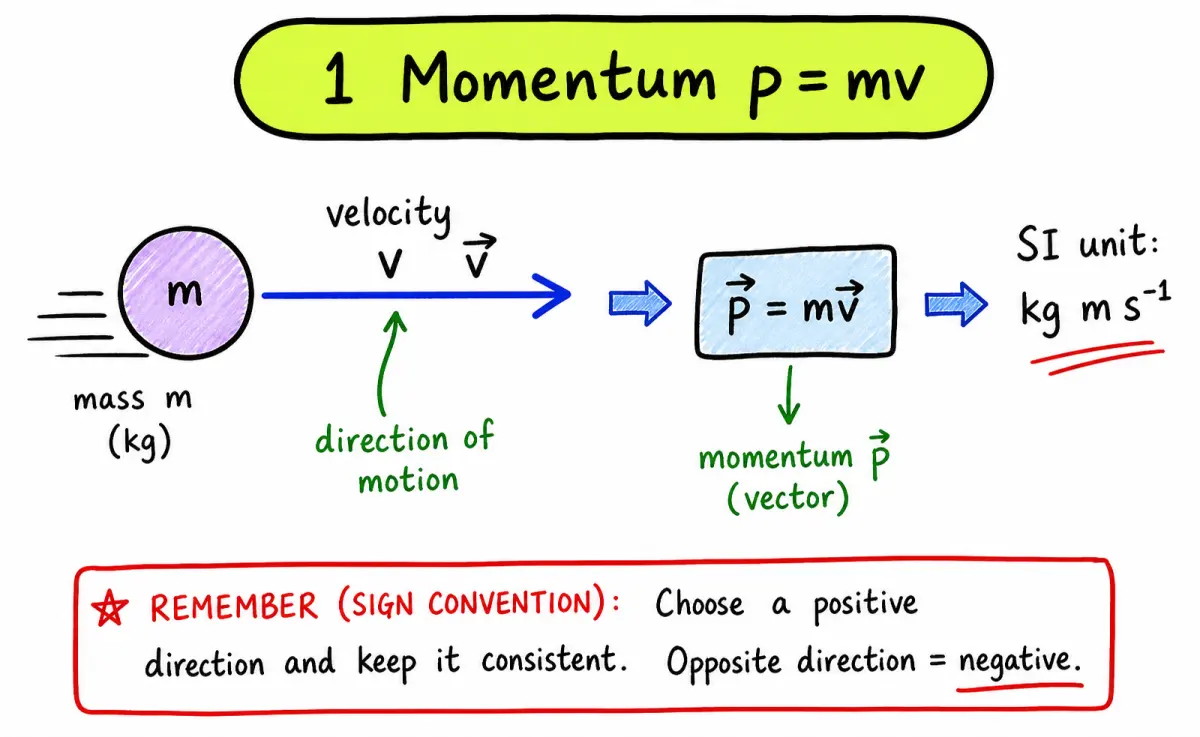
Linear momentum is calculated using:
p = mv
The SI unit is kg m s^-1. Because velocity is a vector, momentum is also a vector. If an object moves to the right and right is chosen as positive, its momentum is positive. Motion to the left has negative momentum in that one-dimensional model.
The sign is not a statement that the object has negative mass. It records direction relative to the chosen axis. Keep the same sign convention for every object in the system.
Conservation in Collisions
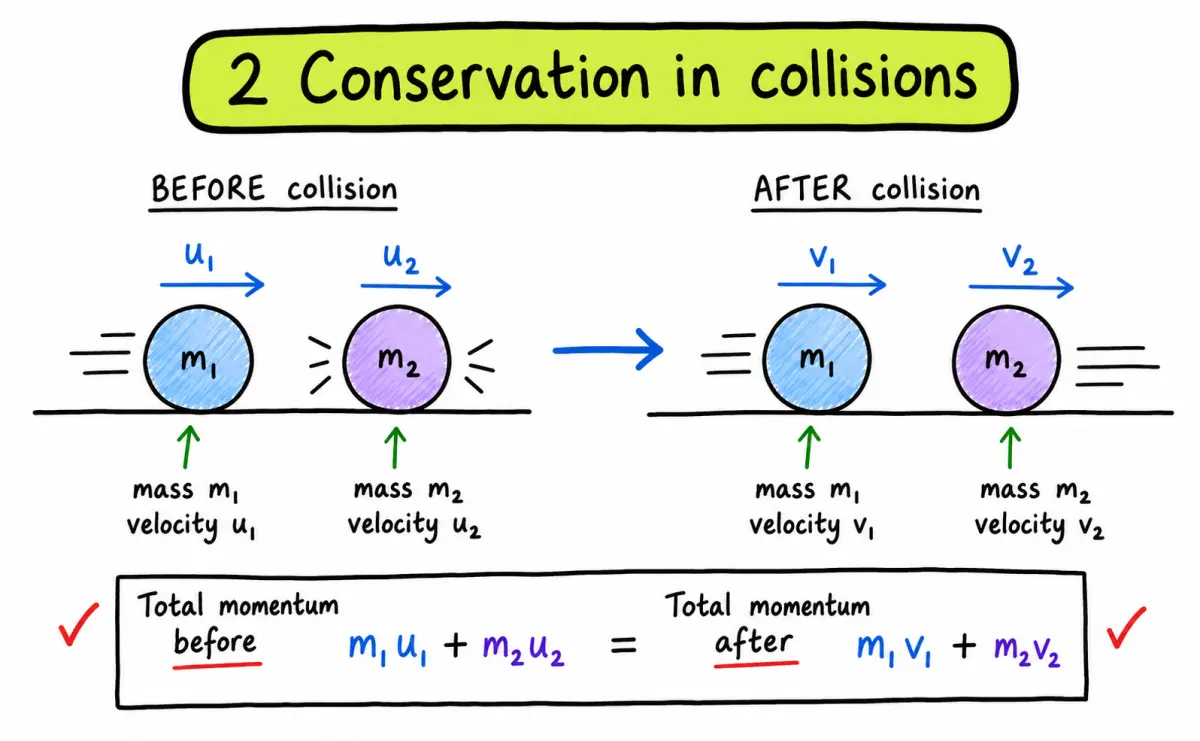
Momentum is conserved for an isolated system when the resultant external impulse on that system is negligible. For two objects moving along one line:
m1u1 + m2u2 = m1v1 + m2v2
Here u values are velocities before the interaction and v values are velocities after it. The equation is a vector equation, so negative velocities must be included rather than replaced by their magnitudes.
Choose the system before writing the equation. If the system includes both objects during a short collision, the internal forces cancel as a pair. If a significant external force acts during the interaction, you must account for its impulse instead of assuming total momentum is unchanged.
Impulse and Change in Momentum
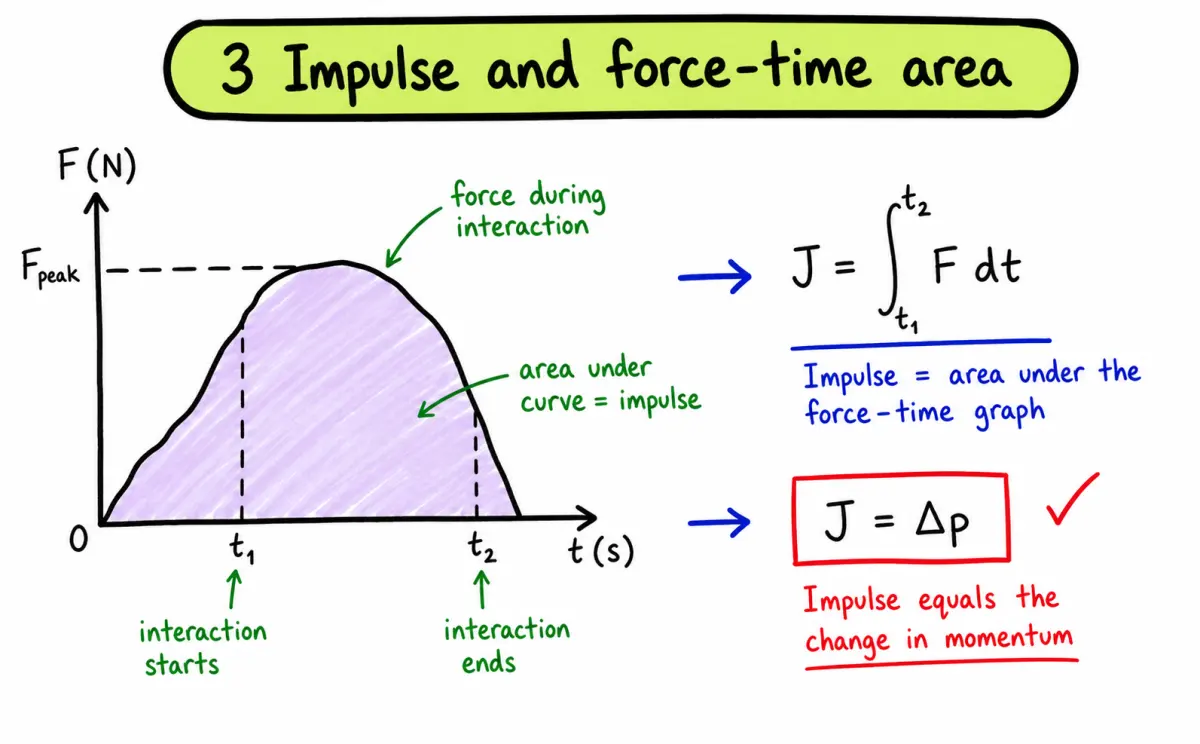
Impulse measures the effect of a force acting over a time interval:
J = Delta p
For a variable force, impulse is the area under the force-time graph:
J = integral F dt
For a constant force, this becomes J = F Delta t. The units of impulse are N s, which are equivalent to kg m s^-1.
The force-time graph is useful when the force changes during a collision. A short, high force and a longer, lower force can produce the same impulse if their areas are equal. This is why increasing collision time can reduce the average force for the same change in momentum.
A Reliable Collision Method
- Define the system and choose a positive direction.
- List the mass and signed velocity of each object before the interaction.
- List the unknown final quantities with signs left visible.
- Write total momentum before = total momentum after.
- Substitute with units and solve.
- Check whether the final direction and magnitude are physically sensible.
If the question includes a force-time graph, calculate the area first and use it as the impulse. If it asks about an external force, do not silently use conservation of momentum for an isolated system.
Common Mistakes
- Treating momentum as a scalar and dropping negative velocity signs.
- Mixing up mass and weight in p = mv.
- Conserving momentum for a system with a significant external impulse.
- Using the area under a force-displacement graph instead of a force-time graph for impulse.
- Giving an answer in kg m s^-1 but calling it force.
- Forgetting that a catalyst, collision type, or energy change does not by itself decide whether momentum is conserved; the system and external impulse do.
Practice This Topic
Try this exam-style question: A 0.50 kg trolley moving at +4.0 m s^-1 collides with a 1.0 kg trolley at rest. They move together after the collision. Find their common velocity, assuming the system is isolated.
Answer guide:
- Total momentum before = (0.50)(+4.0) + (1.0)(0) = 2.0 kg m s^-1.
- After the collision, the combined mass is 1.50 kg.
- Use 2.0 = 1.50v.
- The common velocity is v = 1.33 m s^-1 in the positive direction.
Practice the IB Physics SL Forces and Momentum Question Bank.
Related Study Links
- Explore the subject Study Hub
- IB Physics Data Booklet: Formula Use and Exam Mistakes
- IB Physics SL Mechanics: Forces, Motion, and Exam Marks
- Simple Harmonic Motion Explained: IB Physics Revision Guide
FAQ
Is momentum a scalar or a vector?
Momentum is a vector because it depends on velocity. In one-dimensional questions, use a positive direction and give velocities in the opposite direction negative signs. The sign then carries the direction through the conservation equation.
When is momentum conserved?
Total momentum is conserved for an isolated system when the resultant external impulse is zero or negligible during the interaction. Internal forces do not change the total momentum of the complete system because they act in equal and opposite pairs.
What is the difference between momentum and impulse?
Momentum describes the motion of an object using p = mv. Impulse describes the change in momentum caused by a force acting over time. Their units are equivalent, but they describe different physical quantities.
How do I use a force-time graph?
Find the area under the graph over the interaction interval. That area is the impulse, so it equals the change in momentum. For a rectangle use base times height; for other shapes split the area into familiar parts or use integration when appropriate.
Put topic practice back into your full IB Physics SL study plan.
Return to the complete course overview, or move directly into the most relevant study tool.
Related articles
More course notes, updates and study resources from the EduNinja blog.

IB Physics SL 2025 Syllabus Changes: New Assessment Model
A practical IB Physics SL guide to the 2025 syllabus: the new Paper 1A and 1B structure, Paper 2, scientific investigation, no-options assessment and how to update old notes.
Energy Transformation Examples | Physics
Learn A-Level Physics energy transformations with energy stores, transfer pathways, Sankey diagrams, efficiency and common exam mistakes.
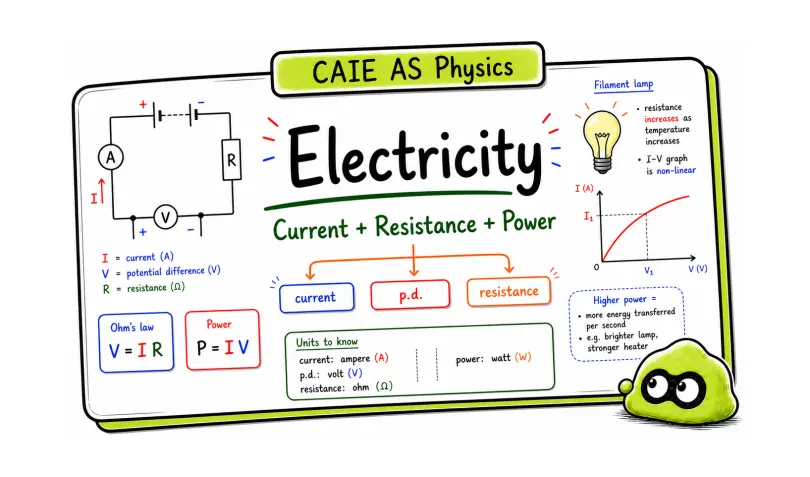
CAIE AS Physics Electricity: Current, Potential Difference, Resistance, and Power
A source-backed CAIE Physics guide for CAIE AS Physics electricity, using EduNinja PDF notes, worked examples, and markscheme-style answers.