Simple Harmonic Motion Explained: IB Physics Revision Guide
Revise simple harmonic motion in IB Physics with restoring force, amplitude, period, frequency, displacement-time graphs and common exam mistakes.
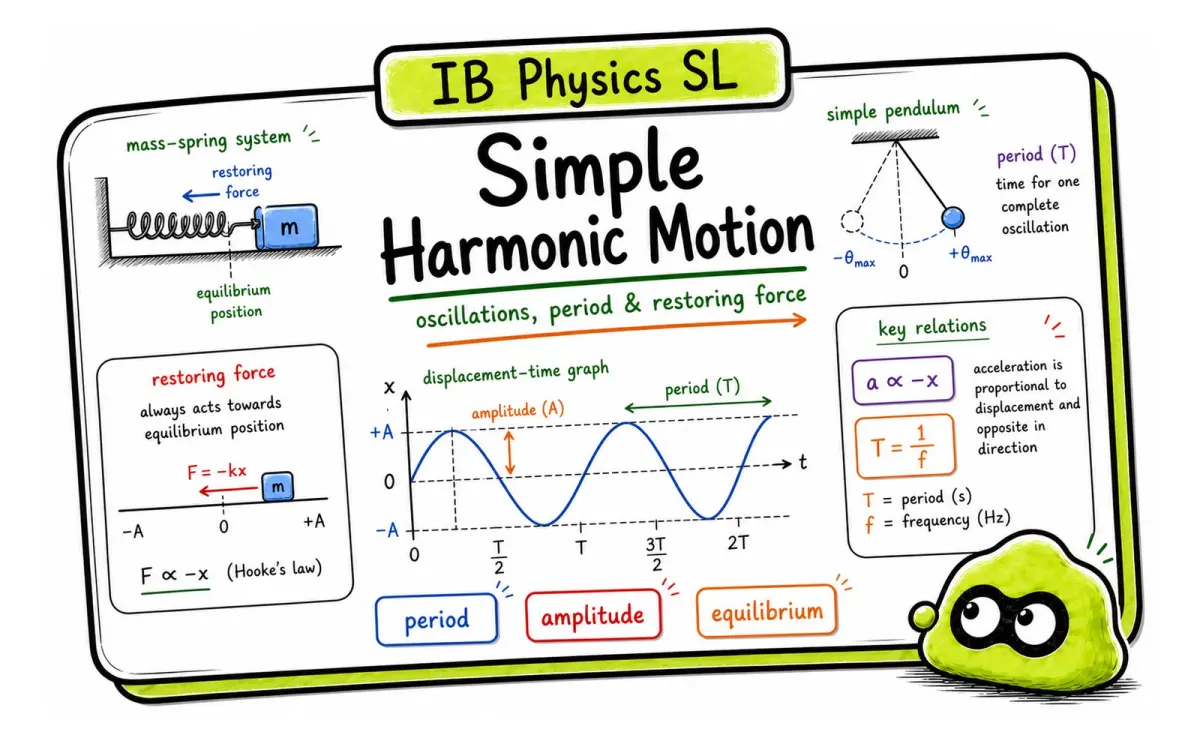
Simple harmonic motion is one of those IB Physics topics that looks friendly until the graph, equation and direction of force all appear in the same question.
The safest route is to keep one idea at the centre: in simple harmonic motion, the acceleration is proportional to displacement from equilibrium and directed back toward equilibrium.
Quick Answer
- Simple harmonic motion is oscillation where acceleration is proportional to displacement and opposite in direction.
- The key relationship is a proportional to -x.
- The restoring force always acts toward the equilibrium position.
- Amplitude is the maximum displacement from equilibrium, not the full peak-to-peak distance.
- Period is the time for one complete oscillation.
- Frequency is the number of oscillations per second.
- Use f = 1 / T and T = 1 / f carefully.
What Makes Motion Simple Harmonic
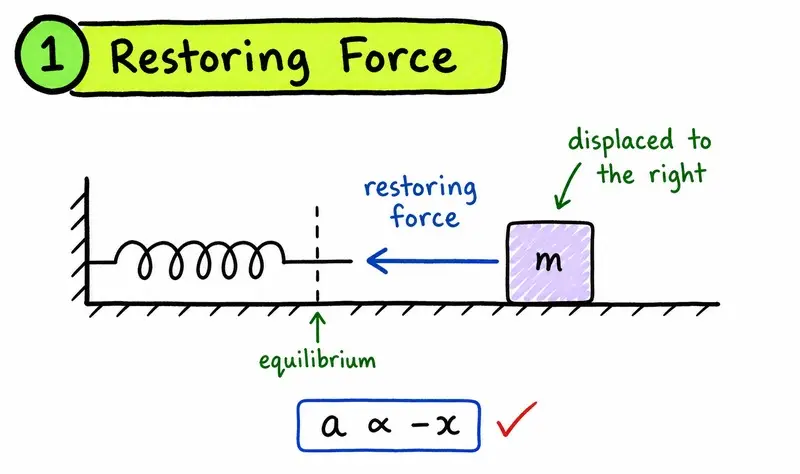
For motion to be simple harmonic, the object must experience a restoring acceleration directed toward equilibrium. The further it is displaced, the larger the acceleration back toward equilibrium.
In exam language:
The acceleration is directly proportional to displacement from equilibrium and acts in the opposite direction.
That single sentence is often the definition the markscheme wants. If you only write "it moves back and forth", you have described oscillation, not simple harmonic motion.
Restoring Force and Equilibrium
The equilibrium position is where the resultant force is zero. When the object is displaced from that position, a restoring force acts to return it.
For a spring system, this links to Hooke's law:
| Quantity | Direction or meaning |
|---|---|
| Displacement x | Measured from equilibrium |
| Restoring force | Acts toward equilibrium |
| Acceleration | Same direction as resultant force |
| Maximum speed | At equilibrium |
| Maximum acceleration | At maximum displacement |
The direction is the exam trap. If the object is displaced to the right, the restoring force is to the left. If the object is displaced upward, the restoring force is downward.
How to Read an SHM Graph
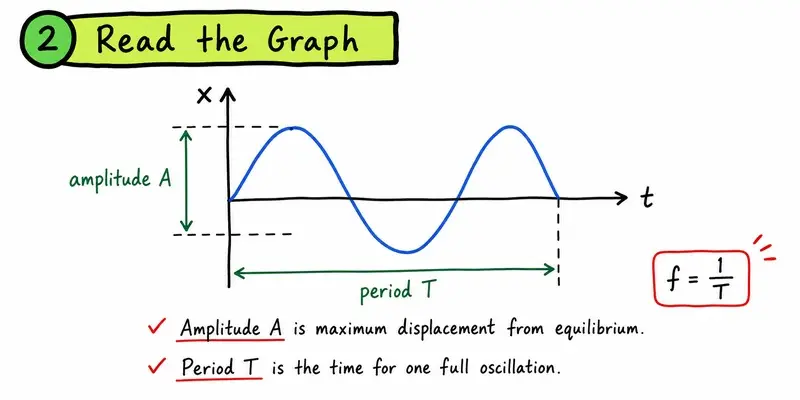
A displacement-time graph for SHM is sinusoidal. You do not need to panic when you see the curve. Start by labelling amplitude and period.
| Graph feature | Meaning |
|---|---|
| Amplitude A | Maximum displacement from equilibrium |
| Period T | Time for one full oscillation |
| Frequency f | Oscillations per second |
| Zero crossing | Object passes through equilibrium |
| Peak or trough | Maximum displacement |
Use the graph to read values before reaching for equations. Many mistakes happen because students plug in the wrong time interval as the period.
Period, Frequency and Units
Period and frequency are linked by:
| Formula | Use |
|---|---|
| f = 1 / T | Find frequency from period |
| T = 1 / f | Find period from frequency |
The units help you catch mistakes. Period is measured in seconds. Frequency is measured in hertz, which means per second.
If a question says an oscillator completes 5 oscillations in 20 seconds, the period is 20 / 5 = 4 seconds. The frequency is 5 / 20 = 0.25 Hz.
Worked Example
Question: A mass on a spring oscillates with a period of 0.80 s. Find its frequency.
Answer: Use f = 1 / T.
f = 1 / 0.80 = 1.25 Hz
Why this works: The period is the time for one oscillation, so the frequency is the reciprocal.
Common Exam Mistakes
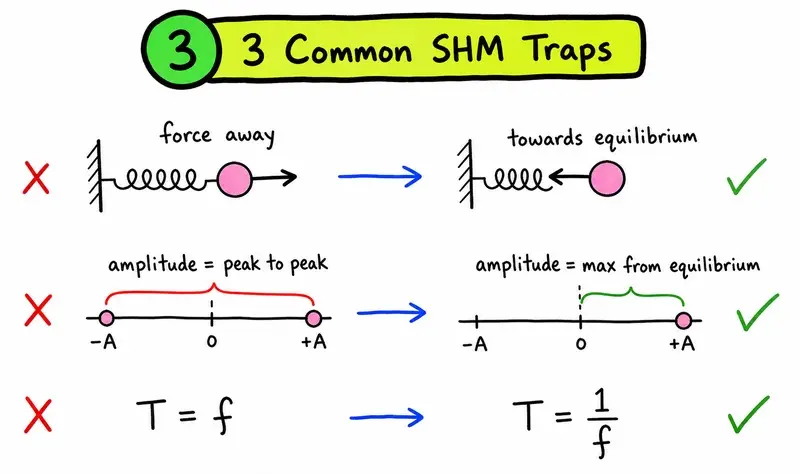
These are the mistakes to remove before your exam:
| Mistake | Why it loses marks | Correct version |
|---|---|---|
| Amplitude is peak-to-peak distance | Peak-to-peak is 2A | Amplitude is maximum displacement from equilibrium |
| Restoring force acts in the direction of motion | Force direction changes during oscillation | Restoring force acts toward equilibrium |
| T = f | Units do not match | T = 1 / f |
| Maximum acceleration is at equilibrium | Displacement is zero there | Maximum acceleration is at maximum displacement |
| Maximum speed is at maximum displacement | Object turns around there | Maximum speed is at equilibrium |
One clean sketch usually prevents half of these errors.
How EduNinja Helps with SHM
Use IB Physics simple harmonic motion questions to practise definitions, graph reading and period-frequency calculations. If you need the related wave language, use the IB Physics wave model questions after this topic.
For a broader mixed set, open the IB Physics SL Question Bank and practise short-response questions where direction, units and graph reading matter.
Practice This Topic
Try this exam-style question:
A mass on a spring is displaced from equilibrium and released. Explain why its motion can be simple harmonic motion.
Answer guide:
- There must be a restoring force or acceleration directed toward equilibrium.
- The restoring acceleration is proportional to displacement from equilibrium.
- The acceleration acts in the opposite direction to the displacement.
- Use exam wording such as a is proportional to -x, not just moves back and forth.
Practice this exact topic
Conditions for SHM question bank
Some questions may require an EduNinja membership.
Browse broader practice
Browse the full IB Physics SL Question Bank
Use this if you want to explore more available practice by topic.
Related Study Links
FAQ
What is simple harmonic motion in IB Physics?
Simple harmonic motion is oscillation where acceleration is directly proportional to displacement from equilibrium and directed toward equilibrium. In short, the acceleration acts opposite to displacement.
Is amplitude the same as peak-to-peak distance?
No. Amplitude is the maximum displacement from equilibrium. Peak-to-peak distance is twice the amplitude, from the highest point to the lowest point on a displacement graph.
Where is speed maximum in simple harmonic motion?
Speed is maximum at the equilibrium position. At that point, displacement is zero, but the object is moving fastest as it passes through the centre of the oscillation.
Where is acceleration maximum in simple harmonic motion?
Acceleration is maximum at maximum displacement, where the restoring force is largest. At equilibrium, acceleration is zero because displacement from equilibrium is zero.
Final Takeaway
Use this memory line: force back, acceleration back, amplitude from the middle. If you can keep direction and graph labels clean, SHM questions become much less slippery.
Put simple harmonic motion back into your full IB Physics SL study plan.
Return to the complete course overview, or move directly into the most relevant study tool.
Related articles
More course notes, updates and study resources from the EduNinja blog.

Transverse vs Longitudinal Waves
Compare transverse and longitudinal waves using particle motion, wave direction, compressions and rarefactions.
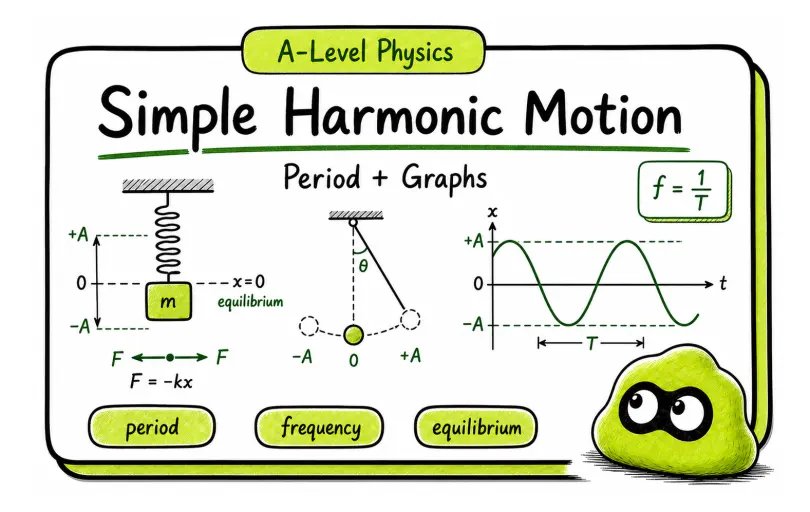
Simple Harmonic Motion in A-Level Physics: Period and Graphs
Revise simple harmonic motion for CAIE A-Level Physics with period, frequency, displacement graphs, restoring force and practice questions.
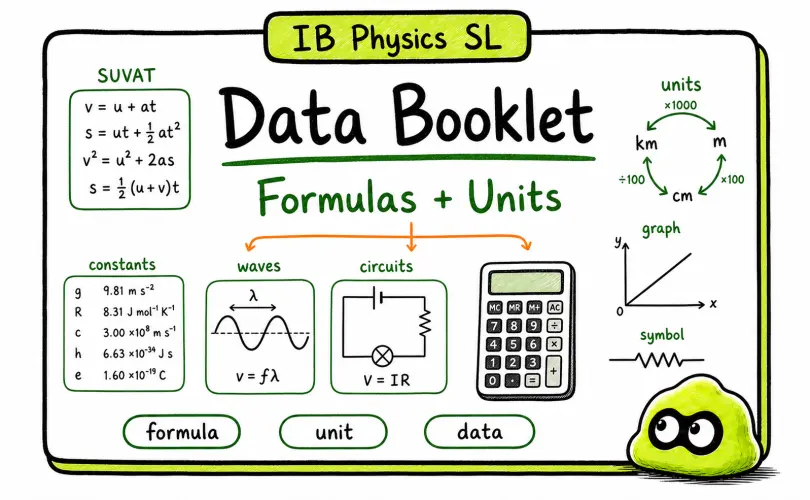
IB Physics Data Booklet: Formula Use and Exam Mistakes
Use the IB Physics data booklet better with formula choice, units, substitution, common exam mistakes and data-handling practice.