IB Physics SL 2025 Syllabus Changes: New Assessment Model
A practical IB Physics SL guide to the 2025 syllabus: the new Paper 1A and 1B structure, Paper 2, scientific investigation, no-options assessment and how to update old notes.
IB Physics SL 2025 Syllabus Changes: New Papers, No Options and What Old Resources Get Wrong
The IB Physics SL course with first assessment in 2025 changes more than the order of your notes. It changes the way you should connect models, equations, data and explanations. The current assessment uses Paper 1A multiple-choice questions, Paper 1B data-based questions, Paper 2 short-answer and extended-response questions, and one scientific investigation. The old option route and old Paper 3 exam structure should no longer be the centre of your revision plan.
Quick Answer
- The current IB Physics SL course was first assessed in 2025.
- Paper 1 is divided into Paper 1A multiple-choice questions and Paper 1B data-based questions.
- Paper 1 totals 45 marks and contributes 36% of the final grade.
- Paper 2 contains short-answer and extended-response questions, totals 55 marks and contributes 44%.
- The scientific investigation is a 24-mark internal assessment worth 20%.
- The old option topics and separate Paper 3 route are not the current SL assessment structure.
The current course still depends on familiar physics: mechanics, energy, waves, electricity, fields and space. What changes is how these ideas are organised and used. Students need to move between a physical model, a mathematical relationship, a graph or table, and a written explanation. Read the official IB Physics guide for the formal course and assessment outline.
What Changed in IB Physics SL?
The 2025 course is organised through connected themes rather than the old core, additional higher-level material and option structure. The SL course is commonly mapped through themes such as space, the particulate nature of matter, wave behaviour and fields. You may still recognise many familiar concepts, but old topic numbers should not be treated as the only valid course map.
The bigger change is the connection between content and skill. A question about motion may ask you to interpret a graph, select a model, calculate a quantity or explain a physical mechanism. A question about waves may require a diagram, an equation, a data trend and a limitation in the same context.
This means a useful revision note should answer four questions:
- What physical system or model is being described?
- Which quantities and relationships represent it?
- What would the data or graph look like?
- How would I explain the result in words?

The Current IB Physics SL Assessment Model
The current SL external assessment lasts three hours in total. Paper 1 takes one hour and 30 minutes and includes Paper 1A and Paper 1B. Paper 2 also takes one hour and 30 minutes. The scientific investigation is completed during the course and is marked out of 24.
| Component | What it contains | Raw marks | Weighting |
|---|---|---|---|
| Paper 1A | Multiple-choice questions | Part of Paper 1 | Part of Paper 1 |
| Paper 1B | Data-based questions | Part of Paper 1 | Part of Paper 1 |
| Paper 1 total | Paper 1A + Paper 1B | 45 | 36% |
| Paper 2 | Short-answer and extended-response questions | 55 | 44% |
| Scientific investigation | One independent investigation | 24 | 20% |
Paper 1 and Paper 2 do not contribute according to raw-mark totals alone. Paper 1 contributes 36% and Paper 2 contributes 44%, while the investigation contributes 20%. Do not add 45, 55 and 24 as though they were one ordinary percentage. The component weightings matter.
Paper 1A: Fast Decisions From Physics Models
Paper 1A is the multiple-choice part of Paper 1. It can test definitions, relationships, diagrams, calculations, units and the interpretation of familiar or unfamiliar situations.
Good Paper 1A revision is not just memorising formulae. Practise:
- identifying the system and the direction of a quantity;
- checking units before substituting into an equation;
- deciding whether a relationship is proportional, inverse or qualitative;
- drawing a quick force, field, ray or circuit diagram;
- checking signs, vector directions and limiting cases;
- using the data booklet or formula sheet without losing the physical meaning.
When you meet a familiar equation, ask what each term represents. For example, in a mechanics question, the equation may be correct but the selected force, direction or time interval may be wrong. The exam is often testing the model choice before it tests the arithmetic.
Paper 1B: Read the Data Before Explaining It
Paper 1B is the data-based part of Paper 1. It asks you to extract information from tables, graphs, diagrams or experimental contexts and then apply physics to the evidence.
Use this sequence:
- Identify the measured variables and their units.
- Check the axis scale, uncertainty and significant figures.
- Describe the observed trend before giving a reason.
- Decide whether a line, curve, proportional relationship or model is justified.
- Use the physical relationship to explain the pattern.
For example, if a force and acceleration table shows a straight-line relationship, first describe the pattern. Then connect it to the model (F_{net}=ma), while checking whether mass is being kept constant. The data show the relationship; the model explains why it appears under those conditions.

Do not write “the graph proves the equation” when the graph only supports a relationship across a tested range. Mention the range, scatter, uncertainty or limitations when the question asks you to evaluate the evidence.
Paper 2: Explain, Calculate and Justify
Paper 2 contains short-answer and extended-response questions on SL material. It rewards more than a correct final number. Your answer may need a diagram, equation, substitution, unit, explanation and conclusion that fit the physical context.
Before answering, identify the command term:
| Command term | What the response needs |
|---|---|
| State | A concise fact, value or relationship |
| Describe | The pattern or features shown by the information |
| Explain | A cause-and-effect chain using physics |
| Calculate | Equation, substitution, working, unit and sensible precision |
| Determine | A result obtained from data, a graph or a model |
| Evaluate | Evidence, limitation and a justified judgement |
For calculation questions, use a repeatable chain:
- identify the requested quantity;
- choose the physical model or equation;
- define the direction or sign if it matters;
- substitute values with units;
- show enough working to make the method visible;
- check the magnitude, unit and significant figures;
- interpret the answer in the situation described.
For explanation questions, connect the equation to the physical mechanism. “The acceleration increases” is a result. “The net force increases while mass is constant, so (a=F_{net}/m) increases” is an explanation.
Scientific Investigation: From Measurement to Evidence
The scientific investigation is one independent investigation worth 24 marks and 20% of the final subject grade. It is not a separate replacement for the old Paper 3 exam. It is a research task in which you develop a question, collect or select relevant data, process it, draw a conclusion and evaluate the method and evidence.
A workable physics investigation should define measurable variables. Before collecting data, decide:
- what you will change or compare;
- what quantity you will measure;
- which variables must be controlled;
- how many data points and repeats are feasible;
- how uncertainty will be recorded and propagated;
- what pattern would support the model;
- what limitations would weaken the conclusion.
The investigation should make the uncertainty meaningful. If the change between two measurements is smaller than the uncertainty, do not present the difference as a strong physical effect. A specific evaluation explains how a limitation affects reliability, validity, precision or the strength of the conclusion, then proposes an improvement that could realistically be carried out.
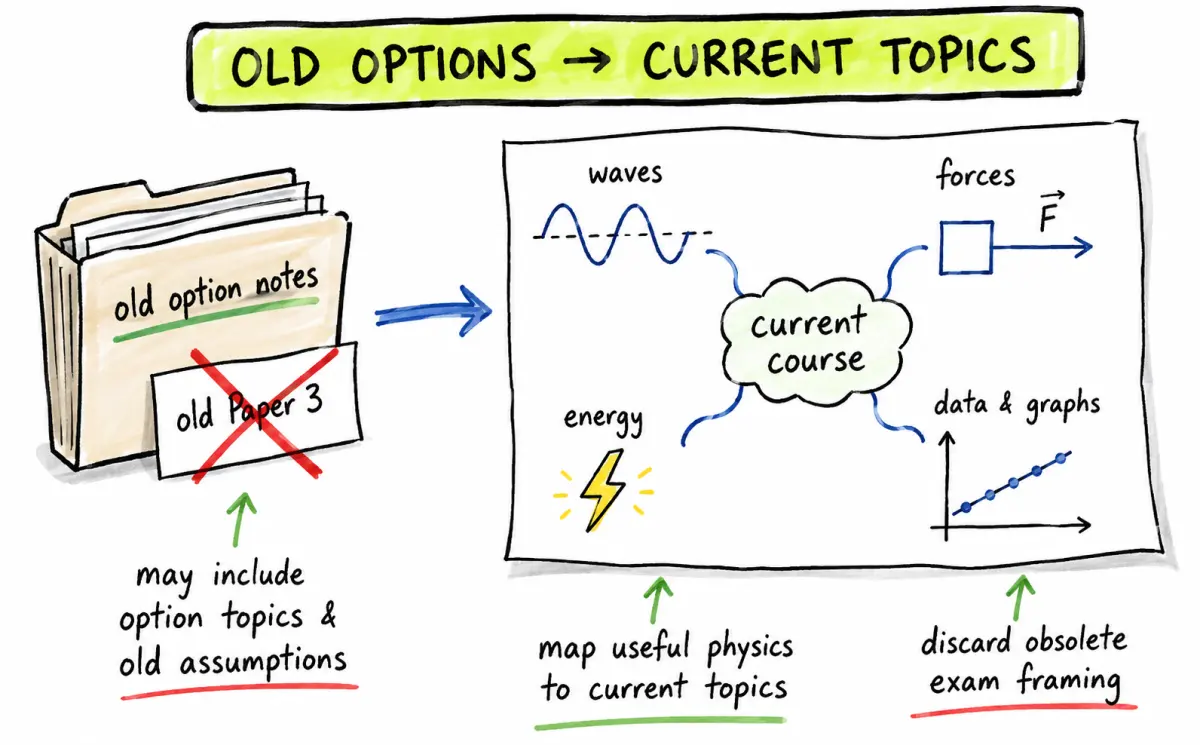
Why Old IB Physics Resources Can Mislead You
Older resources may still contain useful physics, but their labels and assessment advice can be out of date. Be cautious when a resource:
- organises everything through old topic numbers without mapping to the current themes;
- treats option topics as current exam units;
- assumes a separate Paper 3 is part of the current SL examination;
- gives Paper 1 practice without distinguishing Paper 1A from Paper 1B;
- ignores data-based questions, uncertainty or practical evidence;
- uses old component timings, marks or assessment language.
The right response is not to delete every old note. Keep a resource when its physics still helps you answer a current question. Move it aside when its value depends mainly on an obsolete option or paper structure.
Use this migration rule:
| Old resource feature | What to do now |
|---|---|
| Core explanation of a current physics concept | Keep it and relabel it using the current course map. |
| Old option-topic detail | Check each idea against the current syllabus before revising it. |
| Paper 3 data practice | Keep useful data skills, but practise them through current Paper 1B and investigation contexts. |
| Old markscheme wording | Keep accurate physics, but rewrite the response for current command terms. |
| Old topic-number sequence | Use it as an index only, not as the whole revision plan. |
A Better Revision Plan for the 2025 Course
Build each revision session around one model and several representations:
- Draw the physical situation.
- Name the quantities and units.
- Write the governing relationship.
- Predict the shape or direction of the graph.
- Explain the result in words.
- Check uncertainty, assumptions and limits.
Across a week, mix the assessment components. Use one session for Paper 1A retrieval and quick model decisions, one for Paper 1B tables and graphs, one for Paper 2 explanations and calculations, and one for investigation planning or evaluation. This trains the same physics to be used in different ways.
Keep an error log with specific categories: concept, model choice, equation, algebra, units, graph reading, uncertainty or written explanation. “I got physics wrong” is not specific enough to guide the next revision session.
Practice This Topic
Use EduNinja's IB Physics SL question bank to practise the difference between Paper 1A retrieval, Paper 1B data analysis and Paper 2 explanation. Review the relevant IB Physics SL concepts when a mistake comes from the model rather than the arithmetic.
FAQ
When was the current IB Physics SL course first assessed?
The current IB Physics SL course was first assessed in 2025.
Is Paper 3 still part of the current IB Physics SL exam?
No. The current external assessment uses Paper 1, divided into Paper 1A and Paper 1B, plus Paper 2. The scientific investigation is the separate internal assessment component.
Are the old Physics options still current exam units?
No. Do not treat the old option route as a current SL exam structure. Keep useful physics only after mapping it to the current course themes and practice requirements.
How much is Paper 1 worth?
Paper 1 contributes 36% of the final grade and includes Paper 1A multiple-choice questions and Paper 1B data-based questions. The two parts together total 45 marks.
What is the best way to prepare for Paper 1B?
Practise identifying variables and units, describing a data trend, checking uncertainty and then connecting the evidence to a physical model. Do not jump straight from a graph to a conclusion without describing what the data actually show.
What does Paper 2 reward?
Paper 2 rewards short-answer and extended-response reasoning on SL material. Show the model, equation, working and physical explanation that support your answer rather than giving only a final number.
Closing Checklist
Before your next IB Physics SL revision session, check that you can:
- use the current course themes instead of relying only on old topic numbers;
- distinguish Paper 1A recall from Paper 1B data analysis;
- explain a physical relationship with a model and an equation;
- show units, working and sensible precision in calculations;
- interpret graphs with attention to range, scatter and uncertainty;
- plan a scientific investigation with measurable variables;
- recognise when old Paper 3 or option advice no longer matches the current course.
The key shift is to revise physics as a connected system of models, equations, data and explanations. That is what the current IB Physics SL assessment is designed to reward.
Put syllabus changes back into your full IB Physics SL study plan.
Return to the complete course overview, or move directly into the most relevant study tool.
Related articles
More course notes, updates and study resources from the EduNinja blog.
Energy Transformation Examples | Physics
Learn A-Level Physics energy transformations with energy stores, transfer pathways, Sankey diagrams, efficiency and common exam mistakes.
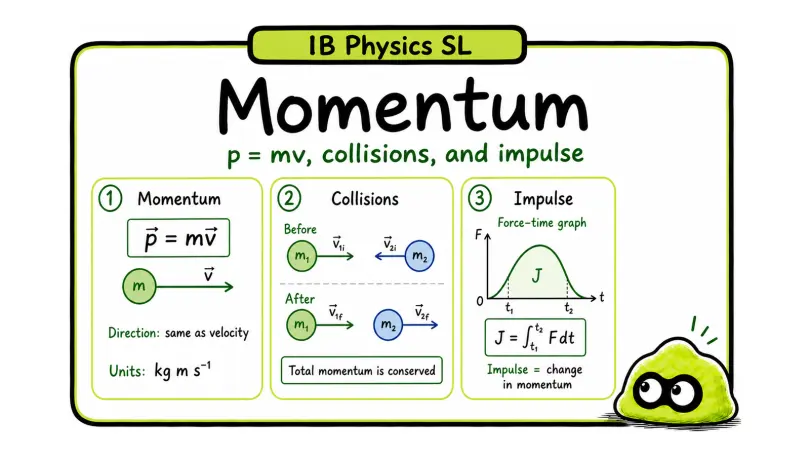
Momentum and Conservation of Momentum | IB Physics SL
Learn IB Physics SL momentum with p = mv, vector direction, conservation in collisions, impulse, force-time graphs and exam practice.
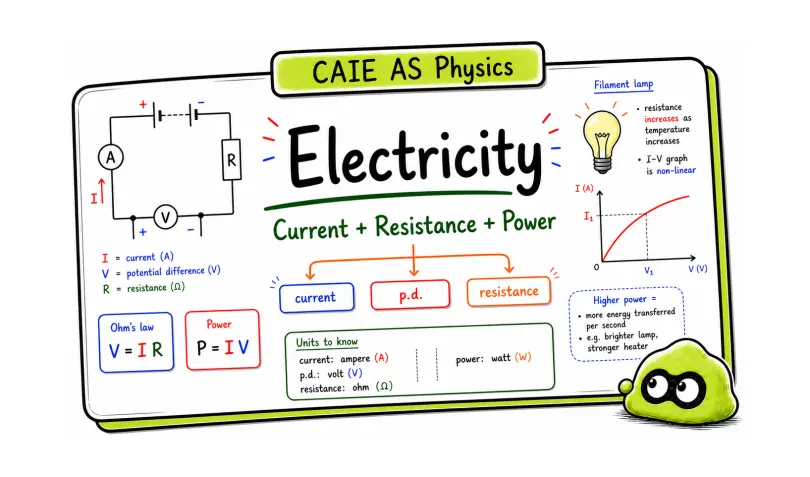
CAIE AS Physics Electricity: Current, Potential Difference, Resistance, and Power
A source-backed CAIE Physics guide for CAIE AS Physics electricity, using EduNinja PDF notes, worked examples, and markscheme-style answers.