CAIE AS Physics Electricity: Current, Potential Difference, Resistance, and Power
A source-backed CAIE Physics guide for CAIE AS Physics electricity, using EduNinja PDF notes, worked examples, and markscheme-style answers.
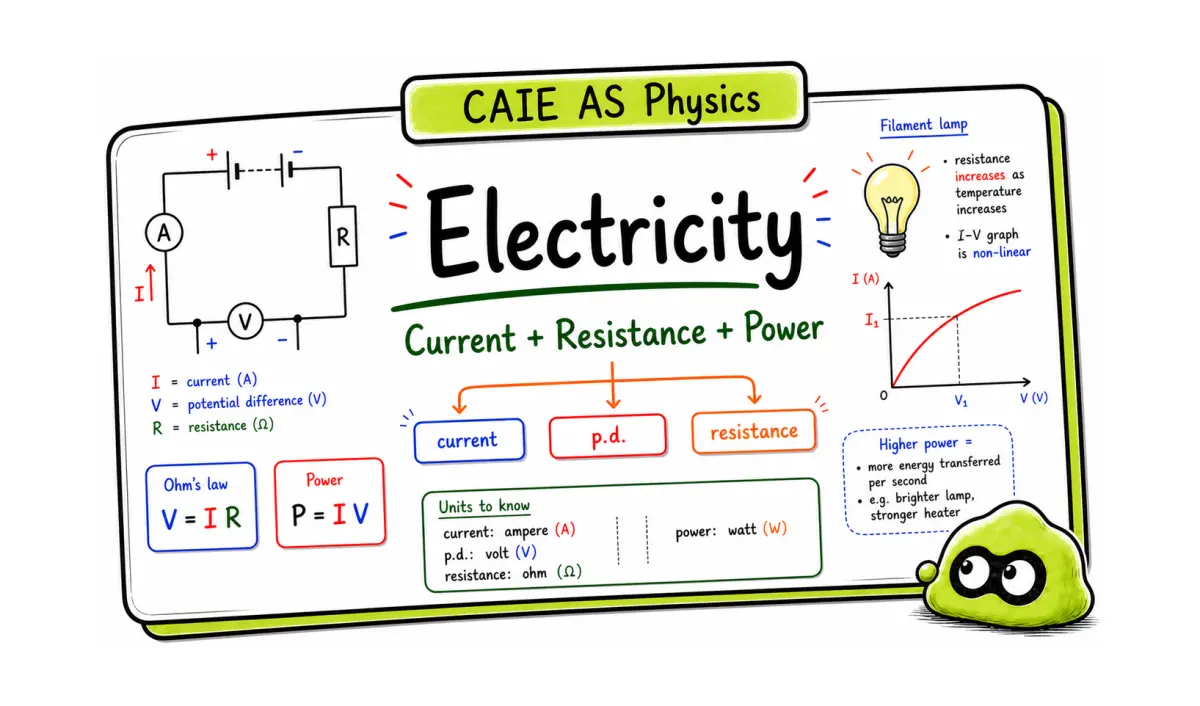
CAIE AS Physics electricity questions often mix definitions, circuit rules, graphs and equations in the same prompt. The hard part is not choosing a formula. It is knowing what the quantity means before you substitute numbers.
This guide covers current, potential difference, resistance, power, series and parallel circuits, I-V graphs and common calculation traps. Use it as a student revision guide, not as an official CAIE syllabus document.
The safest habit is to name the quantity first. Current is rate of flow of charge. Potential difference is energy transferred per unit charge. Resistance is V/I. Power is energy transferred per second.
Useful starting points:
- Practical circuits questions
- AS CIE Physics Notes 2 - Work, energy, and power
Start with notes if the definitions feel thin. Move to question practice when you can state the meaning and unit of each quantity without looking.
Quick answer
- Current is the rate of flow of charge: I = Q / t.
- Potential difference is energy transferred per unit charge: V = W / Q.
- Resistance is R = V / I.
- Power is energy transferred per second: P = E / t.
- Electrical power can also be calculated using P = IV, P = I^2R or P = V^2/R.
- In series circuits, current is the same through each component.
- In parallel circuits, potential difference is the same across each branch.
- Convert mA to A before using equations.
- The gradient of an I-V graph depends on which quantity is on each axis.
- In series circuits, p.d. is shared in proportion to resistance.
- In parallel circuits, total current is the sum of branch currents.
- Resistivity questions need area in m2 and usually use R = rho L / A.
- A potential divider output is the p.d. across the chosen output resistor.
Write the known quantities with units before choosing the equation.
Core definitions and units
| Quantity | Symbol | Meaning | Unit |
|---|---|---|---|
| Charge | Q | Amount of electric charge | coulomb, C |
| Current | I | Rate of flow of charge | ampere, A |
| Potential difference | V | Energy transferred per unit charge | volt, V |
| Resistance | R | Ratio of p.d. to current | ohm |
| Power | P | Rate of energy transfer | watt, W |
| Energy | E or W | Energy transferred | joule, J |
Definitions matter in AS Physics because calculation questions often sit next to explain questions. A correct number with weak wording can still lose marks elsewhere.
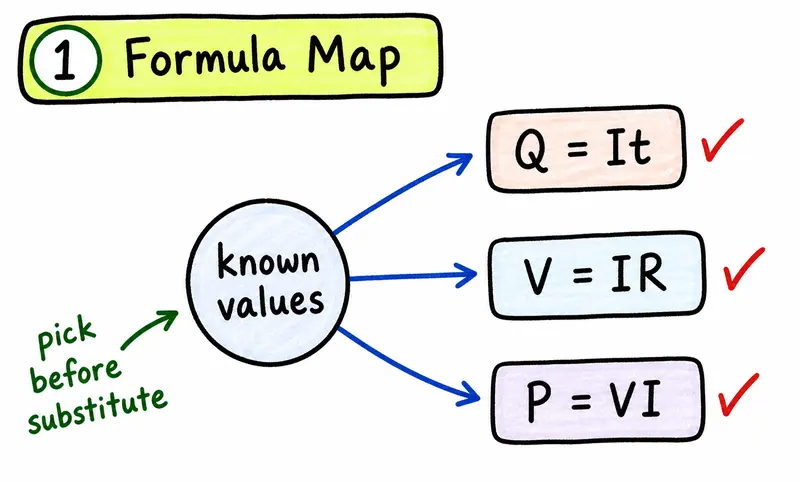
Formula map for electricity
| If you need | Use | Watch out for |
|---|---|---|
| Charge | Q = It | Time in seconds |
| Current | I = Q / t | Charge in coulombs |
| Potential difference | V = W / Q | Energy in joules |
| Resistance | R = V / I | Current in amperes |
| Power | P = IV | Use p.d. across the component |
| Energy | E = Pt or E = VIt | Time in seconds |
| Resistance of a wire | R = rho L / A | Area in m2 |
Do not choose an equation because it looks familiar. Choose it because the quantities match the question.
Worked example 1: charge and current
Question: A current of 0.40 A flows for 30 s. Calculate the charge.
Mark-worthy answer:
Q = It
Q = 0.40 x 30 = 12 C
Why it works:
The answer uses current as rate of flow of charge and keeps time in seconds.
Worked example 2: resistance
Question: A resistor has 6.0 V across it and current 0.50 A. Find resistance.
Mark-worthy answer:
V = IR, so R = V / I
R = 6.0 / 0.50 = 12 ohm
Why it works:
The answer uses the p.d. across the resistor and the current through the resistor.
Unit conversions: small errors, big mark loss
Electricity questions often hide the trap in the prefix.
| Given unit | Convert to |
|---|---|
| 1 mA | 0.001 A |
| 250 mA | 0.250 A |
| 1 kOhm | 1000 Ohm |
| 2.5 kW | 2500 W |
| 1 minute | 60 s |
Write the conversion before substitution. It is easier to spot 250 mA -> 0.250 A than to find the mistake after the final answer is wrong by a factor of 1000.
Series circuits
In a series circuit, components are connected in one path.
| Rule | Meaning |
|---|---|
| Current is the same through each component | There is only one path for charge flow |
| Total p.d. is shared across components | Source p.d. equals sum of component p.d.s |
| Resistances add | Rtotal = R1 + R2 + ... |
If a question gives two resistors in series, do not split the current. The current through each resistor is the same.
Parallel circuits
In a parallel circuit, components sit on separate branches.
| Rule | Meaning |
|---|---|
| Potential difference is the same across each branch | Each branch connects across the same two points |
| Current splits between branches | Total current is the sum of branch currents |
| Total resistance decreases when branches are added | More paths are available for current |
If a question gives a resistor in one branch, use the p.d. across that branch, not the p.d. across a different component.
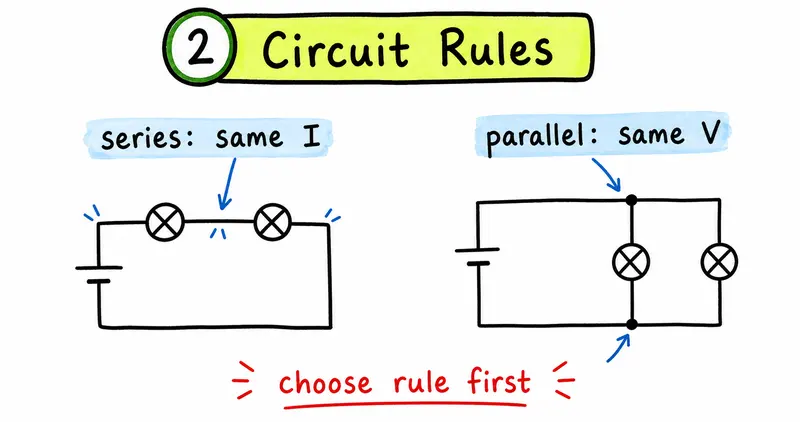
Series vs parallel: choose the rule before the equation
Before using V = IR, decide whether the component is in series or parallel.
| Circuit type | Current | Potential difference | Resistance |
|---|---|---|---|
| Series | Same through each component | Shared between components | Total resistance is R1 + R2 + ... |
| Parallel | Splits between branches | Same across each branch | Total resistance is less than the smallest branch resistance |
A common error is to use the supply p.d. across one series resistor. In a series circuit, the supply p.d. is shared. A common error in parallel circuits is to split p.d. between branches. In parallel, each branch has the same p.d. as the supply.
Worked example 3: series circuit
Question: Two resistors, 4.0 ohm and 8.0 ohm, are connected in series to a 12 V supply. Find the current.
Mark-worthy answer:
Rtotal = 4.0 + 8.0 = 12 ohm
I = V / R = 12 / 12 = 1.0 A
Why it works:
The answer adds series resistances first, then uses the supply p.d. across the whole series circuit.
Worked example 4: parallel branch current
Question: A 6.0 ohm resistor is connected across a 12 V supply in a parallel branch. Find the current in that branch.
Mark-worthy answer:
In parallel, the p.d. across each branch is 12 V.
I = V / R = 12 / 6.0 = 2.0 A
Why it works:
The answer uses the branch p.d. rule before applying V = IR.
Worked example 7: p.d. across a series resistor
Question: A 4.0 ohm resistor and an 8.0 ohm resistor are connected in series across a 12 V supply. Find the p.d. across the 8.0 ohm resistor.
Mark-worthy answer:
Total resistance = 4.0 + 8.0 = 12 ohm
Current I = V / R = 12 / 12 = 1.0 A
P.d. across 8.0 ohm resistor = IR = 1.0 x 8.0 = 8.0 V
Why it works:
The answer finds the series current first, then uses the p.d. across the chosen resistor. It does not put the full supply p.d. across each series component.
I-V graphs and resistance
I-V graphs test whether you understand resistance, not just whether you can quote V = IR.
For an ohmic conductor at constant temperature, current is proportional to potential difference. The graph is a straight line through the origin.
For a filament lamp, the graph curves because the filament heats up. Higher temperature increases resistance, so current does not increase as much for each extra volt.
For a diode, current flows mainly in one direction after a threshold p.d. is reached.
Check the axes before using gradient:
- If V is on the y-axis and I is on the x-axis, gradient = resistance.
- If I is on the y-axis and V is on the x-axis, gradient = 1 / resistance.
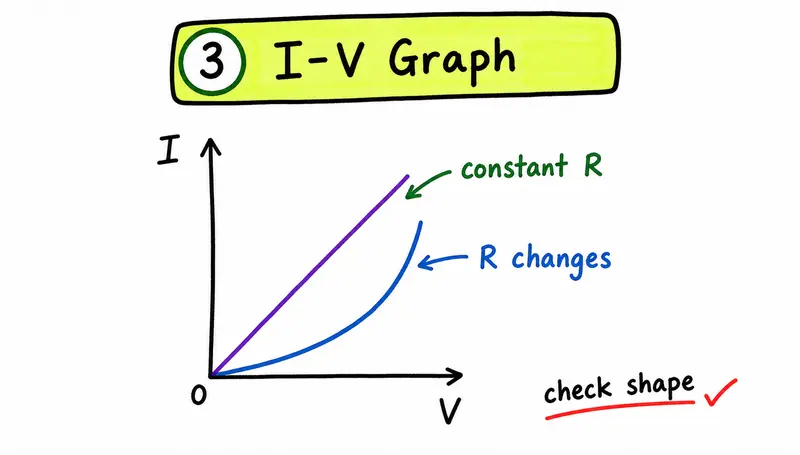
I-V graph shapes: what the shape tells you
| Component | I-V graph feature | Explanation |
|---|---|---|
| Ohmic conductor | Straight line through origin | Resistance is constant if temperature is constant |
| Filament lamp | Curve with decreasing gradient if I is on y-axis | Filament heats up, resistance increases |
| Diode | Very small current until threshold in forward bias | Current mainly flows in one direction |
Always check the axes. If current is on the y-axis and p.d. is on the x-axis, gradient is conductance, not resistance.
Worked example 5: I-V graph gradient
Question: An I-V graph has V on the y-axis and I on the x-axis. A straight-line section goes through (0.20 A, 4.0 V). Find the resistance.
Mark-worthy answer:
Gradient = V / I = 4.0 / 0.20 = 20 ohm
Since V is on the y-axis and I is on the x-axis, the gradient gives resistance.
Why it works:
The answer checks the axes before using the gradient.
Power and energy
Power is the rate of energy transfer.
| Situation | Useful formula |
|---|---|
| Current and p.d. known | P = IV |
| Current and resistance known | P = I^2R |
| P.d. and resistance known | P = V^2 / R |
| Power and time known | E = Pt |
The equation P = I^2R is useful for heating in resistors. The equation P = V^2/R is useful when the p.d. across a component is known.
Worked example 6: electrical power
Question: A 3.0 ohm resistor carries a current of 2.0 A. Calculate the power dissipated.
Mark-worthy answer:
P = I^2R
P = 2.0^2 x 3.0 = 12 W
Why it works:
The answer chooses the power equation that uses the given current and resistance directly.
Resistivity
Resistivity links resistance to the material and dimensions of a wire:
R = rho L / A
| Symbol | Meaning |
|---|---|
| R | Resistance |
| rho | Resistivity of the material |
| L | Length of wire |
| A | Cross-sectional area |
A longer wire has greater resistance. A wire with a larger cross-sectional area has lower resistance. The material matters because different materials have different resistivities.
For calculation questions, check that area is in m2, not mm2.
Worked example 8: resistivity of a wire
Question: A wire has resistance 3.2 ohm, length 1.5 m, and cross-sectional area 0.40 mm2. Calculate its resistivity.
Mark-worthy answer:
Convert area: 0.40 mm2 = 0.40 x 10^-6 m2
Use R = rho L / A, so rho = RA / L.
rho = 3.2 x (0.40 x 10^-6) / 1.5 = 8.5 x 10^-7 ohm m
Why it works:
The answer converts area into m2 before substituting. That is the common mark-losing step in resistivity questions.
Potential dividers
A potential divider uses resistors in series to split a supply p.d.
For two resistors in series:
Vout = Vin x R2 / (R1 + R2)
The output p.d. depends on the ratio of the resistances. If a sensor such as an LDR or thermistor is used, its resistance changes with light or temperature, so the output p.d. changes.
Do not memorise the formula without understanding the circuit. The output is the p.d. across the resistor being measured.
Potential dividers with sensors
A potential divider can use an LDR or thermistor because their resistance changes with conditions.
- For an LDR, resistance decreases as light intensity increases.
- For an NTC thermistor, resistance decreases as temperature increases.
The output p.d. depends on which component the output is taken across. If the output is across the sensor, changes in sensor resistance change the output directly. If the output is across the fixed resistor, the trend may be opposite.
Do not only say "the voltage changes". Say which resistance changes and which component the output p.d. is across.
Common mistakes that cost marks
- Using mA as A.
- Using minutes instead of seconds.
- Applying series rules to a parallel branch.
- Applying parallel rules to a series chain.
- Using the wrong p.d. in V = IR.
- Forgetting that I-V graph gradient depends on the axes.
- Saying current is used up in a circuit.
- Confusing potential difference with current.
- Giving power in joules instead of watts.
- Forgetting units in the final answer.
The repair is to label the quantity and unit before using the equation.
Exam question types
| Question type | First move | Common trap |
|---|---|---|
| Definition | State the physical meaning | Using vague "electricity" wording |
| Circuit calculation | List known quantities and units | Missing mA to A conversion |
| Series/parallel | Identify arrangement first | Using the wrong circuit rule |
| I-V graph | Check axes | Using gradient backwards |
| Power | Choose formula from known quantities | Mixing energy and power |
| Resistivity | Convert area to m2 | Using mm2 directly |
| Potential divider | Identify output resistor | Using the wrong resistor in the ratio |
A short revision route
- Define current, p.d., resistance and power.
- Practise Q = It and V = W/Q.
- Practise V = IR in a single resistor.
- Do one series circuit and one parallel branch question.
- Interpret one I-V graph.
- Practise one power calculation.
- Mark the first wrong unit or circuit rule.
Short sets work best here because most electricity errors repeat.
How to use EduNinja for this topic
Use notes to rebuild definitions and formulae. Then use the question bank for circuit calculations, I-V graphs and power questions.
Good next links:
- A-Level Physics Question Bank
- AS CIE Physics Notes 2 - Work, energy, and power
- Potential difference and power questions
- CAIE AS Physics Concept pages
- EduNinja study guides
Related Study Links
FAQ
What is the difference between current and potential difference?
Current is the rate of flow of charge. Potential difference is the energy transferred per unit charge between two points.
What is resistance in AS Physics?
Resistance is the ratio of potential difference to current, R = V / I. It measures how much a component opposes current.
When do I use P = IV?
Use P = IV when current and potential difference are known or can be found. If resistance is involved, P = I^2R or P = V^2/R may be more direct.
What is the rule for current in a series circuit?
Current is the same through each component in a series circuit because there is only one path for charge flow.
What is the rule for potential difference in a parallel circuit?
Potential difference is the same across each parallel branch because each branch is connected across the same two points.
What is the difference between series and parallel circuits?
In series, current is the same through each component and p.d. is shared. In parallel, p.d. is the same across each branch and current splits between branches.
How do I find resistance from an I-V graph?
Check the axes first. If V is on the y-axis and I is on the x-axis, the gradient gives resistance.
How do I calculate resistivity?
Use R = rho L / A and rearrange if needed. Convert cross-sectional area into m2 before substituting.
How does a potential divider work?
A potential divider uses series resistors to split the supply p.d. The output p.d. is taken across one chosen resistor and depends on the ratio of the resistances.
Closing
Electricity questions become easier when you slow down at the start. Name the quantity, convert the unit, identify the circuit arrangement, then choose the equation.
Put CAIE back into your full A-Level CAIE Physics AS study plan.
Return to the complete course overview, or move directly into the most relevant study tool.
Related articles
More course notes, updates and study resources from the EduNinja blog.

IB Physics SL 2025 Syllabus Changes: New Assessment Model
A practical IB Physics SL guide to the 2025 syllabus: the new Paper 1A and 1B structure, Paper 2, scientific investigation, no-options assessment and how to update old notes.
Energy Transformation Examples | Physics
Learn A-Level Physics energy transformations with energy stores, transfer pathways, Sankey diagrams, efficiency and common exam mistakes.
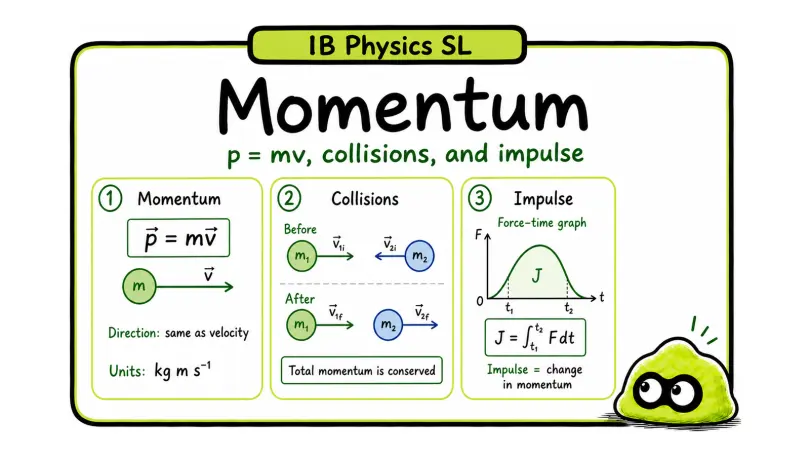
Momentum and Conservation of Momentum | IB Physics SL
Learn IB Physics SL momentum with p = mv, vector direction, conservation in collisions, impulse, force-time graphs and exam practice.