Energy Transformation Examples | Physics
Learn A-Level Physics energy transformations with energy stores, transfer pathways, Sankey diagrams, efficiency and common exam mistakes.
Energy Transformation Examples | Physics
Energy transformation questions become easier when you describe what happens to the energy store, identify the transfer pathway and account for the useful and dissipated outputs. For CAIE A-Level Physics, the safest starting point is conservation of energy: energy is not destroyed, but it can move between stores and spread to the surroundings as thermal energy.
Quick Answer
- Chemical energy can transform into kinetic, thermal, light or electrical energy.
- Gravitational potential energy can transform into kinetic energy as an object falls.
- Electrical energy can transform into thermal, light, sound or mechanical energy.
- Some output is usually dissipated to the surroundings as thermal energy.
- A Sankey diagram shows the input, useful output and wasted or dissipated output.
- Always describe the transfer pathway, not just the final device output.
What Is an Energy Transformation?
An energy transformation is a change from one energy store to another. In an exam answer, “chemical energy changes into kinetic energy” is useful, but a stronger answer explains the system and pathway: chemical energy in fuel is transferred mechanically and thermally as a car accelerates, while some energy is dissipated by friction and air resistance.
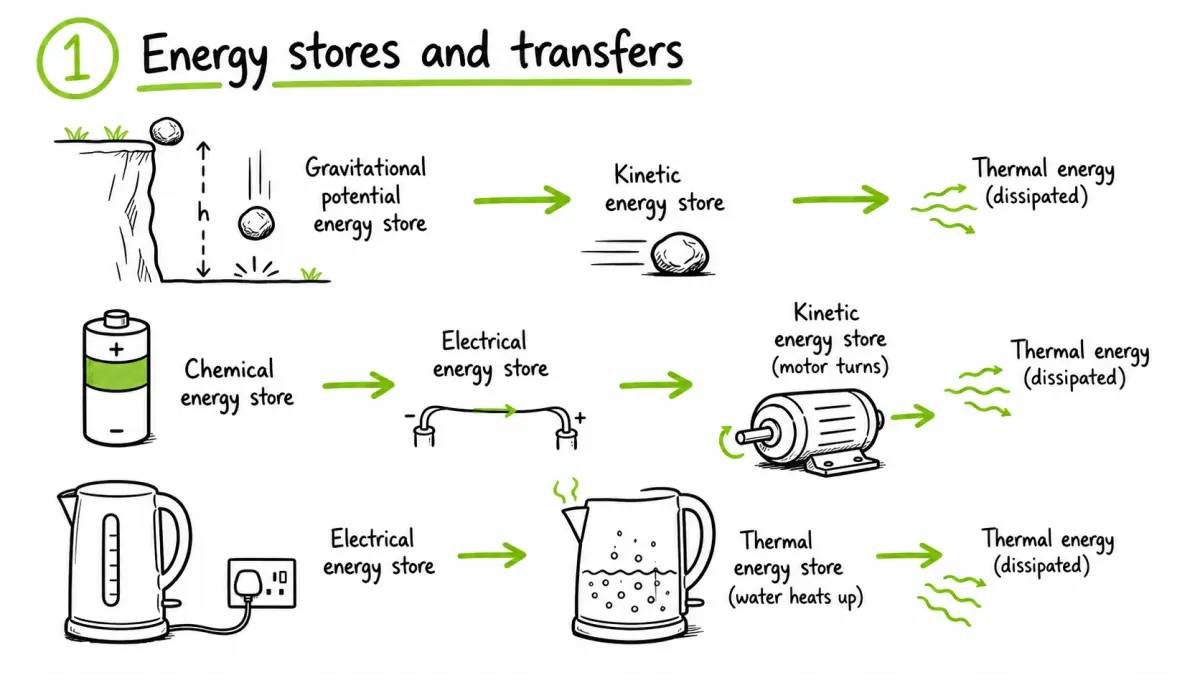
The total energy remains constant in a closed system. Efficiency is less than 100% when some input energy is transferred to unwanted stores or spread to the surroundings.
Common Energy Transformation Examples
| System | Main input store | Useful output | Common dissipated output |
|---|---|---|---|
| Falling object | Gravitational potential | Kinetic | Thermal energy from air resistance |
| Battery-powered motor | Chemical | Kinetic or mechanical | Thermal energy in wires and motor |
| Electric kettle | Electrical | Thermal energy in water | Thermal energy to surroundings |
| Solar cell | Nuclear energy in the Sun | Electrical | Thermal energy |
| Speaker | Electrical | Sound | Thermal energy |
| Food-powered movement | Chemical | Kinetic or mechanical | Thermal energy |
The wording “wasted energy” is common in everyday explanations, but energy is not destroyed. “Dissipated” means the energy has spread into the surroundings and is less useful for the intended task.
How to Read a Sankey Diagram
- Find the total input arrow.
- Follow the useful output arrow to the device's intended result.
- Identify the dissipated output and name its store or pathway.
- Check that output widths add to the input width.
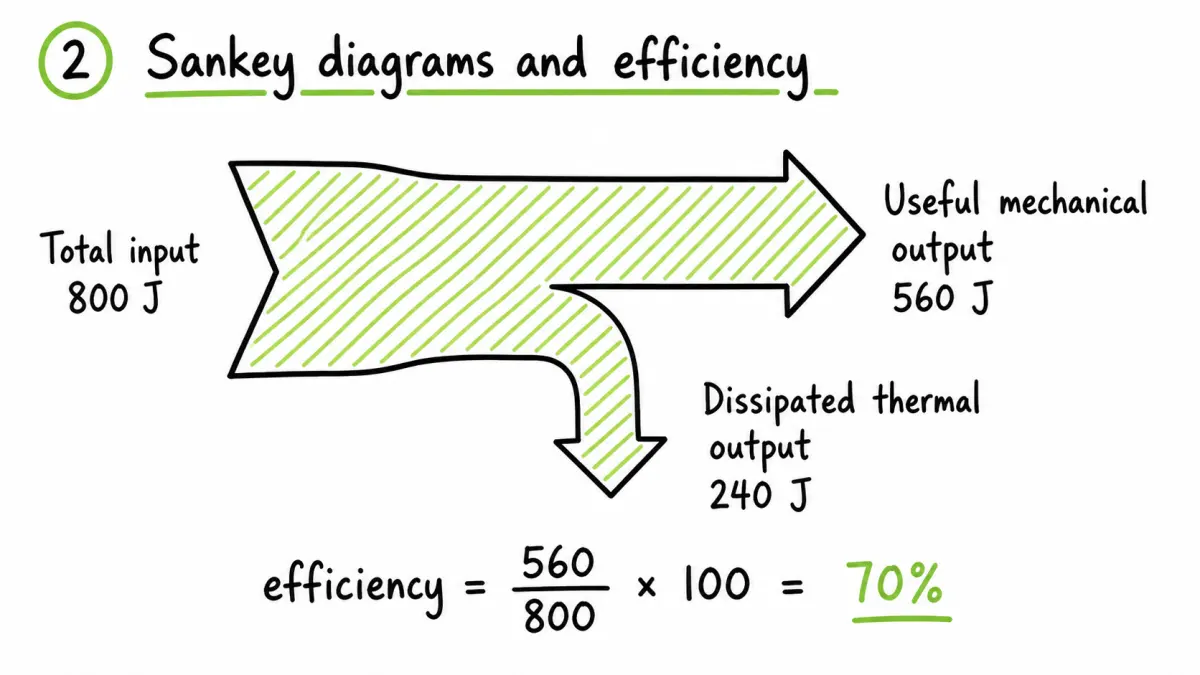
- Use efficiency = useful output energy divided by total input energy, multiplied by 100 percent.
For example, if a motor receives 500 J and produces 350 J of useful mechanical energy, its efficiency is 70 percent. The remaining 150 J is transferred to less useful stores, mainly thermal energy in the motor and surroundings.
Worked Example: A Falling Object
Describe the energy transfers as a ball falls from a height.
Answer: The ball's gravitational potential energy decreases while its kinetic energy increases. Energy is transferred mechanically by the force of gravity. If air resistance is significant, some energy is also transferred to thermal energy in the air and ball, so the kinetic energy gain is less than the original gravitational potential energy decrease.
Common Exam Mistakes
- Saying energy is used up or destroyed. State that it is transferred or dissipated.
- Listing an energy type without naming the initial and final stores.
- Calling heat an energy store in every context. Thermal energy is the store; heating is a transfer pathway.
- Ignoring friction, air resistance or resistance when explaining why efficiency is below 100 percent.
- Treating a Sankey diagram as a sequence of time steps. It represents energy accounting for a system.
Practice This Topic
Try this exam-style question:
An electric motor receives 800 J of energy and transfers 560 J to useful mechanical output. Calculate its efficiency and state one destination for the remaining energy.
Answer guide:
- Efficiency = 560 / 800 x 100 = 70 percent.
- The remaining 240 J is dissipated, for example as thermal energy in the motor and surroundings.
- The answer should describe energy transfer rather than saying that the energy disappeared.
Practice this topic
Practise CAIE A-Level Physics questions
FAQ
Is energy transformation the same as energy transfer?
They are closely related but not identical. Transformation usually describes a change between energy stores, while transfer describes how energy moves between stores or systems, for example mechanically, electrically, by heating or by radiation.
Why is some energy called wasted?
It is called wasted because it is no longer available for the intended useful output. It has not been destroyed; it has usually been dissipated as thermal energy in the surroundings, where it becomes more difficult to use.
What should I write when explaining a device?
Name the input store, the useful output store and at least one dissipated output. Then state the pathway if the question asks how the transfer occurs. This is clearer than listing several energy types without a system boundary.
Related Study Links
- Review the complete syllabus Study Hub
- Review CAIE A-Level Physics AS concepts
- Practise CAIE A-Level Physics questions
- Revise current, potential difference and power
- Review the Faraday constant and charge calculations
Final Takeaway
For any energy transformation example, name the starting store, the useful output, the dissipated output and the transfer pathway. Then use conservation of energy and efficiency to check the explanation.
Put energy transformations back into your full A-Level CAIE Physics AS study plan.
Return to the complete course overview, or move directly into the most relevant study tool.
Related articles
More course notes, updates and study resources from the EduNinja blog.

IB Physics SL 2025 Syllabus Changes: New Assessment Model
A practical IB Physics SL guide to the 2025 syllabus: the new Paper 1A and 1B structure, Paper 2, scientific investigation, no-options assessment and how to update old notes.
Momentum and Conservation of Momentum | IB Physics SL
Learn IB Physics SL momentum with p = mv, vector direction, conservation in collisions, impulse, force-time graphs and exam practice.
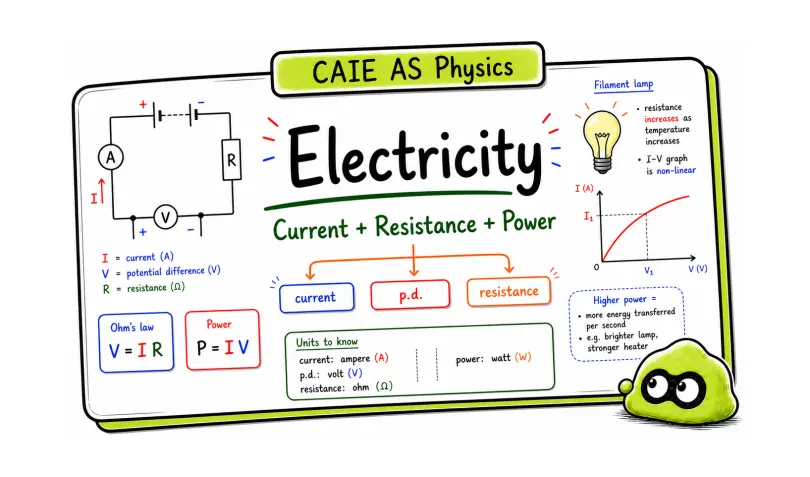
CAIE AS Physics Electricity: Current, Potential Difference, Resistance, and Power
A source-backed CAIE Physics guide for CAIE AS Physics electricity, using EduNinja PDF notes, worked examples, and markscheme-style answers.