IB Physics SL Mechanics: Forces, Motion, and Exam Marks
Revise IB Physics SL mechanics through free-body diagrams, Newton's laws, motion graphs, energy, momentum, and calculation habits.
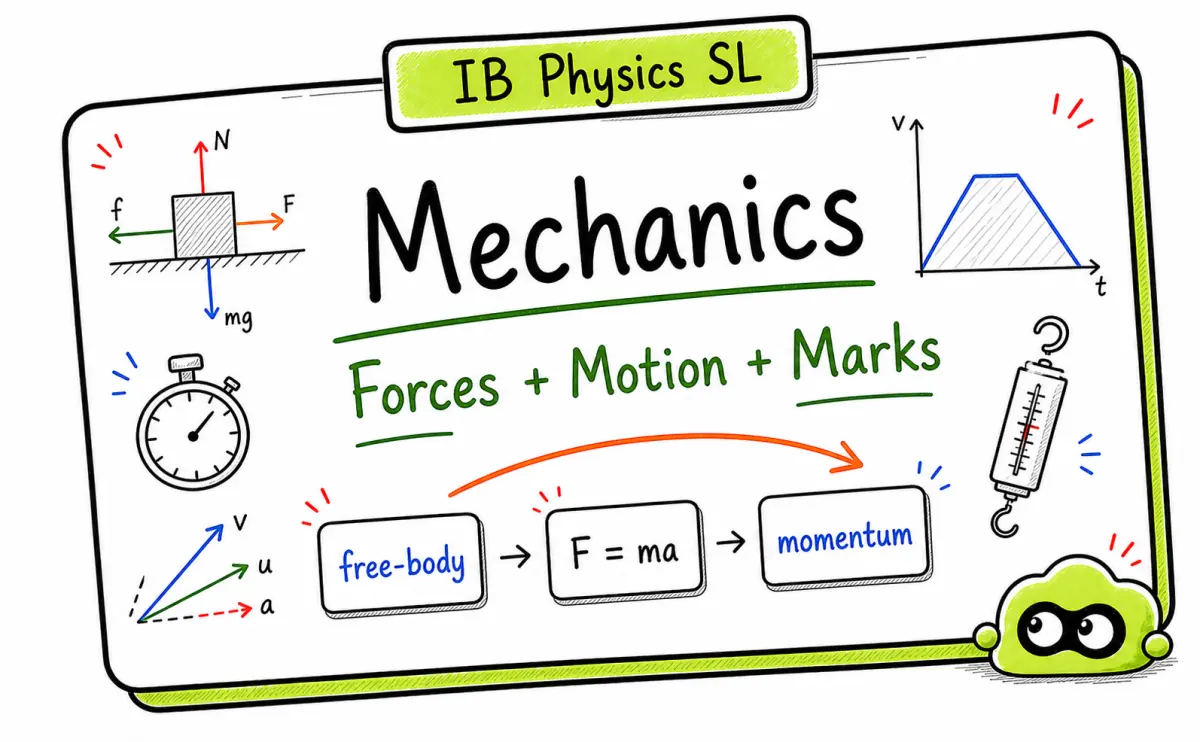
Physics marks often disappear in the gap between "I know this" and "I wrote enough for the markscheme." Mechanics is especially unforgiving. A student may know Newton's second law, draw a decent graph, or remember that momentum is conserved, but still lose the mark because the answer skips the force direction, the system boundary, the unit, or the link back to the question.
Use this page as a short active-recall check. Read the rule, try the worked examples, then look at your own wording. If your answer stops one sentence too early, that is usually where the mark went.
Use these EduNinja pages as your base:
Open one topic first. Do not turn revision into tab collecting. Read the note, answer a question, mark the missing step, then move on.
Quick answer
For IB Physics SL mechanics, most answers improve when you do four things first:
- Draw or imagine the free-body diagram before choosing an equation.
- Decide the positive direction before adding forces.
- Read motion graphs as gradients and areas, not just shapes.
- Set the system boundary before using conservation of momentum or energy.
That sounds basic, but it is where many marks sit.
Mechanics topics covered in IB Physics SL
| Area | What students need to do | Common mark loss |
|---|---|---|
| Forces and Newton's laws | Identify forces, resultant force, and acceleration direction. | Using a single force instead of resultant force. |
| Kinematics | Use displacement, velocity, acceleration, and time correctly. | Mixing up distance and displacement. |
| Motion graphs | Read gradients and areas from displacement-time and velocity-time graphs. | Describing shape without naming the physical quantity. |
| Work, energy, and power | Track energy transfers and work done by forces. | Saying energy is lost without naming the transfer. |
| Momentum | Define the system before applying conservation of momentum. | Forgetting the closed-system condition. |
The mechanics habit that gets marks
Mechanics is not just formula matching. The exam usually wants you to show what the formula means in that situation.
Forces first. Equation second.
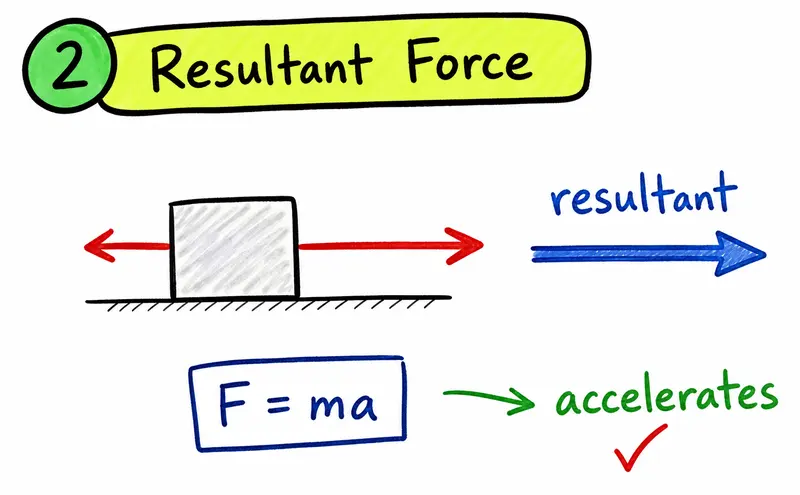
If a question involves acceleration, do not jump straight to F = ma. Ask:
- Which object am I analysing?
- Which forces act on that object?
- Which direction is positive?
- What is the resultant force?
- Does the acceleration point the same way as the resultant force?
Once those are clear, the calculation becomes much safer.
| Idea | What it means | How it earns marks |
|---|---|---|
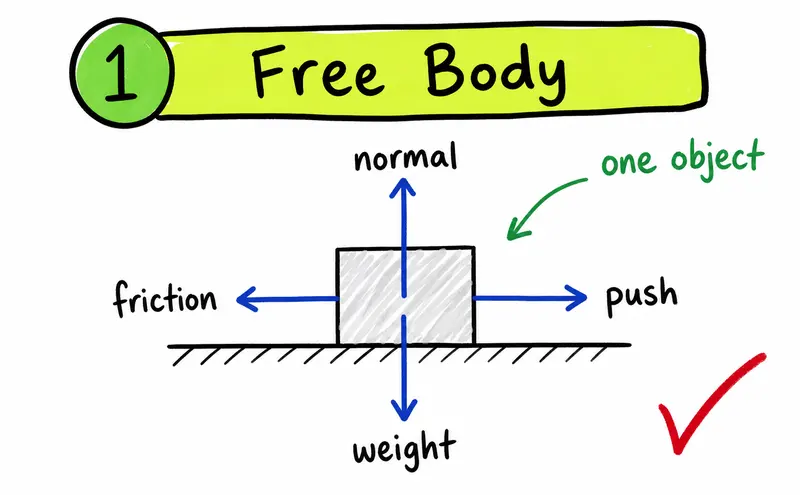
| Free-body diagram | Forces acting on one object | It stops you adding forces from different objects. |
| Velocity-time graph | Gradient gives acceleration | Area gives displacement, not distance in every case. |
F = ma |
Resultant force causes acceleration | Direction and units matter. |
| Momentum | p = mv |
Conservation only works for a closed system or negligible external force. |
| Energy | Energy transfers between stores or forms | Define the system before saying energy is conserved. |
Free-body diagrams: the setup before the equation
A free-body diagram should show the forces acting on one object only. Do not include forces that the object exerts on something else.
For many SL mechanics questions, check for:
- weight acting downwards
- normal reaction perpendicular to the surface
- tension along the string or rope
- friction or drag opposite the motion or attempted motion
- thrust or driving force in the direction of the push or pull
After drawing the forces, choose a positive direction and write the resultant force. Only then use F = ma.
A common mistake is to draw all the forces in the story instead of all the forces on one object. The exam usually rewards the second one.
Weak answer vs stronger answer
| Weak answer habit | Stronger answer move |
|---|---|
| "The object moves because there is a force." | Say which force is larger and which way the resultant force acts. |
| "Velocity is constant, so the forces are equal." | Say acceleration is zero, so the resultant force is zero. |
| "Momentum is conserved." | State the system and say external resultant force is zero or negligible. |
| "The graph gets steeper." | Say the gradient increases, so acceleration increases. |
| "Energy is lost." | Say energy is transferred to the surroundings, often by work done against friction or drag. |
The stronger answers are not longer for the sake of being longer. They name the missing physics.
Worked example 1: resultant force
Question: A 2.0 kg object accelerates at 3.0 m s^-2. Find the resultant force.
Answer:
Use F = ma.
F = 2.0 x 3.0 = 6.0 N
The resultant force is 6.0 N in the direction of the acceleration.
Why this scores:
The answer gives the formula, substitutes the values, includes the unit, and states the direction. The last phrase matters because force is a vector.
Worked example 2: constant velocity
Question: Explain why constant velocity means zero resultant force.
Answer:
Constant velocity means acceleration is zero. Since F = ma, the resultant force must also be zero. Individual forces may still act, but they are balanced.
Why this scores:
It does not say "no forces act." That is the common trap. The object can have weight, normal reaction, drag, thrust, or tension acting on it while the resultant force is still zero.
Worked example 3: two opposite forces
Question: A trolley has a forward driving force of 18 N and a backward friction force of 5 N. Its mass is 2.6 kg. Find its acceleration.
Answer:
Choose forward as positive.
Resultant force = 18 - 5 = 13 N
a = F / m = 13 / 2.6 = 5.0 m s^-2
The acceleration is 5.0 m s^-2 forward.
Why this scores:
The answer uses the net force, not the driving force alone. That is the whole point of the question.
Worked example 4: velocity-time graph
Question: A velocity-time graph has a straight line rising from 0 m s^-1 to 12 m s^-1 in 4.0 s. Find the acceleration.
Answer:
Acceleration is the gradient of a velocity-time graph.
a = change in velocity / time
a = 12 / 4.0 = 3.0 m s^-2
The acceleration is 3.0 m s^-2.
Why this scores:
The answer identifies the graph rule before calculating. It uses gradient, not area.
Worked example 5: momentum conservation
Question: A 0.50 kg trolley moving at 2.0 m s^-1 collides and sticks to a stationary 0.50 kg trolley. Find their speed after the collision.
Answer:
Take the two trolleys as the system. External forces are negligible during the collision, so momentum is conserved.
Initial momentum = 0.50 x 2.0 = 1.0 kg m s^-1
Total mass after collision = 1.0 kg
Final speed = 1.0 / 1.0 = 1.0 m s^-1
The trolleys move together at 1.0 m s^-1.
Why this scores:
The answer states the system and the conservation condition before using the numbers.
Motion graphs: what to check first
Students often describe the graph shape and forget the physics. For mechanics, translate the graph into a quantity.
| Graph | Gradient means | Area means | Common mistake |
|---|---|---|---|
| Displacement-time | Velocity | Usually not needed | Calling a curved line "acceleration" without mentioning changing gradient. |
| Velocity-time | Acceleration | Displacement | Counting squares without checking units. |
| Acceleration-time | Change in velocity | Change in velocity | Forgetting that area can be positive or negative. |
If the question says "describe the motion," use graph language and physics language together.
Weak:
- The graph goes up.
Better:
- The velocity increases at a constant rate, so the acceleration is constant and positive.
Momentum questions: set the system
Momentum questions become much easier once you decide what belongs inside the system.
Before using conservation of momentum, write a quick line:
- The system is the two objects involved in the collision.
- External forces are negligible during the collision.
- Total momentum before equals total momentum after.
Then calculate.
Do not write "momentum is always conserved" as a stand-alone statement. Momentum is conserved for a closed system, or when the external resultant force is zero or negligible. That condition is often the mark.
Energy questions: do not say "lost" and stop
In exam answers, "energy is lost" is often too vague. Energy is not destroyed. It is transferred, often to the surroundings by heating or sound.
Better wording:
- Some kinetic energy is transferred to thermal energy because work is done against friction.
- Gravitational potential energy decreases as the object moves downwards.
- If air resistance is negligible, mechanical energy is conserved.
The habit is simple: name the energy store or transfer, then link it to the force or motion in the question.
Why knowing the formula is not enough
In mechanics, the formula usually gives only part of the mark. The setup often gives the rest.
Before writing an equation, ask what the symbols mean in this exact question. In F = ma, F means resultant force, not thrust, friction, weight, or tension by itself. In momentum questions, v needs a direction. In energy questions, the distance used for work done must be the distance moved in the direction of the force.
This is why two students can use the same formula and get different marks. One has matched the equation to the situation. The other has only remembered it.
Question-type breakdown
| Question type | First move | What to avoid |
|---|---|---|
| Define or state | Give the exact term first | Adding a long explanation that blurs the definition. |
| Calculate | Write the equation and substitute clearly | Using the wrong force, distance, or mass. |
| Explain | Use a cause-and-effect chain | Listing facts with no link between them. |
| Graph question | Identify gradient or area | Describing only the visual shape. |
| Momentum question | Define the system | Claiming conservation without a condition. |
| Energy question | Name the transfer | Saying energy is "lost" with no mechanism. |
A short revision route for mechanics
Use this when you have 30 minutes and do not want to reread a whole chapter.
- Pick one subtopic: forces, graphs, momentum, or energy.
- Write the main equation from memory.
- Write one sentence explaining what the equation means.
- Answer one exam-style question without notes.
- Mark only the missing step.
- Turn that missing step into one flashcard.
The correction should be short. If it becomes a paragraph, you are rewriting notes instead of fixing the error.
Common mistakes that cost marks
- Adding forces without direction.
- Using one force when the question asks for resultant force.
- Mixing up mass and weight.
- Using distance when displacement is needed.
- Reading a velocity-time graph as if the height is distance.
- Forgetting units in the final answer.
- Saying momentum is conserved without stating the condition.
- Saying energy is lost without naming the transfer.
These are not tiny details. They are often the marks.
Exam-ready mini checklist
Before you move on from a mechanics answer, ask:
- Did I choose the object or system?
- Did I define the positive direction if forces are involved?
- Did I use resultant force where needed?
- Did I include units?
- Did I explain the graph with gradient or area?
- Did I say why conservation applies?
- Did I link the final sentence back to the question?
If one of those is missing, fix that sentence first.
How EduNinja helps
Use EduNinja as a practice loop, not as another reading folder.
Start with IB Physics Notes to rebuild the idea. Then use the IB Physics Question Bank to test whether you can apply it. When you mark the answer, do not copy out the whole solution. Write down the one phrase you missed.
For mechanics, a good study block is small:
- one concept
- one question set
- one correction list
That is enough for one session. You can come back tomorrow and test the same idea again.
Teacher check: start with forces
Mechanics answers get stronger when the first step is a force story.
Draw or describe the forces. Choose a direction. Find the resultant force. Then use the equation.
If acceleration is zero, say the resultant force is zero and the forces are balanced. If acceleration is not zero, say which side has the larger force. This keeps the answer tied to Newton's laws instead of turning it into equation matching.
Related Study Links
FAQ
How should I revise IB Physics SL mechanics quickly?
Pick one narrow skill, such as free-body diagrams or velocity-time graphs. Write the rule from memory, answer one short question, and mark the missing step. Do not start by rereading the whole mechanics chapter.
Are notes enough for mechanics?
Notes help you rebuild the idea, but they do not prove you can use it. Mechanics marks usually come from applying the idea to a force diagram, graph, system, or calculation.
Why do I lose marks when I know the formula?
You may be using the formula before setting up the physics. Check the object, direction, resultant force, system boundary, and unit before you calculate.
What is the most common mechanics mistake?
Using the wrong force in F = ma is one of the biggest. The equation needs resultant force, not any single force that appears in the question.
How do I get better at motion graphs?
Translate the graph first. On a velocity-time graph, gradient means acceleration and area means displacement. On a displacement-time graph, gradient means velocity. Write that before you describe the shape.
What formulas do I need for IB Physics SL mechanics?
The most common mechanics formulas involve resultant force, acceleration, momentum, work done, kinetic energy, gravitational potential energy, and power. Do not revise them as a list only. For each formula, know what each symbol means and when the formula applies.
How do I avoid mistakes in mechanics calculations?
Write the known values with units, choose a positive direction, identify the resultant force or system, then substitute into the equation. After calculating, check that the unit and direction make sense.
Related study links
- EduNinja Blog
- IB Physics Question Bank
- IB Physics Notes
- IB Physics Study Library
Closing
Mechanics becomes easier when every answer starts with the situation, not the formula. Choose the object, draw the forces, name the graph quantity or system, then calculate. That extra setup is often what turns a remembered fact into a mark.
Put exam skill back into your full IB Physics SL study plan.
Return to the complete course overview, or move directly into the most relevant study tool.
Related articles
More course notes, updates and study resources from the EduNinja blog.

IB Physics SL 2025 Syllabus Changes: New Assessment Model
A practical IB Physics SL guide to the 2025 syllabus: the new Paper 1A and 1B structure, Paper 2, scientific investigation, no-options assessment and how to update old notes.

Transverse vs Longitudinal Waves
Compare transverse and longitudinal waves using particle motion, wave direction, compressions and rarefactions.
Energy Transformation Examples | Physics
Learn A-Level Physics energy transformations with energy stores, transfer pathways, Sankey diagrams, efficiency and common exam mistakes.