EduNinja

IGCSE Math B10.G Product ruleTopic Practice

10.G Product rule

Use of product rule for two or more independent events Knowing that when A and B are independent events, P(A and B) = P(A) x P(B)

Question 7(c)

[Maximum number: 2]

To pass a course, Preety has to pass two tests, test A and test B.
Each test only has to be passed once.
Passing test A and passing test B are independent events.
Preety has three attempts to pass test A.
The probability that she passes test A on her first attempt is 35\frac{3}{5}
If she fails on her first attempt, the probability that she passes on her second attempt is 25\frac{2}{5}
If she fails on her second attempt, the probability that she passes on her third attempt is 38\frac{3}{8}

Preety decides to take the two tests only if the probability that she passes the course is greater than 0.5.

State whether or not Preety should take the two tests.
Give a reason for your answer.

Question 8(b)

[Maximum number: 2]

Table 1 gives information about the probability that a biased red six-sided dice will land on each of the numbers 1,2,5,7,9,11.

Table

Pabel rolls the red dice twice.
Calculate the probability that the red dice lands on the numbers 2 and 5.

Question 10(c)

[Maximum number: 2]
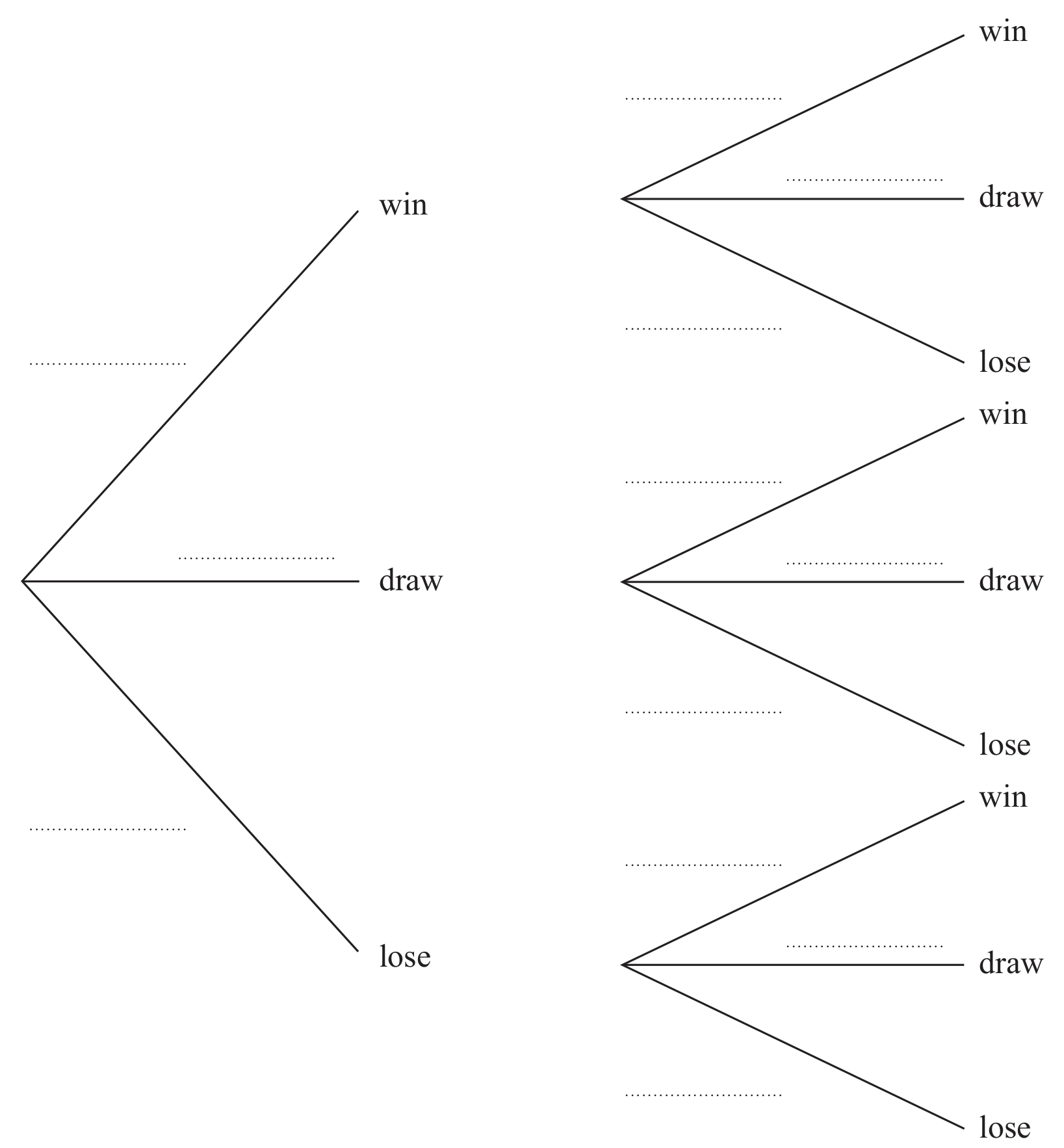
Question image

Hugo is learning a new game. Each time he plays the game the possible outcomes are that he may win, draw or lose.

The first time Hugo plays the game the probability that
P(win)=14,P(draw)=112.P(\text{win})=\frac14,\quad P(\text{draw})=\frac1{12}.

The second time Hugo plays the game the probability that
P(win)=35,P(draw)=110,P(lose)=310.P(\text{win})=\frac35,\quad P(\text{draw})=\frac1{10},\quad P(\text{lose})=\frac3{10}.

Hugo plays the game twice.
Hugo scores points each time he plays. He scores 3 points if he wins, 2 points if he draws and 1 point if he loses.
After 2 games Hugo has 3 points.

Find the probability that he draws both of his games.

0 selected