IB Physics SL S2.3.2 Evaluating

Practise evaluating investigations by identifying assumptions and random or systematic errors, predicting their effects and proposing realistic, targeted improvements.

Syllabus
First assessment 2025
Objective
S2.3.2
Level
SL

Exam points

  • identify a systematic error or unrealistic assumption and state why it affects the method
  • predict whether heat loss, transferred material or instrument offset raises or lowers the result
  • propose a feasible improvement with the same apparatus and link it to the error reduced

S2.3.2—Evaluating question 1

[Maximum number: 3]

A student studies the relationship between the centripetal force applied to an object undergoing circular motion and its period T.
The object (mass m ) is attached by a light inextensible string, through a tube, to a weight W which hangs vertically. The string is free to move through the tube. A student swings the mass in a horizontal, circular path, adjusting the period T of the motion until the radius r is constant. The radius of the circle and the mass of the object are measured and remain constant for the entire experiment.
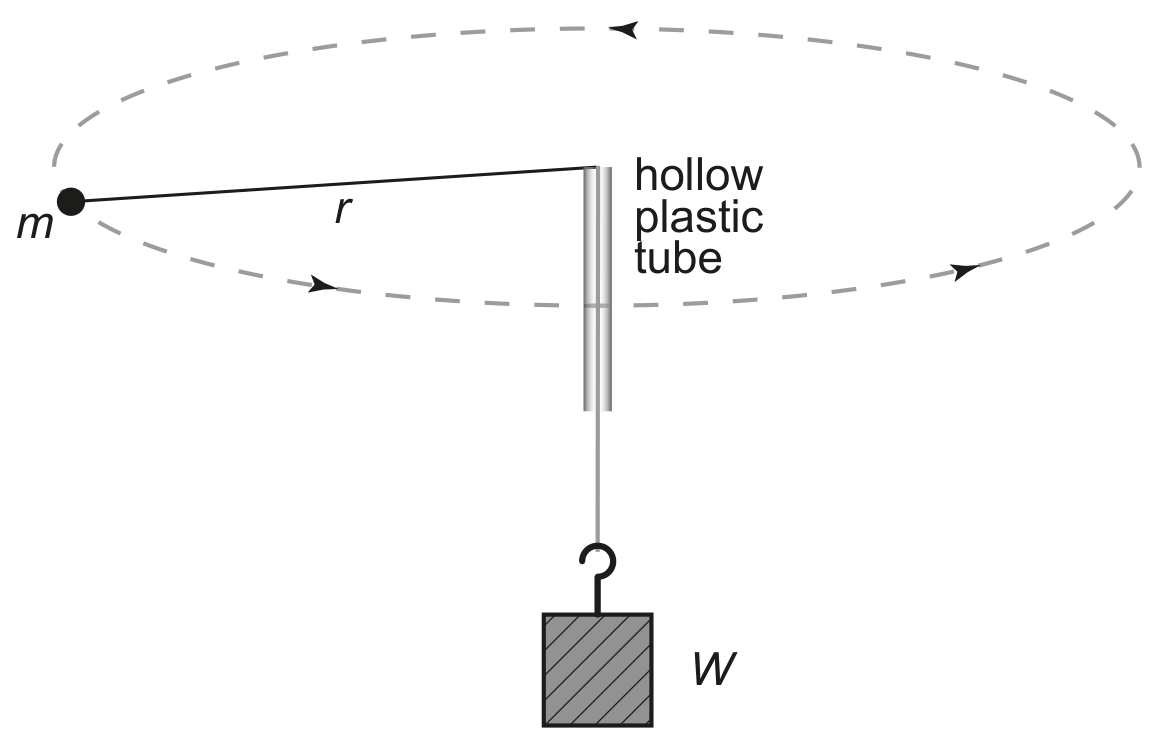
Figure for Question S2.3.2—Evaluating question 1 — IB Physics SL

The student collects the measurements of T five times, for weight W. The weight is then doubled ( 2 W ) and the data collection repeated. Then it is repeated with 3 W and 4 W. The results are expected to support the relationship

W=4π2mrT2W=\frac{4 \pi^{2} m r}{T^{2}}

Question (a)

(a)

The measurements of T were collected five times. Explain how repeated measurements of T reduced the random error in the final experimental value of m r.

[ 2 ]

Question (b)

(b)

Outline why repeated measurements of T would not reduce any systematic error in T. provided.

[ 1 ]
All question bank results loaded