EduNinja

IB Physics SLE.5 Fusion and starsQuestion Bank

Question E1

[Maximum number: 4]

E1. This question is about the star Naos (Zeta Puppis).

The following data are available for the star Naos.

 Surface temperature =4.24×10⁴ K Radius =7.70×10⁹ m Apparent magnitude =+2.21 Parallax angle =3.36×10³ arcseconds \begin{array}{ll} \text { Surface temperature } & =4.24 \times 10^{4} \mathrm{~K} \\ \text { Radius } & =7.70 \times 10^{9} \mathrm{~m} \\ \text { Apparent magnitude } & =+2.21 \\ \text { Parallax angle } & =3.36 \times 10^{-3} \text { arcseconds } \end{array}

(a) State the spectral class of Naos.

(b) State what is meant by apparent magnitude.
(c) Determine, for Naos, its
(i) distance from Earth, in parsec.
(ii) absolute magnitude.
(d) The distance to Naos may be determined by the method of stellar parallax. The diagram shows the star Naos and the Earth in its orbit around the Sun.

Question image

(i) Draw lines on the diagram above in order to indicate the parallax angle of Naos.
(ii) Outline how the parallax angle of Naos may be measured.
(e) Determine, using the data given,
(i) the luminosity of Naos.

(ii) the wavelength at which Naos emits most of its energy.
(f) The star Mizar has the same apparent brightness as Naos and a much lower temperature. To the naked eye Naos does not appear as bright as Mizar.

By reference to your answer to (e)(ii), suggest an explanation of this fact.

Question B1

Question B1(d)

Question B1(d)(b)

(a)
(i)

In one nuclear reaction two deuterons (hydrogen-2) fuse to form tritium (hydrogen-3) and another particle. The tritium undergoes β\beta^{-}decay to form an isotope of helium.

[ 3 ]

Question B1(d)(b)(ii)

(i)

Explain which of these reactions is more likely to occur at high temperatures.

B2. This question is in two parts. Part 1 is about simple harmonic motion and forced oscillations. Part 2 is about electric and magnetic force fields.

Part 1 Simple harmonic motion and forced oscillations
The graph shows the variation with time of the displacement of an object undergoing simple harmonic motion.
displacement / mm

Question image

time / ms

[ 3 ]

Question 23

[Maximum number: 1]

Which statement correctly describes the process of nuclear fusion?

A

The joining together of two small atoms to create a larger atom.

B

The splitting up of a large atom to create two smaller atoms.

C

The joining together of two small nuclei to create a larger nucleus.

D

The splitting up of a large nucleus to create two smaller nuclei.

Question 24

[Maximum number: 1]

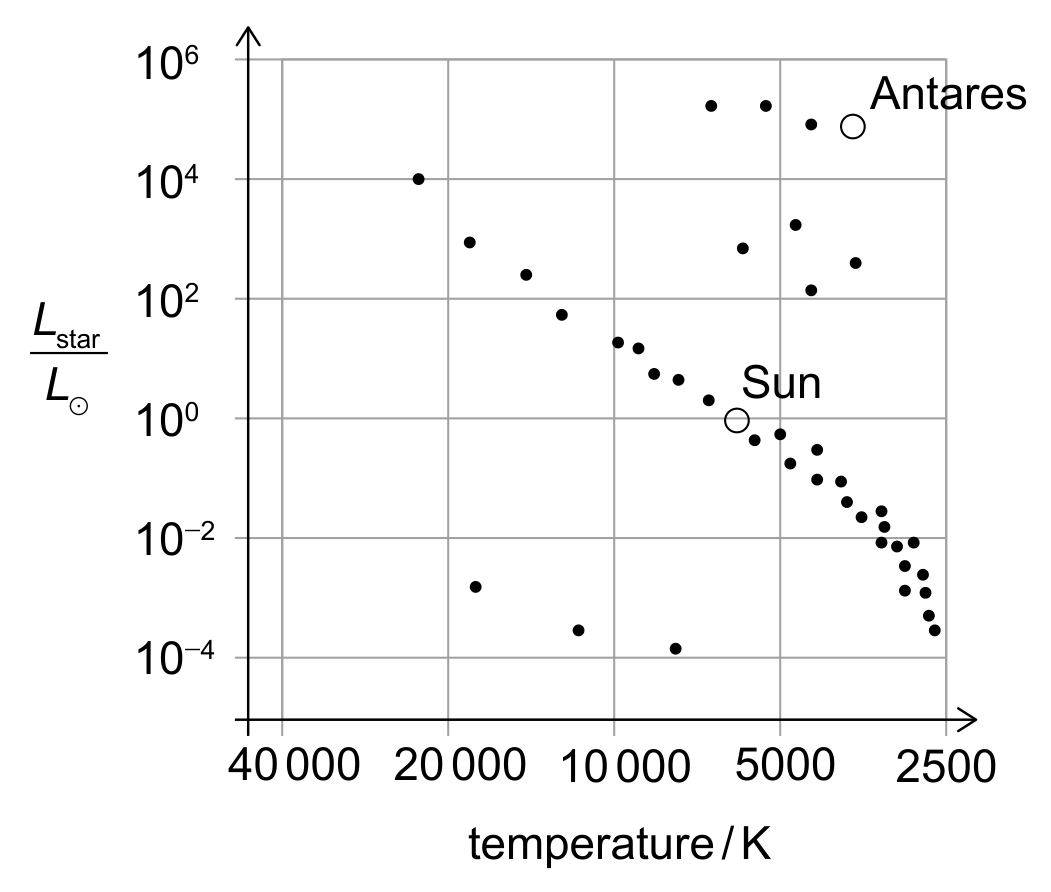
The Sun and positions of four stars A, B, C and D are plotted on the grid of a Hertzsprung-Russell (HR) diagram. Which star is a white dwarf?

Question image

Question 25

[Maximum number: 1]

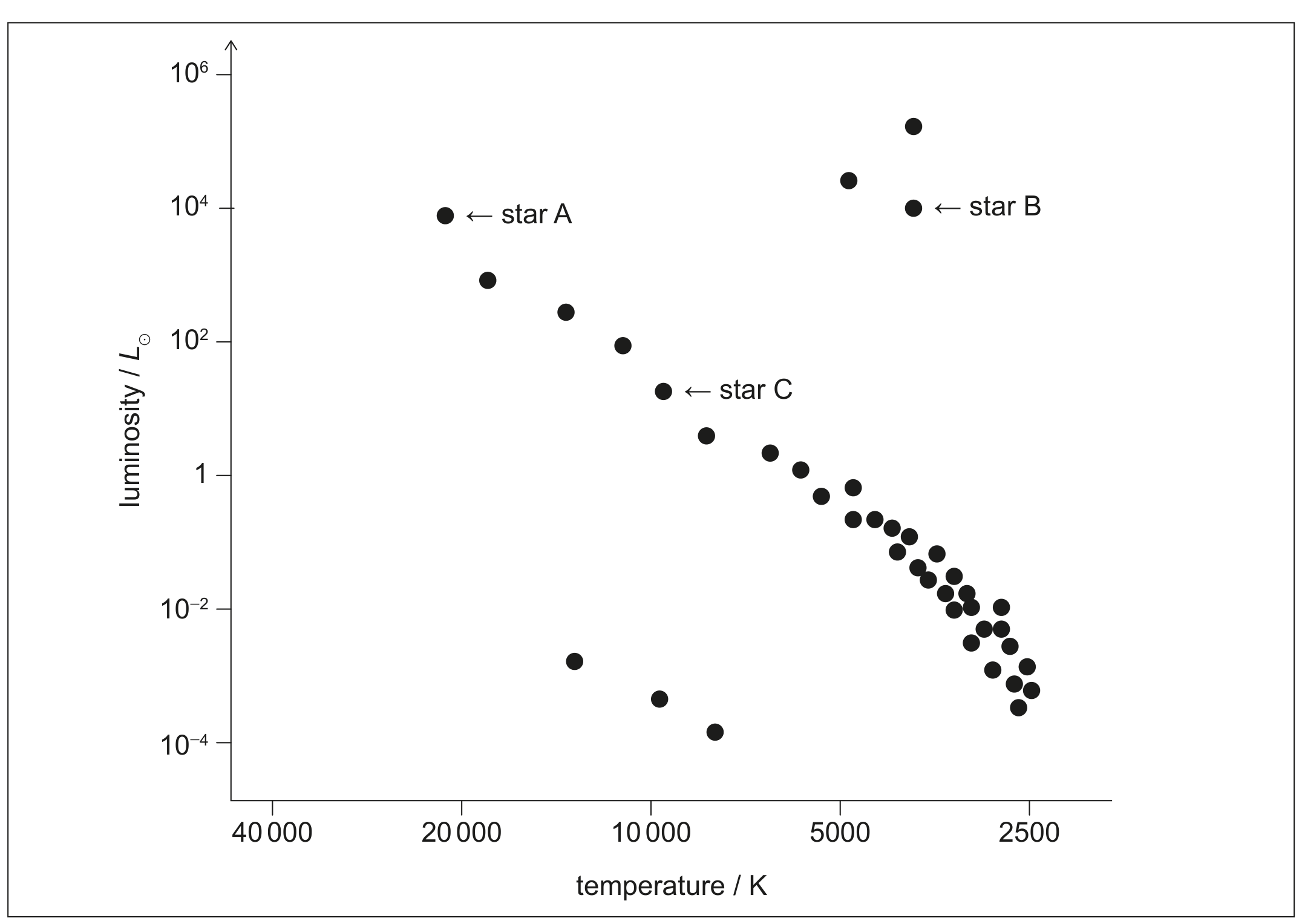
The HR diagram shows two stars, X and Y.

Question image

Three statements are made about star X and star Y .

I. Star X is hotter than star Y .
II. Star X has a larger radius than star Y .
III. Star X is more luminous than star Y .

Which of the statements are correct?

A

I and II only

B

I and III only

C

II and III only

D

I, II and III

Question 25

[Maximum number: 1]

Stars X and Y have the same surface temperature. Star X has a radius R and is a distance d from Earth. The distance of star Y from Earth is d2\frac{d}{2}. The apparent brightness of Y is double that of X.

What is the radius of star Y ?

A

R2\frac{R}{2}

B

22R\frac{\sqrt{2}}{2} R

C

R

D

2 R

Question 25

[Maximum number: 1]

A star has a parallax angle of 1×10²¹ \times 10^{-2} arc-second the orbit of the Earth.

What is the distance from the Sun to the star?

A

0.01 pc

B

0.02 pc

C

50 pc

D

100 pc

Question 25

[Maximum number: 1]

A star is found to have a parallax angle of 0.25 arc-seconds. What is the distance to the star in light years?

A

4.0

B

13

C

6.0×10116.0 \times 10^{11}

D

38×101538 \times 10^{15}

Question 25

[Maximum number: 1]

The stellar parallax method involves a measurement of...

A

the peak wavelength of radiation from a star.

B

the frequency shift of the lines in a stellar spectrum.

C

the position of a star in the sky at different times of year.

D

the intensity of radiation from a star at different wavelengths.

Question 5

[Maximum number: 8]

The following data are available for the Sun when it entered the main sequence.

 Mass =2.0×1030 kg Radius =7.0×10⁸ m Surface temperature =5800 K Core temperature =1.5×10⁷ K Core density =1.6×10⁵ kg m3\begin{aligned} \text { Mass } & =2.0 \times 10^{30} \mathrm{~kg} \\ \text { Radius } & =7.0 \times 10^{8} \mathrm{~m} \\ \text { Surface temperature } & =5800 \mathrm{~K} \\ \text { Core temperature } & =1.5 \times 10^{7} \mathrm{~K} \\ \text { Core density } & =1.6 \times 10^{5} \mathrm{~kg} \mathrm{~m}^{-3} \end{aligned}

Question 5(a)

Question 5(a)(i)

(a)
(i)

State and explain which of the above features make nuclear fusion in the Sun possible.

[ 3 ]

Question 5(a)(ii)

(ii)

Outline how the Sun maintains its equilibrium state.

[ 2 ]

Question 5(c)

(b)

The Sun will leave the main sequence when it has converted 10 % of its hydrogen mass into helium. The total energy released in the reactions in (b) is 4.3×10¹² J4.3 \times 10^{-12} \mathrm{~J}. The current luminosity of the Sun is 3.8×1026 W3.8 \times 10^{26} \mathrm{~W}. When the Sun entered the main sequence its hydrogen mass was 1.5×1030 kg1.5 \times 10^{30} \mathrm{~kg}.

[ 3 ]

Question 5(c)(i)

(i)

Show that the Sun will stay on the main sequence for about 8×1098 \times 10^{9} years.

[ 3 ]
0 selected