EduNinja

IB Physics SLE.3 Radioactive decayQuestion Bank

Question B1

[Maximum number: 5]

B1. This question is about plutonium as a power source.
Plutonium (94238Pu)\left({ }_{94}^{238} \mathrm{Pu}\right) decays by alpha emission. The energy of the alpha particle emitted is 8.8×10¹³ J8.8 \times 10^{-13} \mathrm{~J}. The decay constant of plutonium-238 is 8.1×10³yr18.1 \times 10^{-3} \mathrm{yr}^{-1}.
(a) Define decay constant.
(b) Plutonium-238 is to be used as a power source in a space probe.
(i) Determine the initial activity of plutonium such that the power released by plutonium is 6.0 W .
(ii) The power source becomes useless when the power released decreases to 4.0 W . Determine the time, in years, for which the power source can be used in the space probe.

Question 3

[Maximum number: 5]

This question is about binding energy and mass defect.

Question 3(a)

(a)

State what is meant by mass defect.

[ 1 ]

Question 3(b)

Question 3(b)(i)

(b)
(i)

Data for this question is given below.

Binding energy per nucleon for deuterium (12H)\left({ }_{1}^{2} \mathrm{H}\right) is 1.1 MeV .
Binding energy per nucleon for helium- 3(23He)3\left({ }_{2}^{3} \mathrm{He}\right) is 2.6 MeV .
Using the data, calculate the energy change in the following reaction.

12H+11H23He+γ{ }_{1}^{2} \mathrm{H}+{ }_{1}^{1} \mathrm{H} \rightarrow{ }_{2}^{3} \mathrm{He}+\gamma
[ 2 ]

Question 3(b)(ii)

(ii)

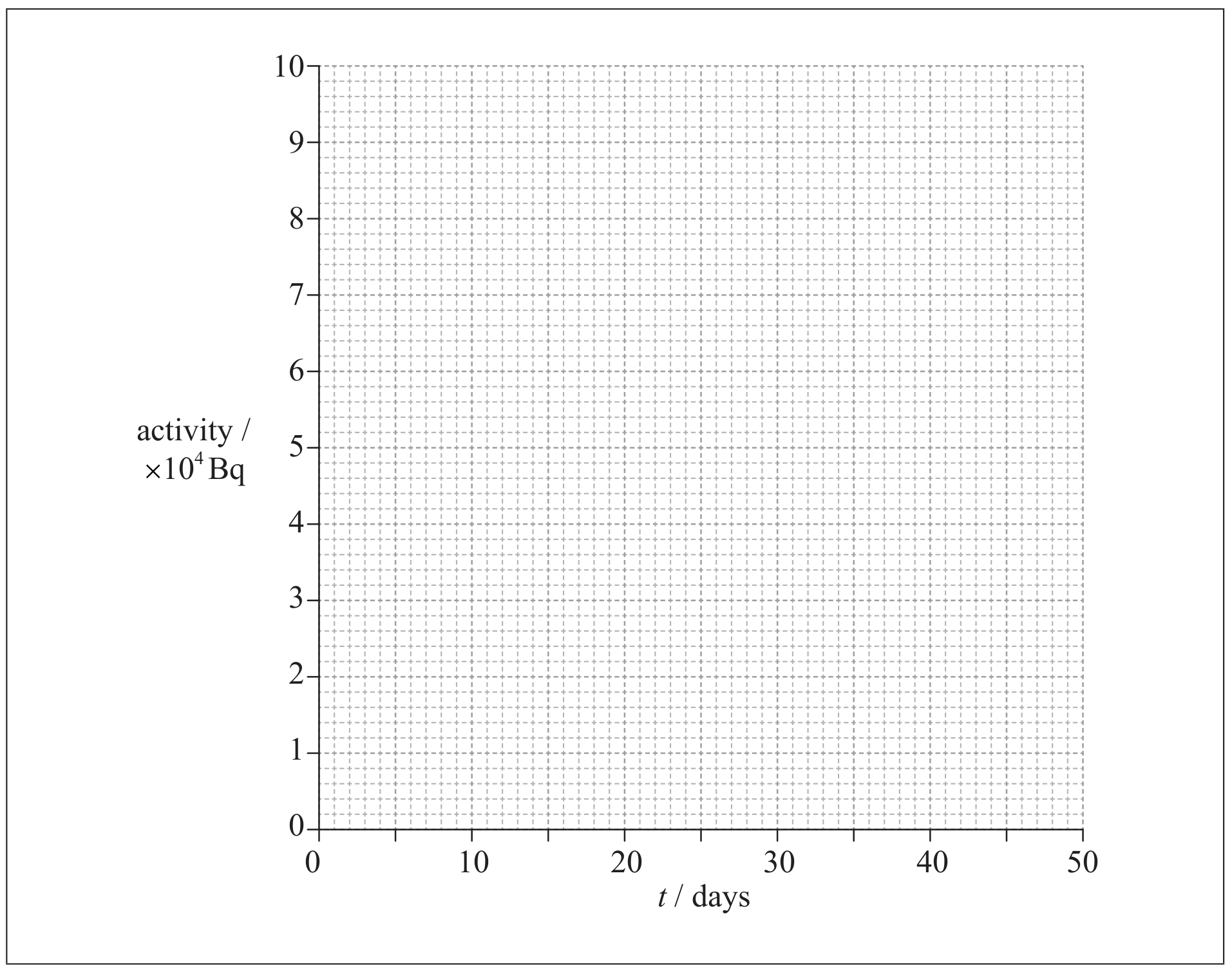
The cross on the grid shows the binding energy per nucleon and nucleon number A of the nuclide nickel-62.

Question image

On the grid, sketch a graph to show how the average binding energy per nucleon varies with nucleon number A.

[ 2 ]

Question 2

[Maximum number: 2]

The Feynman diagram shows electron capture.

Question image

Question 2(a)

(a)

Deduce that X must be an electron neutrino.

[ 2 ]

Question 2

[Maximum number: 4]

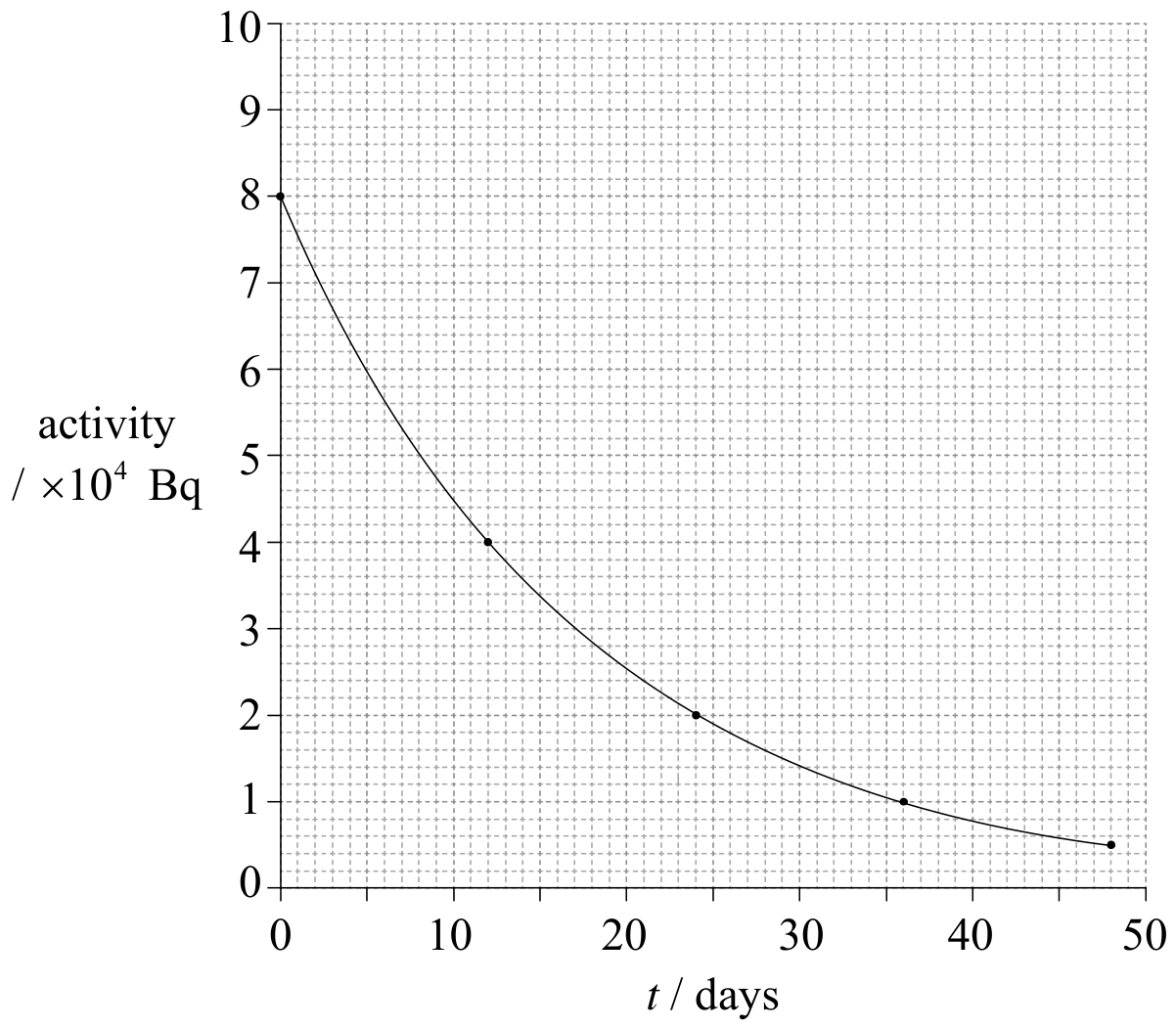
The graph shows the variation with time t of the activity A of a sample of protactinium-234.

Question image

Question 2(a)

(a)

Suggest why the activity approaches a non-zero constant value.

[ 1 ]

Question 2(b)

(b)

Estimate the half-life of protactinium-234 explaining your work. provided.

[ 3 ]

Question 2

[Maximum number: 4]

The graph shows the variation with time t of the activity A of a sample of protactinium-234.

Question image

Question 2(a)

(a)

Suggest why the activity approaches a non-zero constant value.

[ 1 ]

Question 2(b)

(b)

Estimate the half-life of protactinium-234 explaining your work. provided.

[ 3 ]

Question 3

Question 3(a)

(a)

A stationary isotope of 88Ra{ }_{88} \mathrm{Ra} (Radium) decays into Rn (Radon) and an alpha particle.

[ 2 ]

Question 3(a)(ii)

(i)

Show that the energy released in this decay is about 5 MeV .

[ 2 ]

Question A3

[Maximum number: 6]

This question is about nuclear reactions.

Question A3(a)

(a)

The nuclide U-235 is an isotope of uranium. A nucleus of U-235 undergoes radioactive decay to a nucleus of thorium-231 (Th-231). The proton number of uranium is 92.

[ 3 ]

Question A3(a)(i)

(i)

State what is meant by the terms nuclide and isotope.

Nuclide:

Isotope:

[ 2 ]

Question A3(a)(ii)

(ii)

One of the particles produced in the decay of a nucleus of U-235 is a gamma photon. State the name of another particle that is also produced.

[ 1 ]

Question A3(c)

(b)

Nuclei of U-235 bombarded with low energy neutrons can undergo nuclear fission. The nuclear reaction equation for a particular fission is shown below.

01n+92235U56144Ba+3689Kr+301n{ }_{0}^{1} \mathrm{n}+{ }_{92}^{235} \mathrm{U} \rightarrow{ }_{56}^{144} \mathrm{Ba}+{ }_{36}^{89} \mathrm{Kr}+3{ }_{0}^{1} \mathrm{n}

Show, using the following data, that the kinetic energy of the fission products is about 200 MeV .

Mass of nucleus of U-235 =235.04393 u
Mass of nucleus of Ba-144 =143.922952 u
Mass of nucleus of Kr-89 =88.91763 u
Mass of neutron =1.00867u\quad=1.00867 \mathrm{u}

[ 3 ]

Question 2

Question 2(a)

(a)

Silicon-30 (1430Si)\left({ }_{14}^{30} \mathrm{Si}\right) can be formed from phosphorus-30 (1530P)\left({ }_{15}^{30} \mathrm{P}\right) by a process of beta-plus decay.

[ 2 ]

Question 2(a)(i)

(i)

Write down the nuclear equation that represents this reaction.

[ 2 ]

Question 3

[Maximum number: 3]

A foam forms above a liquid when the liquid is stirred or poured.

A student investigates the change in volume of a foam with time.
At time t=0, the liquid is poured quickly into a measuring cylinder and a foam forms above the liquid. The student waits one minute for the foam to settle and then records the volume V of the foam and the time t.

The student repeats the measurement every minute.

Question image

The student plots the data to show how V varies with t. Error bars are given for values of V; errors in t are negligible.

Question image

Question 3(b)

(a)

The student suggests that the foam experiment can model radioactive decay.

For this to be true, the V-t graph must have similar properties to those of a graph of corrected count rate against time for the decay of a radioactive nuclide.

[ 1 ]

Question 3(b)(i)

(i)

Explain how data from the V-t graph can be tested to decide whether the foam experiment can model radioactive decay.

[ 1 ]

Question 3(c)

(b)

The student decides to stop the experiment when the volume of the foam has decreased by 78th \frac{7}{8}^{\text {th }} of its original volume.
Predict the time at which the student will stop the experiment.

[ 2 ]

Question A3

Question A3(a)

(a)

State the nuclear equation for this reaction.

55137CsBa+10β+{ }_{55}^{137} \mathrm{Cs} \rightarrow{ }_{\ldots} \mathrm{Ba}+{ }_{-1}^{0} \beta^{-}+\ldots \ldots \ldots
[ 2 ]

Question A3(b)

(b)

Determine the fraction of caesium-137 that will have decayed after 120 years.

[ 2 ]

Question A3(c)

(c)

Explain, with reference to the biological effects of ionizing radiation, why it is important that humans should be shielded from the radiation emitted by caesium-137.
This section consists of three questions: B1, B2 and B3.
B1. This question is in two parts. Part 1 is about momentum change. Part 2 is about an oscillating water column (OWC) energy converter.

[ 2 ]
0 selected