IB Physics SL E.5.1 Stellar Equilibrium

Practise explaining hydrostatic equilibrium as the balance between inward gravitational compression and outward pressure gradients supported by hot gas and fusion energy.

Syllabus
First assessment 2025
Objective
Level
SL

Exam points

  • identify inward gravitational force and outward pressure-gradient force in a stable star
  • explain how fusion supplies thermal energy that maintains core temperature and pressure
  • predict contraction or expansion when gravity and outward pressure become temporarily unbalanced

E.5.1—Stellar equilibrium question 1

[Maximum number: 2]

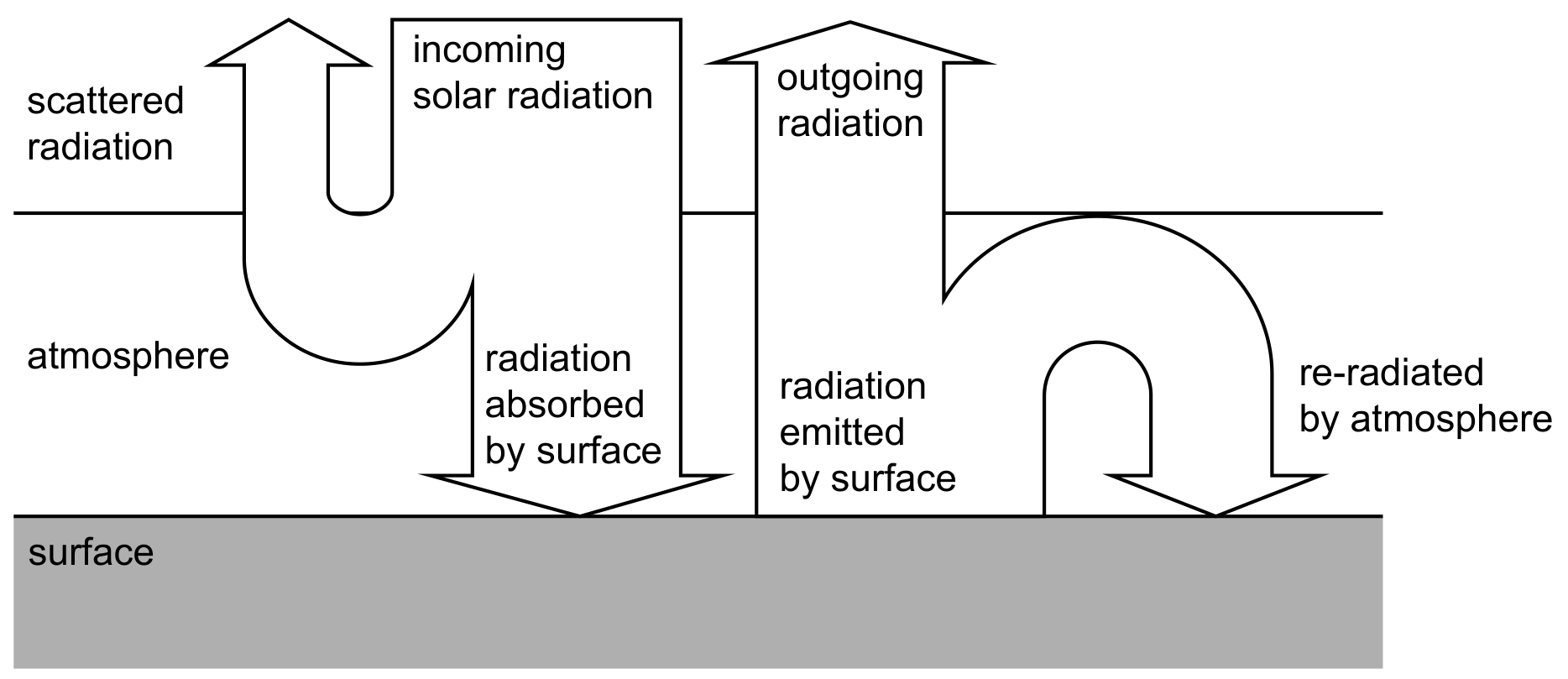
The diagram shows a simplified energy-balance model for the Earth surface–atmosphere system.

Figure for Question E.5.1—Stellar equilibrium question 1 — IB Physics SL

The following data are given:

 Average albedo of Earth =0.30 Average global temperature of the surface =288 K Average Earth-Sun distance =1.5×10¹¹ m\begin{aligned} \text { Average albedo of Earth } & =0.30 \\ \text { Average global temperature of the surface } & =288 \mathrm{~K} \\ \text { Average Earth-Sun distance } & =1.5 \times 10^{11} \mathrm{~m} \end{aligned}

The primary energy source of the Sun is the proton-proton (p-p) chain of fusion reactions. Four protons and two electrons produce a helium nucleus together with neutrinos and gamma photons. The overall reaction is:

411p+210e24He+200ve+4γ4{ }_{1}^{1} \mathrm{p}+2{ }_{-1}^{0} \mathrm{e} \rightarrow{ }_{2}^{4} \mathrm{He}+2{ }_{0}^{0} v_{e}+4 \gamma

Outline the role of fusion reactions in maintaining a stable radius of the Sun.

All question bank results loaded