IB Physics SL D.1.3 Point-Mass Approximation

Practise deciding when an extended body may be treated as a point or spherical mass and identifying when size, shape or non-uniform density makes the approximation unreliable.

Syllabus
First assessment 2025
Objective
Level
SL

Exam points

  • treat a spherically symmetric body as if its mass were concentrated at its centre for external points
  • use the approximation when body dimensions are small compared with separation
  • reject the approximation for overlapping, nearby irregular or strongly non-uniform mass distributions

D.1.3—Point-mass approximation question 1

[Maximum number: 1]

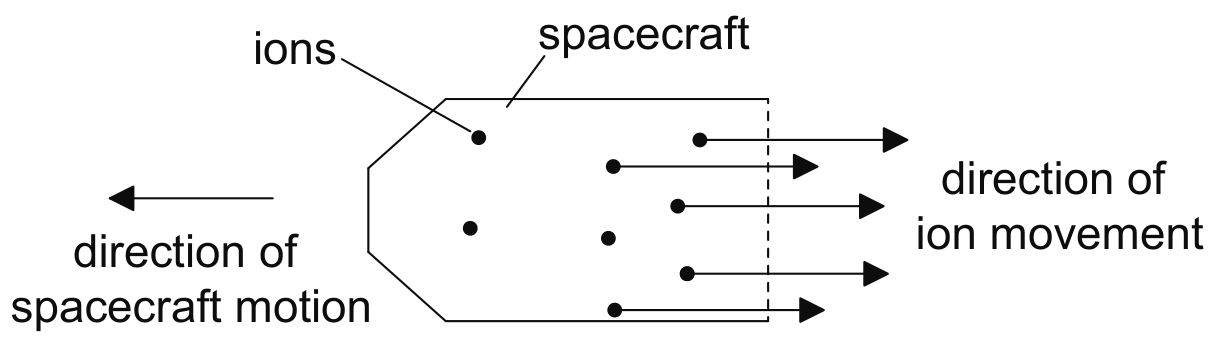
Ion-thrust engines can power spacecraft. In this type of engine, ions are created in a chamber and expelled from the spacecraft. The spacecraft is in outer space when the propulsion system is turned on. The spacecraft starts from rest.

Figure for Question D.1.3—Point-mass approximation question 1 — IB Physics SL

The mass of ions ejected each second is 6.6×10⁶ kg6.6 \times 10^{-6} \mathrm{~kg} and the speed of each ion is 5.2×10⁴ m s15.2 \times 10^{4} \mathrm{~m} \mathrm{~s}^{-1}. The initial total mass of the spacecraft and its fuel is 740 kg . Assume that the ions travel away from the spacecraft parallel to its direction of motion.

On arrival at the planet, the spacecraft goes into orbit as it comes into the gravitational field of the planet.

Newton's law of gravitation applies to point masses. Suggest why the law can be applied to a satellite orbiting a spherical planet of uniform density.

All question bank results loaded