IB Physics SL B.3.8 Ideal Gas Approximation Limits

Practise deciding when real gases approximate the ideal model and explaining failure at high pressure, high density or low temperature through molecular volume and attractions.

Syllabus
First assessment 2025
Objective
Level
SL

Exam points

  • select low pressure, low density and high temperature as conditions closest to ideal behaviour
  • explain high-pressure failure because molecular volume is no longer negligible
  • explain low-temperature failure because intermolecular attractions and condensation become significant

B.3.8—Ideal gas approximation limits question 1

[Maximum number: 2]

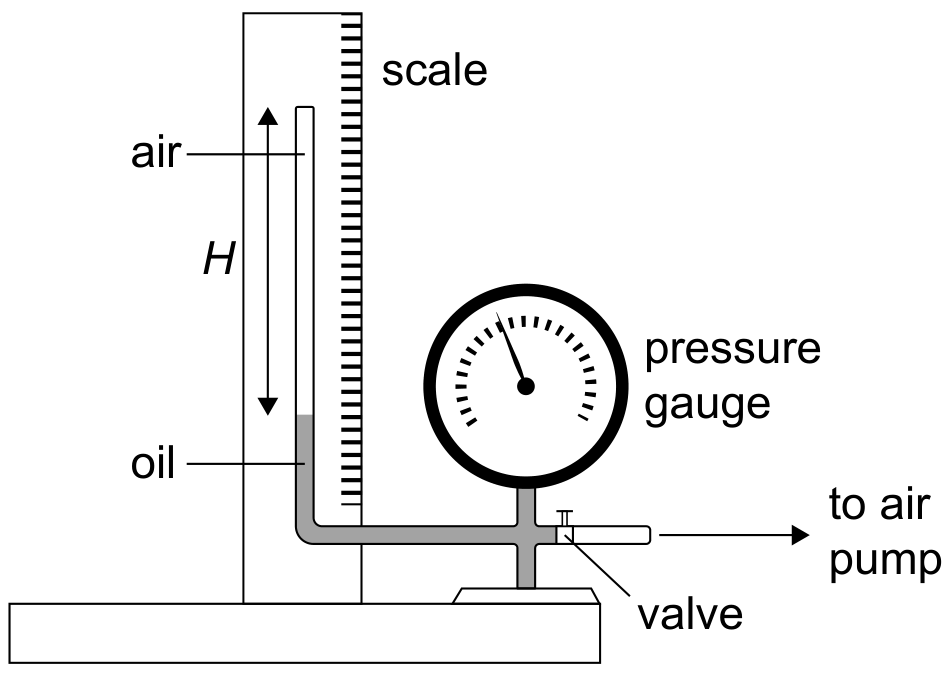
The equipment shown in the diagram was used by a student to investigate the variation with volume, of the pressure p of air, at constant temperature. The air was trapped in a tube of constant cross-sectional area above a column of oil.

Figure for Question B.3.8—Ideal gas approximation limits question 1 — IB Physics SL

The pump forces oil to move up the tube decreasing the volume of the trapped air.

The equation in (b) may be used to predict the pressure of the air at extremely large values of 1H\frac{1}{H}. Suggest why this will be an unreliable estimate of the pressure.

All question bank results loaded