IB Physics SL B.3.6 Molecular Pressure Model

Practise deriving gas pressure from molecular momentum changes at container walls and applying P = ρv²/3 while explaining pressure changes through collision rate and impulse.

Syllabus
First assessment 2025
Objective
Level
SL

Exam points

  • use elastic wall collisions to calculate molecular momentum change normal to the surface
  • link wall force to momentum transferred per time and pressure to force per unit area
  • apply P = ρvrms²/3 and explain higher pressure through faster or more frequent collisions

B.3.6—Molecular pressure model question 1

[Maximum number: 1]

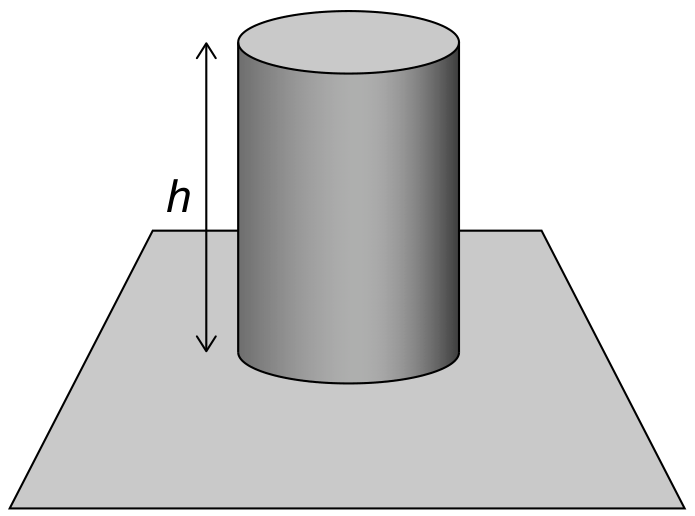
A solid cylinder of height h and density ρ\rho rests on a flat surface.

Figure for Question B.3.6—Molecular pressure model question 1 — IB Physics SL

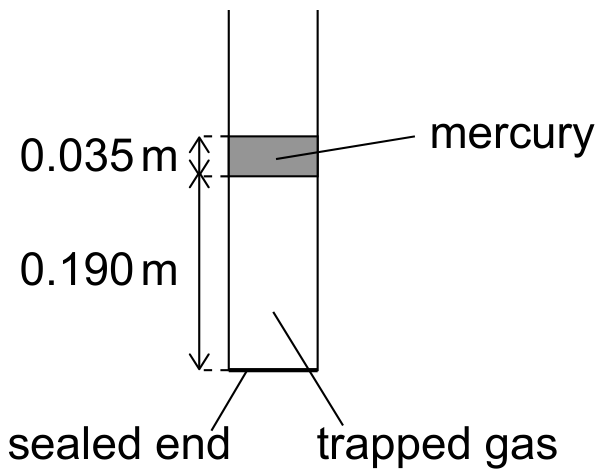
A tube of constant circular cross-section, sealed at one end, contains an ideal gas trapped by a cylinder of mercury of length 0.035 m . The whole arrangement is in the Earth's atmosphere. The density of mercury is 1.36×10⁴ kg m31.36 \times 10^{4} \mathrm{~kg} \mathrm{~m}^{-3}.

Figure for Question B.3.6—Molecular pressure model question 1 — IB Physics SL

When the mercury is above the gas column the length of the gas column is 0.190 m .

Outline why the gas particles in the tube hit the mercury surface less often after the tube has been rotated.

All question bank results loaded