IB Physics SL B.3.1 Pressure

Practise calculating pressure from perpendicular force and area, using pressure differences to find net forces and deriving hydrostatic or buoyant effects from depth and density.

Syllabus
First assessment 2025
Objective
Level
SL

Exam points

  • calculate P = F/A using perpendicular force and area converted correctly into square metres
  • find net force from a pressure difference times area, including atmospheric pressure on one side
  • derive or apply ΔP = ρgΔh and connect lower-fluid pressure to an upward buoyant resultant

B.3.1—Pressure question 1

[Maximum number: 2]

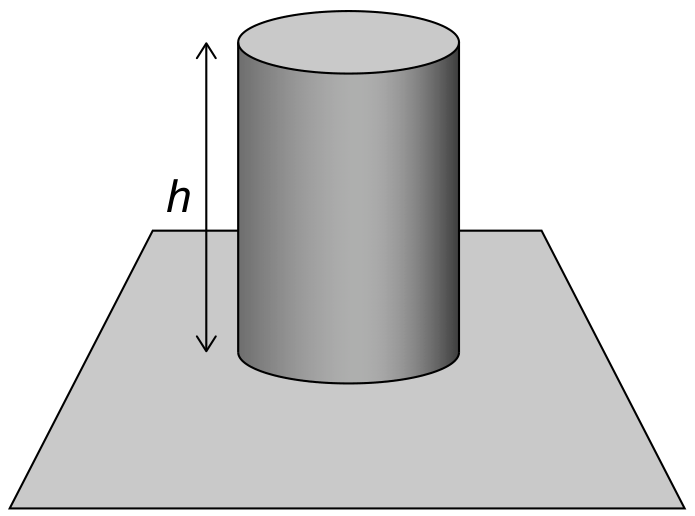
A solid cylinder of height h and density ρ\rho rests on a flat surface.

Figure for Question B.3.1—Pressure question 1 — IB Physics SL

Show that the pressure pCp_{\mathrm{C}} exerted by the cylinder on the surface is given by pC=ρghp_{\mathrm{C}}=\rho g h.

All question bank results loaded