EduNinja

IB Chemistry SL3.2 Electron transfer reactionsQuestion Bank

Question 1

[Maximum number: 3]

Phosphine (IUPAC name phosphane) is a hydride of phosphorus, with the formula PH3\mathrm{PH}_{3}.

Question 1(b)

(a)

Phosphine is usually prepared by heating white phosphorus, one of the allotropes of phosphorus, with concentrated aqueous sodium hydroxide. The equation for the reaction is:

P4( s)+3OH(aq)+3H2O(l)PH3( g)+3H2PO2(aq)\mathrm{P}_{4}(\mathrm{~s})+3 \mathrm{OH}^{-}(\mathrm{aq})+3 \mathrm{H}_{2} \mathrm{O}(\mathrm{l}) \rightarrow \mathrm{PH}_{3}(\mathrm{~g})+3 \mathrm{H}_{2} \mathrm{PO}_{2}^{-}(\mathrm{aq})
[ 3 ]

Question 1(b)(v)

(i)

Oxidation is now defined in terms of change of oxidation number. Explore how earlier definitions of oxidation and reduction may have led to conflicting answers for the conversion of P4\mathrm{P}_{4} to H2PO2\mathrm{H}_{2} \mathrm{PO}_{2}^{-}and the way in which the use of oxidation numbers has resolved this.

[ 3 ]

Question 1

[Maximum number: 4]

Iron(II) sulfide can be produced by heating powdered iron and sulfur together.

Question 1(c)

(a)

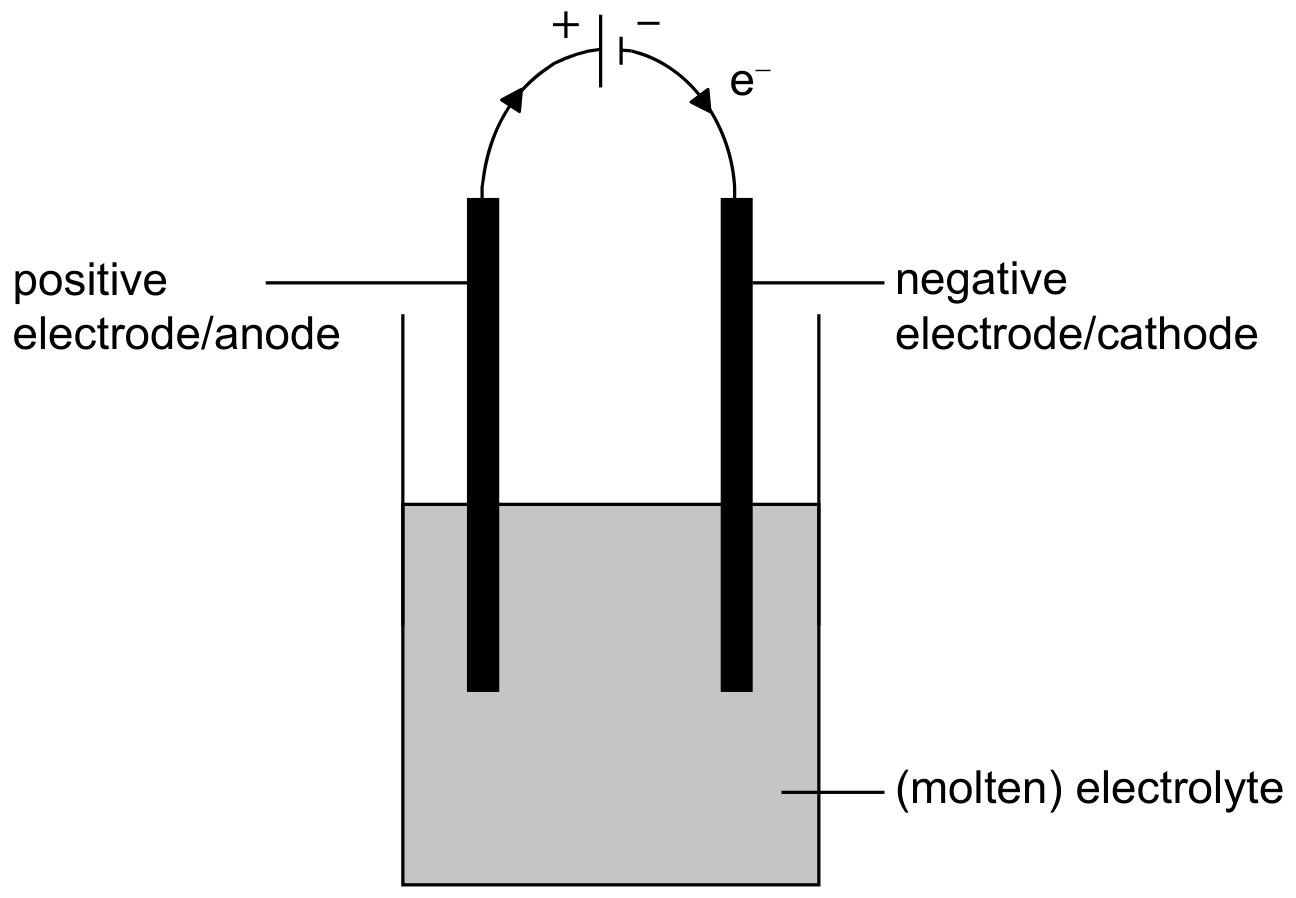
A student hypothesised that iron(II) sulfide is ionic and therefore can be converted back to iron and sulfur by electrolysis of the molten salt, using inert electrodes.

[ 4 ]

Question 1(c)(i)

(i)

Annotate the electrolytic cell with the terms anode and cathode, and show the direction of ion movement.

Question image
[ 2 ]

Question 1(c)(ii)

(ii)

Write half-equations for the reaction occurring at each electrode.

Negative electrode:

Positive electrode:

[ 2 ]

Question 1

[Maximum number: 2]

Hydrogen peroxide, H2O2(aq)\mathrm{H}_{2} \mathrm{O}_{2}(\mathrm{aq}), releases oxygen gas, O2( g)\mathrm{O}_{2}(\mathrm{~g}), as it decomposes according to the equation below.

2H2O2(aq)2H2O(l)+O2( g)2 \mathrm{H}_{2} \mathrm{O}_{2}(\mathrm{aq}) \rightarrow 2 \mathrm{H}_{2} \mathrm{O}(\mathrm{l})+\mathrm{O}_{2}(\mathrm{~g})

50.0 cm350.0 \mathrm{~cm}^{3} of hydrogen peroxide solution was placed in a boiling tube, and a drop of liquid detergent was added to create a layer of bubbles on the top of the hydrogen peroxide solution as oxygen gas was released. The tube was placed in a water bath at 75C75^{\circ} \mathrm{C} and the height of the bubble layer was measured every thirty seconds. A graph was plotted of the height of the bubble layer against time.

Question image

Question 1(d)

(a)

The decomposition of hydrogen peroxide to form water and oxygen is a redox reaction.

[ 2 ]

Question 1(d)(ii)

(i)

State two half-equations for the decomposition of hydrogen peroxide.

Oxidation:

Reduction:

[ 2 ]

Question 1

[Maximum number: 1]

A student set up a simple voltaic cell consisting of a copper electrode and a zinc electrode dipped in sodium chloride solution.

Question image

The student gradually increased the distance, d, between the electrodes to study the effect on the initial current, I, passing through the light bulb.

The student hypothesized that the initial current would be inversely proportional to the distance between the electrodes.

Question 1(b)

(a)

The following data was collected over five trials.

Table

The data did not support the student's hypothesis. He investigated other possible relationships by plotting a graph of the average current against the distance between the electrodes. He obtained the following best-fit line with a correlation coefficient ( r ) of -0.9999 .

Question image
[ 1 ]

Question 1(b)(iii)

(i)

Outline how current flows in the sodium chloride solution.

[ 1 ]

Question 1

[Maximum number: 2]

Iron tablets are often prescribed to patients. The iron in the tablets is commonly present as iron(II) sulfate, FeSO4\mathrm{FeSO}_{4}.
Two students carried out an experiment to determine the percentage by mass of iron in a brand of tablets marketed in Cyprus.
Experimental Procedure:
- The students took five iron tablets and found that the total mass was 1.65 g .
- The five tablets were ground and dissolved in 100 cm3100 \mathrm{~cm}^{3} dilute sulfuric acid, H2SO4(aq)\mathrm{H}_{2} \mathrm{SO}_{4}(\mathrm{aq}). The solution and washings were transferred to a 250 cm3250 \mathrm{~cm}^{3} volumetric flask and made up to the mark with deionized (distilled) water.
- 25.0 cm325.0 \mathrm{~cm}^{3} of this Fe2+(aq)\mathrm{Fe}^{2+}(\mathrm{aq}) solution was transferred using a pipette into a conical flask. Some dilute sulfuric acid was added.
- A titration was then carried out using a 5.00×10³moldm35.00 \times 10^{-3} \mathrm{moldm}^{-3} standard solution of potassium permanganate, KMnO4(aq)\mathrm{KMnO}_{4}(\mathrm{aq}). The end-point of the titration was indicated by a slight pink colour.
The following results were recorded.

Table

Question 1(d)

(a)

This experiment involves the following redox reaction.

5Fe2+(aq)+MnO4(aq)+8H+(aq)5Fe3+(aq)+Mn2+(aq)+4H2O(l)5 \mathrm{Fe}^{2+}(\mathrm{aq})+\mathrm{MnO}_{4}^{-}(\mathrm{aq})+8 \mathrm{H}^{+}(\mathrm{aq}) \rightarrow 5 \mathrm{Fe}^{3+}(\mathrm{aq})+\mathrm{Mn}^{2+}(\mathrm{aq})+4 \mathrm{H}_{2} \mathrm{O}(\mathrm{l})
[ 1 ]

Question 1(d)(i)

(i)

Define the term reduction in terms of electrons.

[ 1 ]

Question 1(f)

Question 1(f)(ii)

(b)
(i)

Suggest a reason why manganese(IV) oxide formed instead of Mn2+\mathrm{Mn}^{2+} (aq).

[ 1 ]

Question 1

[Maximum number: 1]

Which is the correct equation for the electrolysis of molten sodium chloride?

A

2NaCl(l)2Na(l)+Cl2( g)2 \mathrm{NaCl}(\mathrm{l}) \rightarrow 2 \mathrm{Na}(\mathrm{l})+\mathrm{Cl}_{2}(\mathrm{~g})

B

2NaCl(s)2Na(s)+Cl2( g)2 \mathrm{NaCl}(\mathrm{s}) \rightarrow 2 \mathrm{Na}(\mathrm{s})+\mathrm{Cl}_{2}(\mathrm{~g})

C

2NaCl(l)2Na(s)+Cl2( g)2 \mathrm{NaCl}(\mathrm{l}) \rightarrow 2 \mathrm{Na}(\mathrm{s})+\mathrm{Cl}_{2}(\mathrm{~g})

D

2NaCl(aq)2Na(s)+Cl2( g)2 \mathrm{NaCl}(\mathrm{aq}) \rightarrow 2 \mathrm{Na}(\mathrm{s})+\mathrm{Cl}_{2}(\mathrm{~g})

Question 1

[Maximum number: 1]

A student used the technique of titration to determine the concentration of ascorbic acid (C6H8O6)\left(\mathrm{C}_{6} \mathrm{H}_{8} \mathrm{O}_{6}\right) in a sample of orange juice. Excess potassium iodide, KI(aq), was added to acidified orange juice. The resulting solution was titrated with potassium iodate, KIO3(aq)\mathrm{KIO}_{3}(\mathrm{aq}), in the presence of starch as an indicator. The end-point of the titration was shown by a blue-black colour.

Step 1IO3(aq)+5I(aq)+6H+(aq)3I2(aq)+3H2O(l)1 \quad \mathrm{IO}_{3}{ }^{-}(\mathrm{aq})+5 \mathrm{I}^{-}(\mathrm{aq})+6 \mathrm{H}^{+}(\mathrm{aq}) \rightarrow 3 \mathrm{I}_{2}(\mathrm{aq})+3 \mathrm{H}_{2} \mathrm{O}(\mathrm{l})

lodine is only slightly soluble in water; but in the presence of excess iodide ions, I(aq)\mathrm{I}^{-}(\mathrm{aq}), it forms the soluble tri-iodide ion, I3\mathrm{I}_{3}{ }^{-}(aq).

Step 2I2(aq)+I(aq)I3(aq)2 \quad \mathrm{I}_{2}(\mathrm{aq})+\mathrm{I}^{-}(\mathrm{aq}) \rightleftharpoons \mathrm{I}_{3}{ }^{-}(\mathrm{aq})
Ascorbic acid reacts with tri-iodide ions as follows.

Step 3C6H8O6(aq)+I3(aq)C6H6O6(aq)+2H+(aq)+3I(aq)3 \quad \mathrm{C}_{6} \mathrm{H}_{8} \mathrm{O}_{6}(\mathrm{aq})+\mathrm{I}_{3}{ }^{-}(\mathrm{aq}) \rightarrow \mathrm{C}_{6} \mathrm{H}_{6} \mathrm{O}_{6}(\mathrm{aq})+2 \mathrm{H}^{+}(\mathrm{aq})+3 \mathrm{I}^{-}(\mathrm{aq})

Question 1(a)

Question 1(a)(ii)

(a)
(i)

Identify the oxidizing and reducing agents in step 1.

Oxidizing agent:

Reducing agent:

[ 1 ]

Question 1

[Maximum number: 1]

Pasteurization is used to eliminate pathogenic bacteria. The concentration of vitamin C was monitored over a period of time in pasteurized and unpasteurized orange juice.

Question image

Question 1(d)

(a)

The concentration of vitamin C (ascorbic acid) can be measured by performing a redox titration using acidified iodate, IO3\mathrm{IO}_{3}{ }^{-}, and iodide ions. Starch reacts with excess iodine once the vitamin C is consumed to produce a dark-blue complex.

Reaction 1: IO3(aq)+5I(aq)+6H+(aq)3I2(aq)+3H2O(l)\mathrm{IO}_{3}{ }^{-}(\mathrm{aq})+5 \mathrm{I}^{-}(\mathrm{aq})+6 \mathrm{H}^{+}(\mathrm{aq}) \rightarrow 3 \mathrm{I}_{2}(\mathrm{aq})+3 \mathrm{H}_{2} \mathrm{O}(\mathrm{l})

Reaction 2: ascorbic acid (aq) +I2(aq)2I(aq)++\mathrm{I}_{2}(\mathrm{aq}) \rightarrow 2 \mathrm{I}^{-}(\mathrm{aq})+ dehydroascorbic acid (aq)

[ 1 ]

Question 1(d)(i)

(i)

Identify the oxidizing agent in reaction 1.

[ 1 ]

Question 1

[Maximum number: 2]

Ethyne, C2H2\mathrm{C}_{2} \mathrm{H}_{2}, reacts with oxygen in welding torches.

Question 1(d)

(a)

Product B,CH3CHO\mathbf{B}, \mathrm{CH}_{3} \mathrm{CHO}, can also be synthesized from ethanol.

[ 2 ]

Question 1(d)(i)

(i)

Suggest the reagents and conditions required to ensure a good yield of product B.

Reagents:

Conditions:

[ 2 ]

Question 1

[Maximum number: 1]

Ethane-1,2-diol, HOCH2CH2OH\mathrm{HOCH}_{2} \mathrm{CH}_{2} \mathrm{OH}, has a wide variety of uses including the removal of ice from aircraft and heat transfer in a solar cell.

Question 1(d)

(a)

Ethane-1,2-diol can be oxidized first to ethanedioic acid, (COOH)2(\mathrm{COOH})_{2}, and then to carbon dioxide and water. Suggest the reagents to oxidize ethane-1,2-diol.

[ 1 ]
0 selected