IB Chemistry SL Reactivity 3.2.6 Primary Voltaic Cells

Practise explaining how a spontaneous redox reaction in a primary voltaic cell produces electrical energy. Trace electrons through the external circuit from anode to cathode,…

Syllabus
First assessment 2025
Objective
3.2.6
Level
SL

Exam points

  • trace electrons from the oxidation anode to the reduction cathode through the wire
  • explain how salt-bridge ions migrate to maintain electrical neutrality in each half-cell
  • draw or describe two connected half-cells with electrodes, voltmeter and salt bridge

3.2.6—Primary (voltaic) cells question 1

[Maximum number: 1]

Iron rusts in the presence of oxygen and water. Rusting is a redox process involving several steps that produces hydrated iron(III) oxide, Fe2O3nH2O\mathrm{Fe}_{2} \mathrm{O}_{3} \bullet \mathrm{nH}_{2} \mathrm{O}, as the final product. The half-equations involved for the first step of rusting are given below.

Half-equation 1: Fe(s)Fe2+(aq)+2e\quad \mathrm{Fe}(\mathrm{s}) \rightarrow \mathrm{Fe}^{2+}(\mathrm{aq})+2 \mathrm{e}^{-}

Half-equation 2: O2(aq)+4e+2H2O(l)4OH(aq)\quad \mathrm{O}_{2}(\mathrm{aq})+4 \mathrm{e}^{-}+2 \mathrm{H}_{2} \mathrm{O}(\mathrm{l}) \rightarrow 4 \mathrm{OH}^{-}(\mathrm{aq})

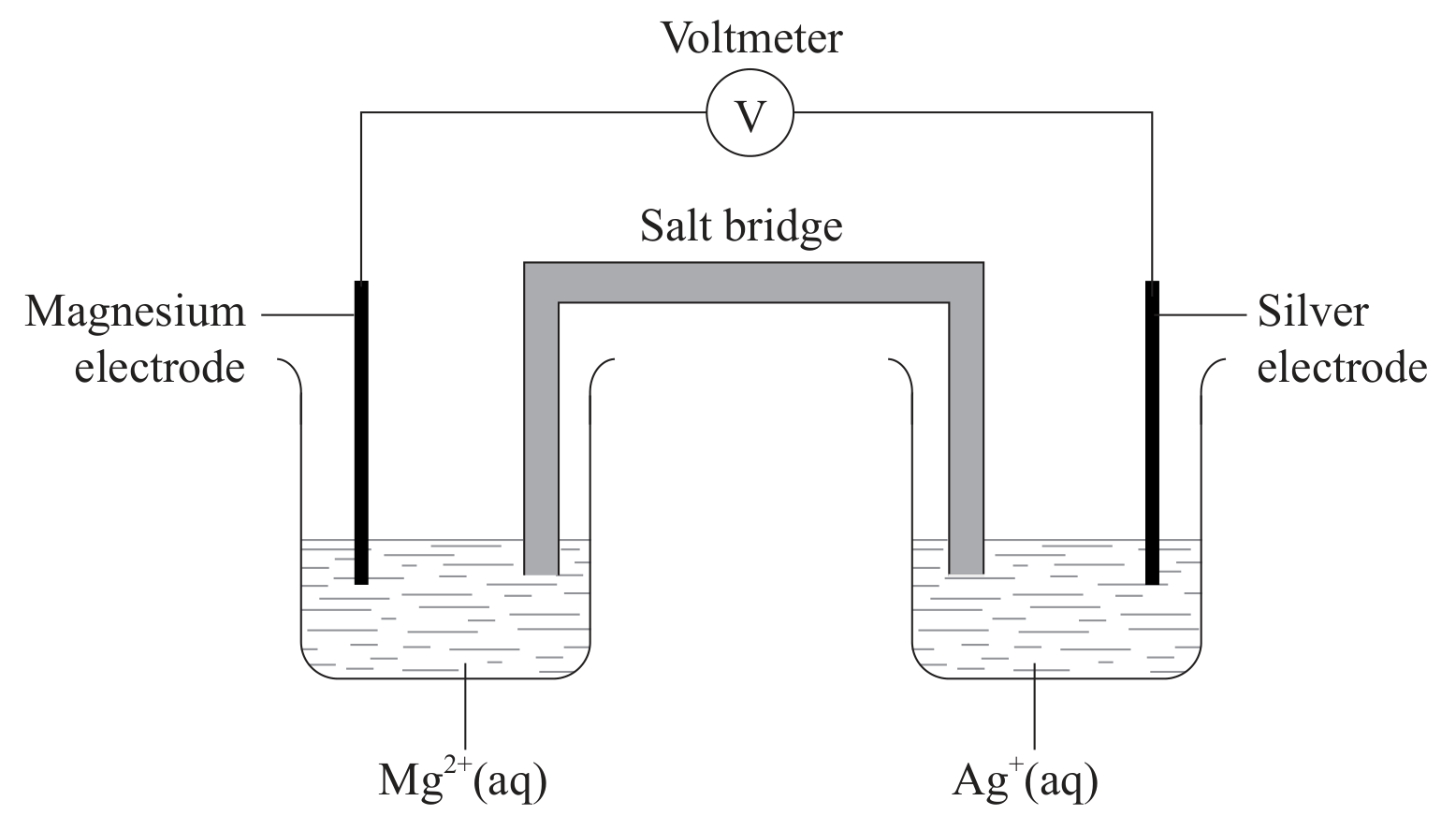
A voltaic cell is made from a half-cell containing a magnesium electrode in a solution of magnesium nitrate and a half-cell containing a silver electrode in a solution of silver(I) nitrate.

Figure for Question 3.2.6—Primary (voltaic) cells question 1 — IB Chemistry SL

Negative electrode (anode):

Positive electrode (cathode):
(ii) Outline one function of the salt bridge.

All question bank results loaded