IB Chemistry SL Reactivity 1: What Drives Chemical Reactions?

Explore how energy changes, entropy and feasibility drive chemical reactions. Practise measuring or calculating enthalpy, constructing Hess cycles, using bond data and evaluating…

Syllabus
First assessment 2025
Topic
Level
SL

Reactivity 1. What drives chemical reactions? question 1

[Maximum number: 1]

The increased concentration of carbon dioxide in the atmosphere is thought to result from the increased combustion of fossil fuels such as petroleum.

Outline why the energy available from an engine will be less than these theoretical values.

Reactivity 1. What drives chemical reactions? question 2

[Maximum number: 4]

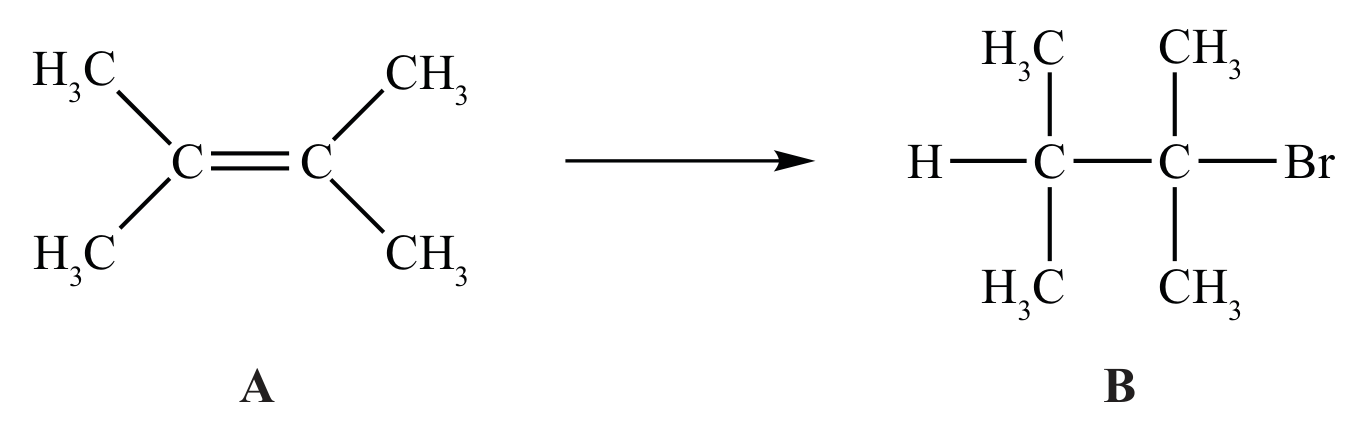
Alkenes, such as A (shown below), are important intermediates in the petrochemical industry because they undergo addition reactions to produce a wide variety of products, such as the conversion shown below.

Figure for Question Reactivity 1. What drives chemical reactions? question 2 — IB Chemistry SL

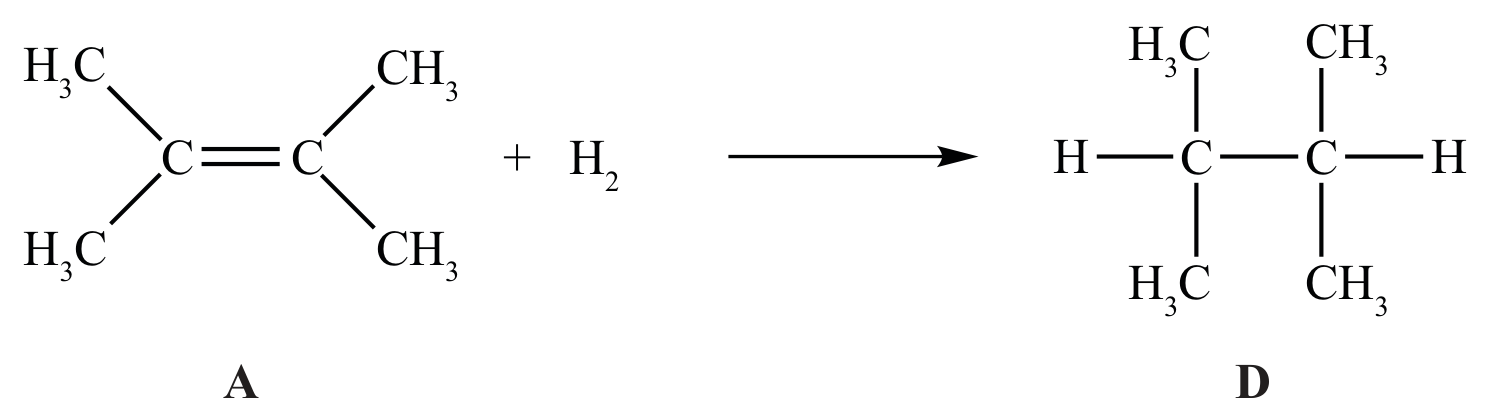
In the gas phase, A reacts with hydrogen to form D.

Figure for Question Reactivity 1. What drives chemical reactions? question 2 — IB Chemistry SL

Determine the enthalpy change, in kJmol1\mathrm{kJ} \mathrm{mol}^{-1}, for the reaction of A with hydrogen, using Table 10 of the Data Booklet, and state whether the reaction is exothermic or endothermic.

Reactivity 1. What drives chemical reactions? question 3

[Maximum number: 5]

Ethyne, C2H2\mathrm{C}_{2} \mathrm{H}_{2}, reacts with oxygen in welding torches.

Question (a)

(a)

Write an equation for the complete combustion of ethyne.

[ 1 ]

Question (b)

(b)

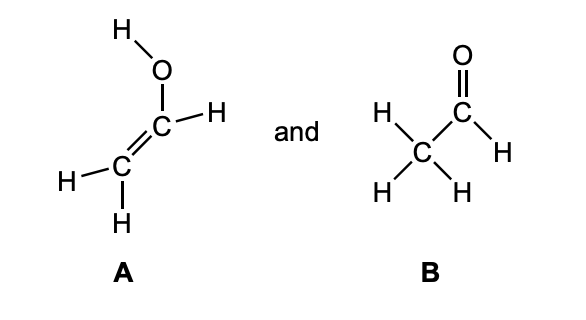
Ethyne reacts with steam.

Two possible products are:

Figure for Question (b) — IB Chemistry SL
[ 4 ]

Question (i)

(i)

Determine the enthalpy change for the reaction, in kJ , to produce A using section 11 of the data booklet.

[ 3 ]

Question (ii)

(ii)

The enthalpy change for the reaction to produce B is -213 kJ .

Predict, giving a reason, which product is the most stable.

[ 1 ]

Reactivity 1. What drives chemical reactions? question 4

[Maximum number: 4]

Chlorine occurs in Group 7, the halogens.

Question (a)

(a)

Chloroethene, H2C=CHCl\mathrm{H}_{2} \mathrm{C}=\mathrm{CHCl}, the monomer used in the polymerization reaction in the manufacture of the polymer poly(chloroethene), PVC, can be synthesized in the following two-stage reaction pathway.

Stage 1: C2H4( g)+Cl2( g)ClCH2CH2Cl(g)\quad \mathrm{C}_{2} \mathrm{H}_{4}(\mathrm{~g})+\mathrm{Cl}_{2}(\mathrm{~g}) \rightarrow \mathrm{ClCH}_{2} \mathrm{CH}_{2} \mathrm{Cl}(\mathrm{g})

Stage 2: ClCH2CH2Cl(g)H2C=CHCl(g)+HCl(g)\quad \mathrm{ClCH}_{2} \mathrm{CH}_{2} \mathrm{Cl}(\mathrm{g}) \rightarrow \mathrm{H}_{2} \mathrm{C}=\mathrm{CHCl}(\mathrm{g})+\mathrm{HCl}(\mathrm{g})

[ 4 ]

Question (i)

(i)

Determine the enthalpy change, ΔH\Delta H, in kJmol1\mathrm{kJ} \mathrm{mol}^{-1}, for stage 1 using average bond enthalpy data from Table 10 of the Data Booklet.

[ 3 ]

Question (ii)

(ii)

State whether the reaction given in stage 1 is exothermic or endothermic.

[ 1 ]

Reactivity 1. What drives chemical reactions? question 5

[Maximum number: 3]

Question (a)

(a)

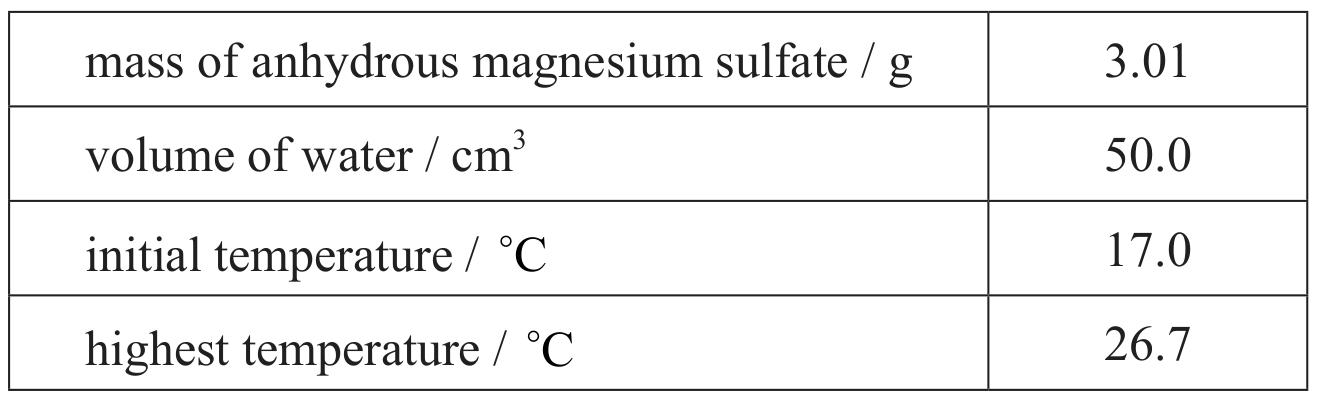
Magnesium sulfate can exist in either the hydrated form or in the anhydrous form. Two students wished to determine the enthalpy of hydration of anhydrous magnesium sulfate. They measured the initial and the highest temperature reached when anhydrous magnesium sulfate, MgSO4( s)\mathrm{MgSO}_{4}(\mathrm{~s}), was dissolved in water. They presented their results in the following table.

Table for Question (a) — IB Chemistry SL
[ 2 ]

Question (i)

(i)

Calculate the enthalpy change, ΔH1\Delta H_{1}, for anhydrous magnesium sulfate dissolving in water, in kJmol1\mathrm{kJ} \mathrm{mol}^{-1}. State your answer to the correct number of significant figures.

[ 2 ]

Question (b)

(b)

The students repeated the experiment using 6.16 g of solid hydrated magnesium sulfate, MgSO47H2O(s)\mathrm{MgSO}_{4} \cdot 7 \mathrm{H}_{2} \mathrm{O}(\mathrm{s}), and 50.0 cm350.0 \mathrm{~cm}^{3} of water. They found the enthalpy change, ΔH2\Delta H_{2}, to be +18 kJ mol1+18 \mathrm{~kJ} \mathrm{~mol}^{-1}.

The enthalpy of hydration of solid anhydrous magnesium sulfate is difficult to determine experimentally, but can be determined using the diagram below.

MgSO47H2O( s) water ΔH2Mg2+(aq)+SO42(aq)\mathrm{MgSO}_{4} \cdot 7 \mathrm{H}_{2} \mathrm{O}(\mathrm{~s}) \xrightarrow[\text { water }]{\Delta H_{2}} \mathrm{Mg}^{2+}(\mathrm{aq})+\mathrm{SO}_{4}^{2-}(\mathrm{aq})
[ 1 ]

Question (i)

(i)

Determine the enthalpy change, ΔH\Delta H, in kJmol1\mathrm{kJ} \mathrm{mol}^{-1}, for the hydration of solid anhydrous magnesium sulfate, MgSO4\mathrm{MgSO}_{4}.

[ 1 ]

Reactivity 1. What drives chemical reactions? question 6

[Maximum number: 1]

Which products may be formed during incomplete combustion of octane?

A

CO2\mathrm{CO}_{2} and H2\mathrm{H}_{2}

B

CO and H2\mathrm{H}_{2}

C

CO and H2O\mathrm{H}_{2} \mathrm{O}

D

C, CO and H2\mathrm{H}_{2}

All question bank results loaded